Call for Abstracts: China in Social Sciences (ChiNESS) conference – Emerging Research from the North of England

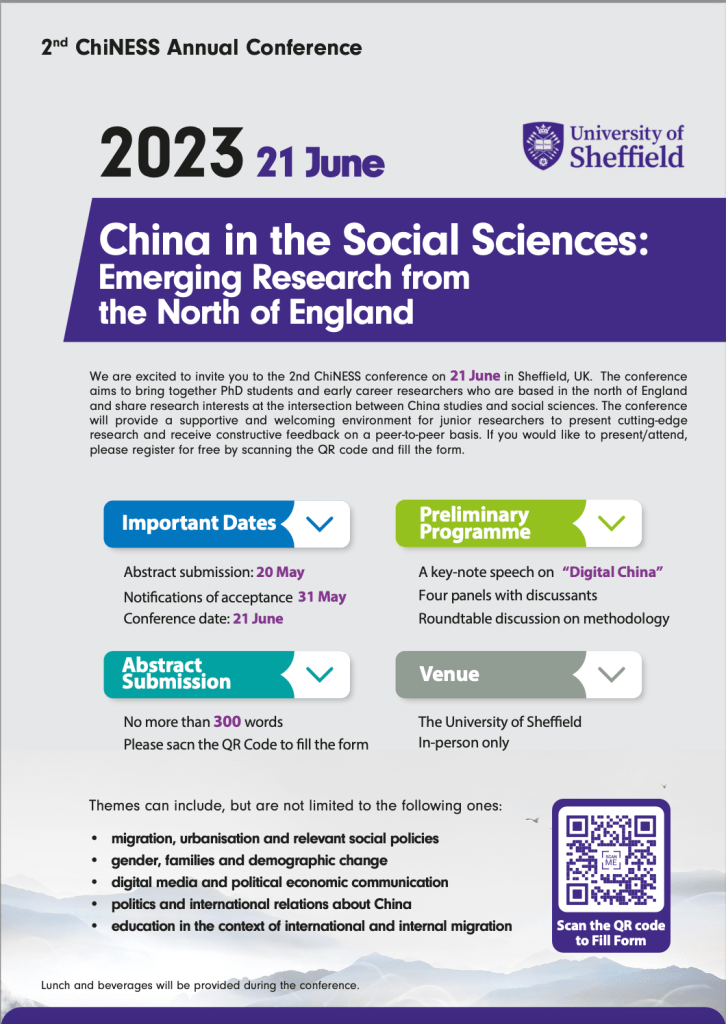
Time: 21 June
Location: University of Sheffield (in-person)

Recent years have seen significant changes and challenges across the globe, such as the Covid-19 pandemic, war and economic recession in many regions. Cooperation between different countries and regions is in urgent need to deal with global challenges and crises. China plays an important role in economic and political issues. It is also experiencing huge social and political transformations due to economic slowdown, demographic changes and technology development. To better understand China as a country and an important participant in global affairs, more research and discussions on China studies deserve our attention and efforts.

The Second ChiNESS Conference aims to bring together PhD students and early career researchers who are based in the north of England and share research interests at the intersection between China studies and social sciences. The conference will provide a supportive and welcoming environment for junior researchers to present cutting-edge research and receive constructive feedback on a peer-to-peer basis.

To draw a broader picture of the field of studies linked to China from an interdisciplinary and multi-context perspective with contributors from different countries and academic backgrounds, we invite abstracts from PhD students and early career researchers based in the north of England. Abstracts should situate at the intersection between China Studies and social sciences or humanities.Themes can include, but are not limited to the following ones:

  • migration, urbanisation and relevant social policies
  • gender, families and demographic change
  • digital media and political economic communication
  • politics and international relations about China
  • education in the context of international and internal migration

Important dates:

  • Submission of abstracts will be closed on 20 May 23:59.
  • Acceptance of abstracts will be notified by the end of May.

Please submit your abstracts (no more than 300 words) via the form. For further information or questions, please contact us via 2ndchinesocsci@gmail.com

Lunch and beverages will be provided during the conference. Please note that any travelling and accommodation costs should be paid by the participants.

Link to the first ChiNESS Conference in 2022: https://wrdtp.ac.uk/events/china-in-the-social-sciences/

Organising committee:

  • Yingzi Shen (the University of Sheffield)
  • Xinrui Liu (the University of Sheffield)
  • Shichong Li (the University of Leeds)
  • Linghua Cai (the University of Durham)

Managing editor: Lisa (Zhiyun Bian)

Not Too Soon to Plan to Volunteer as a Reviewer for the 2024 Annual Meeting—Volunteer Portal Opens March 2

While the 2023 AERA Annual Meeting is about to engage thousands of in-person and virtual attendees in April and May 2023, AERA encourages education researchers to volunteer as peer reviewers of submissions for the 2024 AERA Annual Meeting.

The call for volunteer reviewers will be released on March 2, 2023, and those interested in being selected have until April 28, 2023, to sign up.

A quality peer review system is the bedrock of a quality annual meeting. Therefore, AERA encourages persons with depth of research expertise to volunteer to review by responding to the call in their specialty area.

Serving on a review panel is a selective process. It is considered to be an honor and is publicized in the AERA community as a form of important service to the association and the field. Reviewers are publicly acknowledged, which also adds to the transparency of the process and the accountability of each submission unit for ensuring that review panels reflect the criteria for selection.

The call includes information on how to volunteer and the selection criteria. AERA urges education research scholars with expertise across career stages to volunteer and participate in creating an annual meeting of excellence.

Managing Editor: Tong Meng

PhD Scholarship Opportunity

Project: Investigating the transforming sociolinguistic profile of Chinese heritage schools in the UK (Ref. SoSS-2023-023)

For students who are interested in multilingualism, language-in-education policy and heritage language education, please feel free to contact Dr Yuying Liu (yuying.liu@hw.ac.uk) for informal enquiries before a formal application is submitted.

Apply here

PhD scholarship details:

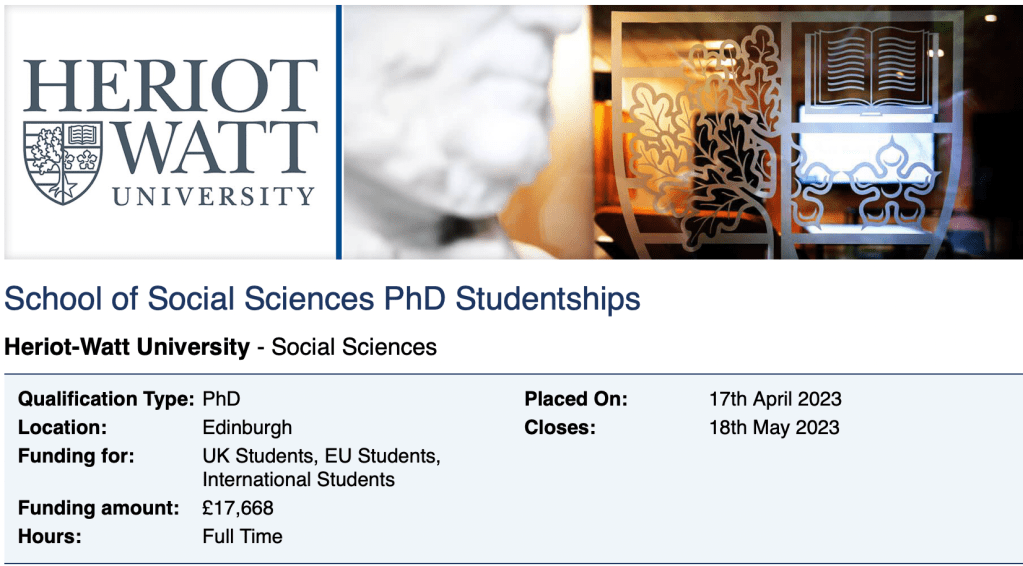
The School of Social Sciences at Heriot-Watt University is offering a number of full-time PhD studentships to start in September 2023.  Studentships include a tuition fee waiver and an annual stipend currently set at £17,668.  The duration of the studentships is three years.  The School of Social Sciences also offers a research support allowance of £2,250 over the registered period of study.  In addition, full-time scholarship holders are normally offered an opportunity to undertake paid teaching support each academic year.

The School consists of the Department of Languages & Intercultural Studies, the Department of Psychology, and Edinburgh Business School.  Our world-leading research in languages and intercultural studies is based around the Centre for Translation and Interpreting Studies in Scotland and the Intercultural Research Centre.  Research students have access to a range of training and other activities supported by the School, and through the University’s Research Futures Academy.

We have a number of project areas to which we’re looking to recruit high-quality PhD candidates:

Investigating the transforming sociolinguistic profile of Chinese heritage schools in the UK (Ref. SoSS-2023-023)

For informal enquiries, please contact Dr Yuying Liu (yuying.liu@hw.ac.uk)

Further details of these project areas can be found by following the link to the scholarship pages on our website.  Applicants are strongly encouraged to get in touch with the relevant named contact(s) for an informal discussion prior to submitting their application.

Entry Criteria and Application

Applicants should have an undergraduate degree with a minimum classification of 2:1 in a field relevant to the project for which they are applying.  A Master’s degree is desirable for all projects, and essential for some (see the project-specific information by following the links to our website for further details).  Any additional project-specific entry criteria can be found by following the links above.  In addition, candidates for whom English is a second language should meet the University’s minimum English-language requirements.  If you have not already studied a degree programme that was taught and examined in the medium of English, the minimum overall IELTS score is 6.5 with no score lower than 6.0 in Reading, Writing, Speaking and Listening.  Applications for more than one project from the same candidate will be considered.

Please note that possession of the minimum qualifications does not guarantee shortlisting for interview.

Applicants should submit their application via  https://www.hw.ac.uk/study/apply/uk/postgraduate.htm

When completing the online application form, please indicate that you are applying to the ‘SoSS 2023 PhD scholarship competition’ in the field that asks how you will fund your studies.

Applicants should supply:

  1. A full Curriculum Vitae.
  2. Copies of full academic transcripts from all previous academic degree courses and copies of degree certificates for degrees already awarded. If you are currently pursuing a degree course please provide all available marks to date.  If your degree is from a non-UK institution, please provide evidence of the UK equivalency of your qualification.
  3. A brief covering letter outlining why you want to study for a PhD at Heriot-Watt University, and what makes you an excellent candidate.
  4. An outline research proposal (max. 1500 words). This should clearly identify how the proposed research question and modes of inquiry align with your chosen project area. The proposal should clearly identify which project area has been selected by referring to the project title and ref. no. You should also ensure that the name of the main contact for your project area listed above is included in your application when prompted to enter your proposed supervisor.

Interviews will be conducted via video conferencing (e.g. Zoom or similar). Interview support for those with disabilities will be available where required (e.g. a BSL interpreter).

If you have any general queries about the applications process, please contact soss.pgr@hw.ac.uk

At Heriot-Watt University we understand that being diverse makes us better which is why we support a culture of respect and equal opportunity, and value diversity at the heart of what we do. We want to increase the diversity of our workplace to underpin a creative environment and welcome applications from underrepresented groups. Heriot-Watt is committed to giving access and opportunities to student carers, and received the Going Higher for Student Carers Recognition Award from Carers Trust Scotland in 2020.

Managing editor: Lisa (Zhiyun Bian)

The role of social networks in academic discourse socialization: insights from degree-seeking multilingual international students in China

Li, W., & Gong, Y. (2023). The role of social networks in academic discourse socialization: insights from degree-seeking multilingual international students in China. Multilingua. https://doi.org/10.1515/multi-2022-0106

Research background

The development of internationalization of higher education has led to numerous studies on the educational experiences of internationally mobile students. However, the study abroad (SA) scholarship predominantly reflects Western voices and over-represents the experiences of white Anglophone students with relatively higher levels of economic privilege, who undertake SA more as “vacations” than for academic purposes (Diao, 2021). This perspective largely neglects the experiences of international students from underprivileged contexts, who pursue a degree abroad due to socioeconomic reasons or a lack of higher education opportunities in their home country. Moreover, the media often depicts international students’ multilingualism with a deficit framing that stigmatizes their linguistic and cultural resources and renders them invisible in their academic pursuits. To address these gaps, our study examined the academic trajectories of degree-seeking multilingual international students from less advantaged backgrounds in China.

What we did

In our study, we conceptualized international students’ academic experience as a process of academic discourse socialization (ADS), where newcomers to an educational context acquire the competence to participate appropriately in the academic discourse and practice in the community (Duff, 2010). For international students, socialization demands more than just mastery of academic skills, it also involves navigating different educational norms and discursive practices, negotiating access to academic expertise, and developing multicompetence for academic interaction (de León and García-Sánchez, 2021; Duff, 2010; Friedman, 2021). To investigate these processes, we adopted a social network perspective and analyzed how the students accessed and mobilized resources within their situated contexts to appropriate certain discursive practices in their quest for community participation and acceptance. We analyzed the compositional and structural characteristics of the international students’ networks as outcomes and generated rich information about their socializing patterns. Additionally, we categorized the students’ networks based on compositional and structural features to interpret and compare the role of different social connections in academic discourse socialization.

What we found

The study resulted in a typology of five networks, which include heterogeneous-sparse network, heterogeneous-dense network, homogeneous-sparse network, homogeneous-dense network, and balanced network. These networks were found to have differential impacts on students’ socialization trajectories, in terms of their capacities to access and negotiate academic norms, channels to academic expertise, and space for multicompetence development. Our findings also reveal that networks with similar characteristics may have divergent impacts. Similar socializing patterns do not necessarily guarantee similarly successful academic discourse socialization for individuals with varying agency and learning needs (Carhill-Poza & Kurata, 2021). The participants’ experiences highlight that their social networks were mediated by a range of individual and sociocultural factors, including personal histories and agency (learning trajectories, mobility experiences), program accommodation, online networking access, and more. While we agree that a balanced network can lead to “more successful integration” and provide individuals with richer opportunities for social and academic development (Gautier, 2019), expecting all students to develop such a sociable profile might seem an unattainable goal, considering the complex interplay of various sociocultural factors and individual efforts to establish, maintain, and expand social connections in students’ academic experiences

Theoretical contributions

Our study, conducted through a social network lens, went beyond linguistic and cultural challenges faced by international students in previous SA research to expose the structural tensions underlying students’ academic trajectories. These include deficient framings of international students, group segregation, unequal distribution of resources, denigration of linguistic and cultural resources, and more.

We demonstrated how social networks can facilitate or constrain the access and use of resources for underprivileged international students, and how they negotiated these social arrangements in their ADS. Our findings challenge deficit framings of international students as incompetent “others” and dismantle divisive discourse that categorizes students based solely on their linguistic and cultural heritage.

Our study enhances the understanding of community and competence in ADS research by highlighting the fluidity, multiplicity, and complexity of academic discourse communities (de León and García-Sánchez, 2021; Friedman, 2021). This complexity is complicated by the inclusion of both real-time relations and online SNS, providing myriad avenues for accessing community belonging and developmental opportunities. Additionally, our study extends the traditional understanding of competence, which involved highly “academic” reading and writing literacies, to incorporate individuals’ strategic use of interactional resources in their network channels, such as multi-national peers, families, and online friends, as they build interpersonal connections and engage with academic interaction.

Practical implications

The academic success of degree-seeking international students is largely dependent on developing in-depth and diverse network connections that provide access to academic resources. To understand the availability of educational resources in students’ situated environments and their engagement with these resources, researchers should direct more attention to the various types of social networks in which international students are embedded, including immediate social networks and virtual networks.

Educational practitioners can encourage and support students to develop concentrated and diversified social relationships during SA by implementing adequately designed follow-up tasks to complement in-class group work and promote sustainable and in-depth student collaboration. Program support could facilitate mingling between students with diverse backgrounds, while inclusive accommodation options and friendly educational policies can help international and local students establish meaningful and reciprocal relationships.

Overall, our study emphasizes the importance of social networks for international students’ academic discourse socialization and highlights the need for more research and practical interventions focused on social networks to promote academic success and social integration for these students.

References

Carhill-Poza, A., & Kurata, N. (2021). Social Networks in Language Learning and Language Teaching. Bloomsbury Academic.

de León, L., & García-Sánchez, I. M. (2021). Language Socialization at the Intersection of the Local and the Global: The Contested Trajectories of Input and Communicative Competence. Annual Review of Linguistics, 7(1), 421–448. https://doi.org/10/gmczhd

Diao, W. (2021). Speaking against racism: Stories of successful Chinese L2 learners of color in China. Critical Inquiry in Language Studies, 18(2), 105–132. https://doi.org/10.1080/15427587.2020.1764358

Duff, P. A. (2010). Language Socialization into Academic Discourse Communities. Annual Review of Applied Linguistics, 30, 169–192. https://doi.org/10.1017/S0267190510000048

Friedman, D. A. (2021). Language socialization and academic discourse in English as a Foreign Language contexts: A research agenda. Language Teaching, 1–15. https://doi.org/10/gnpfbz

Gautier, R. (2019). Understanding socialization and integration through social network analysis: American and Chinese students during a stay abroad. In M. Howard (Ed.), Study abroad, second language acquisition and interculturality (pp. 207–236). Multilingual Matters.

Author’s Bio

Wendong (Marco) LI, University of Macau

Wendong (Marco) LI is a doctoral student at the Faculty of Education, University of Macau. His research interests are language and identity, language policy and planning, language socialization, and Chinese as an additional language education. His recent publications appear in journals such as Language, Culture and Curriculum, and Journal of Language, Identity and Education, and Multilingua. He can be reached at wendong.li@connect.um.edu.mo

ORCID: 0000-0002-0431-6235

GONG Yang (Frank), University of Macau

GONG Yang (Frank) is an assistant professor and teacher educator for Chinese Education in the University of Macau (Macau SAR, China). Born and raised in Mainland China, he pursued his bachelor’s degree in Chinese Language and Literature and master’s degree in History of Ancient Chinese at Zhengzhou University before attending the University of Hong Kong (Hong Kong SAR, China) to pursue his PhD in Second Language Acquisition and Teacher Education. Frank worked as a language teacher (Chinese, English, & Thai), K-12 education administrator, and Chinese journal editor. His research focuses on how to facilitate international students to promote their language proficiency and optimize their learning experience in learning Chinese as a foreign/second language, with expertise in the areas of sociocultural theory, teacher education and development, learner identity, and student intercultural experiences. He serves on the editorial board of Language, Culture and Curriculum (Taylor & Francis). He was the Faculty’s Outstanding Academic Staff (2020/2021) at the Faculty of Education, University of Macau.

Email: frankgong@um.edu.mo

ORCID: 0000-0001-5249-6437.

Managing Editor: Tong Meng

Research Degree Opportunity

Project Summary

One fully funded project in Cultural Studies is available. This PhD project will examine media representations and/ or lived experiences of P. R. Chinese women who have graduated from western universities, including Australian universities, and returned to China (haigui).

Degrees Available for this project

  • Doctor of Philosophy (PhD)

Available Scholarships

Cultural Studies PhD scholarship: Chinese women graduates of western universities Funded by the Australian Research Councils as part of ARCDP230100442. The successful applicant will receive a scholarship package which includes a living allowance and full fee offset for the duration of their candidature.

Stipend Amount

AUD $34,400 p.a. (2023 full time study rate) for up to 3.5 years p.a. pro rata

Project Details

This PhD is attached to a research project funded by the Australian Research Council, on which principal supervisor Prof. Fran Martin is Chief Investigator. In recent years, large numbers of young women from China have chosen to study in Western nations. Motivated by desires to overcome gender discrimination in China’s labour market and to escape the neotraditionalist ideology that increasingly restricts women’s opportunities at home, significantly more Chinese women than men travel overseas for degrees. Prof Martin’s research project investigates how educational mobility affects these women’s lives in the long term, after their return to China. The attached PhD project will focus on a k..View full project details

Anticipated project start date

Tue Feb 20 2024

Offered by

Culture and Communication, Faculty of Arts

Location

Parkville

Managing Editor: Tong Meng