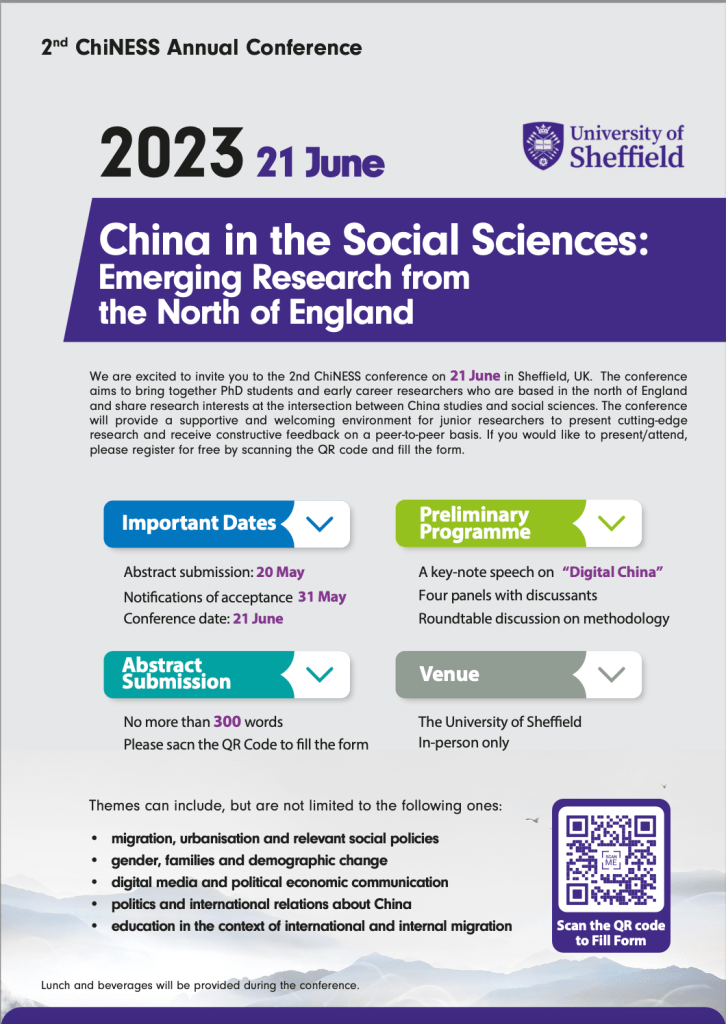
Call for Abstracts: China in Social Sciences (ChiNESS) conference – Emerging Research from the North of England

Time: 21 June
Location: University of Sheffield (in-person)

Recent years have seen significant changes and challenges across the globe, such as the Covid-19 pandemic, war and economic recession in many regions. Cooperation between different countries and regions is in urgent need to deal with global challenges and crises. China plays an important role in economic and political issues. It is also experiencing huge social and political transformations due to economic slowdown, demographic changes and technology development. To better understand China as a country and an important participant in global affairs, more research and discussions on China studies deserve our attention and efforts.

The Second ChiNESS Conference aims to bring together PhD students and early career researchers who are based in the north of England and share research interests at the intersection between China studies and social sciences. The conference will provide a supportive and welcoming environment for junior researchers to present cutting-edge research and receive constructive feedback on a peer-to-peer basis.

To draw a broader picture of the field of studies linked to China from an interdisciplinary and multi-context perspective with contributors from different countries and academic backgrounds, we invite abstracts from PhD students and early career researchers based in the north of England. Abstracts should situate at the intersection between China Studies and social sciences or humanities.Themes can include, but are not limited to the following ones:

  • migration, urbanisation and relevant social policies
  • gender, families and demographic change
  • digital media and political economic communication
  • politics and international relations about China
  • education in the context of international and internal migration

Important dates:

  • Submission of abstracts will be closed on 20 May 23:59.
  • Acceptance of abstracts will be notified by the end of May.

Please submit your abstracts (no more than 300 words) via the form. For further information or questions, please contact us via 2ndchinesocsci@gmail.com

Lunch and beverages will be provided during the conference. Please note that any travelling and accommodation costs should be paid by the participants.

Link to the first ChiNESS Conference in 2022: https://wrdtp.ac.uk/events/china-in-the-social-sciences/

Organising committee:

  • Yingzi Shen (the University of Sheffield)
  • Xinrui Liu (the University of Sheffield)
  • Shichong Li (the University of Leeds)
  • Linghua Cai (the University of Durham)

Managing editor: Lisa (Zhiyun Bian)

The role of social networks in academic discourse socialization: insights from degree-seeking multilingual international students in China

Li, W., & Gong, Y. (2023). The role of social networks in academic discourse socialization: insights from degree-seeking multilingual international students in China. Multilingua. https://doi.org/10.1515/multi-2022-0106

Research background

The development of internationalization of higher education has led to numerous studies on the educational experiences of internationally mobile students. However, the study abroad (SA) scholarship predominantly reflects Western voices and over-represents the experiences of white Anglophone students with relatively higher levels of economic privilege, who undertake SA more as “vacations” than for academic purposes (Diao, 2021). This perspective largely neglects the experiences of international students from underprivileged contexts, who pursue a degree abroad due to socioeconomic reasons or a lack of higher education opportunities in their home country. Moreover, the media often depicts international students’ multilingualism with a deficit framing that stigmatizes their linguistic and cultural resources and renders them invisible in their academic pursuits. To address these gaps, our study examined the academic trajectories of degree-seeking multilingual international students from less advantaged backgrounds in China.

What we did

In our study, we conceptualized international students’ academic experience as a process of academic discourse socialization (ADS), where newcomers to an educational context acquire the competence to participate appropriately in the academic discourse and practice in the community (Duff, 2010). For international students, socialization demands more than just mastery of academic skills, it also involves navigating different educational norms and discursive practices, negotiating access to academic expertise, and developing multicompetence for academic interaction (de León and García-Sánchez, 2021; Duff, 2010; Friedman, 2021). To investigate these processes, we adopted a social network perspective and analyzed how the students accessed and mobilized resources within their situated contexts to appropriate certain discursive practices in their quest for community participation and acceptance. We analyzed the compositional and structural characteristics of the international students’ networks as outcomes and generated rich information about their socializing patterns. Additionally, we categorized the students’ networks based on compositional and structural features to interpret and compare the role of different social connections in academic discourse socialization.

What we found

The study resulted in a typology of five networks, which include heterogeneous-sparse network, heterogeneous-dense network, homogeneous-sparse network, homogeneous-dense network, and balanced network. These networks were found to have differential impacts on students’ socialization trajectories, in terms of their capacities to access and negotiate academic norms, channels to academic expertise, and space for multicompetence development. Our findings also reveal that networks with similar characteristics may have divergent impacts. Similar socializing patterns do not necessarily guarantee similarly successful academic discourse socialization for individuals with varying agency and learning needs (Carhill-Poza & Kurata, 2021). The participants’ experiences highlight that their social networks were mediated by a range of individual and sociocultural factors, including personal histories and agency (learning trajectories, mobility experiences), program accommodation, online networking access, and more. While we agree that a balanced network can lead to “more successful integration” and provide individuals with richer opportunities for social and academic development (Gautier, 2019), expecting all students to develop such a sociable profile might seem an unattainable goal, considering the complex interplay of various sociocultural factors and individual efforts to establish, maintain, and expand social connections in students’ academic experiences

Theoretical contributions

Our study, conducted through a social network lens, went beyond linguistic and cultural challenges faced by international students in previous SA research to expose the structural tensions underlying students’ academic trajectories. These include deficient framings of international students, group segregation, unequal distribution of resources, denigration of linguistic and cultural resources, and more.

We demonstrated how social networks can facilitate or constrain the access and use of resources for underprivileged international students, and how they negotiated these social arrangements in their ADS. Our findings challenge deficit framings of international students as incompetent “others” and dismantle divisive discourse that categorizes students based solely on their linguistic and cultural heritage.

Our study enhances the understanding of community and competence in ADS research by highlighting the fluidity, multiplicity, and complexity of academic discourse communities (de León and García-Sánchez, 2021; Friedman, 2021). This complexity is complicated by the inclusion of both real-time relations and online SNS, providing myriad avenues for accessing community belonging and developmental opportunities. Additionally, our study extends the traditional understanding of competence, which involved highly “academic” reading and writing literacies, to incorporate individuals’ strategic use of interactional resources in their network channels, such as multi-national peers, families, and online friends, as they build interpersonal connections and engage with academic interaction.

Practical implications

The academic success of degree-seeking international students is largely dependent on developing in-depth and diverse network connections that provide access to academic resources. To understand the availability of educational resources in students’ situated environments and their engagement with these resources, researchers should direct more attention to the various types of social networks in which international students are embedded, including immediate social networks and virtual networks.

Educational practitioners can encourage and support students to develop concentrated and diversified social relationships during SA by implementing adequately designed follow-up tasks to complement in-class group work and promote sustainable and in-depth student collaboration. Program support could facilitate mingling between students with diverse backgrounds, while inclusive accommodation options and friendly educational policies can help international and local students establish meaningful and reciprocal relationships.

Overall, our study emphasizes the importance of social networks for international students’ academic discourse socialization and highlights the need for more research and practical interventions focused on social networks to promote academic success and social integration for these students.

References

Carhill-Poza, A., & Kurata, N. (2021). Social Networks in Language Learning and Language Teaching. Bloomsbury Academic.

de León, L., & García-Sánchez, I. M. (2021). Language Socialization at the Intersection of the Local and the Global: The Contested Trajectories of Input and Communicative Competence. Annual Review of Linguistics, 7(1), 421–448. https://doi.org/10/gmczhd

Diao, W. (2021). Speaking against racism: Stories of successful Chinese L2 learners of color in China. Critical Inquiry in Language Studies, 18(2), 105–132. https://doi.org/10.1080/15427587.2020.1764358

Duff, P. A. (2010). Language Socialization into Academic Discourse Communities. Annual Review of Applied Linguistics, 30, 169–192. https://doi.org/10.1017/S0267190510000048

Friedman, D. A. (2021). Language socialization and academic discourse in English as a Foreign Language contexts: A research agenda. Language Teaching, 1–15. https://doi.org/10/gnpfbz

Gautier, R. (2019). Understanding socialization and integration through social network analysis: American and Chinese students during a stay abroad. In M. Howard (Ed.), Study abroad, second language acquisition and interculturality (pp. 207–236). Multilingual Matters.

Author’s Bio

Wendong (Marco) LI, University of Macau

Wendong (Marco) LI is a doctoral student at the Faculty of Education, University of Macau. His research interests are language and identity, language policy and planning, language socialization, and Chinese as an additional language education. His recent publications appear in journals such as Language, Culture and Curriculum, and Journal of Language, Identity and Education, and Multilingua. He can be reached at wendong.li@connect.um.edu.mo

ORCID: 0000-0002-0431-6235

GONG Yang (Frank), University of Macau

GONG Yang (Frank) is an assistant professor and teacher educator for Chinese Education in the University of Macau (Macau SAR, China). Born and raised in Mainland China, he pursued his bachelor’s degree in Chinese Language and Literature and master’s degree in History of Ancient Chinese at Zhengzhou University before attending the University of Hong Kong (Hong Kong SAR, China) to pursue his PhD in Second Language Acquisition and Teacher Education. Frank worked as a language teacher (Chinese, English, & Thai), K-12 education administrator, and Chinese journal editor. His research focuses on how to facilitate international students to promote their language proficiency and optimize their learning experience in learning Chinese as a foreign/second language, with expertise in the areas of sociocultural theory, teacher education and development, learner identity, and student intercultural experiences. He serves on the editorial board of Language, Culture and Curriculum (Taylor & Francis). He was the Faculty’s Outstanding Academic Staff (2020/2021) at the Faculty of Education, University of Macau.

Email: frankgong@um.edu.mo

ORCID: 0000-0001-5249-6437.

Managing Editor: Tong Meng

Crisscrossing scapes in the global flow of elite mainland Chinese students

Woo, E.& Wang, L. (2023). Crisscrossing scapes in the global flow of elite mainland Chinese students. High Education. 1-16. https://doi.org/10.1007/s10734-023-01023-x

The Landscapes of Global Flows: Mainland Chinese Students’ Mobility in an Era of ‘Fluid’ Globalisation 

Traditionally, tertiary education has often been regarded as a national sector rooted within a national boundary, reflecting an era in which the nation-state was the dominant territory of mobility. However, the interplay of higher education commercialisation, information technology, and globalisation has drawn the planes of international student mobility (ISM). While vertical mobility – moving to a country where universities are regarded as being superior in quality to those of the home countries – remains the dominant form of ISM, horizontal mobility (such as the Erasmus programme) and multidimensional mobility, which comprises multiple territories involving vertical and horizontal or even reverse mobility (i.e. the opposite of vertical mobility), are becoming increasingly common. Consequently, the hitherto dominant analytical frameworks focussing on agency, structure, and acculturation can no longer capture the complexity and fluidity of ISM as they cannot account for the complications of mobility arising from not only its multi-dimensionality but also from the attendants of globalisation, such as the globalised nature of social media. Therefore, we propose to understand ISM from the perspective of global flows. 

Anthropologist, Arjun Appadurai, urges us to view globalisation as landscapes of flows. His five landscapes of global flow cover ethnoscapes, technoscapes, mediascapes, ideoscapes and financescapes. They reference the topography of people’s mobility, the global reconfiguration of technology, the distribution and dissemination of information, the concatenation of ideas, concepts and ideologies, and the disposition of capital. According to him, these scapes explain how cultures around the world influence each other. These constructs are expected to capture global flows’ complex, overlapping, and disjunctive order. We applied Appadurai’s notion of scapes to study the global flow of these elite mainland students in the immediate aftermath of HK’s large-scale social protests and amidst the Covid-19 pandemic to understand why these students relocated to HK to further their studies given these turbulent circumstances and how their mainlander identity and experiences in the West influence their perceptions of HK’s social movements.

Our research employed semi-structured interviews and naturalistic observation to gather data. We recruited 30 mainland Chinese students from our case university in Hong Kong (HK)- a premier institution, top-ranked in East Asia for its promotion of internationalisation and global competitiveness. These participants are PhD candidates at our case university. What makes them unique is their educational trajectory and education credentials. Before enrolling at our case university, 27 participants had obtained at least one degree from an elite Western university considered a research-intensive flagship university, such as a Russel Group university in the UK or an Ivy League or ‘Public Ivy’ in the US. Moreover, 25 participants were recipients of the most prestigious scholarship offered by our case university or the HK government.

Regarding ethnoscape, each segment of our participant’s mobility (e.g., from mainland China to the West) was characterised by different logic and challenges. HK represented the ‘best’ compromise for our participants, mitigating their nostalgia for home (i.e., mainland China), which was not so much pandemic-induced, whilst offering superior education to the Chinese mainland. Despite their familiarity with the ‘messy politics’ of Western democracies, they generally held a negative and disapproving view of HK’s social movements. Our participants argued that HK people’s pursuit of autonomy should be subordinated to the putative Chinese national interests. We would characterise such an ideoscape as nationalistic, comprising the othering of their HK compatriots. HK’s position as a global education hub propped up, not least by its generous funding schemes (at both university and government levels), is a telling illustration of the influence of global financescape in global higher education and ISM. The importance of the incentivising role in ISM was vindicated in our study: Generous scholarships provided additional incentives driving our participants’ relocation to HK. We often take the formless, shapeless, borderless and timeless techno-media for granted because they are so pervasive that we forget their existence. Our study finds that the techno-mediascape (flow of information) played an indispensable role in stirring up an embattled relationship between the nation (HK) and the state (the government in Beijing), as perceived by our participants. The persistent consumption of Chinese social media, such as WeChat, was found to have resulted in worldview conformity between our participants and the Chinese state. This worldview normalises how our participants viewed HK social movements and social activists involved, thereby driving a wider wedge between the already segregated mainland and HK student population on campus.  

While recognising the limitations of our study, such as the small sample size, we believe our explorative study has contributed to mobility studies.  ISM, rooted in globalisation, is multifaceted and heterogeneous. To capture the complex nature of multi-sited mobility, we conceptualise scapes as the building blocks of ISM. Our endeavour represents a re-conceptualisation of the two-way horizontal or vertical mobility into more fluid crisscrossing mobility of people, ideas, techno-media and finance. Our paper also demonstrates that the landscapes of global flows that undergird ISM are crisscrossing, embedded in one another, and mutually constitutive. Moreover, Appadurai stipulates that disjunctures, instead of homogeneity, grow out of these flows. This prognosis is vindicated in our study, which shows that these flows can act as centripetal and centrifugal forces in our students’ transnational mobility – for example, social media helps bind mainland students with a shared worldview while separating them from their HK local counterparts. 

Authors’ Bio:

Etienne Woo is a teaching associate at the Faculty of Education, University of Cambridge, where he recently completed a PhD in education. His research interests centre around the intersections of power, politics, and knowledge, with a focus on critical policy analysis, Chinese higher education, and globalising higher education. Etiennewoo2021@outlook.com

Ling Wang is a PhD candidate at the Faculty of Education, University of Hong Kong. Her research interests include academic work, higher education policies and leadership, doctoral education, and professional development of researchers. lingwang598@outlook.com

Managing editor: Lisa (Zhiyun Bian)

Revisiting Symbolic Power and Elite Language Education in China: A Critical Narrative Ethnography of the English Education Major at a Top Language University in Shanghai

Liu, Y., Nam, B. H., Yang, Y. (2023). Revisiting symbolic power and elite language education in China: A critical narrative ethnography of the English education major at a top language university in Shanghai. Educational Review, 1-26. https://doi.org/10.1080/00131911.2023.2184774

English as a de facto global lingua franca is a commonly accepted concept in a contemporary global society. Accordingly, the promise of English language teaching (ELT) as an academic profession and the use of English as a medium of instruction (EMI) as a bilingual/multilingual practice have become barometers of economic globalization and internationalization of higher education (IHE). Indeed, many non-Anglophone and monolingual nations have adopted a neoliberal approach to language panning and educational development, using ELT and EMI to participate in cosmopolitan academic and market competition. Opportunities for cooperation within diverse professional industries often make ELT a worthwhile venture in the educational industry. However, the hegemonic position of the English language potentially divides classes based on socioeconomic status. Thus, the Anglophone ideology and its linguistic capitalism have long been ingrained into many non-English-speaking countries’ educational systems and social structures. Meanwhile, China has demonstrated an even more complex example of language planning and educational development. Despite the promise of ELT and EMI for many college students enrolled at prestigious universities, concerns have been growing about the decline in the number of English majors and structural problems in elite language education reflected in the rural-urban divide and resulting educational gaps. In this context, the English education major at a top language-intensive university could serve as a key site for this investigation. In China, English education means teacher education in English that aims to foster public school teachers. Hence, this study explored the life course stages of Chinese students who were originally from rural areas or socioeconomically underrepresented regions/districts and majoring in English education at a top language-intensive university located in Shanghai, along with the concerns about the decline of English-related majors.

This study drew insights from Pierre Bourdieu’s thinking tools, such as social and cultural capital, especially using his work, “Language and Symbolic Power,” to look at the life course stages of 18 students. By adopting a critical narrative ethnographic approach, two Chinese authors and one American author examined how Chinese students majoring in English education at a top-tier, language-intensive institution in Shanghai cultivated linguistic habitus and capital in the stratified realm of elite language education; factors influencing their academic major choice; and ways to broaden horizons and worldviews about prospective careers, despite the decline of English-related majors in the current Chinese higher education system. Thus, the authors conducted direct and participant observations, developed field notes, and conducted in-depth interviews with study participants. The findings showed that mothers’ involvement significantly influenced students’ motivation to learn English, college admission, and academic major choice. However, students also developed personal perceptions about career prospects while in college. Accordingly, this study suggested these four primary themes: (a) “Mothers’ Involvement”: Family Habitus and the Development of Linguistic Capita; (b) “On the Glorious Journey to Shanghai”: Motivation, Admission, Major, and Career Prospects; (c) Securing the Accumulated Linguistic Capital and Rebranding It to Cosmopolitan Capital; (d) From English Teacher to Be…”: Career Transitioning to the Global Academia. 

This study promoted scholarly discussions. Initially, it was significant to view Chinese mothers as gatekeepers and participants’ cultivation of linguistic habitus and capital in elite education from the domestic perspective. Participants’ family habitus inevitably differed based on socioeconomic status. However, the most common and generalizable factor was their mothers’ involvement in their education as gatekeepers. Mothers were driven to help their children achieve their academic aspirations, regardless of their financial circumstances. As evidenced throughout the participants’ narratives, their mothers provided financial support even if their families faced financial challenges. Thus, linguistic habitus and capital can be fostered through collective and committed efforts by both parents and children. Furthermore, it was instrumental in interpreting how participants managed their accumulated linguistic capital in the stratified realm of global education. They believed that obtaining admission to higher education institutions in the most economically advanced and cosmopolitan city would lead to numerous career opportunities. Many were initially interested in pursuing careers as English teachers at public schools. However, through socialization with diverse peers and foreign teachers and new sociocultural learning experiences, they broadened their horizons about future career prospects. Further, they engaged in extracurricular activities to accumulate linguistic capital and rebrand it as cosmopolitan capital, such as cross-cultural and linguistic competencies and professional interdisciplinary knowledge. From Bourdieusian social and cultural reproductive perspectives, while students from relatively wealthy families in urban areas have more access to social-emotional support from their parents, a greater opportunity to develop self-efficacy and cultivate positive social and cultural personae, students from rural areas have fewer opportunities to gain such benefits in the competitive academic ecological system. Due to inadequate fundamental forms of social and cultural capital, not every student can obtain entry into prestigious universities. Given the nature of competitive elite education, only some students gain support from social agents to foster a positive schooling experience, socialization process, and personal development. 

Moreover, this study presented the ethnographers’ reflexive turns on symbolic power and elite language education in China. From the American author’s perspective as an outsider, contemporary China seems more globalized and multicultural than ever. The country has hosted numerous international mega-events, promoted important slogans of actions, such as the social importance of education, informatization of education, digitalization of education, and emphasized cultural heritage conservation through its historical sites and world-class museums. However, inner cultural conflicts and educational inequality issues frequently hinder the effectiveness of the current movement of socialist education with Chinese characteristics, which should demonstrate prosperity, justice, equality, candor, and trustworthiness. From the Chinese authors’ standpoints as insiders, the mainstream Chinese academy has seen that many younger generations have developed decolonial awareness from Anglophone linguistic ideology, valuing their native language over English in diverse public places, social spaces, and cultural events. However, ELT and EMI have still been dominant in Chinese higher education curricula and worldwide, despite many nations’ aspirations for promoting decolonial awareness.

Additionally, the English education major at a top-tier language-intensive university in Shanghai has developed some optimistic perceptions and attitudes toward their career transition out of post-secondary education. Indeed, China is a prominent socialist regime. Thus, the nation emphasizes social equality of education by fostering qualified teachers for the public education system and language talents who can serve their nations’ cultural diplomacy and international relations. Thus, investigating the life course stages and how a cohort of socioeconomically non-elite students develop optimistic social imaginaries and educational values, becoming academically “elite” students is meaningful. This has positive implications for promoting critical pedagogic theory and practice in teacher education. Finally, this study called upon scholars to rethink the meaning of symbolic power and elite language education in a broader global context. From Western and Anglophone standpoints, scholars have often positioned international students from China and across the world in institutions of Anglophone higher education as potential cosmopolitan elites armed with English proficiency, foreign academic degrees, and global social network circles. However, numerous Chinese higher education institutions have also made great efforts to provide students with opportunities to develop cosmopolitan capital by promoting international student mobility and academic migration. Therefore, domestic students in China may have greater opportunities to become equalized to those international students in Anglophone nations and broaden their cosmopolitan worldviews and horizons regarding their academic goals and career prospects regardless of their socioeconomic status and sociocultural circumstance.

Authors’ bio:

Dr. Yuanyuan LIU, Shanghai International Studies University

Dr. Yuanyuan LIU is an assistant professor in the School of Education at Shanghai International Studies University. Her research focuses on English language education policies in China, teachers’ and students’ identity construction in relation to their lived experiences of transnational mobility, multilingualism, and online learning. Her publication appears in international peer-reviewed journals, such as Current Issues in Language PlanningJournal of Language, Identity and EducationHumanities & Social Sciences CommunicationsEducational Review, and so on. She can be contacted via email: liuyuanyuan@shisu.edu.cn

Dr. Benjamin H. Nam, Shanghai International Studies University

Dr. Benjamin H. Nam is an associate professor in the School of Education and a senior researcher in the Center for Comparative Study of Global Education at Shanghai International Studies University. His current research interests and focus center on comparative and international education, sociolinguistics, STEAM education, and vocational education. He is an editorial board member of the International Journal of Intercultural Relations and the Journal of Intercultural Communication and Interactions Research. He is also a member of the International Academy for Intercultural Research (IAIR), Comparative and International Education Society (CIES), and Society of Transnational Academic Researchers (STAR). He can be contacted via email: W2004@shisu.edu.cn

Miss Yicheng YANG, the University of Pennsylvania

Miss Yicheng YANG is currently a graduate student studying Intercultural Communication in the M.S. in Education program at the Graduate School of Education, the University of Pennsylvania. Her research interests include symbolic competence development in foreign language education, intercultural competence and capital building, and immigrant identity development. Her publications appear in international peer-reviewed journals, such as International Journal ofIntercultural Relations and Educational Review. She can be contacted via email: ycyang@upenn.edu

Managing editor: Lisa (Zhiyun) Bian

International habitus, inculcation and entrepreneurial aspirations: International students learning in a Chinese VET college

Xu, W., & Stahl, G. (2023). “International habitus, inculcation and entrepreneurial aspirations: international students learning in a Chinese VET college“. Globalisation, Societies and Education, 1-14.

While research continues to document the influence of higher education institutions on students’ identities, studies considering how these institutions inform students’ post-study aspirations and career pathways remain limited. In the article International habitus, inculcation and entrepreneurial aspirations: International students learning in a Chinese VET college we published in Globalisation, Societies & Education (doi:10.1080/14767724.2023.2193316), we engage with a new phenomenon – international students in vocational colleges in China and examine how the cultural and expressive characteristics of the institution empowered them to imagine their futures.

Drawing upon Bourdieu’s conceptualisation of institutional habitus, we use institutional habitus to probe empirical data highlighting the specific effects on students who attended the VET college. Byrd (2019, pp. 16-17), in reviewing the use of institutional habitus in empirical research, critiques the lack of attention on ‘institutional status as the source of institutional habitus’ and ‘field’s role in structuring institutional practice’. As such, we contextualise the social status of the specific Chinese VET college under research in two dimensions. Firstly, the institution’s positioning at the bottom of the educational hierarchy1 has led to negative stereotypes of its domestic students (e.g. educational ‘failures’) and low enrolment of international students. Secondly, the VET sector is embedded in the nexus between China’s two strategies of soft power – the internationalisation of higher education and the Belt and Road Initiative (BRI) (Han & Tong, 2021; Wen & Hu, 2019), which influences the institution’s action and decision on providing career support to its international students.

Based upon qualitative data collected through semi-structured interviews with 17 self-funded international students and two teachers in the VET college – Seaside – in southeast China, we found that the institutional culture informed the career choices of students. The education and entrepreneurism integrated mode of learning, in conjunction with the institution’s (in)formal ties with enterprises, hands-on experiences and the accrual of valuable social capital in the entrepreneurial field, appears to shape the students’ evaluation, perception and decision-making of the field of possibilities and the future direction of their lives after graduation. Seaside has taken advantage of its geographic location to foster more authentic entrepreneurial experiences. As strategies of shaping aspirations, students were not only encouraged to engage in a broader range of career programs, but also to visit and liaise with local entrepreneurs through the teachers’ personal network. These institutional practices, as cultural and expressive characteristics of Seaside, are structured in a way that that ‘recognize[s], reward[s], and inculcate[s] systems of thought and behaviour’ (Byrd, 2019, p. 2) based on a specified version of vocationally oriented, entrepreneurial culture.

Importantly, our data further suggest that students’ capacities to imagine career possibilities were significantly influenced by Seaside. They unanimously expressed their intentions to start up their own business after completing their studies, and some of them already registered companies and received orders from customers, even though their original aspirations were to pursue an academic route which is more common amongst international students in China. The school is a primary generative space for habitus, ‘where the student is directly and indirectly imparted with patterns of thinking and being’ (Stahl 2015). Their attraction to entrepreneurialism reflects the influence of institutional practices on an individuals’ behaviour as they are mediated through a complex mix of curriculum offer, organisational practices and such (Reay 1998, Reay, David et al. 2001). 

In understanding the issues involved with student choice in educational contexts, a number of important studies have tended to draw upon the concept of institutional habitus, which extends Bourdieu’s (1990) work on the individual habitus, to help explain the ways in which individual institutions play a significant role in shaping and influencing young people in progressing to higher education (see, for example, Reay 1998, Reay, David et al. 2001, Pugsley 2004) or imagining a wider field of possibilities after graduation (see, for example, Lee 2021, Lee 2021). This article contributes to the theoretical building of institutional habitus by expanding it to career choices in Chinese higher education. We have found institutional habitus to offer rich explanatory potentiality in understanding that aspirations are ‘not simply individual cognitions residing within ones’ heads’; rather, individuals’ aspirations and views of futures careers are ‘complex and socially embedded (and constructed) phenomena’ – formed within social contexts (Archer, DeWitt et al. 2012, Stahl 2017, Xu and Stahl 2021).

References

Byrd, D. (2019). Uncovering hegemony in higher education: A critical appraisal of the use of “institutional habitus” in empirical scholarship. Review of Educational Research, 89(2), 171-210. 

Han, C., & Tong, Y. (2021). Students at the nexus between the Chinese diaspora and internationalisation of higher education: The role of overseas students in China’s strategy of soft power. British Journal of Educational Studies, 1-20. doi:10.1080/00071005.2021.1935446

Wen, W., & Hu, D. (2019). The emergence of a regional education hub: Rationales of international students’ choice of China as the study destination. Journal of Studies in International Education, 23(3), 303-325. doi:10.1177/1028315318797154.

Authors’ bio:

Dr. Wen Xu, East China Normal University, China

Dr. Wen Xu is a post-doc research fellow at East China Normal University, China. Her research interests focus on language(s) education and society, socio-cultural studies of education, learner identities, and equity/inequality. Considering the worldwide growing upheaval and scepticism around Chinese language education, she writes extensively on how Chinese literacy can be theorised as a pathway towards equity and upward social mobility for Australian students, especially those from underprivileged backgrounds. She can be contacted via email: xuwen0826@gmail.com.

Dr. Garth Stahl, University of Queensland, Australia

Dr. Garth Stahl is an associate professor in the School of Education at the University of Queensland, Australia. His research interests focus on the relationship between education and society, socio-cultural studies of education, student identities, equity/inequality, and social change. Currently, his research projects and publications encompass theoretical and empirical studies of youth, sociology of schooling in a neoliberal age, gendered subjectivities, equity and difference as well as educational reform.

Managing editor: Lisa (Zhiyun Bian)