Call for Abstracts: China in Social Sciences (ChiNESS) conference – Emerging Research from the North of England

Time: 21 June
Location: University of Sheffield (in-person)

Recent years have seen significant changes and challenges across the globe, such as the Covid-19 pandemic, war and economic recession in many regions. Cooperation between different countries and regions is in urgent need to deal with global challenges and crises. China plays an important role in economic and political issues. It is also experiencing huge social and political transformations due to economic slowdown, demographic changes and technology development. To better understand China as a country and an important participant in global affairs, more research and discussions on China studies deserve our attention and efforts.

The Second ChiNESS Conference aims to bring together PhD students and early career researchers who are based in the north of England and share research interests at the intersection between China studies and social sciences. The conference will provide a supportive and welcoming environment for junior researchers to present cutting-edge research and receive constructive feedback on a peer-to-peer basis.

To draw a broader picture of the field of studies linked to China from an interdisciplinary and multi-context perspective with contributors from different countries and academic backgrounds, we invite abstracts from PhD students and early career researchers based in the north of England. Abstracts should situate at the intersection between China Studies and social sciences or humanities.Themes can include, but are not limited to the following ones:

  • migration, urbanisation and relevant social policies
  • gender, families and demographic change
  • digital media and political economic communication
  • politics and international relations about China
  • education in the context of international and internal migration

Important dates:

  • Submission of abstracts will be closed on 20 May 23:59.
  • Acceptance of abstracts will be notified by the end of May.

Please submit your abstracts (no more than 300 words) via the form. For further information or questions, please contact us via 2ndchinesocsci@gmail.com

Lunch and beverages will be provided during the conference. Please note that any travelling and accommodation costs should be paid by the participants.

Link to the first ChiNESS Conference in 2022: https://wrdtp.ac.uk/events/china-in-the-social-sciences/

Organising committee:

  • Yingzi Shen (the University of Sheffield)
  • Xinrui Liu (the University of Sheffield)
  • Shichong Li (the University of Leeds)
  • Linghua Cai (the University of Durham)

Managing editor: Lisa (Zhiyun Bian)

Call for Papers: CHERN Workshop “Technology-Migration Interlinkages of Chinese Mobilities in Europe”

See the call & apply: China in Europe Research Network (CHERN) working group 5 (Labour and Migration) Workshop and Working Group Meeting
Date: 7–8 September 2023, Amsterdam

Building on calls to pay more attention to the material side of migration (e.g. Basu and Coleman 2008; Vilar Rosales 2018; Tazzioli 2023; Yi-Neumann et al. 2022), including in Chinese contexts (Wang, Zheng, and Gao 2020), this workshop draws attention to technologies as one specific material dimension. In particular, this workshop explores the still little-understood, complex interlinkages of technology and migration in relation to China in Europe. Hereby, technology is broadly understood to comprise “social-material networks or systems, including sets of techniques and equipment, but also trained personnel, raw materials, ideas and institutions […] generating material goods and social relationships […]” (Bray 2008, 320–21). In this sense, technologies play a key role in migration. Analogue technologies like maps, boats, trains, letters, and monetary remittances have long been central to migration (e.g. Chu 2010). More recently, digital technologies such as smartphones and the Internet have shaped migration in new ways (e.g. Sun and Yu 2022), including during the Covid-19 pandemic (Xiang 2022). At the same time, they have also enhanced our methodological toolkits for studying migration. Looking at both non-digital and digital technologies, this workshop asks how migration and migrants are shaped by technologies and how migrants employ and shape technologies.

The workshop invites papers that explores this theme, such as – but not restricted to – the following questions regarding China in Europe:

  • How do technologies such as passports, means of transportation, financial infrastructures, as well as platforms for job searches, studying abroad, immigration and dating enable migration?
  • How do technologies such as border fences, visas and surveillance cameras inhibit, transform or postpone migration?
  • How do technologies like computers, mobile phones and internet networks spur the imaginations and plans of future migrants?
  • How do remote working technologies facilitate “virtual migration” (Aneesh 2006), whereby people stay in their places of origin, but work remotely for companies based in other countries around the world?
  • How do migrants and their friends, relatives and colleagues who stay in China use technologies like WeChat and Alipay to stay connected and maintain social relationships?
  • How are technologies embodied in migrants, and how do they connect migrants and non-migrants, e.g. in the form of shared knowledge and techniques?
  • How do technologies shape migrants’ bodies, e.g. when consulting online doctors?
  • How do technologies and related knowledge and skills migrate alongside migrants,e.g. in view of knowledge migration and talent recruitment?

Please submit your abstract (max. 250 words) as well as a short biographical note, including your name and affiliation, by 30 April 2023 to Lena Kaufmann (lena.kaufmann@uzh.ch).

This interdisciplinary workshop is held on behalf of the Working Group 5 Labour and Migration of the COST Action CA18215 China in Europe Research Network (CHERN) and is open to all CHERN members. It will be organised in conjunction with the CHERN Joint Working Group Conference at the University of Amsterdam, on 7–8 September 2023. Funding of travel costs is available for workshop participants whose papers have been selected for presentation and who are eligible for reimbursement according to the e-COST criteria. For any questions regarding the eligibility of CHERN membership and reimbursement, please contact Alexandra Filius (a.filius@vu.nl).

References

Aneesh, A. 2006. Virtual Migration: The Programming of Globalization. Durham, NC: Duke University Press.

Basu, Paul, and Simon Coleman. 2008. “Introduction: Migrant Worlds, Material Cultures.” Mobilities 3 (3): 313–30.

Bray, Francesca. 2008. “Science, Technique, Technology: Passages between Matter and Knowledge in Imperial Chinese Agriculture.” The British Journal for the History of Science 41 (3): 319–44.

Chu, Julie Y. 2010. Cosmologies of Credit: Transnational Mobility and the Politics of Destination in China. Durham, NC: Duke University Press.

Sun, Wanning, and Haiqing Yu. 2022. WeChat and the Chinese Diaspora: Digital Transnationalism in the Era of China’s Rise. London: Routledge.

Tazzioli, Martina. 2023. “Counter-Mapping the Techno-Hype in Migration Research.” Mobilities 0 (0): 1–16.

Vilar Rosales, Marta. 2018. “Framing Movement Experiences: Migration, Materiality and Everyday Life.” Transitions: Journal of Transient Migration 2 (1): 27–41.

Wang, Cangbai, Victor Zheng, and Hao Gao. 2020. “Materialities and Corridors: The Chinese Diaspora and Connected Societies.” Asian and Pacific Migration Journal 29 (2): 133– 38.

Xiang, Biao. 2022. “Remote Work, Social Inequality and the Redistribution of Mobility.” International Migration 60 (6): 280–82.

Yi-Neumann, Friedemann, Andrea Lauser, Antonie Fuhse, and Peter J. Bräunlein, eds. 2022. Material Culture and (Forced) Migration: Materializing the Transient. London: UCL Press.

Managing editor: Lisa (Zhiyun Bian)

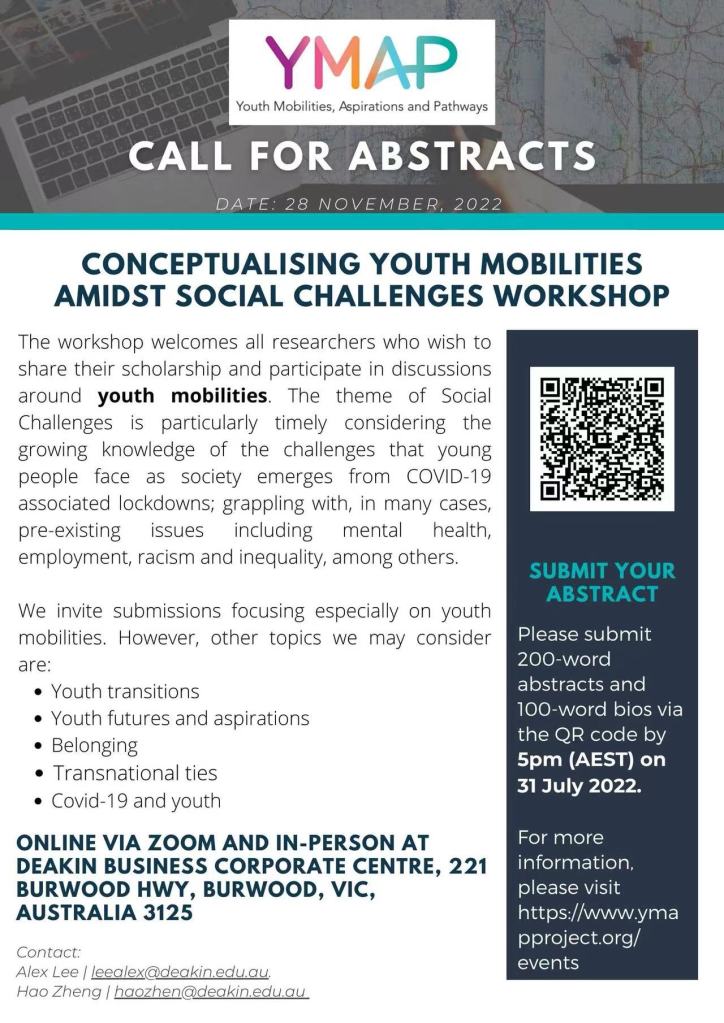
Call for Abstracts: Conceptualising Youth Mobilities amidst Social Challenges Workshop

Conceptualising Youth Mobilities amidst Social Challenges will bring together researchers with an interest in youth mobilities, from across the social sciences, for a one-day workshop. This workshop will be held on Monday, 28 November 2022, at Deakin Burwood Corporate Centre (BCC) and online on Zoom.  

The workshop welcomes all researchers who wish to share their scholarships and participate in discussions around youth mobilities. It seeks to provide an opportunity for attendees to build networks and connect with like-minded researchers at all stages of their careers, including early career and postgraduate. We seek to support research that has a connection to Australia. However, we also recognise that as youth mobilities research, this may likely include connections to places overseas.

We invite presentations that examine transnational youth mobilities amidst the social challenges of our contemporary world. What is the role of mobility in young people’s negotiation of social challenges? How might emerging forms of mobility (re)shape perceptions of adulthood and aspirations for youth transitions? How do young people construct belonging and place in a mobile world?


The theme of Social Challenges is particularly timely considering the growing knowledge of the challenges that young people face as society emerges from COVID-19 associated lockdowns; grappling with, in many cases, pre-existing issues including mental health, employment, racism and inequality, among others.  

We invite submissions focusing especially on youth mobilities. However, other topics we may consider are:
• Youth transitions
• Youth futures and aspirations
• Belonging
• Transnational ties
• Covid-19 and youth

Traditional academic papers and alternative presentations (e.g. creative readings, collective presentations, posters, etc.) are welcome. Please submit 200-word abstracts and 100-word bios via the Google Form by 5pm (AEST) on 31 July 2022. For questions or more information, please get in touch with Hao Zheng (haozhen@deakin.edu.au) or Alex Lee (leealex@deakin.edu.au).

Managing editor: Tong Meng

Call for Papers: Chinese Sociological Review

Special Issue on Growing Up in a Time of Uncertainty: Rethinking Education and Inequality in Chinese Societies and Beyond

Guest Editors

Anning Hu, Fudan University

Angran Li, NYU Shanghai

Duoduo Xu, University of Hong Kong

《中华社会学评论》是Chinese Sociological Review的中文刊名。本刊努力推动对当代中国社会的高质量、专业化的深入研究, 见证了很多年轻的量化社会科学学者的成长,现向海内外学界同仁征稿。

Growing Up in a Time of Uncertainty:

Rethinking Education and Inequality in Chinese Societies and Beyond

We are living in a time of tremendous uncertainty for our children’s future. The lingering COVID-19 pandemic, the rapidly changing policy environment, the foreseeable economic recession, and the clashing cultural repertoires, have fundamentally reshaped our educational institutions, generating long-lasting impacts on individual educational trajectories and outcomes as well as on social inequality and mobility. In Chinese societies, as in societies elsewhere, children, parents, teachers, and schools have to accommodate the unintended consequences of school closure, policy changes, and other interruptions during the time of uncertainty. Although new strategies and practices have been adopted to facilitate student learning, widening inequality impends to disrupt our educational systems and to leave many children behind.

Against this backdrop, Chinese Sociological Review (CSR) invites papers for a special issue on Growing Up in a Time of Uncertainty: Rethinking Education and Inequality in Chinese Societies and Beyond. This call invites authors to submit papers that consider various aspects of the relationship between education and inequality under a time of uncertainty in Chinese societies, preferably with a global and comparative perspective. We encourage submissions from various sectors, countries (areas), and disciplines. Both empirical (quantitative, qualitative, mixed methods) and theoretical studies are welcomed.

We are particularly interested in papers that explore the following questions:

  • What impact do the pandemic, policy changes, economic recession, and cultural shifts have on the future of primary, secondary, tertiary, and post-tertiary educational systems? How do these changes alter the existing educational inequalities and generate new ones at the individual, organizational, and national levels?
  • What are the macro-, meso-, and micro-level social mechanisms that can explain the emerging educational inequalities given the institutional transformations in response to those uncertainties?
  • What are the emerging strategies and practices adopted by families and schools that can help to close the gap in educational outcomes and build more equitable educational systems during the time of uncertainty?

We also welcome research addressing the following themes:

  • Chinese Meritocratic Educational Systems
  • Cultural Capital in Non-western Contexts
  • Policy Changes and Shadow Education
  • School Choice in Chinese Societies

Submission Guideline

Authors who want their work to be considered for publication in this special issue should email a proposal with a captioned title “CSR Education Special Issue” to specialcsr@gmail.com and address to Guest Editors Anning Hu, Professor of Sociology, Fudan University, Angran Li, Assistant Professor of Sociology, NYU Shanghai, Duoduo Xu, Assistant Professor of Sociology, The University of Hong Kong, by August 31, 2022. Proposals should be about 1,000 words long in total and should articulate how the themes of the special issue are addressed.

The editorial team will consider the pool of proposals received by this deadline. Proposals will be selected based on their theoretical and/or practical contributions. Once been selected, the editorial team will invite the authors to submit a full paper (no more than 9000 words). Invitations to submit the full-length research papers will be sent out to authors by Sept 10, 2022. The full-length paper for peer reviews will be due on November 30, 2022. A workshop may be organized for authors to present their work and further improve their manuscripts. The special issue is expected to be published online before Fall 2023.

Chinese Sociological Review (CSR) (Print ISSN: 2162-0555 Online ISSN: 2162-0563), founded in 1968, publishes high-quality original works from sociologists and other social scientists. The mission of the journal is to advance the understanding of contemporary Chinese society and contribute to general knowledge in the discipline of sociology. All research articles will undergo a rigorous editorial screening and peer review process. The journal is intended for an international readership, now published by Taylor & Francis Inc. 530 Walnut Street, Suite 850, Philadelphia, PA 19106.

For more information, please visit https://www.tandfonline.com/journals/mcsa20.

Managing editor: Tong Meng