“Bribery with Chinese characteristics” and the use of guanxi to obtain admission to prestigious secondary schools in urban China

Research Highlighted:

Ruan, J. 2019. “Bribery with Chinese characteristics” and the use of guanxi to obtain admission to prestigious secondary schools in urban China, Critical Asian Studies, 51(1):120-130

Dr Ji RUAN, Hanshan Normal University, China

Guanxi, the Chinese personal relationships, connections or networks, is a fundamental element of traditional Chinese social structure, which continues to be pervasive in contemporary China and often involves bribery and corruption. How can we distinguish proper guanxi from bribery?

Some argue that bribes are one-off but guanxi is premised on a long-term relationship. Other argue that guanxi is based on affection and esteem while bribery is based on coercion. Some argue that bribery is based on improper inducement while guanxi is not. However, evidence from this study supports a different point of view.

The author carried out ethnographic case studies in two Chinese cities where parents used guanxi to obtain school places in prestigious schools. Evidence has shown that a bribery relation in Chinese society can be a guanxi relation involving some degree of affection and esteem while simultaneously having a coercive intent. In addition, some bribery in China does not necessarily involve coercion, but instead relies on ethical force. Moreover, some affection or esteem in guanxi practice are not genuine but a performance to cover the bribery, which makes it difficult to distinguish proper guanxi from bribery.

Bribery cannot be distinguished from guanxi simply by judging whether it is a one-off deal or a part of a long-term relationship. Some bribery in China may involve long-term indebtedness and the return of favors after a long period of time, which looks like a proper guanxi but in fact bribery with long-term trust. Moreover, long term friendship in Chinese society also involves bribery from time to time.

Bribery in China is significantly influenced by the concept and ethics of renqing. Although guanxi and bribery acts can be distinguished theoretically by whether these carry an improper inducement, it is extremely difficult to distinguish them in practice since many people consider giving money to officials as following a traditional ethic (renqing) and is proper.

中文摘要

一些学者试图区分某种行为是人情关系还是贿赂,但在中国,有些行为是很难断定它是人情还是贿赂的,这与一些中国传统观念和做法有关。首先,传统上人们更看重人情伦理而非法律,这使得人们很难判断拉关系行为是否存在“不当引诱”; 第二,贿赂中使用的一些互动仪式其实是一种表演,企图证明其不道德行为的正当性,有意混淆人情关系与贿赂;第三,贿赂中所表现出的一些“感情”和“尊敬”有时只是一种逢场作戏,而并非真正的感情和尊敬;第四,有些人试图将他们的贿赂关系表演成一种长期的亲友关系,而不是一次性的交易,这也加大了局外观察者区分人情关系和贿赂的难度。由于“道德化”的文化习俗把人情关系和贿赂混为一谈,使得观察者很难通过判断一项行为是否是纯粹基于尊敬还是被胁迫、是基于长期关系或一次性交易、是基于“不当引诱”还是正当合法行为。

Author Bio

Dr Ji Ruan is currently an associate professor in sociology in Hanshan Normal University in China. He earned his PhD in sociology at the University of Kent, U.K. He is author of Guanxi, Social Capital and School Choice in China: The Rise of Ritual Capital (Palgrave). His research interests include guanxi, bribery, corruption, social stratification and exclusion, rural governance, Confucianism. he can be contacted via 200807689@qq.com.

Recent publications:

Ruan Ji & Chen Feng (2020) The Role of Guanxi in Social Exclusion against the Background of Social Stratification: Case Studies of Two Chinese Villages, Journal of Contemporary China, 29:125, 698-713, DOI: 10.1080/10670564.2019.1705001

Ruan, J. 2019b, Motivations for Ritual Performance in Bribery: Ethnographic Case Studies of the Use of Guanxi to Gain School Places in China,Current Sociology,DOI: 10.1177/0011392119892676

Ruan, J.2019a. “Bribery with Chinese characteristics” and the use of guanxi to obtain admission to prestigious secondary schools in urban China, Critical Asian Studies, 51(1):120-130

Ruan, J. 2017c. ‘Interaction Rituals in Guanxi Practice and the Role of Instrumental Li’, Asian Studies Review 41(4): 664–678

Ruan, J. 2017b. ‘Ritual Capital: A Proposed Concept From a Case Study of School Selection in China’, Asian Journal of Social Science 45 (3): 316–339

Ruan, J. 2017a. Guanxi, Social Capital and School Choice in China: The Rise of Ritual Capital, London: Palgrave Macmillan.
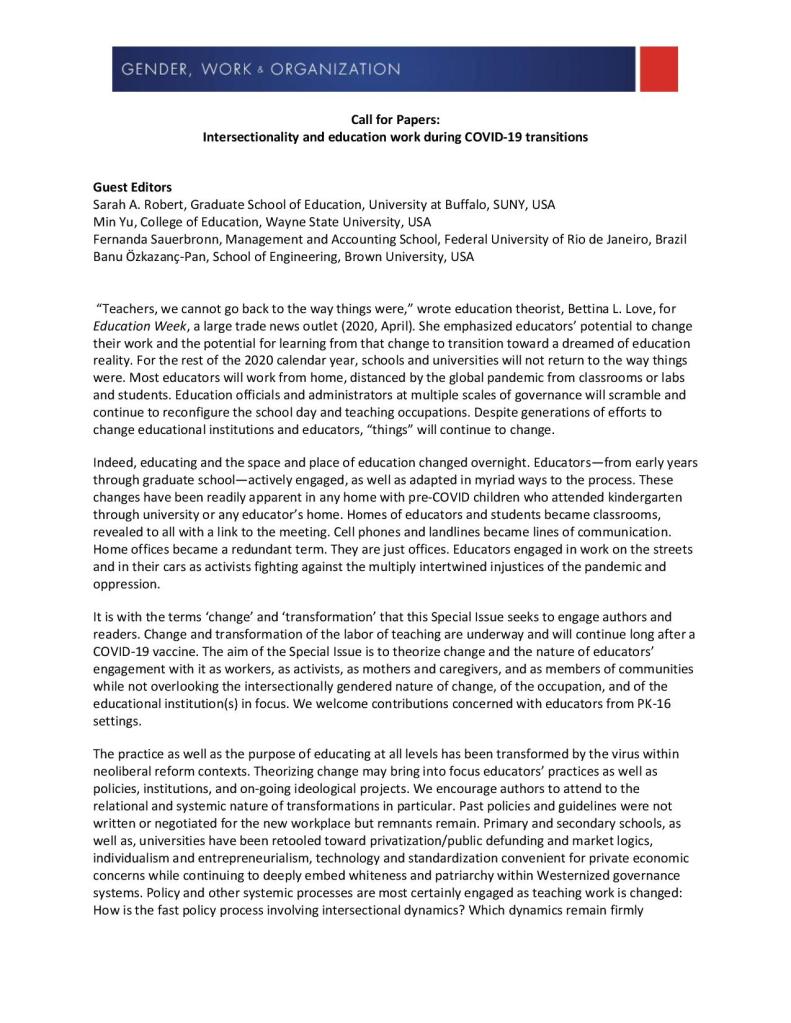
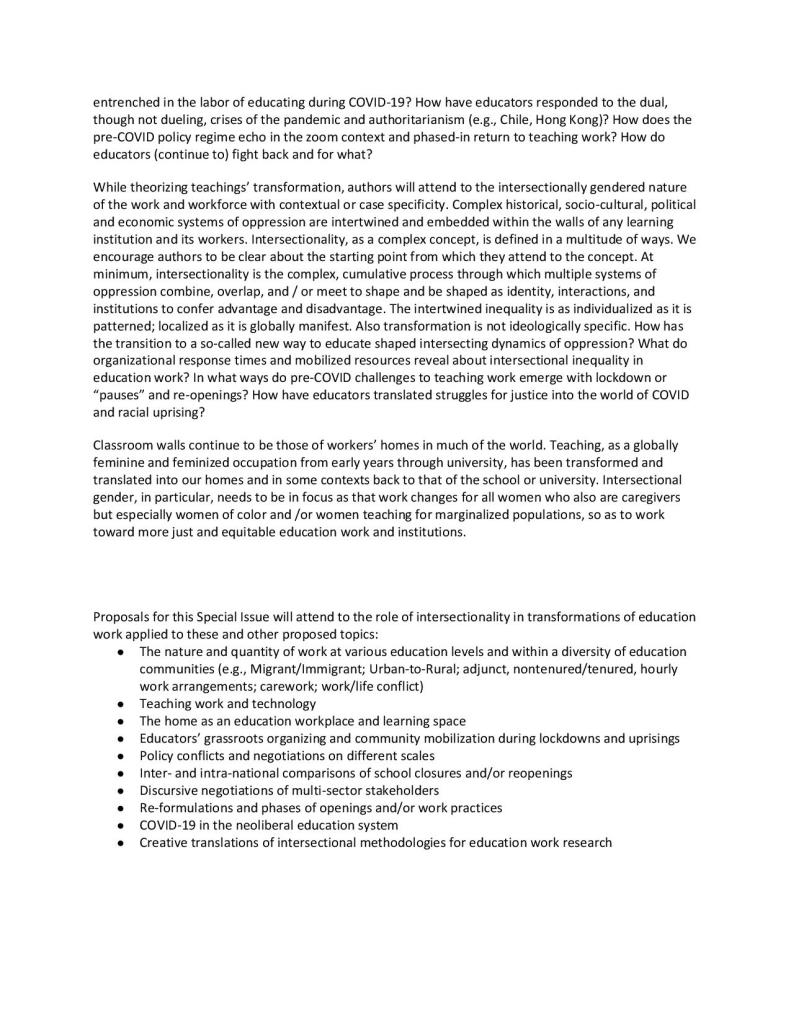
CfP: Special Issue on ‘Intersectionality and education work during COVID-19 transitions’ in Gender, Work and Organization

The aim of the Special Issue is to theorize change and the nature of educators’ engagement with it as workers, as activists, as mothers and caregivers, and as members of communities while not overlooking the intersectionally gendered nature of change, of the occupation, and of the educational institution(s) in focus. The link of the CfP is here.


We invite interested authors to send an extended abstracts by close of business November 10, 2020to Sarah A. Robert (sarah@buffalo.edu). Proposals will contain a title, author(s) name(s) and affiliations, an extended abstract (500 words), and a short bio for each author (150 words). Invitations for full submission will be sent mid-December. Deadline for full submissions: 1 June 2021.

Uyghur educational elites in China: mobility and subjectivity uncertainty on a life-transforming journey

Research Highlighted

Zhenjie Yuan & Hong Zhu (2020): Uyghur educational elites in China: mobility and subjectivity uncertainty on a life-transforming journey, Journal of Ethnic and Migration Studies. https://doi.org/10.1080/1369183X.2020.1790343 (open access)

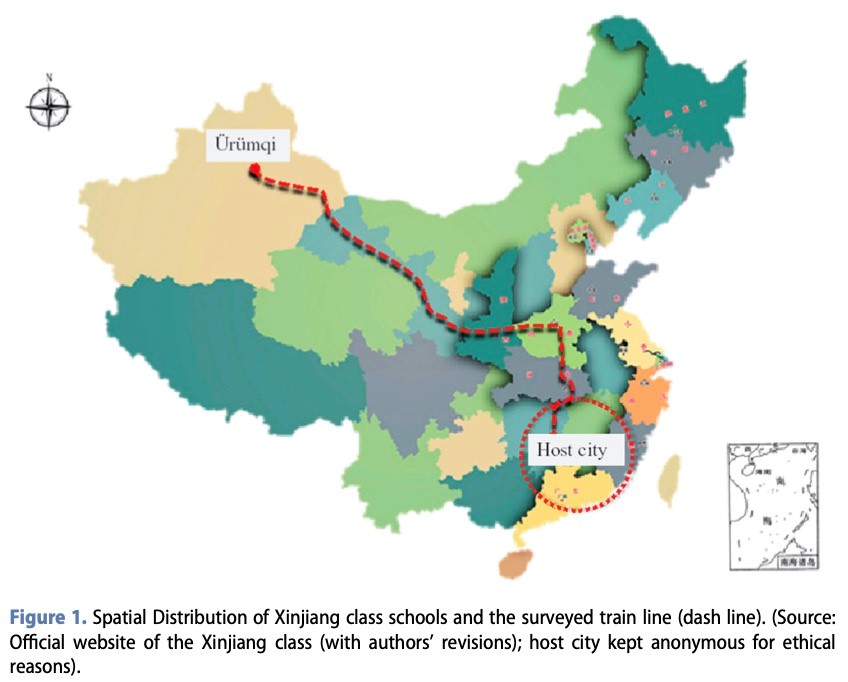
Relocation as a strategy: policy designs and spatial agendas of the Xinjiang class

Education has been perceived as a key mechanism to ease interethnic conflict, enhance mutual trust, and promote national unity in China, a state that has been presented for decades in its official media as multi-ethnic and multi-cultural. However, taking the Uyghur as an example, although preferential policies have been deployed for years, conflicts between the Uyghur and Han-dominant educational systems have continuously been reported. Spatial isolation, religion, language, and sense of ethnic belonging, etc. are the most-discussed factors leading to gaps between Uyghur students and mainstream society in educational/career contexts across schools, universities, and workplaces.

This article concerns a boarding school project named Xinjiang Interior Class, which has been defined as an emblem of a nationalist project aimed at improving minority education and fostering solidarity among ethnic groups. Unlike the trend of “moving-inwards” that introduces educational resources into Xinjiang– the focus of most preferential educational policies related to Xinjiang – the Xinjiang class represents a “moving-outwards” trend: Xinjiang students are relocated from their home areas to receive education at designated campuses in selected central and eastern cities. In this vein, the policy involves a physical relocation of students (mostly ethnic minority, especially Uyghur) from Xinjiang Uyghur Autonomous Region to the eastern and central parts of the country.

The Xinjiang class policy has been defined as successful in official discourses, increasing from 1,000 enrolments in 2000 to around 10,000 enrolments since 2014. By 2017, nearly 100,000 Xinjiang students had received education through this policy, with about 21,000 graduates starting their careers in Xinjiang. However, the policy has been critiqued due to its strategy of removing students from their homeland, and its explicit political goals of cultivating politically loyal (mostly ethnic minority) elites. Arguably, the policy is one of the most influential but controversial minority education policies in contemporary China.

Current debates and research questions

The policy has attracted increasing academic attention. Existing scholarship has focused on interethnic interaction and identity politics among current students and graduates in different spatial contexts (including schools, universities, and workplaces), unveiling both the efficiencies and problems with of the policy. Although the existing research has revealed myriad interethnic politics in everyday schooling, critical, but still underexplored, questions are: Who are the students before they enter such a new educational world? How did they experience the relocation process? Drawing on theories of mobility and subjectivity, especially in relation to train space, this study interrogates Uyghur students’ subjectivity experiences in this space-in-motion.

Subjectivity, in this study, refers to all the elements that make up a thinking, perceiving and feeling human subject. These consist of the various domains of conscious experience – the attitudes, values, memories, feelings, beliefs, interpretations, perceptions, expectations, imaginations and personal or cultural understandings specific to a person. This study focuses on subjectivity since it focuses more on ideas about the subject and one’s own mental world, which is expected to provide a more subtle and nuanced perspective on understanding the thoughts, feelings and perceptions of the Xinjiang students during the process of mobility.

Methods

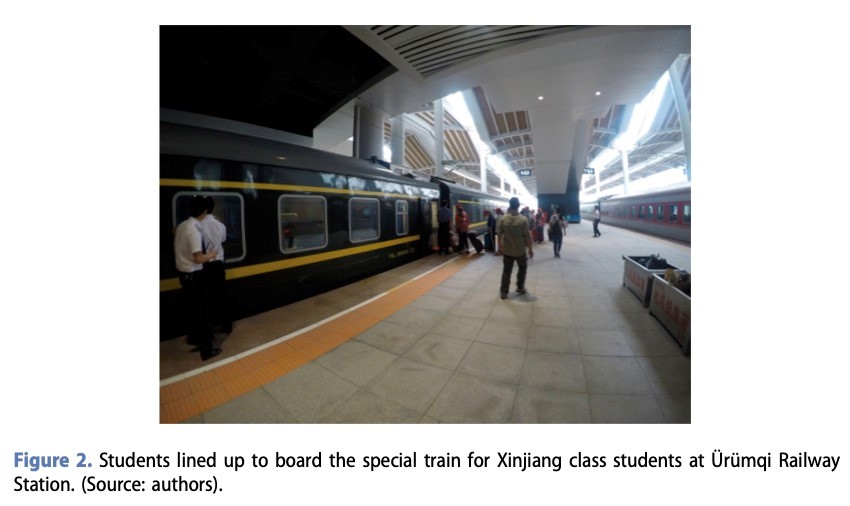
The field site of this study is a moving train. This study is based on a “mobile ethnography”, which is a qualitatively-based method of tracking the students’ journey, gathering students’ insight and capturing the student voice. I had a seat in the same compartment as the students, spending the entire three-day and two-night trip with them, which offered me significant time and space to talk with students, hear their voices and observe their behaviours. Drawing on interviews (N=16), observations, and questionnaire surveys (N=97) with Uyghur students on a train which took them to their new educational world, this article examines what the students felt, thought, perceived and did during the trip, and analyses how these subjective experiences are related to the process of being mobile.

Findings and discussions

We find that the process of mobility provided the students with a specific time and space to rethink who they are and how they are connected to different places, people and communities. The rich but subtle experiences during the mobility process result in intricate subjectivity uncertainty for the students, chiefly entailing a strong sense of eliteness, a reinforced sense of self-discipline, and increased place identity to Xinjiang. Furthermore, these experiences also rendered the train an affective space, where bodies (students), materials, emotions and imaginations were intertwined, but also a social-political space entailing significant implications for examining the politics of ethnicity in relation to the Xinjiang class.

The article supplements the current literature by presenting the poetics and politics of subjectivity among Uyghur students in a mobile space, further reinforcing the significance of mobility theories in understanding ethnic migration and its politics in China.

First, this study offers researchers a mobilities perspective to examine the interethnic politics of the Xinjiang class, but also reminding both scholars and observers of China to extend their focus to other spatial contexts associated with the policy.

Second, we contend that mobility has become a core value and emblem of progress during China’s modernization and urbanization, and should be a critical perspective for examining ethnic politics in contemporary China. We argue that the process of movement/travel, an important but underexplored arena, might not only create a transitional time-space for (ethnic minority) migrants to conduct relocation, but also produces intense psychological and behavioural responses to their decisions about and expectations of im/mobility, which is connected to the broader socio-economic picture in China.

Authors’ bios

Dr Zhenjie Yuan is Associate Professor in School of Geography and Remote Sensing, Guangzhou University. He holds a PhD in Human Geography/Chinese studies from the Centre for Contemporary Chinese Studies, the University of Melbourne. His research is inter-disciplinary, traversing across geography of education, sociology of education and ethnic studies. It focuses particularly on the politics of multi-ethnic interaction of the “Xinjiang Inland Class”. Email: zjyuan@gzhu.edu.cn.

Dr Hong Zhu is a Professor in the School of Geography and Remote Sensing, Guangzhou University. His research interests lie in social and culture geography. He is also the Director of Guangdong Provincial Center for Urban and Migration Studies. He is now the Principal Investigator of a Key Project of the National Science Foundation of China which focuses on human-place interaction and the negotiation of place for various types of migrants in the context of China’s globalization and modernization. Email: zhuhong@gzhu.edu.cn.