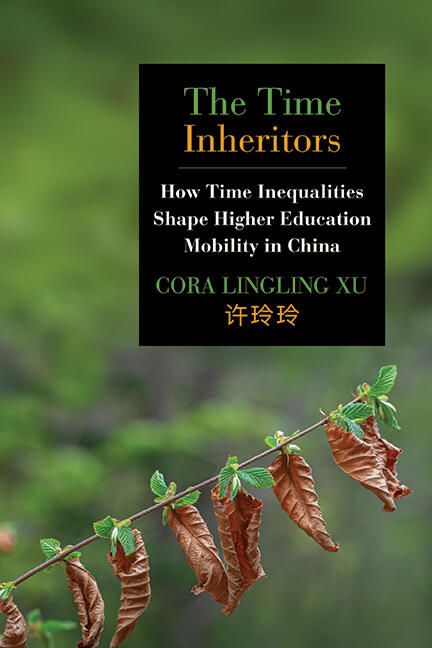
‘The Time Inheritors: How Time Inequalities Shape Higher Education Mobility in China’ by Cora Lingling Xu

We are delighted to share the publication of a new book by our director Dr Cora Lingling Xu. Read this profile (in Chinese) with People Magazine 《人物》杂志 and blog post to learn about the personal stories behind this book.

Please find an abstract of ‘The Time Inheritors‘ and critical reviews below.

If you wish to order this book, you can use SNWS25 to get 30% off when you order from the SUNY Press website.

To learn more about the book talks and interviews visit this page. Listen to the New Books Network’s interview with Cora. 听’时差In-Betweenness’与Cora的对话小宇宙链接). Check out this page for frequently asked questions (e.g. what you should do if you wish to write a book review) about this book. Share your stories of ‘time inheritance’. If you wish to contact Cora about arranging book talks and interviews, complete this contact form.

Abstract

Can a student inherit time? What difference does time make to their educational journeys and outcomes? The Time Inheritors draws on nearly a decade of field research with more than one hundred youth in China to argue that intergenerational transfers of privilege or deprivation are manifested in and through time. Comparing experiences of rural-to-urban, cross-border, and transnational education, Cora Lingling Xu shows how inequalities in time inheritance help drive deeply unequal mobility. With its unique focus on time, nuanced comparative analysis, and sensitive ethnographic engagement, The Time Inheritors opens new avenues for understanding the social mechanisms shaping the future of China and the world.

Critical reviews

“Xu’s conceptually sophisticated monograph reveals how intersectional inequalities are constructed, experienced, and transmitted temporally, with special reference to education. Through the vivid stories of students in mainland China and Hong Kong, and Chinese international students, Xu brings to life different individuals’ ‘time inheritances,’ demonstrating the exciting possibilities time offers as a lens for innovative thinking about inequality. A must-read for sociologists and anthropologists of education, China, and time.” — Rachel Murphy, author of The Children of China’s Great Migration

“Innovative and ambitious, The Time Inheritors proposes a time-centric framework that brings together analyses of social structure, history, individual behavior, and affect. We often feel we are fighting for time. But, as Cora Xu argues in this important study of Chinese students, the scarcity of time is not a given or universal. Different experiences of time result in part from the varying amounts of time we inherit from the previous generation. Time inheritance is therefore critical to the reproduction of social inequality.” — Biao Xiang, coauthor of Self as Method: Thinking through China and the World

“Cora Lingling Xu offers a groundbreaking analysis of educational inequality and social mobility in contemporary China. Xu centers the voices of marginalized students throughout, providing poignant insights into their lived experiences of rural poverty, urban precarity, and educational alienation. At the same time, Xu’s comparative scope reveals how even seemingly privileged groups can be constrained by the temporal logics of social reproduction. The Time Inheritors is a must-read for scholars, educators, and policymakers concerned with educational equity and social justice. Xu’s lucid prose and engaging case studies make the book accessible to a wide audience while her cutting-edge theoretical framework and methodological rigor set a new standard for research on education and inequality.” — Chris R. Glass, coeditor of Critical Perspectives on Equity and Social Mobility in Study Abroad: Interrogating Issues of Unequal Access and Outcomes

“By centering the temporal dimension of who is advantaged or disadvantaged, how, why, and with what consequences, The Time Inheritors takes a unique and powerful approach. Not only does the book contribute theoretically and empirically to our understanding of class inequalities but it also resonates deeply. The inclusion of Chinese translations and characters will give Chinese readers a rich, nuanced cultural appreciation of her findings.” — Dan Cui, author of Identity and Belonging among Chinese Canadian Youth: Racialized Habitus in School, Family, and Media

“An extremely well-written, theoretically informed, and compelling volume that represents a major contribution to the study of education, migration, and social inequality in China and beyond. The Time Inheritors proposes a bold and innovative framework—that of time inheritance—to open the black box of social inequality’s temporal dimension. Whereas the relatively privileged classes inherit temporal wealth and strategies that enable them to bank and save time, facilitating their mobility, the time poor lack this inheritance, forcing them into a vicious cycle of wasting time and paying back temporal debts. Drawing from a rich palette of vivid and intimate longitudinal case studies, The Time Inheritors unpacks the complex intersections between familial, national, and global time inequalities.” — Zachary M. Howlett, author of Meritocracy and Its Discontents: Anxiety and the National College Entrance Exam in China

Release Dates

Hardcover: 1st April 2025

Paperback: 1st October 2025

Different paths, same destination? Mobility trajectories of Mainland PhD students during the COVID-19 pandemic at a Hong Kong University

Wang, L., & Yang, R. (2023). Different paths, same destination? Mobility trajectories of Mainland PhD students during the COVID-19 pandemic at a Hong Kong UniversityEducational Philosophy and Theory, 1-13. DOI: 10.1080/00131857.2023.2284104

Existing studies on student mobility are plentiful. They have predominantly focused on the push and pull factors that drive linear student mobilities from less developed regions to regions with more advanced systems of education; the identity formation of students during their transnational or transborder journeys; and the policy rationales, developments, and implications of students’ transnational mobilities (Gümüş et al., 2020; Hong, 2022; Tran, 2016; Xu, 2018; Wen & Hu, 2019). However, few studies have investigated mobility trajectories characterized by different durations of stay and directions of movement that individual students navigate at different points in their academic lives. Additionally, the impact of the outbreak of COVID-19—the global pandemic that significantly decreased global movement but made virtual mobilities (e.g., online learning) prevalent—on students’ academic mobilities remains unexplored.

Another important strand of research has revealed that Hong Kong (HK), the regional education hub characterized by a hybrid culture and sociopolitical tensions between HK local and Mainland China (MC) students, has attracted students from MC for numerous decades (e.g., Li & Bray, 2007, Xu, 2018). However, few studies have examined the academic experiences of students who relocated to HK in the midst of the COVID-19 pandemic, how these students perceive their academic experience in HK, and whether their mobility plans have changed since coming to HK. Given the research gaps identified, the study has two aims: to investigate diverse academic mobility trajectories among MC students who have relocated to HK for doctoral studies and to explore the factors that shape mobility trajectories. 

This study conceptualizes student mobility through the lens of power by combining and adapting the work of Hong (2022) and Holyk (2011). Hong (2022) synthesizes the work of He and Wilkins (2019), Tran and Vu (2018), and Bae and Lee (2020) on the soft power of national cultural or education programs and considers three types of soft power produced by student mobility: social capital soft power, cultural soft power, and participatory capital soft power. Taking into consideration the fact that financial support and HK’s geopolitical proximity to MC are significant factors to attract MC students (Li & Bray, 2007), this study also includes economic hard power—geographical advantages and financial support as emphasized by Holyk (2011, p. 229) in our framework. Based on this framework, we argue that multiple student mobility trajectories exist in universities due to the combined impact of soft power and hard power. Universities serve as convergence points for diverse ideas, values, and cultures. Students, whose identities embody dynamic hybridity, find themselves embedded in interconnected social networks influenced by various forms of power that are distributed unevenly in terms of size and influence. The onset of the COVID-19 pandemic has introduced a distinctive spatial-temporal context, leading students to respond differently to various manifestations of power. As a result, distinct mobility trajectories have surfaced.

Our research data include semi-structured interviews with 20 full-time PhD students from a prestigious university (University A) supplemented by university documents on student mobility projects, COVID-19 policies, and university development plans. Ethical clearance was obtained before research. All the interviewees were recruited through a purposeful sampling strategy and had previously studied at top Western universities and navigated multiple mobility trajectories. Their cross-cultural experiences offered valuable insights into the intricate and multifaceted processes that influence the formation of various mobility patterns and their underlying factors. Data were analyzed deductively and inductively following the method of Saldaña (2016).

Our findings reveal two forms of cross-border mobilities: 1) degree mobilities from Western societies to HK and 2) international academic mobilities that involved HK as a place of both departure and return. What motivated interviewees to choose HK as a study destination was the combined effect of economic hard power (the availability of generous scholarships and HK’s geopolitical proximity to MC), one aspect of social capital power (having desirable doctoral supervisors), and the global pandemic that restricted travel restrictions. Aspects of cultural soft power closely connected to a university’s core missions of research and teaching seemed to exert minimal influence on the decisions of these students to choose HK. The power imbalance between University A and prominent Western universities was evident because of University A’s lack of international exchange programs and visiting opportunities with top-tier Western universities.

The intracity academic mobilities of students in this study were characterized by disengaged virtual spaces and confined physical spaces, both contributing to decreased academic mobilities. Although online learning helped overcome spatial barriers, it posed challenges related to student engagement and teaching quality, as illustrated by previous studies (Mok et al., 2021). Moreover, the subpar quality of teaching, combined with a highly competitive research environment where students struggled to establish meaningful connections with peers and academics, left them disempowered to build the social capital necessary for fostering a supportive learning environment. Consequently, their intracity academic mobility trajectories were limited.

The interviewees’ reflections on HK as both a safe and unsafe place, a finding that emerged from the interview data, were based on their intra- and intercity physical mobility experiences, which were influenced by various factors including the COVID-19 policies of HK and MC, Mandarin discrimination, and HK’s political movements. As a result, very few interviewees were able to cultivate a sense of belonging in HK. Their identities as bystanders in HK gave support to the statement that ‘ways of being’ and ‘ways of belonging’ are different (Levitt & Schiller, 2004, p. 1008) and academic involvement and social engagement are important dimensions of belonging (Ahn & Davis, 2020).

Limitations of the study include the small sample size and the lack of representativeness of our participants. Despite these limitations, various types of power, each with different levels of influence, shape the directions and durations of student mobilities, offering a novel perspective into student mobility trajectories. Our findings also emphasize the significance of students’ sociocultural development through meaningful interactions and the importance of a campus that fosters intellectual exchanges and respectful dialogue in a space of equality.

Author’s bio

Ling Wang is a PhD candidate at the Faculty of Education, University of Hong Kong. Her research focuses on power and leadership in higher education, academic career, and doctoral education.

Rui Yang is a Professor and Dean in the Faculty of Education at The University of Hong Kong. With three and a half decades in China, Australia and Hong Kong, he has established his reputation among scholars in English and Chinese languages in the fields of comparative and international education and Chinese higher education. His research interests include education policy sociology, comparative and cross-cultural studies in education, international higher education, educational development in Chinese societies, and international politics in educational research.

References

Ahn, M. Y., & Davis, H. H. (2020). Four domains of students’ sense of belonging to university. Studies in Higher Education, 45(3), 622–634. https://doi.org/10.1080/03075079.2018.1564902

Bae, Y., & Lee, Y. W. (2020). Socialized soft power: Recasting analytical path and public diplomacy. Journal of International Relations and Development, 23(4), 871–898. https://doi.org/10.1057/s41268-019-00169-5

Gümüş, S., Gök, E., & Esen, M. (2020). A Review of Research on International Student Mobility: Science Mapping the Existing Knowledge Base. Journal of Studies in International Education, 24(5), 495–517. https://doi.org/10.1177/1028315319893651

He, L., & Wilkins, S. (2019). The Return of China’s Soft Power in South East Asia: An Analysis of the International Branch Campuses Established by Three Chinese Universities. Higher Education Policy, 32(3), 321–337. https://doi.org/10.1057/s41307-018-0084-x

Hong, M. (2022). Evaluating the soft power of outbound student mobility: An analysis of Australia’s New Colombo Plan. Higher Education Research & Development, 41(3), 743–758.

Holyk, G. G. (2011). Paper Tiger? Chinese Soft Power in East Asia. Political Science Quarterly, 126(2), 223–254. https://doi.org/10.1002/j.1538-165X.2011.tb00700.x

Tran, L. T. (2016). Mobility as ‘becoming’: A Bourdieuian analysis of the factors shaping international student mobility. British Journal of Sociology of Education, 37(8), 1268–1289. https://doi.org/10.1080/01425692.2015.1044070

Levitt, P., & Schiller, N. G. (2004). Conceptualizing Simultaneity: A Transnational Social Field Perspective on Society1. International Migration Review, 38(3), 1002–1039. https://doi.org/10.1111/j.1747-7379.2004.tb00227.x

Li, M., & Bray, M. (2007). Cross-Border Flows of Students for Higher Education: Push-Pull Factors and Motivations of Mainland Chinese Students in Hong Kong and Macau. Higher Education, 53(6), 791–818.

Mok, K. H., Xiong, W., & Bin Aedy Rahman, H. N. (2021). COVID-19 pandemic’s disruption on university teaching and learning and competence cultivation: Student evaluation of online learning experiences in Hong Kong. International Journal of Chinese Education, 10(1), 22125868211007011. https://doi.org/10.1177/22125868211007011

Saldaña, J. (2016). The coding manual for qualitative researcher (3rd ed.). Sage.

Tran, L. T., & Vu, T. T. P. (2018). Beyond the ‘normal’ to the ‘new possibles’: Australian students’ experiences in Asia and their roles in making connections with the region via the New Colombo Plan. Higher Education Quarterly, 72(3), 194–207. https://doi.org/10.1111/hequ.12166

Xu, C. L. (2018). Transborder habitus in a within-country mobility context: A Bourdieusian analysis of mainland Chinese students in Hong Kong. The Sociological Review, 66(6), 1128–1144. https://doi.org/10.1177/0038026117732669

Managing Editor: Tong Meng

Cultivating Global Scholars in international mobility: integration experiences from Chinese doctoral students at Finnish universities  

Research highlighted 

Title: Cultivating Global Scholars in international mobility: integration experiences from Chinese doctoral students at Finnish universities  

Zheng, G., Cai, Y. & Zuo, B. Cultivating Global Scholars: Delving into Chinese Doctoral Students’ Integration Experiences at Finnish Universities Through an Institutional Logics Lens. Journal of Knowledge Economy (2023). doi.org/10.1007/s13132-023-01420-8 

International mobility of doctoral students contributes substantially to the global knowledge production across borders. This requires international doctoral students have the intercultural competency in adapting to the incremental changes of cultural background in global mobility and integrate into the local academic environment. However, international doctoral students often face various challenges in integrating into the host academic system when they mobile from one country to another. Through interviews with ten Chinese doctoral students and four Finnish supervisors, this study examines the integration of Chinese international doctoral students at Finnish universities and unveils the reasons behind the challenges from an institutional logics’ perspective. Institutional logics refer to “the socially constructed, historical pattern of material practices, assumptions, values, beliefs, and rules by which individuals produce and reproduce their material subsistence, organize time and space, and provide meaning to their social reality” (Thornton & Ocasio, 1999, p. 804). 

Multiple logics underlying Chinese doctoral students’ expectations.  

The study shows at the beginning of the integration process, the Chinese international doctoral students’ expectations of doctoral studies was marked by a constellation of logics of profession, bureaucratic state, and family. Influenced by a profession logic, most interviewed doctoral students chose their future supervisors based on supervisors’ research interest and academic merits, and had high academic expectations on their supervisors. Moreover, Chinese doctoral students expected to receive some kind of “mentorship in life” from their supervisors and to join a “research family” during their doctoral study. This reflects the concept of academic parents and children in keeping with family logic in Chinese society. They also expected greater regulations on the processes and outputs of doctoral education, which reflects a bureaucratic state logic.  

Multiple logics in the context of Finnish universities  

The study shows the Finnish universities offered another important input to the institutional environment for Chinese international students’ integration: the dominant institutional logics of profession, democratic state, and corporation. Underlined by profession logic, doctoral supervisors in Finnish universities expected doctoral students to act as independent researchers. Finnish universities also expected the relations between doctoral supervisors and students to be formal and professional, reflecting a profession logic, as well as being equal, in related to a democratic state logic. In Finnish universities, doctoral students with and without contractual relations were expected to be managed under different tracks, which indicates a corporation logic.   

Conflicting logics contributing to challenges in integration 

As shown above, the two inputs of multiple logics are not fully compatible, which provided conflicting sense-making frames to the Chinese international students, contributing to the mismatches between Chinese doctoral students’ expectation and the reality in Finnish universities.  

A first mismatch was rooted in the expected role of doctoral students. Influenced by the family logic, most interviewed Chinese doctoral students considered themselves the “academic children” of their supervisors and placed themselves in a lower position. However, Finnish supervisors expected doctoral students to be independent (following profession logic) and develop a more equal and professional supervisor–supervisee relation (underlined by the democratic state logic and the profession logic). This mismatch and the conflicting logics underlying it were a source of confusion for the Chinese students at the beginning of the integration process.  

A second mismatch was reflected in the differences between Chinese doctoral students’ expectations of a regulated, monitored doctoral learning process—behind which is the bureaucratic state logic that governed their experiences in the Chinese educational system—and the advocated autonomy, endorsed by the logic of profession in the Finnish universities. Especially at the beginning of their integration process, some Chinese doctoral students did not realize that they should manage their doctoral studies autonomously. 

A third mismatch lies in the varied interpretations of roles of universities universities. Influenced by profession logic, Chinese students expected universities to act solely as academic hubs for knowledge provision and transmission by researchers. However, along with the reform of new public management in higher education, the impacts of the corporation logic in the Finnish system become prevailing, which views universities as employers to manage researchers. In the beginning of integration, interviewed doctoral students were not used to the management system in Finnish universities. Even being informed, they felt it went against their professional values.  

Nevertheless, throughout the integration process, these multiple logics continued to interact and reconcile, and they finally aligned with the underlying logics in the Finnish universities. This implies that the interviewed Chinese doctoral students were eventually integrated into the local context to a large extent, despite the challenges in the process.  

Implications of the study 

First, for international doctoral students, they should learn about the practices in the host doctoral education system in advance which can help them better align their expectations and adapt to the local environment. For the instance of Chinese doctoral students in Finnish universities, they should strengthen their professional identity as early career researchers (strengthening the underlying profession logic), lower their expectations of familial relations with supervisors and institutions (weakening the underlying family logic), and familiarize themselves with the corporate management style of Finnish universities (strengthening the underlying corporation logic). 

Second, for host universities and supervisors, they should be aware of the potential mismatches between international doctoral students’ expectations about doctoral education and the social realities of the host universities. Finnish universities can provide more guidance to both doctoral students and their supervisors, such as an orientation course tailored to international doctoral students that introduces the regulations, academic norms, values, and culture of host universities along with other useful toolkits.  

Third, the study also found the differences between Chinese doctoral students’ expectations and Finnish social reality can promote organizational innovation in host universities. One Finnish supervisor changed her supervision practices by learning from her Chinese doctoral students and adopted innovative supervision practices within her research group. Bidirectional learning between the international supervisors and doctoral students is the key to turning integration challenges into opportunities for change. In line with this thinking, if one wants to enable global and local cultures to inform each other in the development of global scholarship, bidirectional learning between actors on both sides may also be key.  

References  

Thornton, P. H., & Ocasio, W. (1999). Institutional Logics and the Historical Contingency of Power in Organizations: Executive Succession in the Higher Education Publishing Industry, 1958–1990. American Journal of Sociology, 105(3), 801-843. https://doi.org/10.1086/210361  

Bio-notes of authors  

Dr Gaoming Zheng is an assistant professor at Institute of Higher Education, Tongji University, China and an affiliated researcher at Higher Education Group, Faculty of Management and Business, Tampere University, Finland. Her research interest of higher education covers internationalization of higher education, Europe-China higher education cooperation, doctoral education, academic profession, quality assurance and institutional logics.   

Dr Yuzhuo Cai is Senior Lecturer and Adjunct Professor at the Higher Education Group, Faculty of Management and Business, Tampere University, Finland. He is the Director of Sino-Finnish Education Research Centre, JoLii, and Deputy Director of Research Centre on Transnationalism and Transformation at Tampere University. He is also Co-Editor-in-Chief of Triple Helix: A Journal of University-Industry-Government Innovation and Entrepreneurship and Co-Editor of Journal of Studies in International Education. He has 150 academic publications in the fields of higher education research and innovation studies. yuzhuo.cai@tuni.fi 

Prof Bing Zuo is a professor at Faculty of Education, Lingnan Normal University, Zhanjiang, China.  Her research interests include higher education management, university organizational culture and teacher education. She was a visiting scholar at the Ontario Institute for Studies in Education at University of Toronto in Canada, and at University of Tampere in Finland. She held a national project of Education of the National Social Science Foundation “Influence of Overseas study experience on Teachers’ Beliefs and Behavior in Chinese Regional Colleges and Universities”.