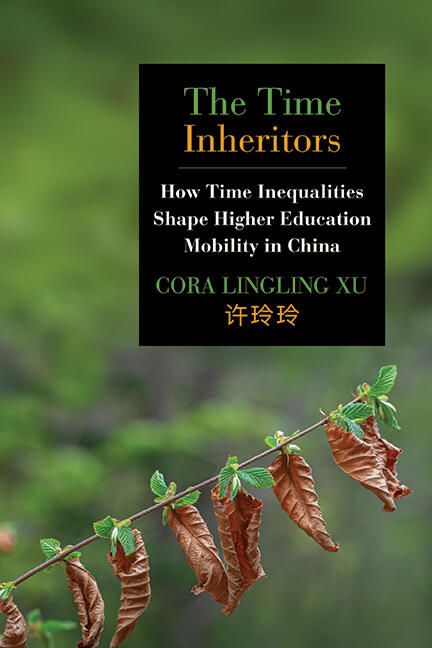
‘The Time Inheritors: How Time Inequalities Shape Higher Education Mobility in China’ by Cora Lingling Xu

We are delighted to share the publication of a new book by our director Dr Cora Lingling Xu. Read this profile (in Chinese) with People Magazine 《人物》杂志 and blog post to learn about the personal stories behind this book.

Please find an abstract of ‘The Time Inheritors‘ and critical reviews below.

If you wish to order this book, you can use SNWS25 to get 30% off when you order from the SUNY Press website.

To learn more about the book talks and interviews visit this page. Listen to the New Books Network’s interview with Cora. 听’时差In-Betweenness’与Cora的对话小宇宙链接). Check out this page for frequently asked questions (e.g. what you should do if you wish to write a book review) about this book. Share your stories of ‘time inheritance’. If you wish to contact Cora about arranging book talks and interviews, complete this contact form.

Abstract

Can a student inherit time? What difference does time make to their educational journeys and outcomes? The Time Inheritors draws on nearly a decade of field research with more than one hundred youth in China to argue that intergenerational transfers of privilege or deprivation are manifested in and through time. Comparing experiences of rural-to-urban, cross-border, and transnational education, Cora Lingling Xu shows how inequalities in time inheritance help drive deeply unequal mobility. With its unique focus on time, nuanced comparative analysis, and sensitive ethnographic engagement, The Time Inheritors opens new avenues for understanding the social mechanisms shaping the future of China and the world.

Critical reviews

“Xu’s conceptually sophisticated monograph reveals how intersectional inequalities are constructed, experienced, and transmitted temporally, with special reference to education. Through the vivid stories of students in mainland China and Hong Kong, and Chinese international students, Xu brings to life different individuals’ ‘time inheritances,’ demonstrating the exciting possibilities time offers as a lens for innovative thinking about inequality. A must-read for sociologists and anthropologists of education, China, and time.” — Rachel Murphy, author of The Children of China’s Great Migration

“Innovative and ambitious, The Time Inheritors proposes a time-centric framework that brings together analyses of social structure, history, individual behavior, and affect. We often feel we are fighting for time. But, as Cora Xu argues in this important study of Chinese students, the scarcity of time is not a given or universal. Different experiences of time result in part from the varying amounts of time we inherit from the previous generation. Time inheritance is therefore critical to the reproduction of social inequality.” — Biao Xiang, coauthor of Self as Method: Thinking through China and the World

“Cora Lingling Xu offers a groundbreaking analysis of educational inequality and social mobility in contemporary China. Xu centers the voices of marginalized students throughout, providing poignant insights into their lived experiences of rural poverty, urban precarity, and educational alienation. At the same time, Xu’s comparative scope reveals how even seemingly privileged groups can be constrained by the temporal logics of social reproduction. The Time Inheritors is a must-read for scholars, educators, and policymakers concerned with educational equity and social justice. Xu’s lucid prose and engaging case studies make the book accessible to a wide audience while her cutting-edge theoretical framework and methodological rigor set a new standard for research on education and inequality.” — Chris R. Glass, coeditor of Critical Perspectives on Equity and Social Mobility in Study Abroad: Interrogating Issues of Unequal Access and Outcomes

“By centering the temporal dimension of who is advantaged or disadvantaged, how, why, and with what consequences, The Time Inheritors takes a unique and powerful approach. Not only does the book contribute theoretically and empirically to our understanding of class inequalities but it also resonates deeply. The inclusion of Chinese translations and characters will give Chinese readers a rich, nuanced cultural appreciation of her findings.” — Dan Cui, author of Identity and Belonging among Chinese Canadian Youth: Racialized Habitus in School, Family, and Media

“An extremely well-written, theoretically informed, and compelling volume that represents a major contribution to the study of education, migration, and social inequality in China and beyond. The Time Inheritors proposes a bold and innovative framework—that of time inheritance—to open the black box of social inequality’s temporal dimension. Whereas the relatively privileged classes inherit temporal wealth and strategies that enable them to bank and save time, facilitating their mobility, the time poor lack this inheritance, forcing them into a vicious cycle of wasting time and paying back temporal debts. Drawing from a rich palette of vivid and intimate longitudinal case studies, The Time Inheritors unpacks the complex intersections between familial, national, and global time inequalities.” — Zachary M. Howlett, author of Meritocracy and Its Discontents: Anxiety and the National College Entrance Exam in China

Release Dates

Hardcover: 1st April 2025

Paperback: 1st October 2025
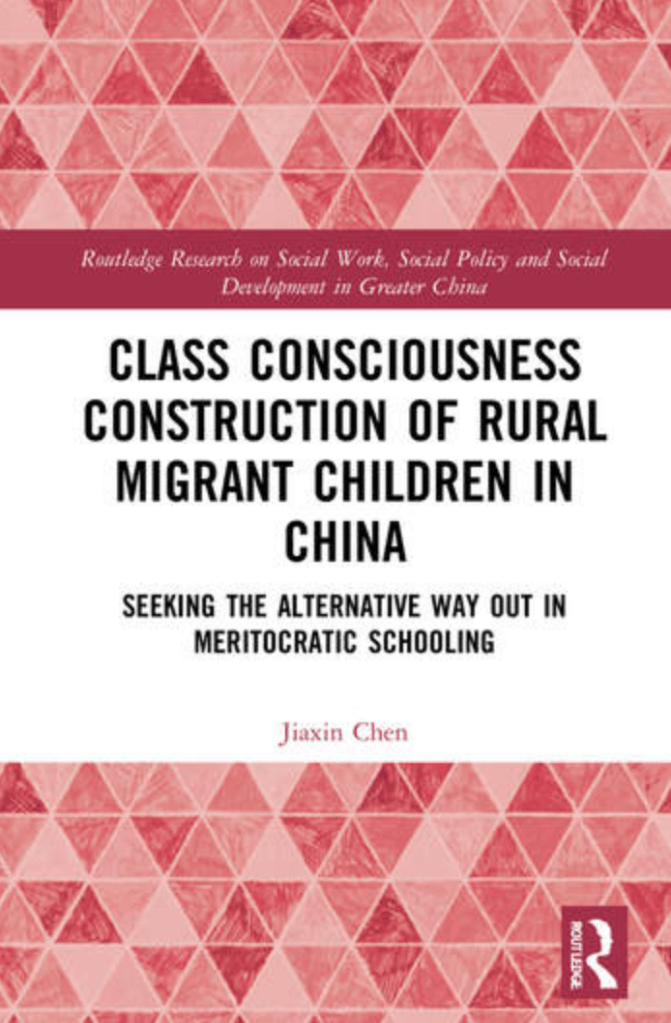
Class Consciousness Construction of Rural Migrant Children in China: Seeking the Alternative Way Out in Meritocratic Schooling

Jiaxin Chen (2022) Class Consciousness Construction of Rural Migrant Children in China. Taylor & Francis.

As China’s urban economy continued to boom after entering the twenty-first century, its rural migrant population experienced unprecedented expansion, making it a significant portion of the working-class people in China. Despite their massive population, rural migrant workers enjoy little labour protection and endure long working hours, subsistence-level wages, and harsh working conditions. However, they rarely take collective action against the injustices they experience. With lacking of the central element for class formation, as the emerging ‘new’ members of the Chinese working class, rural migrant workers are still in the state of ‘class-in-itself’. This phenomenon calls for attention to the formation of migrant workers’ class consciousness.

In this monograph, I address this issue by focusing on its constructive process in childhood. To be specific, I mainly focus on the construction of class consciousness among rural migrant children, who are likely to reproduce their parents’ migrant working jobs in the future. I intend to answer two main research questions: How rural migrant children perceive their surrounding social realities and how their social perceptions could be constructed and reshaped throughout their urban schooling process. I conducted qualitative investigations in two primary schools – one private migrant school and one public school in Beijing between June 2014 and April 2015. Data were drawn from document reviews, questionnaires, interviews, and school observations conducted in the two case schools.

This book borrows Paulo Freire’s works on two states of consciousness – false and critical – of the oppressed to conceptualise an analytic framework. Findings reveal that, even at their young age, rural migrant children had already developed an awareness of manual workers’ poor working conditions and inferior situation relative to their employers. They distinguished between manual and mental labour, firmly subscribing to the latter’s superiority. They also believed in meritocracy, seeing workers’ educational failures as the primary cause of their falling into and being limited to physical labour and their adversities. Because of their perceptions of a hierarchical social structure, rural migrant children favoured mental-labour-oriented occupations and expected to become employers to differentiate themselves from their parents, who mainly worked as manual labourers. However, although rural migrant children considered the employment regime as the critical mechanism of exploitation, they tended to blame incidents of exploitation on the poor moral quality of individual employers and workers’ bad luck.

Such attribution features make it unlikely that these children would take collective action to improve their future employment relations. Indeed, many of them rejected the collective action migrant workers could have performed in the labour market. Therefore, if these migrant children eventually become the next generation of China’s new workers, they may adopt similar strategies as their parents and the current migrant working class, such as enduring hardships and relying upon the employers’ morality and conscience (not workers themselves) to initiate action for improvement.

This book proves that the formation of class consciousness begins early in one’s childhood. However, rural migrant children’s interpretations of perceived class-based inequalities and their intended actions to achieve future improvements showed a state of false consciousness overshadowed by individualism, meritocracy, and the duality of images. More importantly, such dominant ideologies of individualism and meritocracy and the depreciation of migrant workers were strongly embraced by migrant families and school environments, the two most significant institutions shaping migrant children’s class consciousness construction.

The family context plays an important role in revealing the problematic situation of the migrant working class in mainstream society to rural migrant children, allowing them to develop their awareness. However, it must be admitted that migrant parents’ passive acceptance of their bosses’ labour abuses could also send their children the message that workers are weak and have no choice but to swallow the abuse and endure.

Schools, therefore, are expected to play a pivotal role in cultivating children’s critical consciousness, from offering oppressed children a chance to identify that they are situated in social, political, and economic contradictions to problematising the contradictions of (and eventually initiating collective actions against) social oppression. Nevertheless, as discussed in this book, such a possibility is also in danger and challenged by the current schooling system. As investigated, all teachers at the two case schools were committed to the ideology that ‘education changes destiny.’ Like migrant parents, teachers also saw studying hard as the only conceivable way for migrant children to climb the social ladder, even though only a token number would ever enter university and become white-collar professionals, and most would be tracked into vocational education or directly into the labour market. Despite the good intentions underlying teachers’ work to motivate migrant children to study, teachers’ negative narrations of migrant parents embedded within the schools’ educational meritocracy further reinforced rural migrant children’s recognition of manual workers’ inferiority in the labour market.

A small group of teachers in the private migrant school actively attempted to unravel the issues of social inequality among their migrant students in the school context. Nevertheless, labour issues were still rarely addressed in the school context or, again, were viewed from the perspective of the migrant–local/rural-urban dichotomy. Additionally, teachers’ limited teaching competency in the migrant school significantly constrained the quality of their initial attempts to critically analyse class-based inequalities with migrant children.

In this vein, neither the migrant children nor the adults and institutions surrounding them had enough exposure to conceptual resources to form critical views of social inequalities from the class dimension. The above findings suggest that the current lack of collective resistance among China’s ‘new workers’ may result from workers’ strong belief in meritocracy and internalisation of the employer position they developed in their youth while in school.

Overall, this book bridges the research gap by applying a critical class perspective to the analysis of migrant children’s perception of their and their working-class parents’ experiences of marginalisation and exclusion in urban society and the influence of urban schooling thereon. These findings also provide empirical evidence to verify Freire’s explanation of the development of oppressed people’s social consciousness from a Chinese perspective.

Author Bio

Dr Jiaxin Chen, The Hong Kong Polytechnic University

Dr Jiaxin Chen is an Assistant Professor at the Department of Applied Social Sciences, The Hong Kong Polytechnic University, Hong Kong. Her research interests include rural-urban inequalities and labour migration in China, academic mobility, parenting, and rural community development. She is particularly interested in investigating social issues via the sociological lens and qualitative methods. She is currently working on two research projects, academic returnees’ cultural adaptation in Chinese higher education system (funded by Early Career Scheme from Hong Kong Research Grants Council) and rural migrant parents’ involvement in children’s education in China.

Managing editor: Tong Meng