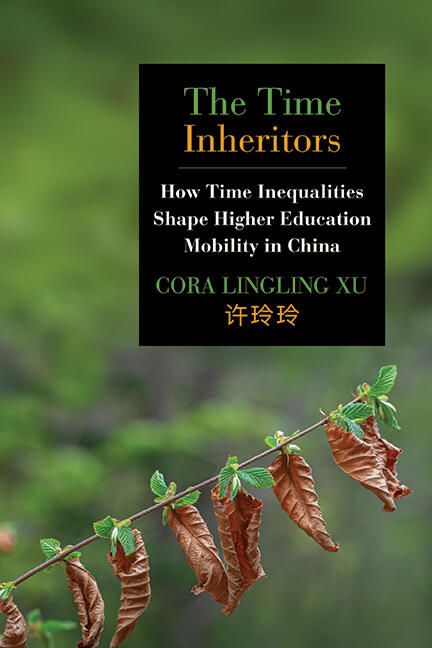
‘The Time Inheritors: How Time Inequalities Shape Higher Education Mobility in China’ by Cora Lingling Xu

We are delighted to share the publication of a new book by our director Dr Cora Lingling Xu. Read this profile (in Chinese) with People Magazine 《人物》杂志 and blog post to learn about the personal stories behind this book.

Please find an abstract of ‘The Time Inheritors‘ and critical reviews below.

If you wish to order this book, you can use SNWS25 to get 30% off when you order from the SUNY Press website.

To learn more about the book talks and interviews visit this page. Listen to the New Books Network’s interview with Cora. 听’时差In-Betweenness’与Cora的对话小宇宙链接). Check out this page for frequently asked questions (e.g. what you should do if you wish to write a book review) about this book. Share your stories of ‘time inheritance’. If you wish to contact Cora about arranging book talks and interviews, complete this contact form.

Abstract

Can a student inherit time? What difference does time make to their educational journeys and outcomes? The Time Inheritors draws on nearly a decade of field research with more than one hundred youth in China to argue that intergenerational transfers of privilege or deprivation are manifested in and through time. Comparing experiences of rural-to-urban, cross-border, and transnational education, Cora Lingling Xu shows how inequalities in time inheritance help drive deeply unequal mobility. With its unique focus on time, nuanced comparative analysis, and sensitive ethnographic engagement, The Time Inheritors opens new avenues for understanding the social mechanisms shaping the future of China and the world.

Critical reviews

“Xu’s conceptually sophisticated monograph reveals how intersectional inequalities are constructed, experienced, and transmitted temporally, with special reference to education. Through the vivid stories of students in mainland China and Hong Kong, and Chinese international students, Xu brings to life different individuals’ ‘time inheritances,’ demonstrating the exciting possibilities time offers as a lens for innovative thinking about inequality. A must-read for sociologists and anthropologists of education, China, and time.” — Rachel Murphy, author of The Children of China’s Great Migration

“Innovative and ambitious, The Time Inheritors proposes a time-centric framework that brings together analyses of social structure, history, individual behavior, and affect. We often feel we are fighting for time. But, as Cora Xu argues in this important study of Chinese students, the scarcity of time is not a given or universal. Different experiences of time result in part from the varying amounts of time we inherit from the previous generation. Time inheritance is therefore critical to the reproduction of social inequality.” — Biao Xiang, coauthor of Self as Method: Thinking through China and the World

“Cora Lingling Xu offers a groundbreaking analysis of educational inequality and social mobility in contemporary China. Xu centers the voices of marginalized students throughout, providing poignant insights into their lived experiences of rural poverty, urban precarity, and educational alienation. At the same time, Xu’s comparative scope reveals how even seemingly privileged groups can be constrained by the temporal logics of social reproduction. The Time Inheritors is a must-read for scholars, educators, and policymakers concerned with educational equity and social justice. Xu’s lucid prose and engaging case studies make the book accessible to a wide audience while her cutting-edge theoretical framework and methodological rigor set a new standard for research on education and inequality.” — Chris R. Glass, coeditor of Critical Perspectives on Equity and Social Mobility in Study Abroad: Interrogating Issues of Unequal Access and Outcomes

“By centering the temporal dimension of who is advantaged or disadvantaged, how, why, and with what consequences, The Time Inheritors takes a unique and powerful approach. Not only does the book contribute theoretically and empirically to our understanding of class inequalities but it also resonates deeply. The inclusion of Chinese translations and characters will give Chinese readers a rich, nuanced cultural appreciation of her findings.” — Dan Cui, author of Identity and Belonging among Chinese Canadian Youth: Racialized Habitus in School, Family, and Media

“An extremely well-written, theoretically informed, and compelling volume that represents a major contribution to the study of education, migration, and social inequality in China and beyond. The Time Inheritors proposes a bold and innovative framework—that of time inheritance—to open the black box of social inequality’s temporal dimension. Whereas the relatively privileged classes inherit temporal wealth and strategies that enable them to bank and save time, facilitating their mobility, the time poor lack this inheritance, forcing them into a vicious cycle of wasting time and paying back temporal debts. Drawing from a rich palette of vivid and intimate longitudinal case studies, The Time Inheritors unpacks the complex intersections between familial, national, and global time inequalities.” — Zachary M. Howlett, author of Meritocracy and Its Discontents: Anxiety and the National College Entrance Exam in China

Release Dates

Hardcover: 1st April 2025

Paperback: 1st October 2025
Call for Papers: CHERN Workshop “Technology-Migration Interlinkages of Chinese Mobilities in Europe”

See the call & apply: China in Europe Research Network (CHERN) working group 5 (Labour and Migration) Workshop and Working Group Meeting
Date: 7–8 September 2023, Amsterdam

Building on calls to pay more attention to the material side of migration (e.g. Basu and Coleman 2008; Vilar Rosales 2018; Tazzioli 2023; Yi-Neumann et al. 2022), including in Chinese contexts (Wang, Zheng, and Gao 2020), this workshop draws attention to technologies as one specific material dimension. In particular, this workshop explores the still little-understood, complex interlinkages of technology and migration in relation to China in Europe. Hereby, technology is broadly understood to comprise “social-material networks or systems, including sets of techniques and equipment, but also trained personnel, raw materials, ideas and institutions […] generating material goods and social relationships […]” (Bray 2008, 320–21). In this sense, technologies play a key role in migration. Analogue technologies like maps, boats, trains, letters, and monetary remittances have long been central to migration (e.g. Chu 2010). More recently, digital technologies such as smartphones and the Internet have shaped migration in new ways (e.g. Sun and Yu 2022), including during the Covid-19 pandemic (Xiang 2022). At the same time, they have also enhanced our methodological toolkits for studying migration. Looking at both non-digital and digital technologies, this workshop asks how migration and migrants are shaped by technologies and how migrants employ and shape technologies.

The workshop invites papers that explores this theme, such as – but not restricted to – the following questions regarding China in Europe:

  • How do technologies such as passports, means of transportation, financial infrastructures, as well as platforms for job searches, studying abroad, immigration and dating enable migration?
  • How do technologies such as border fences, visas and surveillance cameras inhibit, transform or postpone migration?
  • How do technologies like computers, mobile phones and internet networks spur the imaginations and plans of future migrants?
  • How do remote working technologies facilitate “virtual migration” (Aneesh 2006), whereby people stay in their places of origin, but work remotely for companies based in other countries around the world?
  • How do migrants and their friends, relatives and colleagues who stay in China use technologies like WeChat and Alipay to stay connected and maintain social relationships?
  • How are technologies embodied in migrants, and how do they connect migrants and non-migrants, e.g. in the form of shared knowledge and techniques?
  • How do technologies shape migrants’ bodies, e.g. when consulting online doctors?
  • How do technologies and related knowledge and skills migrate alongside migrants,e.g. in view of knowledge migration and talent recruitment?

Please submit your abstract (max. 250 words) as well as a short biographical note, including your name and affiliation, by 30 April 2023 to Lena Kaufmann (lena.kaufmann@uzh.ch).

This interdisciplinary workshop is held on behalf of the Working Group 5 Labour and Migration of the COST Action CA18215 China in Europe Research Network (CHERN) and is open to all CHERN members. It will be organised in conjunction with the CHERN Joint Working Group Conference at the University of Amsterdam, on 7–8 September 2023. Funding of travel costs is available for workshop participants whose papers have been selected for presentation and who are eligible for reimbursement according to the e-COST criteria. For any questions regarding the eligibility of CHERN membership and reimbursement, please contact Alexandra Filius (a.filius@vu.nl).

References

Aneesh, A. 2006. Virtual Migration: The Programming of Globalization. Durham, NC: Duke University Press.

Basu, Paul, and Simon Coleman. 2008. “Introduction: Migrant Worlds, Material Cultures.” Mobilities 3 (3): 313–30.

Bray, Francesca. 2008. “Science, Technique, Technology: Passages between Matter and Knowledge in Imperial Chinese Agriculture.” The British Journal for the History of Science 41 (3): 319–44.

Chu, Julie Y. 2010. Cosmologies of Credit: Transnational Mobility and the Politics of Destination in China. Durham, NC: Duke University Press.

Sun, Wanning, and Haiqing Yu. 2022. WeChat and the Chinese Diaspora: Digital Transnationalism in the Era of China’s Rise. London: Routledge.

Tazzioli, Martina. 2023. “Counter-Mapping the Techno-Hype in Migration Research.” Mobilities 0 (0): 1–16.

Vilar Rosales, Marta. 2018. “Framing Movement Experiences: Migration, Materiality and Everyday Life.” Transitions: Journal of Transient Migration 2 (1): 27–41.

Wang, Cangbai, Victor Zheng, and Hao Gao. 2020. “Materialities and Corridors: The Chinese Diaspora and Connected Societies.” Asian and Pacific Migration Journal 29 (2): 133– 38.

Xiang, Biao. 2022. “Remote Work, Social Inequality and the Redistribution of Mobility.” International Migration 60 (6): 280–82.

Yi-Neumann, Friedemann, Andrea Lauser, Antonie Fuhse, and Peter J. Bräunlein, eds. 2022. Material Culture and (Forced) Migration: Materializing the Transient. London: UCL Press.

Managing editor: Lisa (Zhiyun Bian)

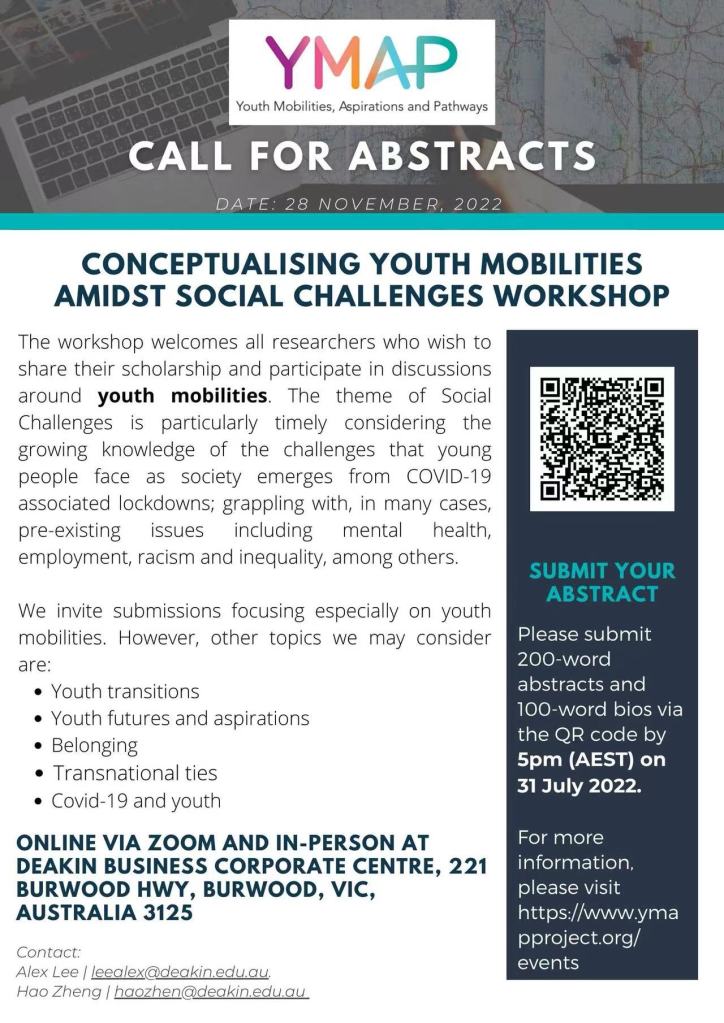
Call for Abstracts: Conceptualising Youth Mobilities amidst Social Challenges Workshop

Conceptualising Youth Mobilities amidst Social Challenges will bring together researchers with an interest in youth mobilities, from across the social sciences, for a one-day workshop. This workshop will be held on Monday, 28 November 2022, at Deakin Burwood Corporate Centre (BCC) and online on Zoom.  

The workshop welcomes all researchers who wish to share their scholarships and participate in discussions around youth mobilities. It seeks to provide an opportunity for attendees to build networks and connect with like-minded researchers at all stages of their careers, including early career and postgraduate. We seek to support research that has a connection to Australia. However, we also recognise that as youth mobilities research, this may likely include connections to places overseas.

We invite presentations that examine transnational youth mobilities amidst the social challenges of our contemporary world. What is the role of mobility in young people’s negotiation of social challenges? How might emerging forms of mobility (re)shape perceptions of adulthood and aspirations for youth transitions? How do young people construct belonging and place in a mobile world?


The theme of Social Challenges is particularly timely considering the growing knowledge of the challenges that young people face as society emerges from COVID-19 associated lockdowns; grappling with, in many cases, pre-existing issues including mental health, employment, racism and inequality, among others.  

We invite submissions focusing especially on youth mobilities. However, other topics we may consider are:
• Youth transitions
• Youth futures and aspirations
• Belonging
• Transnational ties
• Covid-19 and youth

Traditional academic papers and alternative presentations (e.g. creative readings, collective presentations, posters, etc.) are welcome. Please submit 200-word abstracts and 100-word bios via the Google Form by 5pm (AEST) on 31 July 2022. For questions or more information, please get in touch with Hao Zheng (haozhen@deakin.edu.au) or Alex Lee (leealex@deakin.edu.au).

Managing editor: Tong Meng