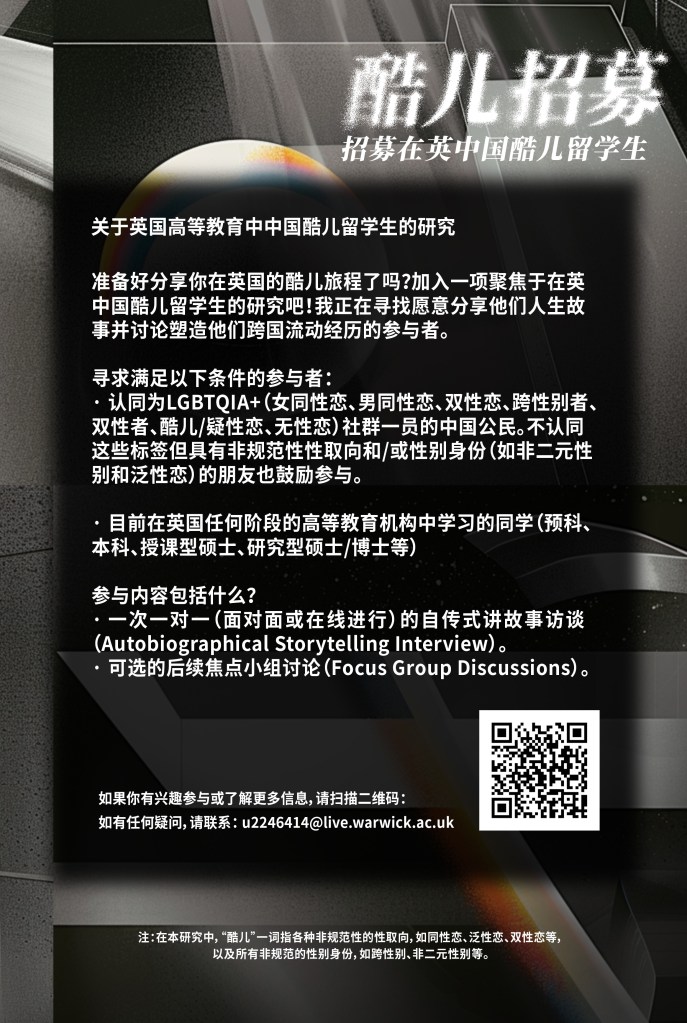
Call for Participants: Exploring the Experiences of LGBTQIA+ Chinese Students in the UK

Haoxi Ou at the University of Warwick is seeking LGBTQIA+ Chinese international students in the UK to participate in a research project exploring their experiences and the kinds of desires that animate international mobility.

Managing Editor: Tong Meng

What Has COVID-19 Taught Us: Advancing Chinese International Student-Related Research, Policies, and Practices Through Critical Race Perspectives

Research Highlighted: 

Yu, J. (2023b). What Has COVID-19 Taught Us: Advancing Chinese International Student-Related Research, Policies, and Practices Through Critical Race Perspectives. Teachers College Record, 125(6), 110-118. https://doi.org/10.1177/01614681231190165

“I’m not excited about ‘going back to normal,’ because normal was the place where all the failures were for the kids I’m concerned about.” ― Gloria Ladson-Billings (December 20, 2020)

As we are ramping up to the return of in-person events in the post-pandemic environment, Gloria Ladson-Billings, a critical race theory scholar, reminds us that the COVID-19 pandemic should be a transformative opportunity that forces us to break with the past and imagine the world anew. For the field of international higher education, this call is right on time. Due to the unprecedented pandemic, international activities, especially cross-border student mobility, have been disproportionately impacted (Mok et al., 2021; Yu, 2021a). As the largest international student group in U.S. higher education, Chinese students have been made particularly vulnerable due to the resurgence of anti-Asian racism and U.S.-China geopolitical tensions. There is therefore a pressing need to make sense of Chinese international students’ perspectives and experiences around U.S. higher education—and in doing so, to highlight the ever-present educational inequalities rooted in academic capitalism, global unevenness, and institutional racism.

This article builds on the results of a critical qualitative research project investigating Chinese international students’ agency, decision-making, and perceptions of race, racism, and power (Yu, 2021a, 2021b, 2022a, 2022b, 2023a, Under Review abc). Drawing from interdisciplinary studies of international education, Asian American studies, sociology, and migration studies, this research project brings critical race perspectives to understanding Chinese students’ transnational mobilities and practices. It aims to unveil global hierarchies and racial inequalities in the field of international education in order to help advance future research and open new paths to practice.

Ideas for Critical Research

The COVID-19 pandemic has taught us that the neoliberal model of international education is falling apart (De Wit, 2020). There is a renewed interest in and urgency for educators, scholars, and practitioners to rethink the field of international higher education through a critical race lens. In considering the theoretical implications of this fact for research, ethical and political dimensions should be centrally incorporated to ponder the issues of rights, responsibility, justice, and equity within international higher education. In recent years, more and more scholars have reset the research agenda and have started to critically reflect on international student mobility (Stein, 2017; Yang, 2020) and academic knowledge production (Kubota, 2020; Shi-xu, 2014); however, theoretically sophisticated critical research on international students’ lived experiences with racism and racialization is still urgently needed. In response to this theoretical challenge, I put forward an innovative framework, Global Asian Critical Race Theory or GlobalAsianCrit (Yu, Under Reviewa), as a contribution that combines the key tenets in Asian Critical Race Theory (Iftikar & Museus, 2018) and Global Critical Race Theory (Christian, 2019). In this creative framework that I proposed, I incorporated both a racial/ethnic and a critical global view into CRT to help understand how global white supremacy has shaped the racial realities of Asian individuals and how racial oppression works differently in different geographical contexts.

Ideas for Equity-Driven Policies

The COVID-19 pandemic and the related rise of anti-Asian racism have also revealed that international students of color are excluded from equity and social justice discourses in U.S. higher education. Thus, institutional policies should start by including disaggregated data on international students’ racial, ethnic, and national identities, which enables colleges and universities to acknowledge the heterogeneity within the highly reductive federal category of “nonresident alien” and to understand the diverse nature of these students’ learning experiences. Disaggregating the data and exploring the heterogeneity within this diverse group of students will be helpful for policymakers, institutional leaders, faculty, staff, and administrators to identify the specific needs of these international students and to support their sustained success and development in the U.S.

In addition, despite the fact that diversity and inclusion are continuously advocated in U.S. higher education, international students have been largely absent from debates and discussions of anti-Blackness and anti-Asian sentiment, due to their status as foreign students and temporary residence. Given this history of exclusion and ethnic discrimination, institutional policies should include global perspectives to uphold principles of educational equality and social justice for international students.

Ideas for Inclusive Practices

Finally, I propose three practical strategies for appropriately supporting Chinese international students. First, open discussions of race, racism, and power need to be included in institutions’ orientation sessions for international students. My research (Yu, 2022a) demonstrates that there is a great discrepancy in Chinese students’ understanding of race and racism before and after their migration to the U.S. It is necessary to equip international students with basic racial knowledge, such as how to identify racist comments and where to seek institutional help when discrimination and racial stereotyping occur. Administrators and practitioners can provide much-needed space for open conversations and transparent communications around racialized incidents on campus. Moreover, providing general education courses on the sociohistorical background of race, racism, and free speech in the U.S. can help international students better understand the complex racial reality of U.S. institutions and the wider society.

Secondly, administrators and staff should use an asset-based approach to designing services and workshops for international students on campus. While various activities are designed for international students to quickly adapt to U.S. campus culture, most available programs tend to be based on a deficit mindset of Chinese students or rooted in racialized logic. The asset-based practices that I recommend are intentional ways of acknowledging and leveraging the strengths of international students, including their everyday experiences, knowledge, and cultural practices to serve as resources for teaching and learning. Domestic students should not be excluded from these events and activities, for critical cultural awareness and cross-cultural communicative skills are essential qualities for all students to work with people from linguistically and culturally diverse backgrounds in future various professional situations.

Thirdly, colleges and universities should structurally facilitate international students’ engagement with domestic students and wider local communities. My research (Yu, 2022b) shows that Chinese students may express prejudicial attitudes toward other people of color, especially African Americans. More interracial contact can help both international and domestic students disrupt their stereotypes about one another. Hence, this form of support for international students can foster their sense of belonging or cohesiveness in a specific campus organization or activity. U.S. institutions should take shared responsibility to reinvest some of the income generated by international student tuition toward creating and supporting inclusive student clubs and extracurricular activities.

Conclusion

It is clear that Chinese international students are “raced” in the U.S., so instead of demanding that students conform to the oppressive social norms and meet the academic expectations of the (white) host learning environment, social justice efforts should be made to interrupt hegemonic thinking and complicate notions of race and racism by looking beyond the limited understanding of these concepts within U.S. borders. As Gloria Ladson-Billings reminded us, the COVID-19 pandemic can be a portal, a gateway to imagine a new world for K-12 schools as well as international higher education. 

References:

Christian, M. (2019). A global critical race and racism framework: Racial entanglements and deep and malleable whiteness. Sociology of Race and Ethnicity, 5(2), 169–185.

De Wit, H (2020). Internationalization of higher education: The need for a more ethical and qualitative approach. Journal of International Students 10(1), i–iv.

Iftikar, J. S., & Museus, S. D. (2018). On the utility of Asian critical (AsianCrit) theory in the field of education. International Journal of Qualitative Studies in Education, 31(10), 935-949.

Mok, K. H., Xiong, W., Ke, G., & Cheung, J. O. W. (2021). Impact of COVID-19 pandemic on international higher education and student mobility: Students perspectives from mainland China and Hong Kong. International Journal of Education Research, 105, 101718.

Stein, S. (2017). Internationalization for an uncertain future: Tensions, paradoxes, and possibilities. Review of Higher Education, 41(1), 3–32.

Yang, P. (2020). Toward a framework for (re)thinking the ethics and politics of international student mobility. Journal of Studies in International Education, 24(5), 518–534.

Yu, J. (2021a). Lost in lockdown? The impact of COVID-19 on Chinese international student mobility in the US. Journal of International Students, 11(S2), 1-18.

Yu, J. (2021b). Caught in the middle? Chinese international students’ self-formation amid politics and pandemic. International Journal of Chinese Education, 10(3), 1-15.

Yu, J. (2022a). The racial learning of Chinese international students in the US context: A transnational perspective. Race, Ethnicity and Education. Advance Online Publication https:// doi.org/10.1080/13613324.2022.2106878

Yu, J. (2022b). “I don’t think it can solve any problems”: Chinese international students’ perceptions of racial justice movements during COVID-19. Journal of Diversity in Higher Education. Advance Online Publication https://doi.org/10.1037/dhe0000457

Yu, J. (2023a). Understanding Chinese international students in the U.S. in times of the COVID-19 crisis: From a Chinese discourse studies perspective. Journal of Multicultural Discourses. Advance Online Publication https://doi.org/10.1080/17447143.2023.2214538

Yu, J. (Under Reviewa). Exploring Chinese international students’ experiences in times of crisis through Global Asian Critical Race Theory.

Yu, J. (Under Reviewb). “Asians are at the bottom of the society”: Chinese international students’ perspectives on Asian Americans in the U.S. racial hierarchy.

Yu, J. (Under Reviewc). #YouAreWelcomeHere? The two faces of American higher education toward Chinese international students.

Authors’ Bio 

Jing Yu PhD, is an Assistant Professor of International Higher Education in the Department of Educational Leadership and Policy Analysis and a Faculty Affiliate in Asian American Studies at University of Wisconsin-Madison. Her research interests include international student mobility, intersections of race, class, and nationality, and international dimensions of equity, diversity, inclusion, and belonging. Her recent project on Chinese international students’ everyday racism and mental health issues has been successfully funded by the Spencer Foundation’s small research grants. She is on the editorial board of the Journal of Diversity of Higher Education, Journal of College Student Development (Research in Briefs), and Journal of Student Affairs Research and Practice.

Managing Editor: Xin Fan

Micro-processes of knowledge sharing in higher education: international students as a source

Yunxin Luo (2023): Micro-processes of knowledge sharing in higher education: international students as a source, Studies in Higher Education, DOI: 10.1080/03075079.2023.2253457

Knowledge sharing is seen as a process involving the donation or collection of knowledge by both the provider and the recipient (Tangaraja et al., 2016). In higher education, knowledge sharing involves faculty and students sharing their knowledge, experiences, insights, and ideas among themselves. International students are fundamental actors in the knowledge sharing process in higher education (Gamlath and Wilson 2022). They play an important role in enabling universities to generate new knowledge and innovation through their contribution to knowledge sharing, intercultural exchange and research (Singh 2009; Pagani et al. 2020; Luo, 2023). Currently, little is known about the knowledge activities of international students and how knowledge sharing processes unfold in higher education. To address these research gaps, this study takes the first step toward delineating the process of knowledge sharing by taking account of international students as knowledge source. This article show how they shape this process to provide more nuanced evidence to discuss the role of international students in knowledge sharing.

Research Method

Based on a qualitative approach, this article studied how the knowledge sharing process in higher education unfolds through the case of Chinese international students in Russian universities. Purposeful sampling techniques were used and a total of twenty-one Chinese students participated in the study. Data for the study came primarily from semi-structured interviews and triangulation of evidence through observation and literature review. In order to elicit specific knowledge-sharing experiences from international students, the critical incident technique was used. Data analysis involves a constant comparison between data and emerging theoretical structures, and a three-step process is used to analyze the data.

Findings

The results of this study, firstly, clarify the knowledge roles of international students. That is, international students are not only knowledge receivers but also knowledge providers. We found that international students are not ‘deficits’, rather they have developed or embedded knowledge and are shaping multicultural exchanges. Secondly, the article sheds light on the micro-processes that take place during knowledge sharing in higher education institutions. The results of this study were synthesized into a proposed model of the knowledge sharing process, describing the activities and four stages associated with knowledge sharing for international students: Prerequisite, Initiation, Unidirectional sharing and Evaluation. We found that international students are influenced by key factors in the knowledge sharing process, and the relative weights of each factor vary across the four stages of knowledge sharing. We also found that knowledge sharing by international students in higher education institutions is a gradual and dynamic process. There may be a shift from one-way providing to two-way exchange during this process.

The result of the current study provides a starting point for subsequent research in knowledge management and higher education. This study elaborated on the processes of knowledge sharing that have not been investigated in previous studies, and the results contribute to understanding the knowledge roles and behaviors of international students. This study provides information on how to provide support at each identified stage to facilitate knowledge sharing by international students. Higher education needs to move away from deficit thinking and adopt a more inclusive and multicultural approach to supporting international students (Nada and Araújo, 2019) to facilitate knowledge sharing among international students and to promote a virtuous cycle of knowledge communication in higher education.

References

Tangaraja, Gangeswari, Roziah Mohd Rasdi, Bahaman Abu Samah, and Maimunah Ismail. 2016. “Knowledge Sharing is Knowledge Transfer: A Misconception in the Literature.” Journal of Knowledge Management 20 (4): 653–70. https:// doi.org/10.1108/JKM-11-2015-0427.

Singh, Michael. 2009. “Using Chinese Knowledge in Internationalising Research Education: Jacques Rancière, an Ignorant Supervisor and Doctoral Students from China.” Globalisation, Societies and Education 7 (2): 185–201. https://doi.org/10.1080/14767720902908034.

Pagani, Regina Negri, Bruno Ramond, Vander Luiz da Silva, Gilberto Zammar, and João Luiz Kovaleski. 2020. “Key Factors in University-to-University Knowledge and Technology Transfer on International Student Mobility.” Knowledge Management Research & Practice 18 (4): 405–23. https://doi.org/10.1080/14778238.2019.1678415.

Gamlath, Sharmila, and Therese Wilson. 2022. “Dimensions of Student-to-Student Knowledge Sharing in Universities.” Knowledge Management Research & Practice 20 (4): 542–56. https://doi.org/10.1080/14778238.2020.1838961.

Nada, Cosmin I., and Helena C. Araújo. 2019. “‘When You Welcome Students Without Borders, You Need a Mentality Without Borders’ Internationalisation of Higher Education: Evidence from Portugal.” Studies in Higher Education 44 (9): 1591–604. https://doi.org/10.1080/03075079.2018.1458219.

Luo, Yunxin. 2023. “International Student Mobility and its Broad Impact on Destination Countries: A Review and Agenda for Future Research.” Industry and Higher Education. https://doi.org/10.1177/09504222221150766.

Author’s Bio

Yunxin Luo, Saint-Petersburg University

Yunxin Luo is a PhD candidate in Economic and Management program at the Saint-Petersburg University. She pursued her bachelor’s degree in Management at Henan University (China) and master’s degree in Education at the University of Adelaide (Australia) before attending the Saint-Petersburg University (Russia) to pursue her PhD. Her research is interdisciplinary, and lies at international migration, global mobility, human capital circulation, knowledge management, with the focus on international students and young talents. Her recent publications appear in journals such as Studies in Higher Education, International Journal of Consumer Studies, and Industry and Higher Education.

Email: luoyx627@gmail.com

ORCiD: https://orcid.org/0000-0001-9562-1376

Managing Editor: Tong Meng

The Reconstruction of the Cosmopolitan Imaginary: Chinese International Students during the COVID-19 Pandemic

Liu, Q. T., & Chung, A. Y. (2023). The Reconstruction of the Cosmopolitan Imaginary: Chinese International Students during the COVID‐19 Pandemic 1. Sociological Inquiry.

Although viewed as belonging to both Asian and Asian American communities, Chinese international students’ experience of discrimination in the U.S. during the pandemic is distinct from those of both long-term immigrants and native-born Asian Americans. The traditional scholarship on Asian/American racial citizenship does not fully explain the intersectional interplay of race and nationality on their sense of non-citizen “Otherness” between nations and the impact on their worldview. We want to highlight that the societal reception to specific immigrant groups has been influenced by not only the social standing of the group within the host nation but also by the geopolitical positioning of their sending nation to the host nation within the world order (Le Espiritu, 2003; Ong, 1999).

Studies on transborder migrants and western-born Asian return migrants suggest that resident citizens in their ancestral nation may also question the national loyalties, sexualities, opportunism, and even class-privileged positionality of nonresident migrants in the diaspora (Chung et al., 2021; Wang, 2016). During the global pandemic, transborder migrants have occupied this growing liminal space between countries in a manner that further distances them not only culturally but also, socially and politically from the worldview of resident citizens in both countries.

In the meantime, the scholarship on cosmopolitanism provides an analytical entryway for understanding the post-colonial features of the western global imaginary today, but they leave open the question of how cosmopolitanism can also be used as a way to reclaim a sense of identity and belonging for diasporic migrants who traverse the borders of developed and developing nations. Our article explores the possibility of a critical cosmopolitan imaginary among international students apart from its colonialist or Western imperialist roots (Mignolo, 2000) and instead, as a reclamation of the nationally liminal aspirations and identities of Asian international students throughout the processes of transnational mobility (Martin, 2021).

Methods

The data for this article come from 16 semi-structured interviews that were collected by phone, remote conferencing, and in-person meetings from spring 2020 through spring 2021 at a university in upstate New York. All the interviews were conducted in their native language–Mandarin. Given the changing disease control policy in China, the political transition from the Trump administration to Biden administration, and the shifting geopolitical dynamics between the two global powers, we later conducted six follow-up interviews in November 2020, January 2021, and May 2022 to track new developments and validate our main findings. The time period for this study is critical in understanding how the cosmopolitan identities and viewpoints of Chinese international students have evolved in response to unusual mobility restrictions and rising ethnonational rhetoric in both U.S. and China. Our interviews generally ranged from 30 minutes to 2 hours in length and we used the grounded theory approach to conduct data analysis.

Findings

The study explains how international students navigate their increasing racially and nationally liminal status between nations and national categories of belonging, particularly during times of crisis. First, the worldview of Chinese international students in the U.S. is conditioned by pre-migration cultural frameworks and geopolitical positioning within the global order–in this case, growing tensions between China and the U.S. that have the potential to create disjunctures between their understanding of race and the dynamics of racial formations in America. This historical disconnect explains some of the contradictions scholars have observed in the solidarity of foreign-born Chinese against anti-Asian hate yet indifference or opposition to affirmative action, Black Lives Matter, and President Trump–all of which were hotly debated during this period (Linthicum, 2016; Poon & Wong, 2019). Our findings suggest that being caught within a “liminal” space makes it challenging for transborder migrants to make sound connections or establish broad solidarity with other Asians, Asian Americans, or other BIPOLC (Black, Indigenous, and People of Color) groups. All of this points to the urgent need for greater, not lesser, education on the multiple and interconnected histories of subjugated groups around the world. Future research may explore to what extent other white international students–such as Russians who themselves come from a country that currently has tense relations with the U.S.—fear backlash to the same degree as non-white immigrants.

Second, because of their nation-less status as diasporic migrants during this period, Chinese students unexpectedly encountered significant pushback from their home government and even hostility and resentment from many fellow citizens–all of which exacerbated their insecure positionality as in-between citizens. Consequently, Chinese international students interpreted and responded to hardening racial and national borders during COVID-19 from the perspective of both displaced racial minorities and transborder migrants. Recent events in China–particularly President Xi’s increasing authoritarian control over the country–may further distance Chinese transborder migrants abroad from their resident compatriots back home (Huang, 2022; Ni, 2022), even as their disconnect from the racial politics of America contributes to their further national liminalization. Future research may explore to what degree this increasing sense of dislocation may explain the conservative ideological bent of Chinese diasporic communities from local communities in the host countries as noted by other pundits (Jiang, 2021; Liu, 2005).

Third, the current body of scholarship suggests that the younger generation of Chinese– whether at home or abroad–are instilled with a strong sense of nationalist loyalty (Wong, 2022), and other studies (Fan et al., 2020) do indicate that discrimination increases Chinese overseas students’ support for authoritarian rule back home. But we find that a broadly sweeping discourse of hyper-nationalism or alternatively, Western colonialist approach to cosmopolitanism oversimplifies their complicated and individualized relationships with their country (Martin, 2021; Wong, 2022) and how it may be taking shape within a post-national global context. Increasing exclusion and dislocation from both US and China have pushed students into a position that both straddles and transcends this nationally and racially liminal space between both countries. As a strategy to overcome this disadvantage, our participants have reappropriated and renegotiated their “cosmopolitan imaginary” in ways that have further alienated them from the official nationalist rhetoric of both countries but resisted “the will to control and homogenize” under the dictates of Western colonialism and modernization (Mignolo, 2000). In the process, they have reclaimed an ideal stripped of its colonialist connotations and used it to reassert their rights and privileges as transborder migrants. If these national divides persist, the question remains which countries will ultimately benefit from the incorporation of highly skilled migrants through greater social acceptance, flexible citizenship policies, and competitive work opportunities.

Overall, our study argues for a more critical approach to international education that does not merely reproduce the nationalist frameworks of the Global North or South nor overlooks the hegemonic effects of post-colonial legacies and global inequalities in shaping migrant experiences. This task will require greater scholarly and public attention to the wide range of transborder migrants and refugees who have been trapped in between competing nations, parties, and ideologies in the post-COVID era.

References

Chung, A. Y., Jo, H., Lee, J. W., & Yang, F. (2021). COVID-19 and the political framing of China, nationalism, and borders in the US and South Korean news media. Sociological Perspectives64(5), 747-764.

Fan, Y., Pan, J., Shao, Z., & Xu, Y. (2020). How Discrimination Increases Chinese Overseas Students’ Support for Authoritarian Rule. 21st Century China Center Research Paper, (2020-05).

Huang, K. (2022). ‘Runology:’ How to ‘Run Away’ from China. Council on Foreign Relations, June, 1.

Jiang, S. (2021). The call of the homeland: Transnational education and the rising nationalism among Chinese overseas students. Comparative Education Review65(1), 34-55.

Le Espiritu, Y. (2003). Home bound: Filipino American lives across cultures, communities, and countries. Univ of California Press.

Linthicum, K. (2016). Meet the Chinese American immigrants who are supporting Donald Trump. Los Angeles Times, May27.

Liu, H. (2005). New migrants and the revival of overseas Chinese nationalism. Journal of Contemporary China14(43), 291-316.

Martin, F. (2021). Dreams of flight: the lives of Chinese women students in the West. Duke University Press.

Mignolo, W. (2000). The many faces of cosmo-polis: Border thinking and critical cosmopolitanism. Public culture12(3), 721-748.

Ni, V. (2022). ‘Run Philosophy’: The Chinese Citizens Seeking to Leave amid Covid Uncertainty. The Guardian, July, 20.

Ong, A. (1999). Flexible citizenship: The cultural logics of transnationality. Duke University Press.

Poon, O., & Wong, J. (2019). The generational divide on affirmative action. Inside Higher Ed: Admissions Insider.

Wang, L. K. (2016). The Benefits of in-betweenness: return migration of second-generation Chinese American professionals to China. Journal of Ethnic and Migration Studies42(12), 1941-1958.

Wong, B. (2022). The Complex Nationalism of China’s Gen-Z. The Diplomat, June, 19.

Author bio

Qing Tingting Liu, University at Albany

Qing Tingting Liu (tliu20@albany.edu) is a Ph.D. candidate in the Sociology Department at SUNY Albany. She has been serving for AAAS Social Science Caucus Council as a Social Media Coordinator for more than 2 years https://sites.google.com/view/aaas-socsci/home. She is also affiliated with the University of Melbourne – Asian Cultural Research Hub (ACRH) https://arts.unimelb.edu.au/school-of-culture-and-communication/our-research/groups-and-resource-centre/asian-cultural-research-hub-acrh/our-members. Her research interests include migration, globalization, race and ethnicity, intersectionality and youth culture. Her dissertation project is about Chinese Working Holiday Makers in Australia, aiming to explore how temporal liminality affects their identity as Chinese diaspora living in Western society. For the detail of her profile, please see https://www.linkedin.com/in/qing-tingting-liu-251bb6181/ .

Angie Y. Chung, University at Albany

Angie Y. Chung is Professor of Sociology at the University at Albany, a 2021-2022 U.S. Fulbright Scholar, and former Visiting Professor at Yonsei and Korea University. She is author of Saving Face: The Emotional Costs of the Asian Immigrant Family Myth and Legacies of Struggle: Conflict and Cooperation in Korean American Politics. She is currently writing a book manuscript titled Immigrant Growth Machines: Urban Growth Politics in Koreatown and Monterey Park based on research funded by the National Science Foundation. She has published in numerous journals on race/ ethnicity, immigration, gender and family, ethnic politics, international education, and media.

Managing Editor: Tong Meng

Research with International Students Conference

December 11 – 12, 2023
Hybrid: at the University of Manchester (United Kingdom) and online

This conference is funded by The Spencer Foundation and builds on the upcoming publication of the Research with International Students book (to be published in late 2023). It further establishes a network of critical researchers and scholars who wish to develop more ethical approaches towards research that includes international students as participants and co-researchers. 

Conference focus

There is a growing recognition in research with international students that their experiences are intersectional (George Mwangi et al. 2019) and unequal (Mok and Zhang 2022). Although international students share a migrant identity, there is significant variation in how their experiences may be racialized, gendered, or seen through ableist or heteronormative lenses. For instance, different groups of international students are routinely ‘othered’ (Moosavi 2021) or stereotyped (Heng 2018) through assumptions they should ‘assimilate’ into the cultures and practices of their hosts. Scholars are also increasingly documenting the ways that becoming an international student may lead to renegotiating new minoritized identities in contexts where concepts such as race may be socially and culturally constructed in different ways (Madriaga and McCaig 2019). International students’ experiences with prejudices, xenophobia, and racism are also well documented (Jiang 2021; Harrison and Peacock 2009; Ladegaard 2017), where some research has started to unravel how this may unfold differently for students with different racial (Ramia 2021), religious (Arafeh 2020), gender (Brooks 2015), or dis/abled (Olave-Encina 2022) identities (among others).

However, research focusing on intersectional inequalities is the exception rather than the rule, as international students are routinely collectivised in research as a homogenised group (Jones 2017). Research has also historically operated from positions of deficit (Lomer and Mittelmeier 2021), as international students are often assumed to ‘lack’ experiences or skills necessary for success, particularly compared to home students. Similarly, international students are frequently portrayed as only experiencing challenges or difficulties (Deuchar 2023), which fails to see the complexity of their multidimensional and intersectional experiences. For example, the subfield is rife with research that seeks to ‘fix’ perceived problems with international students’ believed lack of critical thinking, language proficiency, classroom participation, or referencing knowledge, without reflecting that their educational experiences and knowledges may be different, but not deficient (Heng 2018). 

Many current research approaches fail to view international students as ‘epistemic equals’ (Hayes 2019) whose knowledges and experiences are equally worthy of inclusion rather than erasure. Further, the failure to recognise, document, and address intersectional facets of international students’ identities (of race, religion, gender, sexuality, disability, class, and more) through research means there are limited evidence-based measures for countering inequalities in practice. 

Given these issues, this conference focuses specifically on research designs and approaches within the subfield of research with international students. We aim to develop more methodological guidance to steer the subfield away from problematic discourses and assumptions. Therefore, we invite presentations which consider issues around the following questions:

  • What critical conceptual and methodological issues currently face research with international students as a subfield?
  • What are practical (macro or micro) considerations for research designs in this subfield?
  • How can researchers consider issues of power, inequality, intersectionality, and ethics in research with international students?
  • How might research with international students be imagined differently?
  • What should the future of research with international students look like?

Conference format

This is a two-day hybrid conference with a face-to-face component at the University of Manchester (UK) that will be streamed online. All presentation sessions will be recorded and shared online afterwards for those not able to attend live, but informal discussion sessions will not be recorded. We encourage as many speakers as possible to attend in person, but contributions will be considered at a distance if required. Prior to the conference, we will hold a pre-conference networking workshop online. We also aim to co-create a set of methodological guides for our website, which participants will be invited to collaborate on online after the conference. We ask all accepted speakers to participate in the full conference. 

Confirmed keynotes

We are pleased to confirm the following keynote speakers will join us at the conference in Manchester:

  • Kalyani Unkule (O.P. Jindal Global University)
  • Chrystal A. George Mwangi (George Mason University)
  • Hanne Kirstine Adriansen (Aarhus University) 

Submission guidance

You are invited to contribute as a presenter. We welcome contributions from around the world and support the inclusion of early career researchers and international student scholars. Authors may submit an abstract for an empirical or theoretical presentation related to the conference theme. Please note that the purpose of this conference is to focus on methodological and conceptual considerations for research with international students on a broader scale, considering the process of how we undertake research in the subfield. While authors are welcome to include examples of their research findings in their presentations, abstracts which fully intend to share research findings only will not be accepted.

You can submit a title and abstract of up to 300 words for consideration here: https://www.qualtrics.manchester.ac.uk/jfe/form/SV_5sYVTQcR4Cyuwo6
All (co-)authors will also be asked to include a short 100-word bio for inclusion in the conference programme.

If the Qualtrics survey is inaccessible for any reason, please contact the organisers. 

Deadline: 12:00 noon UK time on 17 July 2023
Time zone converter: https://www.timeanddate.com/worldclock/converter.html?iso=20230717T110000&p1=302 

Funding

This conference is free to attend, in person or online. 

The conference is funded by The Spencer Foundation’s Conference Grants Program. Limited funding is available to support scholars with attending the conference in Manchester (UK). This funding will be competitive and is reserved for those with the highest quality abstracts. Funding will be prioritised for the following categories:

  • Scholars with no institutional funding available for conference travel
  • Scholars based in ‘Global Majority’ or ‘Global South’ contexts
  • Scholars who identify as ethnic, religious, or cultural minorities in their contexts 
  • Disabled scholars
  • Scholars with caring responsibilities 
  • International student scholars
  • Early career researchers 
  • Scholars with any other marginalised or minoritised background or identity in their context 

We are unable to offer funding to scholars who already have institutional funding available for conference attendance. 

The abstract submission form will allow you to indicate whether you would like to be considered for funding to attend. A full application for funding should be submitted by August 31st at: https://www.qualtrics.manchester.ac.uk/jfe/form/SV_6lpysfOxC7NUF94

In the application, you should include a rough budget for the funding you would like to request. If successful, travel and hotels will be booked on your behalf by the conference team (no need to fund up front) and reimbursement is available for visa costs, caring costs, or supporter’s costs. Due to limited available funding, we will likely not be able to fund all requests and ask attendees to keep costs to a minimum to help us stretch the budget as far as we can. We are only able to fund a hotel around the conference days (up to 3 days maximum) and any extended stays will be at the attendee’s own expense. Lunches will be available at no cost on conference days, but other subsistence is at the attendee’s own expense (information about local grocery stores and budget restaurants will be provided). All travel must be in ‘economy’ class. Separate applications must be made for each individual author who wishes to attend.

Maximising your time in the UK: 

Other conferences

We have purposefully scheduled this conference to coincide with two other higher education conferences in the UK, should participants wish to maximise their travel. If you are in receipt of funding to attend our conference, we can pay for travel to/from your choice of an airport or train station in the UK, but not travel between conferences or hotel stays beyond the Research with International Students conference. 

Please note that abstracts to the Research with International Students conference should be significantly different from presentations made at SRHE or ChinaHE.

Collaboration and co-working

If you would like to extend your stay in Manchester for the purposes of collaboration and/or co-working with other conference attendees, we can book university rooms for your use on request. We are also happy to facilitate building connections with other researchers based in the Manchester Institute of Education.

Any questions about the conference can be directed to Jenna Mittelmeier.

Managing Editor: Tong Meng