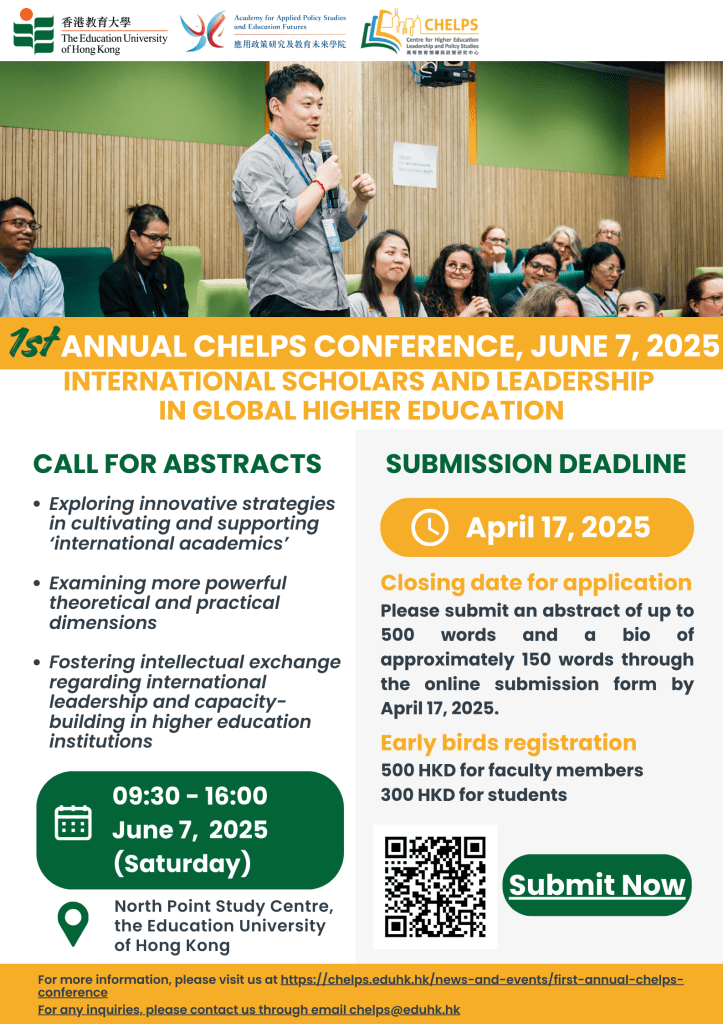
Call for Abstract: 1st Annual CHELPS Conference

Centre for Higher Education Leadership and Policy Studies (CHELPS) are pleased to invite you to submit an abstract for the upcoming 1st Annual CHELPS Conference at North Point Study Centre of the Education University of Hong Kong on 7 June, 2025. This year, our theme is “International Scholars and Leadership in Global Higher Education”, and we welcome submissions from students, researchers, practitioners, and professionals at different stages of their career who are interested in international mobility, collaborations, and intellectual leadership within a globalised context. 

We welcome abstracts addressing issues of internationalisation, international leadership, international collaboration, and global higher education. Submissions should not exceed 500 words for an abstract and 150 words for a brief bio, and must be submitted by 17 April 2025. For more information, please refer to our website: https://chelps.eduhk.hk/news-and-events/first-annual-chelps-conference

To submit your abstract, please visit: https://eduhk.au1.qualtrics.com/jfe/form/SV_1SyOkxKQ9io69sW 

Managing Editor: Tong Meng

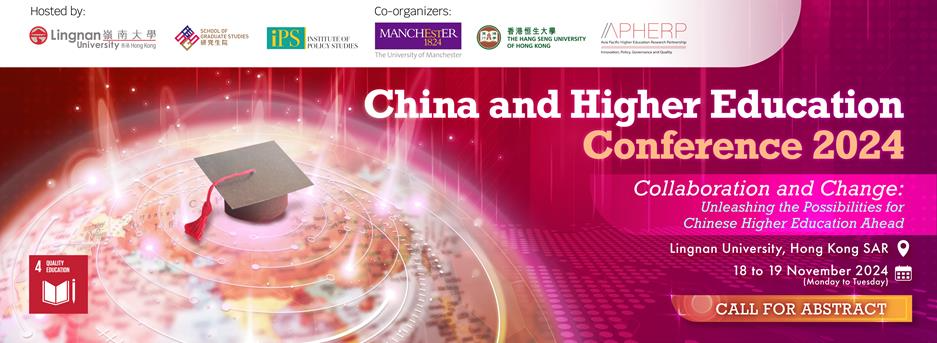
[Call for Abstracts] China and Higher Education Conference 2024|Lingnan University and University of Manchester

Dear Professors and Friends,

Greetings from Lingnan University! We are honored to extend this invitation to your faculty and postgraduate students to contribute and attend the China and Higher Education Conference 2024 (ChinaHE) from 18 to 19 November 2024 (Monday to Tuesday). The conference theme is Collaboration and Change: Unleashing the Possibilities for Chinese Higher Education Ahead.

Keynote Speakers:

With the above theme, the following key questions will be discussed at the conference include, but are not limited to: 

1.          How are collaborations between Chinese and international HEIs reshaping academic research, pedagogy, and students’ learning experiences?

2.          How are emerging technologies and digital platforms facilitating collaboration and knowledge sharing among HEIs, and what are the implications for academic research, teaching, and learning?

3.          What strategies are effective in promoting interdisciplinary collaboration within Chinese HEIs, and how can interdisciplinary approaches address complex societal challenges?

4.          How are collaborations between Chinese HEIs and government agencies driving policy reform, regulatory changes, and institutional autonomy within the higher education sector?

5.          What roles does industry-academia collaboration play in fostering innovation, entrepreneurship, and workforce development within Chinese higher education?

6.          How can collaborative partnerships between Chinese HEIs and non-profit organizations or civil society groups contribute to social equity, community engagement, and sustainable development goals?

7.          What opportunities and challenges arise from international collaboration initiatives, such as the Belt and Road Initiative, in shaping the globalization of Chinese HEIs?

8.          As under-studied stakeholders, what are the roles of international students and professional staff in Chinese HEIs in building national and inter-national collaborations?

9.          What are the roles of educational leaders in promoting collaboration among Chinese and international HEIs to thrive on the changes while addressing the deep-seated educational issues? 

Call for Abstract We invite you to submit your scholarly abstracts and present your latest research at Lingnan University to an international audience.
Submit Now: Click Here [lingnan.asia.qualtrics.com]
Due date: 15 September 2024 at 23:59 HKT (GMT+8)

We also encourage you to share this conference within your professional network to enhance our collective impact.

For further information, kindly visit the webpage provided here [ln.edu.hk]. If you have any inquiries, please feel free to contact the Conference Organizing Committee at ChinaHE@LN.edu.hk .

Managing Editor: Tong Meng

A survey invitation from Tsinghua University

Dear Colleagues/Students,

The Institute of Education at Tsinghua University is conducting a global survey to understand the usage of generative AI tools among students and teachers in higher education. We sincerely invite you to participate in this survey and kindly request you to forward this message to your colleagues and classmates.

Student survey link:https://www.surveymonkey.com/r/SLXHPVN

Teacher survey link:https://www.surveymonkey.com/r/9TSWRK8

Your feedback is crucial to the success of our research. The survey will take approximately 5-10 minutes to complete, and all information collected will be kept strictly confidential and used solely for academic research purposes.

Thank you for your support and cooperation!

Institute of Education, Tsinghua University

Managing Editor: Tong Meng

What Has COVID-19 Taught Us: Advancing Chinese International Student-Related Research, Policies, and Practices Through Critical Race Perspectives

Research Highlighted: 

Yu, J. (2023b). What Has COVID-19 Taught Us: Advancing Chinese International Student-Related Research, Policies, and Practices Through Critical Race Perspectives. Teachers College Record, 125(6), 110-118. https://doi.org/10.1177/01614681231190165

“I’m not excited about ‘going back to normal,’ because normal was the place where all the failures were for the kids I’m concerned about.” ― Gloria Ladson-Billings (December 20, 2020)

As we are ramping up to the return of in-person events in the post-pandemic environment, Gloria Ladson-Billings, a critical race theory scholar, reminds us that the COVID-19 pandemic should be a transformative opportunity that forces us to break with the past and imagine the world anew. For the field of international higher education, this call is right on time. Due to the unprecedented pandemic, international activities, especially cross-border student mobility, have been disproportionately impacted (Mok et al., 2021; Yu, 2021a). As the largest international student group in U.S. higher education, Chinese students have been made particularly vulnerable due to the resurgence of anti-Asian racism and U.S.-China geopolitical tensions. There is therefore a pressing need to make sense of Chinese international students’ perspectives and experiences around U.S. higher education—and in doing so, to highlight the ever-present educational inequalities rooted in academic capitalism, global unevenness, and institutional racism.

This article builds on the results of a critical qualitative research project investigating Chinese international students’ agency, decision-making, and perceptions of race, racism, and power (Yu, 2021a, 2021b, 2022a, 2022b, 2023a, Under Review abc). Drawing from interdisciplinary studies of international education, Asian American studies, sociology, and migration studies, this research project brings critical race perspectives to understanding Chinese students’ transnational mobilities and practices. It aims to unveil global hierarchies and racial inequalities in the field of international education in order to help advance future research and open new paths to practice.

Ideas for Critical Research

The COVID-19 pandemic has taught us that the neoliberal model of international education is falling apart (De Wit, 2020). There is a renewed interest in and urgency for educators, scholars, and practitioners to rethink the field of international higher education through a critical race lens. In considering the theoretical implications of this fact for research, ethical and political dimensions should be centrally incorporated to ponder the issues of rights, responsibility, justice, and equity within international higher education. In recent years, more and more scholars have reset the research agenda and have started to critically reflect on international student mobility (Stein, 2017; Yang, 2020) and academic knowledge production (Kubota, 2020; Shi-xu, 2014); however, theoretically sophisticated critical research on international students’ lived experiences with racism and racialization is still urgently needed. In response to this theoretical challenge, I put forward an innovative framework, Global Asian Critical Race Theory or GlobalAsianCrit (Yu, Under Reviewa), as a contribution that combines the key tenets in Asian Critical Race Theory (Iftikar & Museus, 2018) and Global Critical Race Theory (Christian, 2019). In this creative framework that I proposed, I incorporated both a racial/ethnic and a critical global view into CRT to help understand how global white supremacy has shaped the racial realities of Asian individuals and how racial oppression works differently in different geographical contexts.

Ideas for Equity-Driven Policies

The COVID-19 pandemic and the related rise of anti-Asian racism have also revealed that international students of color are excluded from equity and social justice discourses in U.S. higher education. Thus, institutional policies should start by including disaggregated data on international students’ racial, ethnic, and national identities, which enables colleges and universities to acknowledge the heterogeneity within the highly reductive federal category of “nonresident alien” and to understand the diverse nature of these students’ learning experiences. Disaggregating the data and exploring the heterogeneity within this diverse group of students will be helpful for policymakers, institutional leaders, faculty, staff, and administrators to identify the specific needs of these international students and to support their sustained success and development in the U.S.

In addition, despite the fact that diversity and inclusion are continuously advocated in U.S. higher education, international students have been largely absent from debates and discussions of anti-Blackness and anti-Asian sentiment, due to their status as foreign students and temporary residence. Given this history of exclusion and ethnic discrimination, institutional policies should include global perspectives to uphold principles of educational equality and social justice for international students.

Ideas for Inclusive Practices

Finally, I propose three practical strategies for appropriately supporting Chinese international students. First, open discussions of race, racism, and power need to be included in institutions’ orientation sessions for international students. My research (Yu, 2022a) demonstrates that there is a great discrepancy in Chinese students’ understanding of race and racism before and after their migration to the U.S. It is necessary to equip international students with basic racial knowledge, such as how to identify racist comments and where to seek institutional help when discrimination and racial stereotyping occur. Administrators and practitioners can provide much-needed space for open conversations and transparent communications around racialized incidents on campus. Moreover, providing general education courses on the sociohistorical background of race, racism, and free speech in the U.S. can help international students better understand the complex racial reality of U.S. institutions and the wider society.

Secondly, administrators and staff should use an asset-based approach to designing services and workshops for international students on campus. While various activities are designed for international students to quickly adapt to U.S. campus culture, most available programs tend to be based on a deficit mindset of Chinese students or rooted in racialized logic. The asset-based practices that I recommend are intentional ways of acknowledging and leveraging the strengths of international students, including their everyday experiences, knowledge, and cultural practices to serve as resources for teaching and learning. Domestic students should not be excluded from these events and activities, for critical cultural awareness and cross-cultural communicative skills are essential qualities for all students to work with people from linguistically and culturally diverse backgrounds in future various professional situations.

Thirdly, colleges and universities should structurally facilitate international students’ engagement with domestic students and wider local communities. My research (Yu, 2022b) shows that Chinese students may express prejudicial attitudes toward other people of color, especially African Americans. More interracial contact can help both international and domestic students disrupt their stereotypes about one another. Hence, this form of support for international students can foster their sense of belonging or cohesiveness in a specific campus organization or activity. U.S. institutions should take shared responsibility to reinvest some of the income generated by international student tuition toward creating and supporting inclusive student clubs and extracurricular activities.

Conclusion

It is clear that Chinese international students are “raced” in the U.S., so instead of demanding that students conform to the oppressive social norms and meet the academic expectations of the (white) host learning environment, social justice efforts should be made to interrupt hegemonic thinking and complicate notions of race and racism by looking beyond the limited understanding of these concepts within U.S. borders. As Gloria Ladson-Billings reminded us, the COVID-19 pandemic can be a portal, a gateway to imagine a new world for K-12 schools as well as international higher education. 

References:

Christian, M. (2019). A global critical race and racism framework: Racial entanglements and deep and malleable whiteness. Sociology of Race and Ethnicity, 5(2), 169–185.

De Wit, H (2020). Internationalization of higher education: The need for a more ethical and qualitative approach. Journal of International Students 10(1), i–iv.

Iftikar, J. S., & Museus, S. D. (2018). On the utility of Asian critical (AsianCrit) theory in the field of education. International Journal of Qualitative Studies in Education, 31(10), 935-949.

Mok, K. H., Xiong, W., Ke, G., & Cheung, J. O. W. (2021). Impact of COVID-19 pandemic on international higher education and student mobility: Students perspectives from mainland China and Hong Kong. International Journal of Education Research, 105, 101718.

Stein, S. (2017). Internationalization for an uncertain future: Tensions, paradoxes, and possibilities. Review of Higher Education, 41(1), 3–32.

Yang, P. (2020). Toward a framework for (re)thinking the ethics and politics of international student mobility. Journal of Studies in International Education, 24(5), 518–534.

Yu, J. (2021a). Lost in lockdown? The impact of COVID-19 on Chinese international student mobility in the US. Journal of International Students, 11(S2), 1-18.

Yu, J. (2021b). Caught in the middle? Chinese international students’ self-formation amid politics and pandemic. International Journal of Chinese Education, 10(3), 1-15.

Yu, J. (2022a). The racial learning of Chinese international students in the US context: A transnational perspective. Race, Ethnicity and Education. Advance Online Publication https:// doi.org/10.1080/13613324.2022.2106878

Yu, J. (2022b). “I don’t think it can solve any problems”: Chinese international students’ perceptions of racial justice movements during COVID-19. Journal of Diversity in Higher Education. Advance Online Publication https://doi.org/10.1037/dhe0000457

Yu, J. (2023a). Understanding Chinese international students in the U.S. in times of the COVID-19 crisis: From a Chinese discourse studies perspective. Journal of Multicultural Discourses. Advance Online Publication https://doi.org/10.1080/17447143.2023.2214538

Yu, J. (Under Reviewa). Exploring Chinese international students’ experiences in times of crisis through Global Asian Critical Race Theory.

Yu, J. (Under Reviewb). “Asians are at the bottom of the society”: Chinese international students’ perspectives on Asian Americans in the U.S. racial hierarchy.

Yu, J. (Under Reviewc). #YouAreWelcomeHere? The two faces of American higher education toward Chinese international students.

Authors’ Bio 

Jing Yu PhD, is an Assistant Professor of International Higher Education in the Department of Educational Leadership and Policy Analysis and a Faculty Affiliate in Asian American Studies at University of Wisconsin-Madison. Her research interests include international student mobility, intersections of race, class, and nationality, and international dimensions of equity, diversity, inclusion, and belonging. Her recent project on Chinese international students’ everyday racism and mental health issues has been successfully funded by the Spencer Foundation’s small research grants. She is on the editorial board of the Journal of Diversity of Higher Education, Journal of College Student Development (Research in Briefs), and Journal of Student Affairs Research and Practice.

Managing Editor: Xin Fan

Governing through ambiguity in the normalizing society: The lesson from Chinese transnational higher education regulation

Research highlighted

Han, X. (2023). Governing through ambiguity in the normalizing society: The lesson from Chinese transnational higher education regulation.  Journal of Education Policy, Online First. DOI: https://doi.org/10.1080/02680939.2023.2210094

The traditional technocratic model in policy analysis features in three dimensions: first, it takes language as the transparent vehicle to facilitate communications between writers and various readers; second, it follows the problem-solving route, considering policy documents as the political responses empirically based upon factual data to existing social problems; third, it considers the participants as disinterested individuals immunizing from the policy impact. Following this empiricist-idealist view of language, scholars are expected to provide neutral data/information for policy-makers to develop/revise solutions to the pre-identified problems, seek authorial intentions hidden behind the policy texts, and proffer interpretations which could generate commensurable meaning among readers. In other words, it equalizes language to a static set of perfect signifiers about the externally constituted world of things, and by so doing sidesteps the contingencies, intricacies, and indeterminacies of policies.

The progress in socio-linguistics directs scholars’ attention to the discourse property of language, and also, policy documents. Discourse, especially for Foucault-inspired critical policy analysts, does more than designate things: it delimits what can be said and thought; it constitutes, produces, and creates, rather than enumerating and describing subjects, objects, and places; it sets the norms to fabricate individuals into the social order, elicits their self-governance as an act of free will, and thus yields human beings into made subjects.

While existing critical studies on making politics visible are cornucopian in demonstrating how power penetrates into every aspect of social life, to institute disciplinary technologies and thus conduct individuals’ conduct, Foucault’s own slide from the terminal stage of discourse—the linguistic elements, may whittle the theory’s potency in explaining the reality, especially when referring to policy research in the broader social science fields including public administration, politics and international relations: if policy discourse functions to convey norms in shaping desirable subjects, its expression should be as precise as possible to be followed. Why could policymakers endure and even encourage equivocalness in policy texts instead of trying to reduce it?

Empirically based upon China’s regulation over transnational higher education (TNHE),  this article draws interdisciplinary prism to highlight the persistent existence of ambiguity in policy documents and its impact on the enacting process. For instance, in authoritarian China, linguistic ambiguity could demonstrate its positive effects: within the context of severe discursive conflict, the equivocal expressions not only mask the incompatible norms setting but also leave negotiation room for creative policy enactment. Specifically, Chinese national policies about TNHE embodies the “curious hybrid of command and market”: on one hand, the introduction of neoliberalism permits the penetration of market logic into the previously state-controlled domain of education when China decides to modernize itself by internationalizing its higher education (HE) system. As a vital and integral part of HE internationalization, TNHE thus gains permission (and encouragement) to develop within Chinese territory; on the other hand, although TNHE itself instantiates the imposition of neoliberal discourse, the authoritarian concern of China to take “the total administration of life”, and its ideological reliance on socialism for moral legitimacy prevent its full embrace of market logic. To ensure the state’s interference into every social aspect, the local officials are  expected to simultaneously facilitate and prevent the penetration of market forces into the TNHE.

It is within this context that clarification in policy documents is considered “managerially sound” but “politically irrational”. The deliberate adoption of ambiguous expressions could not only help to convince readers but also leave negotiating room for policy practitioners to achieve contradictory ends. This is the “positive effect of ambiguity” highlighted by Matland (1995, 158). For example, to mask the market -based inequality in China’s socialist society, the national policies adopt rather ambiguous expressions in regulating the tuition fee setting, which is required to consider the affordability of the students” and to achieve the balance between the charges in public and private universities. So while the tuition fee is calculated and decided by the universities, it must gain approval from local governments before coming into effect.

However, the criteria is riddled with ambiguity, clarifying neither the authoritarian/socialist nor neoliberal norm: the difficulty (or more precisely, impossibility) of quantifying the “affordability” of potential students; the fuzzy measurement of “balancing between public and private universities”—especially when considering what the Deputy Director from Y Provincial Government frankly states: “TNHE in China is legally regulated by the Non-state (private) Education Promotion Law, so it is unclear how to balance the charge…”; and the obscuring gauge in calculating the cultivating cost of students, “there is no simple criteria in deciding the faculty salaries in TNHE (compared with Chinese public universities)…most of the time they have to make a better offer (based on the qualification and the faculty’s former pay level) for introducing talents” (2017). These ambiguous statements, on the other hand, permit flexibility for local officials when enacting national policies. As he continues to say candidly: “The tuition fee set by the TNHE (especially Sino-foreign cooperation universities) is relatively autonomous, and we always permit their application for the charge”. Such support and permission are based on the local officials’ understanding of market logic, as he explains: “They are running the TNHE in the market… students have a lot of choices—studying physically abroad, applying to other programs/colleges/universities, or enrolling in other Chinese universities…the setting of charge has already been monitored and modified by the market” (2019).

When the imposition of law in population regulation has been gradually replaced by its calculated practice of directing categories of social agents, the individuals are seemingly permitted to act “freely and proactively”. However, the Chinese local officials’ creativity and innovation in flexibly enacting national policies have never been “in a position of exteriority to power”, but ending up enforcing and intensifying the existing power relations—the authoritarian control in China as they boost the development of TNHE and thus prove the “rightness” of China’s political control. This strategic and invisible operation of power deserves scholarly attention for how it objectifies and subjectifies human beings.

Authors’ Bio

Dr. Xiao Han,
Tianjin University

Dr Xiao HAN earned her B.A. (Economics) from Jilin University and Ph.D (Education) from the Education University of Hong Kong. She worked for two years as a postdoctoral fellow at Lingnan University and then took the position of Beiyang associate professor at the School of Education, Tianjin University. She will take the position of assistant professor at the Department of International Education, Education University of Hong Kong soon. Her research is trans-disciplinary-based, focusing on critical policy analysis, international/transnational higher education, and Foucault/Bourdieu studies. Her works have been published in international journals such as Journal of Education Policy, Higher Education, and Policy and Society. She can be contacted at: hanxiao0309@hotmail.com.

Managing editor: Xin Fan