
Conference Dates
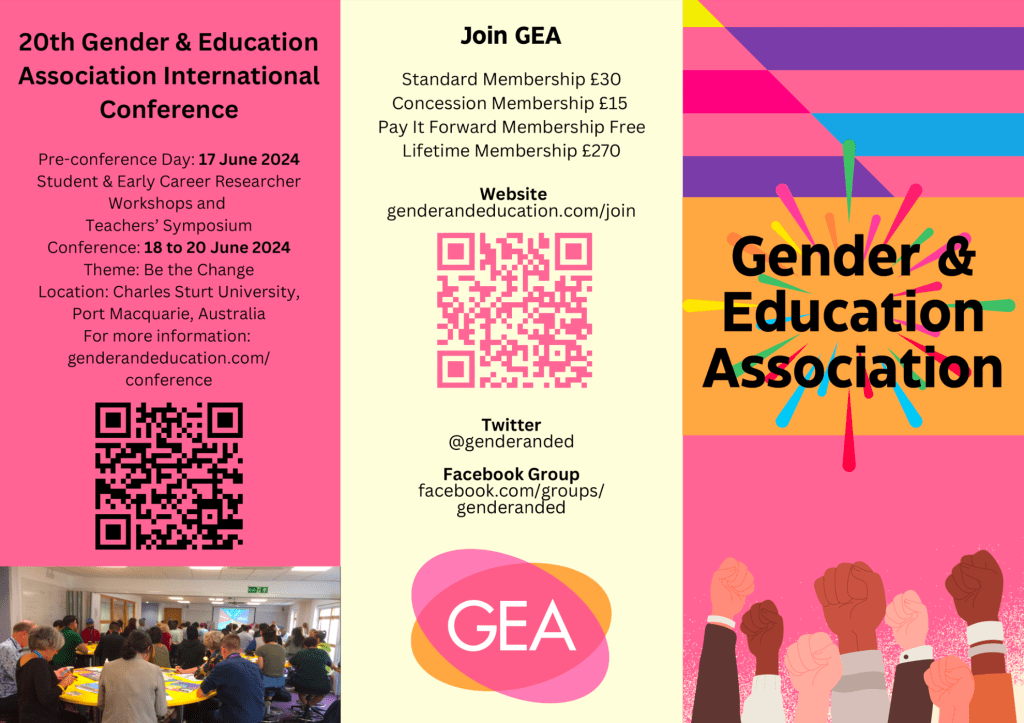
- Pre-conference Day: Student/ECR Workshops and Teachers’ Symposium: Monday 17 June 2024 to be hosted/sponsored by Charles Sturt University Division of Learning, and the Charles Sturt University Research Office
- Conference Dates: Tuesday 18 June to Thursday 20 June 2024
For more information can be found here
Read the Charles Sturt University press release about the conference.
Conference Theme: Be the Change
The Gender and Education Association 2024 conference seeks to bring together education practitioners from all levels of education, activists, academics, students, community members and leaders, artists, researchers,
lawmakers, policymakers, and media to explore the need for change for diversity and inclusion, positionality, and redressing inequalities through both an intersectionality and a gendered lens. Engaging in the debates of inclusion in education is important but pivotal are the pedagogies and ideologies that underpin how we include and reframe the systemic and structural barriers that led to culminative disadvantage. Given the global impact of the pandemic with women being hardest hit with career stability and access to education and services, a call to action is needed to go beyond a deficit model to that of universal inclusion – designing education and pedagogy to be inclusive and accessible to all regardless of ones identified intersections. Our conference theme, Be the Change, aims to be a catalyst for discussion and action to redress global and institution inequality through the power of education and knowledge.
- Be the Change, in understanding that individuals have agency within organisations and society to influence systems and structures that impact on education across the globe.
- Be the Change, is understanding your own intersections and identities and how these impact on an individual’s positionality and interface with educational, political, economic, and societal systems.
- Be the Change, is acknowledging how lived experience can give to voice and activism for change for the greater good in overcoming inequality and utilising education as a powerful tool
- Be the Change, is delivering innovation through codesign for more inclusive and accessible education.
- Be the Change, is acknowledging we all have a part to play
Themes which could be explored include (but are not limited to):
- What are the big questions and issues that need tackling?
a. Local, national, and global inequalities in education
b. Access and success (attrition and progression) in education
c. Inequalities across different contexts, geography, and levels of education
d. Employment in education – inequalities, marginalisation, and resilience in education - One size doesn’t fit all
a. First Nations perspectives to education
b. De-homogenising the majority
c. Taking an intersectional approach - Progressive a/genda(er)
a. Social justice, human rights and education
b. Gender identity and gender expression in and for education
c. Ethics of exclusion – refugees, displaced persons, and environmental refugees – access and surveillance of educational freedoms, Faith and Islamophobia, antisemitism, and religious intolerance in education
d. Classism, ableism, and racism in education
e. Making the invisible visible – Disability, neurodiversity, and mental health in education - Innovation and creation of pedagogy for inclusion
a. creativity in a gendered/non-gendered environment
b. use of alternate creative media, music, art as a knowledge broker
c. Universal design in education - Practice translation for impact
a. Case studies
b. Systemic and structural change for inclusion
c. Initiatives for change - Being the voice of change – new developments and future facing research/action
a. Decolonialisation
b. De-whitening intersectionality
c. Feminism and anti-oppressive strategies in education
d. Activism
We will invite contributions in a range of diverse formats including (and not limited to) 20-minute oral presentations, posters (digital and onsite), roundtables, themed panels, symposia, workshops, creative presentations and ‘other’ which will be led by the abstracts received.
Conference Team
Conference Co-Chairs:
- Associate Professor Cate Thomas School of Social Work & Arts, Athena Swan Convenor
- Kate Wood-Foye, Director External Engagement Charles Sturt University (Port Macquarie)
Conference Organising Committee
- Dr Fredrik Velander School of Social Work & Arts
- Dr Denise Wood Division of Learning & Teaching Social Equality Intersectionality & Inclusion Research Group
- Emmaline Lear SFHEA Manager Researcher Development Office of Research Services & Graduate Studies
- Dr Jennifer Podesta Graduate Studies Engagement Officer Charles Sturt University
- Dr Jacquie Tinkler Division of Learning and Teaching
- Deanne Tilden Campus Ally Lead
- Bethany Brightmore Faculty of Arts & Education Marketing
- Monique Sheppard Post-Doctoral Fellow
- Halima Kramel Community Relations Officer Charles Sturt Port Macquarie Event Support & Logistics
About GEA Conferences
This will be the first GEA conference since 2019 after the pandemic disrupted the amazing plans for the 2020 conference. If this will be your first GEA conference, then you can learn more about the previous 19 conferences here. You can also read reflections from previous conference attendees to learn more about what to expect at a GEA conference:
- http://www.genderandeducation.com/issues/reflections-on-geaconf2019/ (by Natasha Richards)
- http://www.genderandeducation.com/conferences-and-events/countdown-to-conference/c2c2/ (by Carli Rowell)
- https://www.sussex.ac.uk/gender/news-and-events/conference_2018 (by Charlotte Morris)
- http://www.genderandeducation.com/conferences-and-events/conference/resistance-identities-and-reducing-pressure-reflections-on-gea-conference-2017/ (by Nicole Johnson)
- http://www.genderandeducation.com/conferences-and-events/past_events/padam-padam/ (by Zoe Charalambous)
- http://www.genderandeducation.com/conferences-and-events/countdown-to-conference/c2c1/ (by Jessica Gagnon)
About The Gender and Education Association: GEA is a volunteer-led international intersectional feminist charity. Since 1997, our community of educators, researchers, activists, leaders, artists, and more have been working to challenge and eradicate gender stereotyping, sexism, and gender inequality within and through education. UK charity number: 1159145
About Charles Sturt University: ‘Inclusive’ is one of the four core values at Charles Sturt University. Our commitment to gender equity is vital to attracting the best researchers and academics. Charles Sturt University’s Athena SWAN action plan outlines 43 actions that have been developed to reduce gender inequity, not only in STEMM but across the institution. These actions address issues identified in recruitment and induction; career progression and promotion; the gender pay gap; research; leave and flexible work arrangements; promoting inclusivity; and embedding the Athena SWAN principles within core business. Our participation augments the Leadership Development for Women program, the Senior Women’s Leadership Forum, and the University’s Workplace Gender Equity Strategy (2018-2022). The University has also received recognition as a Women in Stem Decadal Plan Champion. Charles Sturt University is a forward-thinking university that engages with community and students from vulnerable backgrounds such as First Nations, first in family to attend university and low social economic status. Charles Sturt prides itself on its ethos yindyamarra winhanganha. The Wiradjuri phrase yindyamarra winhanganha means the wisdom of respectfully knowing how to live well in a world worth living in. This phrase represents who we are at Charles Sturt University – our ethos. It comes from traditional Indigenous Australian knowledge, but it also speaks to the mission of a university – to develop and spread wisdom to make the world a better place.

Managing editor: Lisa (Zhiyun Bian)

 Network for Research into Chinese Education Mobilities (NRCEM)