
Yang, Y., & MacCallum, J. (2022). Transitions across multi-worlds: Experiences of Chinese international doctoral students in STEM fields. Journal of Studies in International Education, 26(5), 535–552. https://doi.org/10.1177/10283153211016266
Introduction
Every year Chinese international doctoral students (CIDS) in science, technology, engineering, and mathematics (STEM) make transitions across different worlds in ways that supports achievement in their host community.
This article reports findings from a longitudinal study investigating holistic experiences of the contemporary generation of STEM CIDS in Australia. Endeavor to reveal both heterogeneity and commonality, this study examined their diverse and challenging experiences to identify factors that facilitate or constrain their successful completion of a PhD abroad.
The Three-Dimensional Multi-World Conceptual Framework
For this study, we developed a conceptual framework to accommodate the features of complexity and to allow a holistic understanding of the nature of doing a PhD abroad. In this framework (Figure 1), first we formed a three-dimensional space to accommodate student experiences. Along the three axles are Continuity, Interaction, and Situation. International doctoral students’ experiences were conceptualized as developmental over time, taking things from the past and modifying the quality of the future; interactive, assigning equal rights to both objective and internal conditions in interactions; and situated within the disciplinary, working, and living contexts.
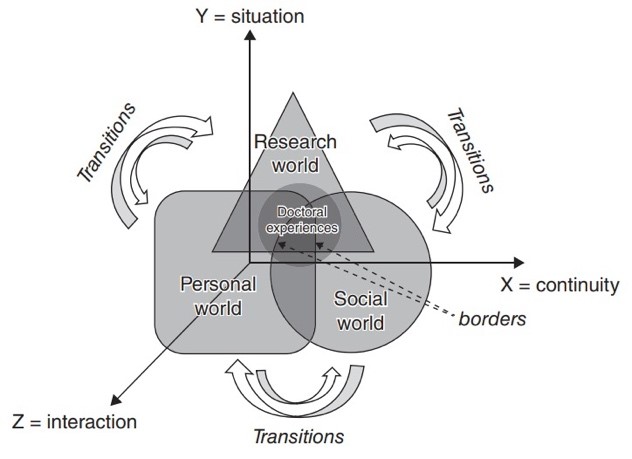
Figure 1. The three-dimensional multi-world conceptual framework
Within this space we established the students’ multi-world model, including students’ research, personal, and social worlds. The three worlds are interconnected and interplay to co-construct study abroad experiences. Between the worlds, there are overlapping areas as experiential interfaces for transitions across each world to occur and lines in-between as borders that may constrain students’ transitions.
The Project
The CIDS Study is a narrative inquiry that involved a 4-year longitudinal study to understand Chinese STEM PhD students’ situated, continuous, and interactive experiences. We adopted narrative as a research approach because it incorporates a range of methodological stances and is agentive in demonstrating how individuals attempt to navigate their life, which suited the purpose of the study.
There were 38 CIDS participants from STEM fields at eight universities in five states of Australia. All participants were interviewed individually or in focus groups, with 17 followed up for a second interview roughly nine months after the first interview and eight followed up for a third interview. Most of these students had completed their PhD by the conclusion of data collection.
Congruence/Difference and Transitions Across the Worlds
The six categories of congruence or difference, and corresponding transitions identified through data analysis were used to structure the findings, though we combined the last two categories to highlight the final complications resulting in a doctoral withdrawal.
Congruent Worlds and Smooth Transitions
In this pattern (n=9), students reported their supervisory team and other social relationships as congruent based on the match of key expectations, values, and beliefs across their multi-worlds. The borders between their multi-worlds were almost imperceivable so that they could make transitions with ease. These students were generally satisfied with their study abroad experience by achieving academic success and enjoying social life while doing the PhD abroad. However, experiencing congruence and smoothness did not mean these students had not experienced difficulties, stress, highs, and lows in the PhD; rather, it meant immense bilateral or multilateral investment of time, effort, care, and patience in facilitating transitions, particularly at certain critical turning points, to enable students’ achievement and development.
Different Worlds and Smooth Transitions
In this second pattern (n=8), regardless of some critical differences in motivations, expectations, values, and beliefs between students’ multi-worlds, they reported easy transitions across and over time. The differences that created borders between the worlds were distinctive based on individual situations. Nevertheless, it was the empathy to accommodate differences and the respect to the existence of differences from the agents of their multi-worlds that enabled their smooth transitions.
Congruent Worlds and Border Crossings Managed
In this pattern (n=9), motivations, expectations, values, beliefs, and actions appeared mostly congruent between an individual’s multi-worlds, but this congruence was created with strong evidence of the performance of personal agency, strategies, skills, and initiatives in managing transitions across perceivable borders. Different from the first pattern that congruence was achieved with smooth transitions or the second pattern that difference remained, students of this third group, facilitated with strong and timely supervisory and peer support, managed to create a shared time and space between their multi-worlds. This sustained them through vicissitudes, sometimes crucial moments, in their PhD abroad.
Different Worlds and Border Crossings Managed
In this category (n=9), motivations, expectations, values, beliefs, and actions between students’ research, personal, and social worlds had critical differences, which had profound impact and led to conflicting ideas, attitudes, and behaviors that constrained students’ PhD progress. However, in general, the conflicts were able to be put under control, and the transitions were managed to achieve the PhD. Students of this group were agentic to act, persistent to achieve, resilient and strategic in expanding their small research context to a broader scope.
Different Worlds and Border Crossings Difficult or Resisted
In both categories (n=2 and n=1), there were some critical differences in motivations, expectations, values, beliefs, and actions across students’ multi-worlds. Differences led to conflicting ideas, attitudes, and behaviors. While some conflicts remained unsolved, diminished motivations, together with poor rapport and escalated complications constrained transitions and limited students’ achievement. In the fifth category, students adapted to the differences and completed the PhD, but negative emotions and limited output, resulted in both leaving the research world. In the sixth category, the student resisted adapting and dropped out of the PhD program.
Discussion and conclusion
Drawing on the three-dimensional multi-world framework, this study found that achieving a PhD abroad was challenging for each participant, but it was the way they experienced the transitions across their multi-worlds that created vast differences in their experiences. The six patterns demonstrated a range of experiences, shedding light on how in some cases STEM CIDS achieved their best outcomes and how in some other cases misunderstandings, frustrations, and severe conflicts occurred.
Besides persistence, resilience, and resources, agency to communicate, termed agentic communication, along with listening in negotiations between students and their supervisors, was key in supporting or undermining the PhD over time. This study highlights the effectiveness of agentic communication in making or breaking the rapport, trust, and respect in the most significant relationship in an individual’s multi-worlds during the PhD abroad.
This study revealed that culture might too easily become the scapegoat when we interpret miscommunication or under-communication situations. When doing a PhD abroad, the focus of these students was on achieving the degree and establishing their professional identity, rather than social or cultural integration with the host community. The conflicts or factors that constrained students’ transitions across multi-worlds were often related to their doctoral research rather than culture-related issues per se. When the communication about scientific research went smoothly, positive transitions ensued, or the reverse.
Given this study identified six patterns of PhD abroad experiences, further research could investigate how different experiences influence students’ post-PhD life and career trajectories and how these students contribute to the society, home, host, or elsewhere in the world, in return for their education received abroad.
Other works related to this project:
Yang, Y., & MacCallum, J. (2023). Chinese Students and the Experience of International Doctoral Study in STEM: Using a Multi-World Model to Understand Challenges and Success. Routledge. https://doi.org/10.4324/9781003258841
Yang, Y., & MacCallum, J. (2022). A three-dimensional multi-world framework for examining cross-cultural experiences of international doctoral students. Studies in Continuing Education, 44(3), 493-509 doi:10.1080/0158037X.2021.1890569
Yang, Y., Volet, S., & Mansfield, C. (2018). Motivations and influences in Chinese international doctoral students’ decision for STEM study abroad. Educational Studies, 44(3), 264-278. doi:10.1080/03055698.2017.1347498
Authors’ Bio

Yibo Yang, Associate Professor, PhD, Deputy Dean for the International Organizations and Global Governance, School of International Studies, Harbin Institute of Technology, China. Her current research interests focus on internationalisation in higher education, international organizations, research methodologies, and academic writing.

Judith MacCallum, Professor Emerita, PhD, College of Health and Education, Murdoch University, Australia. Her research and teaching interests focus on social interaction for learning and development, with emphasis on motivation, mentoring and professional learning.
Managing Editor: Xin Fan



 Network for Research into Chinese Education Mobilities (NRCEM)