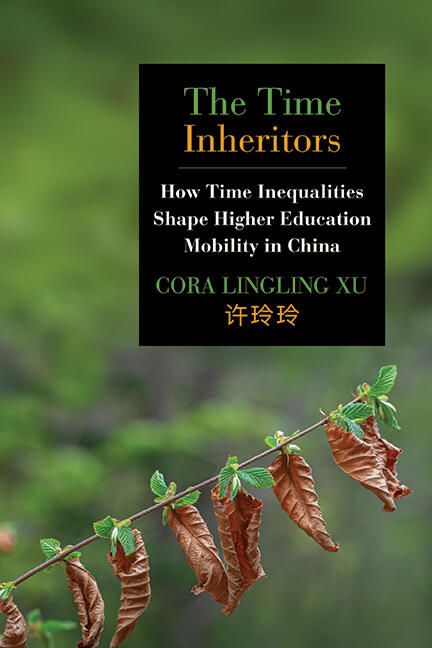
‘The Time Inheritors: How Time Inequalities Shape Higher Education Mobility in China’ by Cora Lingling Xu

We are delighted to share the publication of a new book by our director Dr Cora Lingling Xu. Read this profile (in Chinese) with People Magazine 《人物》杂志 and blog post to learn about the personal stories behind this book.

Please find an abstract of ‘The Time Inheritors‘ and critical reviews below.

If you wish to order this book, you can use SNWS25 to get 30% off when you order from the SUNY Press website.

To learn more about the book talks and interviews visit this page. Listen to the New Books Network’s interview with Cora. 听’时差In-Betweenness’与Cora的对话小宇宙链接). Check out this page for frequently asked questions (e.g. what you should do if you wish to write a book review) about this book. Share your stories of ‘time inheritance’. If you wish to contact Cora about arranging book talks and interviews, complete this contact form.

Abstract

Can a student inherit time? What difference does time make to their educational journeys and outcomes? The Time Inheritors draws on nearly a decade of field research with more than one hundred youth in China to argue that intergenerational transfers of privilege or deprivation are manifested in and through time. Comparing experiences of rural-to-urban, cross-border, and transnational education, Cora Lingling Xu shows how inequalities in time inheritance help drive deeply unequal mobility. With its unique focus on time, nuanced comparative analysis, and sensitive ethnographic engagement, The Time Inheritors opens new avenues for understanding the social mechanisms shaping the future of China and the world.

Critical reviews

“Xu’s conceptually sophisticated monograph reveals how intersectional inequalities are constructed, experienced, and transmitted temporally, with special reference to education. Through the vivid stories of students in mainland China and Hong Kong, and Chinese international students, Xu brings to life different individuals’ ‘time inheritances,’ demonstrating the exciting possibilities time offers as a lens for innovative thinking about inequality. A must-read for sociologists and anthropologists of education, China, and time.” — Rachel Murphy, author of The Children of China’s Great Migration

“Innovative and ambitious, The Time Inheritors proposes a time-centric framework that brings together analyses of social structure, history, individual behavior, and affect. We often feel we are fighting for time. But, as Cora Xu argues in this important study of Chinese students, the scarcity of time is not a given or universal. Different experiences of time result in part from the varying amounts of time we inherit from the previous generation. Time inheritance is therefore critical to the reproduction of social inequality.” — Biao Xiang, coauthor of Self as Method: Thinking through China and the World

“Cora Lingling Xu offers a groundbreaking analysis of educational inequality and social mobility in contemporary China. Xu centers the voices of marginalized students throughout, providing poignant insights into their lived experiences of rural poverty, urban precarity, and educational alienation. At the same time, Xu’s comparative scope reveals how even seemingly privileged groups can be constrained by the temporal logics of social reproduction. The Time Inheritors is a must-read for scholars, educators, and policymakers concerned with educational equity and social justice. Xu’s lucid prose and engaging case studies make the book accessible to a wide audience while her cutting-edge theoretical framework and methodological rigor set a new standard for research on education and inequality.” — Chris R. Glass, coeditor of Critical Perspectives on Equity and Social Mobility in Study Abroad: Interrogating Issues of Unequal Access and Outcomes

“By centering the temporal dimension of who is advantaged or disadvantaged, how, why, and with what consequences, The Time Inheritors takes a unique and powerful approach. Not only does the book contribute theoretically and empirically to our understanding of class inequalities but it also resonates deeply. The inclusion of Chinese translations and characters will give Chinese readers a rich, nuanced cultural appreciation of her findings.” — Dan Cui, author of Identity and Belonging among Chinese Canadian Youth: Racialized Habitus in School, Family, and Media

“An extremely well-written, theoretically informed, and compelling volume that represents a major contribution to the study of education, migration, and social inequality in China and beyond. The Time Inheritors proposes a bold and innovative framework—that of time inheritance—to open the black box of social inequality’s temporal dimension. Whereas the relatively privileged classes inherit temporal wealth and strategies that enable them to bank and save time, facilitating their mobility, the time poor lack this inheritance, forcing them into a vicious cycle of wasting time and paying back temporal debts. Drawing from a rich palette of vivid and intimate longitudinal case studies, The Time Inheritors unpacks the complex intersections between familial, national, and global time inequalities.” — Zachary M. Howlett, author of Meritocracy and Its Discontents: Anxiety and the National College Entrance Exam in China

Release Dates

Hardcover: 1st April 2025

Paperback: 1st October 2025
Call for Papers-Special Issue/Section: Between Inclusion and Exclusion in Migrant Education

This special issue draws the attention to the realities of educating migrant children within different school systems around the world, focusing on the interplay of inclusionary and exclusionary practices, as well as the many in-between positions and the situational differences and processes that have emerged in education settings. Across diverse contexts, the positions and experiences of migrant students reveal a complex landscape shaped by national policies, local initiatives and practices, and institutional pressures. Schools often struggle to balance the value placed on multilingualism and cultural diversity up against the practical challenges of everyday life. In many cases, migrant children’s diverse cultural and linguistic assets are overshadowed by their perceived deficits, such as a lack of proficiency in the host country’s language. This disconnect highlights a broader issue where educational policies and practices may unintentionally further exclusion rather than inclusion.

Centralized educational frameworks and local adaptations and practices both play crucial roles in shaping migrant students’ experiences. While some systems and actors strive to tailor support to individual needs, others may default to standardized approaches that render irrelevant the diversity of student backgrounds. As a result, the extent of inclusionary practices can differ significantly based on local discretion and institutional priorities. Additionally, the readiness and competence of

educators to engage with migrant students, particularly those with refugee backgrounds, impact educational integration. Any gaps between formal training and real-world experiences of teachers underscore the need for better professional development and support structures.

The proposed special issue aims to shed light on these dynamics, offering insights into how actors in educational systems can better navigate the tension between inclusion and exclusion, and ultimately improve the educational experiences of migrant children.

We invite scholars from diverse disciplinary backgrounds to contribute papers that pertain to the scope described above. As we already have a core of articles from Europe, we are especially interested in attracting authors writing about settings in other parts of the world. We welcome empirical, policy and theoretical contributions. The final papers should not exceed 8000 words including abstract and references.

In spring/early summer 2025, we plan to hold a one or two day workshop with selected Authors to enable and benefit from collegial feedback on the proposed papers, which by the time of the workshop would be strong drafts, to be submitted as final versions around July/August 2025. The workshop will be held in-person in Poznań (Poland) and on-line, to allow wider participation. The workshop organizers will cover the cost of accommodation and meals, but we will ask participants to cover their travel costs. Please send us the working title of your paper along with an abstract of 250- 300 words by Friday, 28 of February 2025, to Katarzyna Byłów, PhD: katarzyna.bylow@amu.edu.pl.

Guest editors:

Katarzyna Byłów
Center for Migration Studies (CeBaM)
Adam Mickiewicz University in Poznań, Poland e-mail: katarzyna.bylow@amu.edu.pl

Marie Louise Seeberg
Department for Childhood, Family and Child Welfare research NOVA, Oslo Metropolitan University (OsloMet)

Managing Editor: Tong Meng

Call for Papers for the British Journal of Sociology of Education

The British Journal of Sociology of Education is delighted to invite calls for proposals from individuals or teams to edit a special issue. We are particularly keen to receive proposals that focus on topics that are at the leading edge of current debates and are clearly relevant to the journal’s international leadership.


Proposals should be clearly sociological in nature and address any area of education (including formal and informal sectors). Submissions can adopt theoretical, methodological, review-based and/or empirical angles and must clearly articulate how the overarching theme proposed will make a significant and lasting contribution to the field.


We particularly welcome submissions from editors/editorial teams who identify as from minoritised/ marginalised communities.


Proposals should outline: the topic of the proposed special issue; the research
expertise and any previous editorial experience of the proposed editor/editorial team; and a provisional timetable for putting the special issue together.


Please note that all British Journal of Sociology of Education special issues are
advertised through an open call for papers.


Proposals (no more than 1500 words) should be emailed to Rachel Brooks
(r.brooks@surrey.ac.uk) by 16th October 2023.

Managing Editor: Xin Fan

Call for Papers for CIE / ECI

Comparative and International Education / Éducation comparée et internationale

Special Issue on Pluralizing Educational Mobilities

Guest Editors: Ian Craig, University of the West Indies; Kalyani Unkule, O.P. Jindal Global University, Law School Santiago Castiello-Gutiérrez, Seton Hall University; Jean-Blaise Samou, Saint Mary’s University

The journal of Comparative and International Education / Éducation comparée et internationale invites manuscripts to be considered for a Special Issue on “Pluralizing Educational Mobilities,” to appear in Summer 2024. In recent years, there has been a critical turn in international education scholarship (including education abroad), placing a stronger focus on issues of equity and inclusion, which trains a decolonial lens on research and practice around international mobilities, especially in light of the ongoing disruptions (social movements, global pandemics, wars, climate disasters) that have transformed our world in the past few years. The aim of this Special Issue is to contribute to this endeavour by presenting research in the area of educational mobility that further diversifies meaning-making around this activity by, amongst other approaches:

  • giving greater voice to internationally mobile students from the Global South, exploring their experiences with the same qualitative attention that has been bestowed on their counterparts in the Global North, with due critical consideration of the many complexities that may trouble that binary construct.
  • examining contexts for student mobility that are hitherto under-researched, particularly in the Global South. 
  • drawing on alternative epistemologies and situated cultural knowledge that are typically beyond the purview of current mainstream international education research, thereby offering alternative narratives, tropes and framings that enhance understandings around internationalization in particular contexts. 
  • harnessing collaboration between researchers across scholarly disciplines, thereby bringing complementary or disruptive external perspectives to bear on study abroad scholarship, or collaboration across roles in student mobility, such as between scholars, practitioners, administrators and student-participants.

This Special Issue thus seeks to open new pathways towards a fuller understanding of the contingent and multifaceted nature of this activity, paying due attention to the nuances of cultural context, subject positioning and historical conjuncture, amongst others, that bear on any experience of study overseas. The following questions are relevant:

  • What are the motivations and experiences of education abroad in and from contexts not typically reflected in the field of international education scholarship thus far?
  • For these individuals and contexts particularly, what is the interaction between international experiences and broader processes and systems such as curricula, institutional internationalization, international relations or development politics? 
  • To what extent and how is this critical turn towards equity in the field having a meaningful impact on the way that student mobility is conceptualized, managed and experienced, both by student participants but also by administrators and other actors?
  • Which alternative narratives or situated cultural understandings might broaden or nuance understanding of study abroad experiences? Are there templates and historical experiences of mobility which would fundamentally disrupt and re-orient language and practices of “othering”, assumptions of “knowability” and instrumental framings of “cultural competence” currently pervasive in international education, particularly study abroad?
  • How can study abroad be further and more meaningfully decolonized, both as a scholarly field and an activity? What kind of ripple effects might this have for practices of knowledge creation and dissemination within higher education more broadly – for example: curriculum diversification, internationalization strategies, programme evaluation and reform?

Critical scholarship shows how the conception, structuring, and directions of educational mobilities are rooted in and strengthen dominant worldviews while instrumentally engaging with other ways of being and knowing. Pluralizing educational mobilities therefore includes pluralizing the ways in which we create and disseminate knowledge about them as a field of research and practice. In this spirit, this Special Issue will consider texts which:

  • Situate the meaning, purpose, nature, outcomes and ethics of mobility in alternative cosmologies and historical experiences.
  • Reflect stylistic and methodological approaches which embody reflexivity and emphasize context-specificity in research and its implications for practice.
  • Extend possibilities for bridging critical scholarship with programming practice, particularly through further reflection on conceptual framings, tacit assumptions, linguistic usage, and scope of enquiry in existing literature.

For this Special Issue, CIE / ECI welcomes articles in English,  French, or Spanish presenting original research and scholarship on the specified topic. Submitted articles will be subject to the standard peer review process, must follow the current style guidelines of the American Psychological Association, and include a title and an abstract (up to 150 words). Manuscripts should not exceed 8,000 words, including all notes, quotations, and references. Manuscripts must be submitted through the journal’s online system.

Submission deadline: full manuscript October 1st, 2023. 

For submission information, visit: http://ir.lib.uwo.ca/cieeci/styleguide.html  

If you have an idea for a submission but are not sure whether or not it falls within the scope of this Special Issue, you may submit, by May 15th 2023, a 500-word proposal to ian.craig@cavehill.uwi.edu. Your proposal should cover the following (as applicable): context and purpose for the study, methodology, preliminary findings, implications for research and/or practice, a statement about how the proposed submission pluralizes educational mobilities. This prior submission is optional and all final submissions will be considered for inclusion solely on the basis of the blind peer-review process.

This special issue arises from the work of the Global Collective for Study Abroad Researchers and Administrators (GCSARA), which is the recipient of a Connection Grant from the Social Sciences and Humanities Research Council of Canada. Authors are encouraged to visit www.gcsara.org. 

Managing Editor: Xin Fan

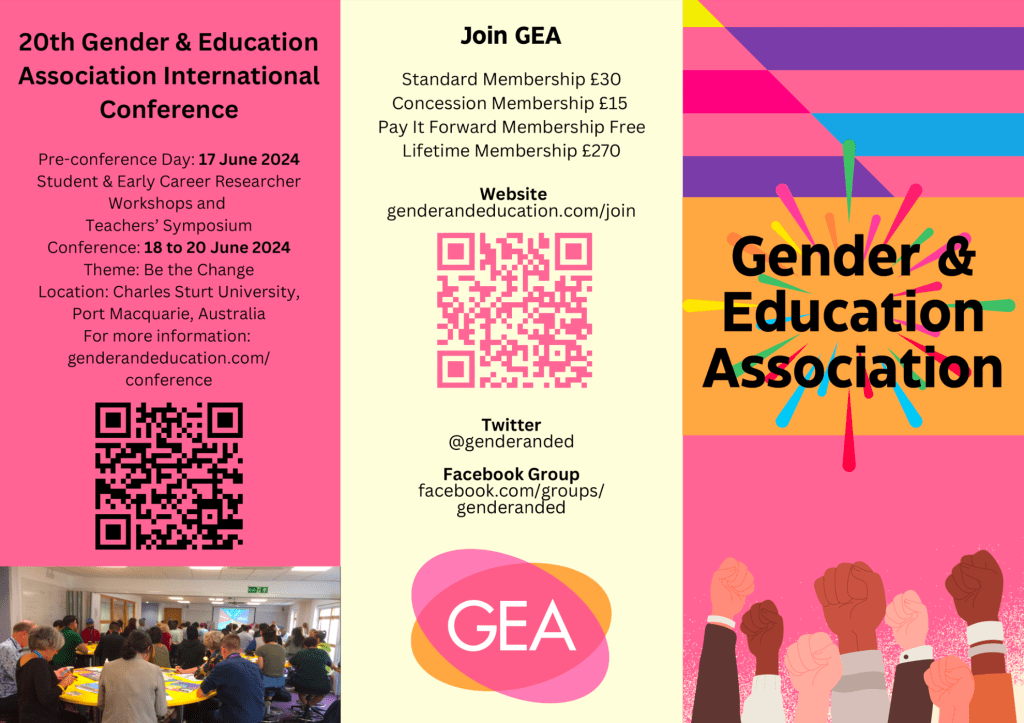
20th Gender & Education Association International Conference

Conference Dates

  • Pre-conference Day: Student/ECR Workshops and Teachers’ Symposium: Monday 17 June 2024 to be hosted/sponsored by Charles Sturt University Division of Learning, and the Charles Sturt University Research Office
  • Conference Dates: Tuesday 18 June to Thursday 20 June 2024

For more information can be found here

Read the Charles Sturt University press release about the conference.

Conference Theme: Be the Change

The Gender and Education Association 2024 conference seeks to bring together education practitioners from all levels of education, activists, academics, students, community members and leaders, artists, researchers,
lawmakers, policymakers, and media to explore the need for change for diversity and inclusion, positionality, and redressing inequalities through both an intersectionality and a gendered lens. Engaging in the debates of inclusion in education is important but pivotal are the pedagogies and ideologies that underpin how we include and reframe the systemic and structural barriers that led to culminative disadvantage. Given the global impact of the pandemic with women being hardest hit with career stability and access to education and services, a call to action is needed to go beyond a deficit model to that of universal inclusion – designing education and pedagogy to be inclusive and accessible to all regardless of ones identified intersections. Our conference theme, Be the Change, aims to be a catalyst for discussion and action to redress global and institution inequality through the power of education and knowledge.

  • Be the Change, in understanding that individuals have agency within organisations and society to influence systems and structures that impact on education across the globe.
  • Be the Change, is understanding your own intersections and identities and how these impact on an individual’s positionality and interface with educational, political, economic, and societal systems.
  • Be the Change, is acknowledging how lived experience can give to voice and activism for change for the greater good in overcoming inequality and utilising education as a powerful tool
  • Be the Change, is delivering innovation through codesign for more inclusive and accessible education.
  • Be the Change, is acknowledging we all have a part to play

Themes which could be explored include (but are not limited to):

  1. What are the big questions and issues that need tackling?
    a. Local, national, and global inequalities in education
    b. Access and success (attrition and progression) in education
    c. Inequalities across different contexts, geography, and levels of education
    d. Employment in education – inequalities, marginalisation, and resilience in education
  2. One size doesn’t fit all
    a. First Nations perspectives to education
    b. De-homogenising the majority
    c. Taking an intersectional approach
  3. Progressive a/genda(er)
    a. Social justice, human rights and education
    b. Gender identity and gender expression in and for education
    c. Ethics of exclusion – refugees, displaced persons, and environmental refugees – access and surveillance of educational freedoms, Faith and Islamophobia, antisemitism, and religious intolerance in education
    d. Classism, ableism, and racism in education
    e. Making the invisible visible – Disability, neurodiversity, and mental health in education
  4. Innovation and creation of pedagogy for inclusion
    a. creativity in a gendered/non-gendered environment
    b. use of alternate creative media, music, art as a knowledge broker
    c. Universal design in education
  5. Practice translation for impact
    a. Case studies
    b. Systemic and structural change for inclusion
    c. Initiatives for change
  6. Being the voice of change – new developments and future facing research/action
    a. Decolonialisation
    b. De-whitening intersectionality
    c. Feminism and anti-oppressive strategies in education
    d. Activism

We will invite contributions in a range of diverse formats including (and not limited to) 20-minute oral presentations, posters (digital and onsite), roundtables, themed panels, symposia, workshops, creative presentations and ‘other’ which will be led by the abstracts received.

Conference Team

Conference Co-Chairs: 

  • Associate Professor Cate Thomas School of Social Work & Arts, Athena Swan Convenor
  • Kate Wood-Foye, Director External Engagement Charles Sturt University (Port Macquarie)

Conference Organising Committee

  • Dr Fredrik Velander School of Social Work & Arts
  • Dr Denise Wood Division of Learning & Teaching Social Equality Intersectionality & Inclusion Research Group
  • Emmaline Lear SFHEA Manager Researcher Development Office of Research Services & Graduate Studies
  • Dr Jennifer Podesta Graduate Studies Engagement Officer Charles Sturt University
  • Dr Jacquie Tinkler Division of Learning and Teaching
  • Deanne Tilden Campus Ally Lead
  • Bethany Brightmore Faculty of Arts & Education Marketing
  • Monique Sheppard Post-Doctoral Fellow
  • Halima Kramel Community Relations Officer Charles Sturt Port Macquarie Event Support & Logistics

About GEA Conferences

This will be the first GEA conference since 2019 after the pandemic disrupted the amazing plans for the 2020 conference. If this will be your first GEA conference, then you can learn more about the previous 19 conferences here. You can also read reflections from previous conference attendees to learn more about what to expect at a GEA conference:

About The Gender and Education Association: GEA is a volunteer-led international intersectional feminist charity. Since 1997, our community of educators, researchers, activists, leaders, artists, and more have been working to challenge and eradicate gender stereotyping, sexism, and gender inequality within and through education. UK charity number: 1159145

About Charles Sturt University: ‘Inclusive’ is one of the four core values at Charles Sturt University. Our commitment to gender equity is vital to attracting the best researchers and academics. Charles Sturt University’s Athena SWAN action plan outlines 43 actions that have been developed to reduce gender inequity, not only in STEMM but across the institution. These actions address issues identified in recruitment and induction; career progression and promotion; the gender pay gap; research; leave and flexible work arrangements; promoting inclusivity; and embedding the Athena SWAN principles within core business. Our participation augments the Leadership Development for Women program, the Senior Women’s Leadership Forum, and the University’s Workplace Gender Equity Strategy (2018-2022). The University has also received recognition as a Women in Stem Decadal Plan Champion. Charles Sturt University is a forward-thinking university that engages with community and students from vulnerable backgrounds such as First Nations, first in family to attend university and low social economic status. Charles Sturt prides itself on its ethos yindyamarra winhanganha. The Wiradjuri phrase yindyamarra winhanganha means the wisdom of respectfully knowing how to live well in a world worth living in. This phrase represents who we are at Charles Sturt University – our ethos. It comes from traditional Indigenous Australian knowledge, but it also speaks to the mission of a university – to develop and spread wisdom to make the world a better place. 

Managing editor: Lisa (Zhiyun Bian)