
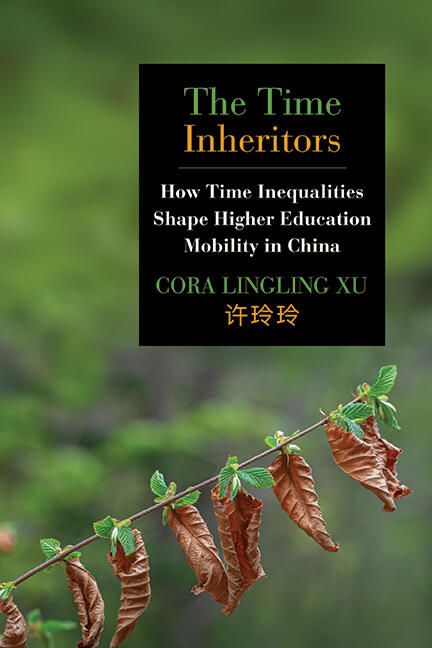
We are delighted to share the publication of a new book by our director Dr Cora Lingling Xu. Read this profile (in Chinese) with People Magazine 《人物》杂志 and blog post to learn about the personal stories behind this book.
Please find an abstract of ‘The Time Inheritors‘ and critical reviews below.
If you wish to order this book, you can use SNWS25 to get 30% off when you order from the SUNY Press website.
To learn more about the book talks and interviews visit this page. Listen to the New Books Network’s interview with Cora. 听’时差In-Betweenness’与Cora的对话(小宇宙链接). Check out this page for frequently asked questions (e.g. what you should do if you wish to write a book review) about this book. Share your stories of ‘time inheritance’. If you wish to contact Cora about arranging book talks and interviews, complete this contact form.
Abstract
Can a student inherit time? What difference does time make to their educational journeys and outcomes? The Time Inheritors draws on nearly a decade of field research with more than one hundred youth in China to argue that intergenerational transfers of privilege or deprivation are manifested in and through time. Comparing experiences of rural-to-urban, cross-border, and transnational education, Cora Lingling Xu shows how inequalities in time inheritance help drive deeply unequal mobility. With its unique focus on time, nuanced comparative analysis, and sensitive ethnographic engagement, The Time Inheritors opens new avenues for understanding the social mechanisms shaping the future of China and the world.
Critical reviews
“Xu’s conceptually sophisticated monograph reveals how intersectional inequalities are constructed, experienced, and transmitted temporally, with special reference to education. Through the vivid stories of students in mainland China and Hong Kong, and Chinese international students, Xu brings to life different individuals’ ‘time inheritances,’ demonstrating the exciting possibilities time offers as a lens for innovative thinking about inequality. A must-read for sociologists and anthropologists of education, China, and time.” — Rachel Murphy, author of The Children of China’s Great Migration
“Innovative and ambitious, The Time Inheritors proposes a time-centric framework that brings together analyses of social structure, history, individual behavior, and affect. We often feel we are fighting for time. But, as Cora Xu argues in this important study of Chinese students, the scarcity of time is not a given or universal. Different experiences of time result in part from the varying amounts of time we inherit from the previous generation. Time inheritance is therefore critical to the reproduction of social inequality.” — Biao Xiang, coauthor of Self as Method: Thinking through China and the World
“Cora Lingling Xu offers a groundbreaking analysis of educational inequality and social mobility in contemporary China. Xu centers the voices of marginalized students throughout, providing poignant insights into their lived experiences of rural poverty, urban precarity, and educational alienation. At the same time, Xu’s comparative scope reveals how even seemingly privileged groups can be constrained by the temporal logics of social reproduction. The Time Inheritors is a must-read for scholars, educators, and policymakers concerned with educational equity and social justice. Xu’s lucid prose and engaging case studies make the book accessible to a wide audience while her cutting-edge theoretical framework and methodological rigor set a new standard for research on education and inequality.” — Chris R. Glass, coeditor of Critical Perspectives on Equity and Social Mobility in Study Abroad: Interrogating Issues of Unequal Access and Outcomes
“By centering the temporal dimension of who is advantaged or disadvantaged, how, why, and with what consequences, The Time Inheritors takes a unique and powerful approach. Not only does the book contribute theoretically and empirically to our understanding of class inequalities but it also resonates deeply. The inclusion of Chinese translations and characters will give Chinese readers a rich, nuanced cultural appreciation of her findings.” — Dan Cui, author of Identity and Belonging among Chinese Canadian Youth: Racialized Habitus in School, Family, and Media
“An extremely well-written, theoretically informed, and compelling volume that represents a major contribution to the study of education, migration, and social inequality in China and beyond. The Time Inheritors proposes a bold and innovative framework—that of time inheritance—to open the black box of social inequality’s temporal dimension. Whereas the relatively privileged classes inherit temporal wealth and strategies that enable them to bank and save time, facilitating their mobility, the time poor lack this inheritance, forcing them into a vicious cycle of wasting time and paying back temporal debts. Drawing from a rich palette of vivid and intimate longitudinal case studies, The Time Inheritors unpacks the complex intersections between familial, national, and global time inequalities.” — Zachary M. Howlett, author of Meritocracy and Its Discontents: Anxiety and the National College Entrance Exam in China
Release Dates
Hardcover: 1st April 2025
Paperback: 1st October 2025

 Network for Research into Chinese Education Mobilities (NRCEM)