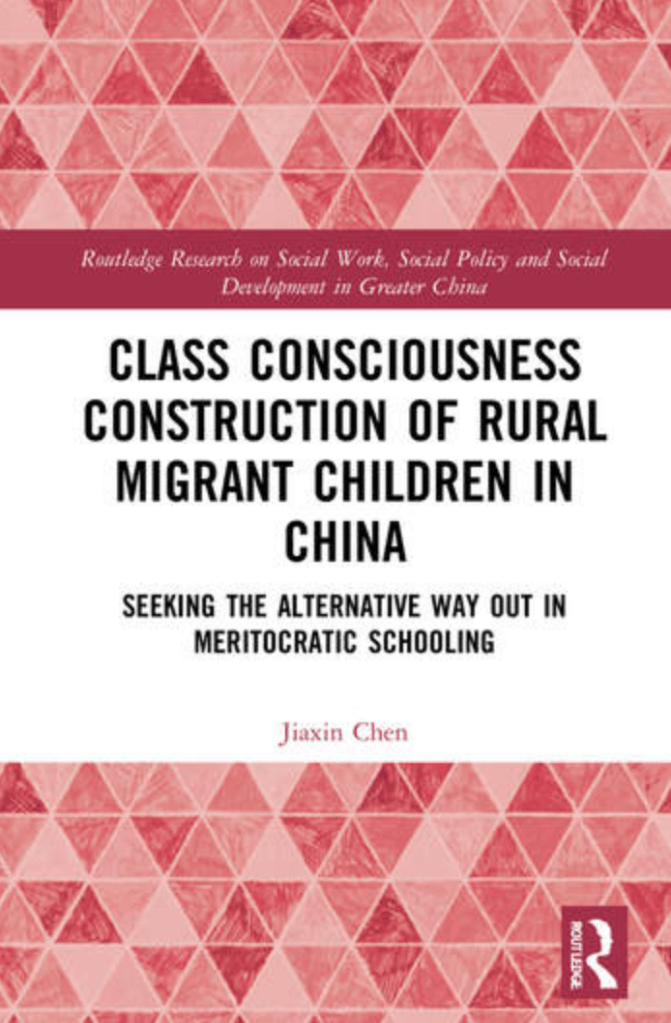
Class Consciousness Construction of Rural Migrant Children in China: Seeking the Alternative Way Out in Meritocratic Schooling

Jiaxin Chen (2022) Class Consciousness Construction of Rural Migrant Children in China. Taylor & Francis.
As China’s urban economy continued to boom after entering the twenty-first century, its rural migrant population experienced unprecedented expansion, making it a significant portion of the working-class people in China. Despite their massive population, rural migrant workers enjoy little labour protection and endure long working hours, subsistence-level wages, and harsh working conditions. However, they rarely take collective action against the injustices they experience. With lacking of the central element for class formation, as the emerging ‘new’ members of the Chinese working class, rural migrant workers are still in the state of ‘class-in-itself’. This phenomenon calls for attention to the formation of migrant workers’ class consciousness.

In this monograph, I address this issue by focusing on its constructive process in childhood. To be specific, I mainly focus on the construction of class consciousness among rural migrant children, who are likely to reproduce their parents’ migrant working jobs in the future. I intend to answer two main research questions: How rural migrant children perceive their surrounding social realities and how their social perceptions could be constructed and reshaped throughout their urban schooling process. I conducted qualitative investigations in two primary schools – one private migrant school and one public school in Beijing between June 2014 and April 2015. Data were drawn from document reviews, questionnaires, interviews, and school observations conducted in the two case schools.

This book borrows Paulo Freire’s works on two states of consciousness – false and critical – of the oppressed to conceptualise an analytic framework. Findings reveal that, even at their young age, rural migrant children had already developed an awareness of manual workers’ poor working conditions and inferior situation relative to their employers. They distinguished between manual and mental labour, firmly subscribing to the latter’s superiority. They also believed in meritocracy, seeing workers’ educational failures as the primary cause of their falling into and being limited to physical labour and their adversities. Because of their perceptions of a hierarchical social structure, rural migrant children favoured mental-labour-oriented occupations and expected to become employers to differentiate themselves from their parents, who mainly worked as manual labourers. However, although rural migrant children considered the employment regime as the critical mechanism of exploitation, they tended to blame incidents of exploitation on the poor moral quality of individual employers and workers’ bad luck.

Such attribution features make it unlikely that these children would take collective action to improve their future employment relations. Indeed, many of them rejected the collective action migrant workers could have performed in the labour market. Therefore, if these migrant children eventually become the next generation of China’s new workers, they may adopt similar strategies as their parents and the current migrant working class, such as enduring hardships and relying upon the employers’ morality and conscience (not workers themselves) to initiate action for improvement.

This book proves that the formation of class consciousness begins early in one’s childhood. However, rural migrant children’s interpretations of perceived class-based inequalities and their intended actions to achieve future improvements showed a state of false consciousness overshadowed by individualism, meritocracy, and the duality of images. More importantly, such dominant ideologies of individualism and meritocracy and the depreciation of migrant workers were strongly embraced by migrant families and school environments, the two most significant institutions shaping migrant children’s class consciousness construction.

The family context plays an important role in revealing the problematic situation of the migrant working class in mainstream society to rural migrant children, allowing them to develop their awareness. However, it must be admitted that migrant parents’ passive acceptance of their bosses’ labour abuses could also send their children the message that workers are weak and have no choice but to swallow the abuse and endure.

Schools, therefore, are expected to play a pivotal role in cultivating children’s critical consciousness, from offering oppressed children a chance to identify that they are situated in social, political, and economic contradictions to problematising the contradictions of (and eventually initiating collective actions against) social oppression. Nevertheless, as discussed in this book, such a possibility is also in danger and challenged by the current schooling system. As investigated, all teachers at the two case schools were committed to the ideology that ‘education changes destiny.’ Like migrant parents, teachers also saw studying hard as the only conceivable way for migrant children to climb the social ladder, even though only a token number would ever enter university and become white-collar professionals, and most would be tracked into vocational education or directly into the labour market. Despite the good intentions underlying teachers’ work to motivate migrant children to study, teachers’ negative narrations of migrant parents embedded within the schools’ educational meritocracy further reinforced rural migrant children’s recognition of manual workers’ inferiority in the labour market.

A small group of teachers in the private migrant school actively attempted to unravel the issues of social inequality among their migrant students in the school context. Nevertheless, labour issues were still rarely addressed in the school context or, again, were viewed from the perspective of the migrant–local/rural-urban dichotomy. Additionally, teachers’ limited teaching competency in the migrant school significantly constrained the quality of their initial attempts to critically analyse class-based inequalities with migrant children.

In this vein, neither the migrant children nor the adults and institutions surrounding them had enough exposure to conceptual resources to form critical views of social inequalities from the class dimension. The above findings suggest that the current lack of collective resistance among China’s ‘new workers’ may result from workers’ strong belief in meritocracy and internalisation of the employer position they developed in their youth while in school.

Overall, this book bridges the research gap by applying a critical class perspective to the analysis of migrant children’s perception of their and their working-class parents’ experiences of marginalisation and exclusion in urban society and the influence of urban schooling thereon. These findings also provide empirical evidence to verify Freire’s explanation of the development of oppressed people’s social consciousness from a Chinese perspective.

Author Bio
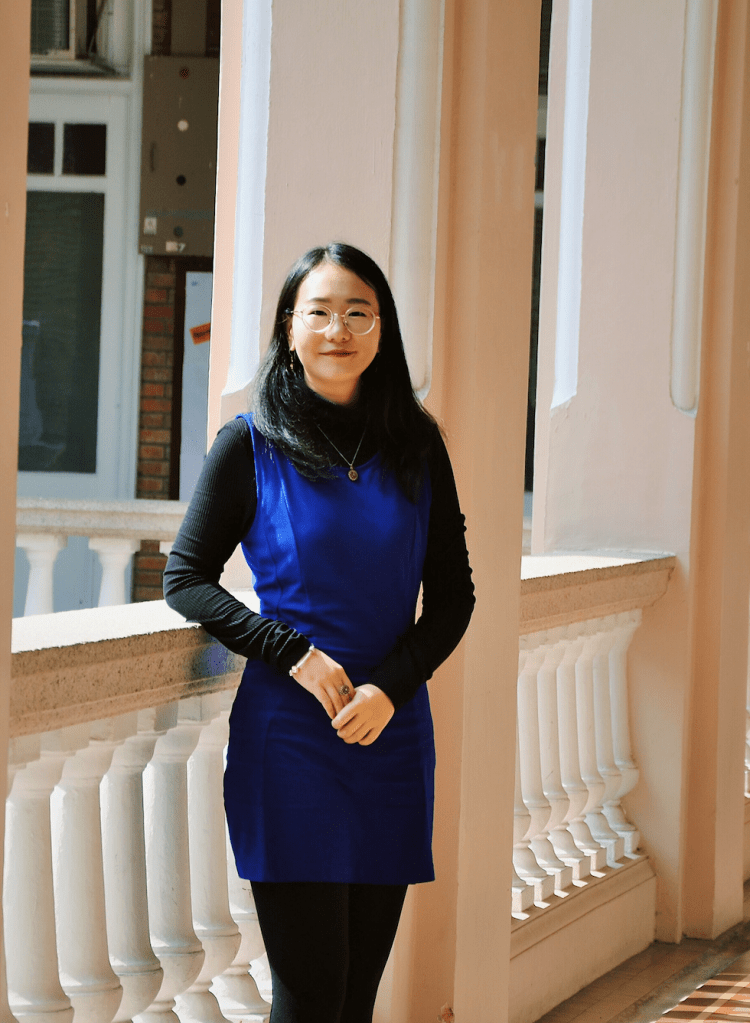
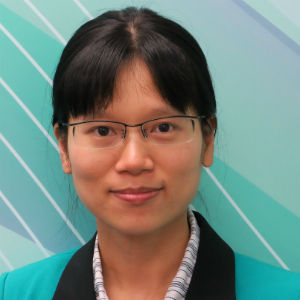
Dr Jiaxin Chen, The Hong Kong Polytechnic University

Dr Jiaxin Chen is an Assistant Professor at the Department of Applied Social Sciences, The Hong Kong Polytechnic University, Hong Kong. Her research interests include rural-urban inequalities and labour migration in China, academic mobility, parenting, and rural community development. She is particularly interested in investigating social issues via the sociological lens and qualitative methods. She is currently working on two research projects, academic returnees’ cultural adaptation in Chinese higher education system (funded by Early Career Scheme from Hong Kong Research Grants Council) and rural migrant parents’ involvement in children’s education in China.

Managing editor: Tong Meng

From Female Graduates to Female Insurance Agents: Educationally Channeled Labour Mobility from Mainland China to Hong Kong

Research highlighted

Zhou, S. & Song, J. (2022). From Female Graduates to Female Insurance Agents: Educationally Channeled Labor Mobility from Mainland China to Hong Kong. Journal of Chinese Women’s Studies, 171(3). Available at: https://mp.weixin.qq.com/s/kopLQ74k-9n8I3ShrZtwWA

中文版本

In the increasingly interwoven global trends of educational mobility and labor migration, a growing number of young women have obtained higher education and acquired greater labor mobility, and have been involved in service work that is more professional and with higher job status. Nevertheless, educational mobility and labor migration are commonly regarded as two independent research fields. Education migration is often related to a promotion of employment opportunities for young people, which provides chances of social upward mobility for men and women. For labor migration studies from a gender perspective, female migrants are often found to concentrate in labor-intensive and low-paid service work. Little attention has been paid to the field where the two topics are related. In Hong Kong, due to the cross-border expansion of the insurance industry in recent years, many female graduates from mainland China have benefited from their cultural capital and cross-border social connections and have been recruited as insurance agents. This study examines the gendered experiences of cross-border labor mobility of these atypical skilled migrants and professional service workers.

This study adopted a qualitative research approach based on in-depth interviews with 32 female graduates who had mainland backgrounds and worked as insurance agents in Hong Kong. The study also draws on participant observation of their work and life, as well as online ethnography about how individuals and companies presented such cross-border labor mobility on social media. To examine women’s educationally channeled labor mobility, this study focuses on how they were recruited and why they chose to become insurance agents. The findings indicate that Hong Kong’s cross-border insurance business tended to recruit highly educated women with mainland backgrounds as professional, independent, and elite women, meanwhile with an emphasis on their patient and empathetic femininity. Such narratives restructured and reinforced gender stereotypes prevalent in service work. These highly educated women were able to utilize human capital and cross-border freedom to pursue greater autonomy in career choice against the control of natal families in places of origin. Nevertheless, these young women also faced a double marginality in the host labor market regarding gender and geography, and they still needed to balance family obligations and career aspirations over the life course. Women’s cross-border mobility helped them to pursue individualistic aspirations and negotiate new career pathways, which challenged traditional gender stereotypes in low-end feminized service work, but their professional and independent workplace images were still constrained by the gendered division of labor and structural inequalities in public and private spheres.

By focusing on female graduates in the cross-border insurance industry, this study demonstrates how the intersection of educational mobility and labor migration can provide new employment opportunities for highly educated women. To some extent, women’s cross-border participation in professional service work has undermined traditional gender role expectations, but their personal choices have not formed a fundamental challenge to gender and structural inequalities in the labor market and domestic spheres. Bridging the two research traditions on educational mobility and labor migration, this study suggests incorporating women’s education-based resource and horizon into the study of their working experience in the host labor market, and linking women’s diverse career choices with their evolving gendered self-positioning processes. The new perspectives can add to a better understanding of how women’s migration brings about new economic opportunities as well as social pressure, and contribute to a more comprehensive reflection on the gender and social implications of women’s evolving career choices.

Author Bio

Siyuan Zhou (周思媛),
The Chinese University of Hong Kong

Ms. ZHOU Siyuan (周思媛) is a Ph.D. candidate in Gender Studies Programme and the Department of Sociology at the Chinese University of Hong Kong. Her research interests include gender and work, migration, and female entrepreneurship. Her doctoral project is about “doing gender” and “doing business” between Hong Kong and mainland China among female IANG insurance agents (Email: siyuanzhou@link.cuhk.edu.hk).

Dr. Jing Song (宋婧),
The Chinese University of Hong Kong

Dr. Jing Song (宋婧) is an Associate Professor in Gender Studies Programme at The Chinese University of Hong Kong and an Associate Researcher (by courtesy) at Shenzhen Research Institute, The Chinese University of Hong Kong. Her research interests include family, gender, work, urbanization, migration and China’s market transition. She has published in China Quarterly, Journal of Contemporary China, Urban Studies, Journal of Rural Studies, Work Employment and Society, Population Space and Place, China Review, Journal of Sociology, Journal of Comparative Family Studies, Housing Studies, Asian Anthropology, and so on. Her book Gender and Employment in Rural China was published in 2017 by Routledge (Email: jingsong@cuhk.edu.hk).

Managing editor: Lisa (Zhiyun) Bian

Call for Papers: Chinese Sociological Review

Special Issue on Growing Up in a Time of Uncertainty: Rethinking Education and Inequality in Chinese Societies and Beyond

Guest Editors

Anning Hu, Fudan University

Angran Li, NYU Shanghai

Duoduo Xu, University of Hong Kong

《中华社会学评论》是Chinese Sociological Review的中文刊名。本刊努力推动对当代中国社会的高质量、专业化的深入研究, 见证了很多年轻的量化社会科学学者的成长,现向海内外学界同仁征稿。

Growing Up in a Time of Uncertainty:

Rethinking Education and Inequality in Chinese Societies and Beyond

We are living in a time of tremendous uncertainty for our children’s future. The lingering COVID-19 pandemic, the rapidly changing policy environment, the foreseeable economic recession, and the clashing cultural repertoires, have fundamentally reshaped our educational institutions, generating long-lasting impacts on individual educational trajectories and outcomes as well as on social inequality and mobility. In Chinese societies, as in societies elsewhere, children, parents, teachers, and schools have to accommodate the unintended consequences of school closure, policy changes, and other interruptions during the time of uncertainty. Although new strategies and practices have been adopted to facilitate student learning, widening inequality impends to disrupt our educational systems and to leave many children behind.

Against this backdrop, Chinese Sociological Review (CSR) invites papers for a special issue on Growing Up in a Time of Uncertainty: Rethinking Education and Inequality in Chinese Societies and Beyond. This call invites authors to submit papers that consider various aspects of the relationship between education and inequality under a time of uncertainty in Chinese societies, preferably with a global and comparative perspective. We encourage submissions from various sectors, countries (areas), and disciplines. Both empirical (quantitative, qualitative, mixed methods) and theoretical studies are welcomed.

We are particularly interested in papers that explore the following questions:

  • What impact do the pandemic, policy changes, economic recession, and cultural shifts have on the future of primary, secondary, tertiary, and post-tertiary educational systems? How do these changes alter the existing educational inequalities and generate new ones at the individual, organizational, and national levels?
  • What are the macro-, meso-, and micro-level social mechanisms that can explain the emerging educational inequalities given the institutional transformations in response to those uncertainties?
  • What are the emerging strategies and practices adopted by families and schools that can help to close the gap in educational outcomes and build more equitable educational systems during the time of uncertainty?

We also welcome research addressing the following themes:

  • Chinese Meritocratic Educational Systems
  • Cultural Capital in Non-western Contexts
  • Policy Changes and Shadow Education
  • School Choice in Chinese Societies

Submission Guideline

Authors who want their work to be considered for publication in this special issue should email a proposal with a captioned title “CSR Education Special Issue” to specialcsr@gmail.com and address to Guest Editors Anning Hu, Professor of Sociology, Fudan University, Angran Li, Assistant Professor of Sociology, NYU Shanghai, Duoduo Xu, Assistant Professor of Sociology, The University of Hong Kong, by August 31, 2022. Proposals should be about 1,000 words long in total and should articulate how the themes of the special issue are addressed.

The editorial team will consider the pool of proposals received by this deadline. Proposals will be selected based on their theoretical and/or practical contributions. Once been selected, the editorial team will invite the authors to submit a full paper (no more than 9000 words). Invitations to submit the full-length research papers will be sent out to authors by Sept 10, 2022. The full-length paper for peer reviews will be due on November 30, 2022. A workshop may be organized for authors to present their work and further improve their manuscripts. The special issue is expected to be published online before Fall 2023.

Chinese Sociological Review (CSR) (Print ISSN: 2162-0555 Online ISSN: 2162-0563), founded in 1968, publishes high-quality original works from sociologists and other social scientists. The mission of the journal is to advance the understanding of contemporary Chinese society and contribute to general knowledge in the discipline of sociology. All research articles will undergo a rigorous editorial screening and peer review process. The journal is intended for an international readership, now published by Taylor & Francis Inc. 530 Walnut Street, Suite 850, Philadelphia, PA 19106.

For more information, please visit https://www.tandfonline.com/journals/mcsa20.

Managing editor: Tong Meng

Reimagining Chinese diasporas in a transnational world: toward a new research agenda

Shibao Guo (2022) Reimagining Chinese diasporas in a transnational world: toward a new research agenda, Journal of Ethnic and Migration Studies, 48:4, 847-872, DOI: 10.1080/1369183X.2021.1983958.

Prof. Shibao Guo from the University of Calgary guest edited a special issue for the Journal of Ethnic and Migration Studies – Chinese Diaspora Studies in a Transnational World – which was published in Volume 48, Issue 4, 2022. This special issue examines the changing nature of the Chinese diasporas in a transnational world and its concomitant implications for Chinese diaspora studies internationally. In the research agenda-setting Introduction, Prof. Guo theorizes the new patterns of Chinese diasporas which can be characterized by unprecedented hypermobility, hyperdiversity, and hyperconnectivity. Such characterizations depict the global dispersal of overseas Chinese as one of the most hyperdiverse groups with substantial sub-group differences that distinguish it from most other diasporas. This special issue consists of six empirically-based articles on Chinese diasporas studies, from a variety of disciplinary or interdisciplinary perspectives, by scholars from different parts of the world. Their perspectives have contributed to the existing Chinese diasporas literature and the interdisciplinary fields of ethnic, migration and mobility studies. Here are the links to the special issue:

Journal of Ethnic and Migration Studies: Vol 48, No 4 (tandfonline.com)

Full article: Reimagining Chinese diasporas in a transnational world: toward a new research agenda (tandfonline.com)

Author Bio

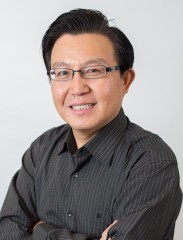
Professor Shibao Guo, University of Calgary, Canada

Dr. Shibao Guo is Professor at the Werklund School of Education, University of Calgary. Over the past twenty years as a transnational academic and scholar, Dr. Guo has developed research expertise in the areas of transnational migration, Chinese diasporas studies, ethnic and race relations, and comparative and international education. His research has been funded by a number of organizations, including the Social Sciences and Humanities Research Council of Canada; Immigration, Refugees and Citizenship Canada; Asia Pacific Foundation of Canada; International Organization for Migration; and Education International. Prof. Guo has numerous publications including books, journal articles, and book chapters. His latest books include: Decolonising lifelong learning in the context of transnational migration (Routledge, 2020), Immigration, racial and ethnic studies in 150 years of Canada: Retrospects and prospects (Brill|Sense, 2018). He is former president of Canadian Ethnic Studies Association (CESA) and the Comparative and International Education Society of Canada (CIESC). Currently he is co-editor of Canadian Ethnic Studies and two book series for Brill|Sense Publishers: Transnational Migration and Education and Spotlight on China.

Managing editor: Tong Meng

Mobile educational space and imaginative travellers in-situ: A case study of a UK international branch campus

Research highlighted

Jingran Yu (2022) Mobile educational space and imaginative travellers in-situ: A case study of a UK international branch campus in ChinaSocial & Cultural Geography, DOI: 10.1080/14649365.2022.2055780

An increased awareness has emerged within academia of how international student mobility (ISM) intensifies differentiation within global educational geographies, consolidating the educational power of certain institutions within specific countries, and consequently entrenching and sometimes even creating socio-spatial inequalities (e.g., Brooks & Waters, 2011; Findlay et al., 2012; Waters, 2012). In contrast, transnational education (TNE), ‘in which the learners are located in a country different from the one where the awarding institution is based’ (Council of Europe, 2002), enables students to receive international education in situ. Instead of the corporeal movement of students, in TNE, it is the education provider that is on the move, incorporating various interdependent movements of educational resources, including teaching materials, knowledge, information, and even staff and institutions. Thus, TNE seems to hold great potential for promoting the reconfiguration of educational geographies through its important role in connecting educational institutions and participants across different places and influencing the (re)distribution of educational resources and power across global space (Leung & Waters, 2013). However, compared to ISM, TNE remains under-researched. The few empirical studies that have explored this topic have concluded that its value has been fundamentally compromised owing to the lack of corporeal mobility (e.g., Waters, 2017, 2018).

This paper challenges the predominant representation of TNE students merely in terms of their corporeal immobility and problematizes the neglect of spatiality and materiality of international branch campuses (IBCs) in extant studies. Based on a case study of a UK international branch campus in China, it incorporates interview narratives and ethnographic observations to reveal the students’ experiences and imaginations, and to delineate the unique texture of the spatiality of the campus. It is worth noticing that IBCs in China are required to take the form of ‘Chinese-Foreign Cooperative Universities’, i.e. ‘joint-venture IBCs’ in the expanded definition provided by the Observatory on Borderless Higher Education (Garrett et al., 2016). The power balance between the Chinese and foreign partners has profound influences on the spatiality of the campus. In this case study, this power balance between the Chinese and British partners has resulted in the unique layout of the university campus which is roughly divided into two halves: the Academic Area, controlled by the British partner, and the Living Area, where the Chinese partner is mainly in charge. 

In this paper, I present the case-study IBC as an infrastructure of (im)mobilities, which is both locally embedded and transnationally connected. On the one hand, this paper explores how transnational imaginations are enabled by the immobile materiality of the IBC in three dimensions: the material space, the virtual space, and the relational space. On the other hand, informed by the perceived–conceived–lived conceptual triad (Lefebvre, 1991/2014), this paper investigates Chinese students’ imaginative spaces by looking at how they perceive, experience, and conceive various spaces, on the basis of which they develop a sense of (not) belonging. This is where issues emerge around ‘whose space’ it is when the control over space is challenged. IBC space and its imagination, as intended by the TNE institution, may not always coincide with the ideas of the students and their imaginative space. At times, the two may collide. 

As the students embody transnational imaginations and mobilities in situ, they are transformed into what I perceive as imaginative travellers, who never physically travel abroad but whose being and belonging have been constantly informed and negotiated in relation to their everyday transnational experiences. Travelling between two different spaces, the Academic Area and the Living Area, the national and the transnational setting, has become a daily routine for the students, contributing to their embodiment of transnational mobilities in an imaginative form and giving shape to the transnational imaginative space they conceive. Informed by their own predispositions, students have developed transnational spatial imaginations, according to which they make differentiated judgements about the different styles in the material environment they inhabit and develop a sense of (non)belongingness to different cultures through their spatial experiences. In everyday spatial practice, imagined and actual spaces may sometimes reinforce and sometimes negate each other. Students then develop a sense of ‘our’ and ‘their’ space – a sense of belonging and not belonging – in their perceptions, experiences, and conceptions. This may have coloured their perceptions, leading to a value-laden appreciation of the space in the Academic Area as well as their simultaneous dislike of the space in the Living Area.

The findings have teased out the ways in which transnational imaginations are enabled by immobile materiality of the IBC, and how students consequently construct their imaginative space, revealing the dynamic interrelations between imagination, materiality, and (im)mobility in (transnational) educational spaces. As international student mobility (in the sense of corporeal mobility) has intensified, and sometimes even created socio-spatial inequalities in global educational geographies, it is important for scholars to pay attention to the imaginative mobilities enabled by TNE because ‘imagination is an essentially creative act that facilitates people’s ability to move beyond structural imbalances of power and economic constraints’ (Salazar, 2020, p. 773). Indeed, imaginative mobility may not be a substitute for corporeal mobility, but may instead change the very nature of being co-present. Accordingly, our views on the emplacement of education, as either here (domestic education) or there (international education), also need to expand to include educational spaces that can be both here and there, that is, trans-national. Contributing to the early discussions about IBCs as infrastructures of (im)mobility, what is novel in this paper is that it offers detailed depictions of the imaginative process, in which spatial imagination and imaginative space (re)produce each other, and are complicated by the various sources of power at play. Drawing upon thick ethnographic data, this paper offers a unique case study of a Chinese-Foreign Cooperative University in which the power balance between the British and Chinese partners has profound implications on the uneven spatiality of the campus. It is important to pay attention to the ‘unevenness of imagination flows’ (Lipura & Collins, 2020), which is subject to political economy in the wider sociocultural context, in which the mythological ‘West’ is often considered ‘legitimate’ and imbued with much higher symbolic value than ‘the rest’. Students, whom I call ‘imaginative travellers’, have tended to display a proximity to ‘the West’, which is physically distant and where most of them have never been, in contrast to ‘the Chinese’ where they are actually located but from which they are imaginatively distant. This may reinforce the existing symbolic power of the West in the global stratification of knowledge.

Authors’ Bio

Dr Jingran Yu (余婧然),
Xiamen University, China

Dr. Jingran Yu (余婧然) is an Assistant Professor at the Institute of Education, Xiamen University, China, and an Honorary Research Associate at the School of Environment, Education and Development (SEED), the University of Manchester, the United Kingdom. She received a doctorate degree in Sociology from the University of Manchester, and won the British Educational Research Association (BERA) 2021 Doctoral Thesis Award for her thesis. Her research interests lie at the intersection of sociology, education, and human geography, with a focus on internationalisation of higher education and socio-spatial (im)moblities. She can be contacted at: yujingran@xmu.edu.cn or jingran.yu@manchester.ac.uk.

Managing editor: Lisa(Zhiyun) Bian