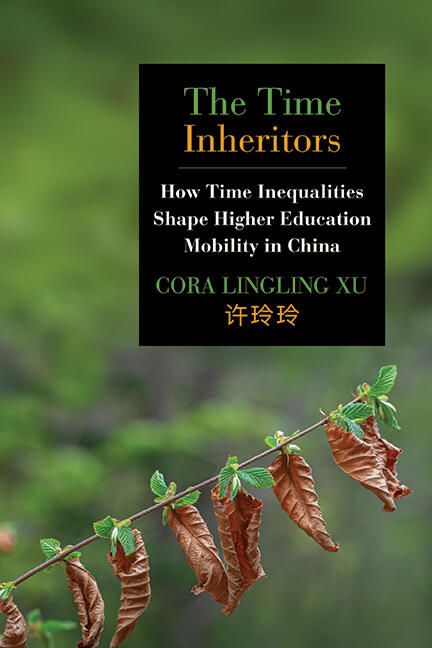
‘The Time Inheritors: How Time Inequalities Shape Higher Education Mobility in China’ by Cora Lingling Xu

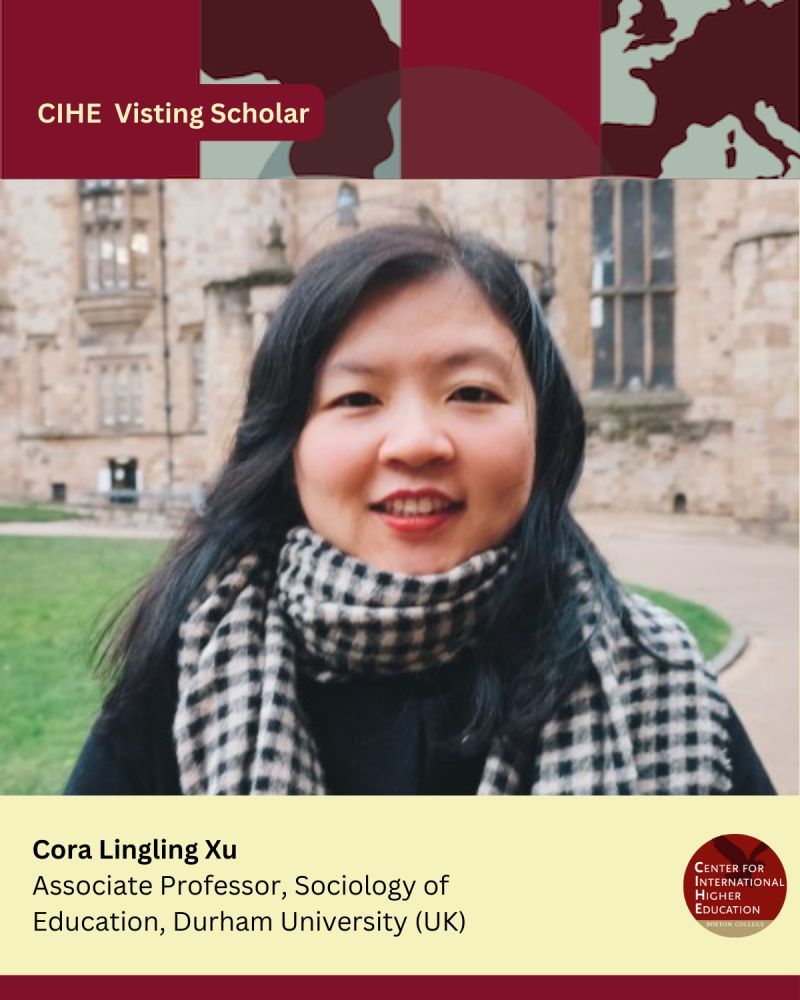
We are delighted to share the publication of a new book by our director Dr Cora Lingling Xu. Read this profile (in Chinese) with People Magazine 《人物》杂志 and blog post to learn about the personal stories behind this book.

Please find an abstract of ‘The Time Inheritors‘ and critical reviews below.

If you wish to order this book, you can use SNWS25 to get 30% off when you order from the SUNY Press website.

To learn more about the book talks and interviews visit this page. Listen to the New Books Network’s interview with Cora. 听’时差In-Betweenness’与Cora的对话小宇宙链接). Check out this page for frequently asked questions (e.g. what you should do if you wish to write a book review) about this book. Share your stories of ‘time inheritance’. If you wish to contact Cora about arranging book talks and interviews, complete this contact form.

Abstract

Can a student inherit time? What difference does time make to their educational journeys and outcomes? The Time Inheritors draws on nearly a decade of field research with more than one hundred youth in China to argue that intergenerational transfers of privilege or deprivation are manifested in and through time. Comparing experiences of rural-to-urban, cross-border, and transnational education, Cora Lingling Xu shows how inequalities in time inheritance help drive deeply unequal mobility. With its unique focus on time, nuanced comparative analysis, and sensitive ethnographic engagement, The Time Inheritors opens new avenues for understanding the social mechanisms shaping the future of China and the world.

Critical reviews

“Xu’s conceptually sophisticated monograph reveals how intersectional inequalities are constructed, experienced, and transmitted temporally, with special reference to education. Through the vivid stories of students in mainland China and Hong Kong, and Chinese international students, Xu brings to life different individuals’ ‘time inheritances,’ demonstrating the exciting possibilities time offers as a lens for innovative thinking about inequality. A must-read for sociologists and anthropologists of education, China, and time.” — Rachel Murphy, author of The Children of China’s Great Migration

“Innovative and ambitious, The Time Inheritors proposes a time-centric framework that brings together analyses of social structure, history, individual behavior, and affect. We often feel we are fighting for time. But, as Cora Xu argues in this important study of Chinese students, the scarcity of time is not a given or universal. Different experiences of time result in part from the varying amounts of time we inherit from the previous generation. Time inheritance is therefore critical to the reproduction of social inequality.” — Biao Xiang, coauthor of Self as Method: Thinking through China and the World

“Cora Lingling Xu offers a groundbreaking analysis of educational inequality and social mobility in contemporary China. Xu centers the voices of marginalized students throughout, providing poignant insights into their lived experiences of rural poverty, urban precarity, and educational alienation. At the same time, Xu’s comparative scope reveals how even seemingly privileged groups can be constrained by the temporal logics of social reproduction. The Time Inheritors is a must-read for scholars, educators, and policymakers concerned with educational equity and social justice. Xu’s lucid prose and engaging case studies make the book accessible to a wide audience while her cutting-edge theoretical framework and methodological rigor set a new standard for research on education and inequality.” — Chris R. Glass, coeditor of Critical Perspectives on Equity and Social Mobility in Study Abroad: Interrogating Issues of Unequal Access and Outcomes

“By centering the temporal dimension of who is advantaged or disadvantaged, how, why, and with what consequences, The Time Inheritors takes a unique and powerful approach. Not only does the book contribute theoretically and empirically to our understanding of class inequalities but it also resonates deeply. The inclusion of Chinese translations and characters will give Chinese readers a rich, nuanced cultural appreciation of her findings.” — Dan Cui, author of Identity and Belonging among Chinese Canadian Youth: Racialized Habitus in School, Family, and Media

“An extremely well-written, theoretically informed, and compelling volume that represents a major contribution to the study of education, migration, and social inequality in China and beyond. The Time Inheritors proposes a bold and innovative framework—that of time inheritance—to open the black box of social inequality’s temporal dimension. Whereas the relatively privileged classes inherit temporal wealth and strategies that enable them to bank and save time, facilitating their mobility, the time poor lack this inheritance, forcing them into a vicious cycle of wasting time and paying back temporal debts. Drawing from a rich palette of vivid and intimate longitudinal case studies, The Time Inheritors unpacks the complex intersections between familial, national, and global time inequalities.” — Zachary M. Howlett, author of Meritocracy and Its Discontents: Anxiety and the National College Entrance Exam in China

Release Dates

Hardcover: 1st April 2025

Paperback: 1st October 2025

The Centre for Research in Educational and Social Inclusion invites you to attend ‘Capitalising on the intellectual bequest of Pierre Bourdieu for social and educational equity’

The Centre for Research in Educational and Social Inclusion invites you to attend ‘Capitalising on the intellectual bequest of Pierre Bourdieu for social and educational equity’

This seminar will present three papers, each from an established Bourdieusian scholar.  More information about schedule for the day below. 

10am-10.15am Acknowledgements and Welcome 

10.15am -11.15am Paper 1 and Q&A
Culture or structure? A Bourdieusian take on the curriculum of formal education

This theoretical paper presents a Bourdieusian framing of formal curriculum that was developed for a study of shadow education or private tutoring. Neo-institutionalism has been the dominant sociological theory in shadow education research. It understands shadow education in terms of a world culture of education and a schooled society. The world culture of education is thought to constitute the schooled society; and by the same logic, to motivate institutionalisation of shadow education. In contrast, it is structure that is socially constitutive in Bourdieusian theory. Bourdieu looked to the evolution of the structures of fields, including that of education, to explain modernity with its capitalist ethos. In these terms, shadow education is an investment in the cultural capital and symbolic power of the curriculum institutionalized in mass formal education. This theorisation is useful for understanding curriculum-making struggles in institutional, programmatic and instructional domains.

Karen Dooley is a Professor in the Faculty of Creative Industries, Education and Social Justice, Queensland University of Technology. Karen’s research focuses on curriculum in conditions of economic disparity and linguistic and cultural difference. She works with classic theories from the sociology of education, including those of Pierre Bourdieu and Basil Bernstein. Karen is currently completing one Australian Research Council Discovery project on shadow education, and is partway through another about home-school connections in times of digitalisation. Karen has taught from early childhood to university in Australia and as a English as a middle school  foreign language teacher in China.  

11.15am-12.15pm Paper 2 and Q&A 
Bourdieu and Sayad’s contributions to knowledge via multi-language modes of research: Postmonolingual theorising as a method of thinking critically  

This study makes an original contribution to methodological knowledge by establishing grounds for postmonolingual theorising as a method of thinking critically. A familiar research practice for making an original contribution to knowledge entails applying, critiquing, and/or extending the signature conceptual products of internationally renowned scholars such as Bourdieu. In contrast, this study argues that efforts to make an original contribution to knowledge also benefit from the problematisation of such taken-for-granted research practices. This study identifies the place of multiple languages in Bourdieu and Sayad’s (1964/2020) mode of research practice employed in their Franco-Algerian field study, albeit practices of theorising that they do not explicitly address. Arguably, multi-language practices of theorising are worth considering for evaluating their use for making an original contribution to knowledge, for challenging monolingual research practices, and for capitalising on researchers’ multi-language capabilities, including those theorists who only speak (multilingual) English.

Michael Singh is a Professor at Western Sydney University. He investigates possibilities for, and constraints on collective counter-agency through research that does not conform to dominant expectations or norms (hysteresis). Focusing on continuing historical struggles over languages in research-informed, education policy practices, Singh explores postmonolingual theorising as a research method for mounting critiques of the logic and practices of domination. Singh works with Higher Degree Researchers to capitalise on misrecognised intellectual cultures, using divergent funds of theoretical knowledge in their repertoire of languages for making original contributions to knowledge. Recently, Professor Singh co-authored Localising Chinese: Educating Teachers through Service-Learning with Dr Nhung Nguyễn, and Postmonolingual Critical Thinking: Internationalising Higher Education through Students’ Languages and Knowledge with Dr Lù Sī Yì (陆思逸).  

12.15-14.30 Lunch 14.30-15.30 Paper 3 and Q&A 
Social problematics and the role of philosophical anthropologies: Evaluating Bourdieu’s framework 

Philosophical anthropologies (PAs) – ontological assumptions about human species-nature – have been controversial in sociological research since Foucault rejected all need for them. Bourdieu resisted this post-PA tide. Agreeing with Bourdieu that PAs are unavoidably assumed in explaining social problematics, I explore his conceptual framework for necessary PAs and how they interact with his worthy analytic concepts for sociological research: e.g. ‘habitus’, ‘field’, ‘forms of capital’. Yet I question Bourdieu’s assumed PA of a ‘libidinal’ need for recognition that drives competitive power-games in social fields. I argue further that a PA is needed-but-missing in Bourdieu’s framework to explain how field participants enact agency to challenge power-games in pursuit of social-ethical purposes for their labours. Drawing on survey data in which Australian education academics comment on how workforce restructures affect their labours, I find the needed PA in Karl Marx’s ‘use-value’ and ‘alienation’ concepts. I thus advocate a ‘Marxification’ of Bourdieu’s framework.

Lew Zipin is a Senior Research Fellow at UniSA; an Honorary Fellow at Victoria University, Melbourne; and an Extraordinary (adjunct) Professor at Stellenbosch University, South Africa. His research, scholarship and practice draw on Bourdieu for sociological analysis of how mainstream school curriculum selectively (re)produces unjust power inequalities. At the same time, he takes up the Funds of Knowledge (FoK) approach to socially-just curricular use of knowledges which have asset-value in lifeworlds of students from marginalised social positions, but which school-worlds too-typically treat as ‘deficits’. Lew thus combines Bourdieuian analysis with FoK praxis in ways that reciprocally fill gaps in combining strengths of each. 

The seminar will be delivered synchronously face-to-face and online.  

Date Monday 25th September 2023 Time 10am – 3:30pm (ACST) please convert to your local time Venue UniSA Mawson Lakes Campus GP2.39 or via Zoom
REGISTER HERE

For further information, contact Associate Professor Michael Mu

Bourdieusian Boundary-Making, Social Networks, and Capital Conversion: Inequality among International Degree Holders in Hong Kong

Au, A. (2023). Bourdieusian Boundary-Making, Social Networks, and Capital Conversion: Inequality among International Degree Holders in Hong Kong. Cultural Sociologyhttps://doi.org/10.1177/17499755231157115

The following summary was prepared by Dr Anson Au’s student: Yuxiao Liu (刘宇骁)

Within the sociological perspective of education, capital and distinction, existing literature has fully discussed the various ways and mechanisms of education transforming from cultural capital to other forms of capital (Lareau and Weininger, 2003). 

However, this direct conversion of different types of capital is not always smooth. With the popularization of international education, non-elite middle-class families are also able to send their children to overseas countries for higher education. The number of international bachelor’s degree holders or above is gradually increasing, which leads to the increasingly saturated labor market and increasingly fierce competition in the job market. Graduates with an international degree are less likely than before to find a decent job that meets their income expectations, which means that the direct conversion of cultural capital from an overseas education degree into economic capital is more difficult than ever (Tholen and Brown, 2017). In this context, how can international degree-holders transfer their cultural capital to other types of capital? And how can they justify an international degree with declining economic returns?

Indeed, while much research has been dedicated to examining the direct benefits of an international higher education degree, less attention has been devoted to understanding the cultural schemas that graduates acquire through foreign higher education, especially among those with non-elite university degrees whose economic returns begin to falter. Addressing this lacuna, this article inquires into the meaning-making in international student migration and the perceived value of an international education degree when its ability to convert into economic capital is disrupted. 

The study focuses on the case of international degree holders in Hong Kong and draws upon Bourdieu’s theory of practice to interrogate the cultural schemas that valorize international degrees when their conversion pathways to economic capital are subjectively perceived to weaken. 

When the ability of international degrees as cultural capital to convert into economic capital is undermined, how do international degree graduates perceive the indirect or implicit benefits of their degrees(the perceived value) and why they still choose to pay more for an overseas university (meaning-making in education)?

Using semi-structured interviews with non-elite international degree graduates based in Hong Kong, this study examines how cultural schemas resist change and symbolic violence is enacted among graduates against other degree holders in the wake of diminishing economic returns. 

Traditionally, a Western legacy of cultural colonization in Hong Kong has allowed international degree holders to remain more competitive in some sectors, but this is fading over time. 

Holders of international degrees admit that the economic returns of an international degree are declining, but they are found to justify their purchase of an international degree by recasting it as a decision motivated by values, vision, and taste. On that score, they emphasize the uniqueness of the opportunity to study abroad and vindicate the cultural riches of an international degree by pitting themselves against local degree holders, who are viewed as inferior. 

The findings suggest that social networks play a significant role in embedding cultural schemas and their effects on relations within the field. When faced with diminishing economic returns, international degree holders hold fast to their schemas in view of fellow international graduates and reconceptualize their degrees as symbolic capital to cope with the loss by enacting symbolic violence against domestic degree holders.

These schemas entrench class boundaries because it makes manifest an interstitial homology, where international degree holders occupy different positions in different fields, namely, a dominant position in the cultural field but a dominated position in the economic field. Put simply, international degree holders are led by their schemas to ignore the structure of the economy as an explanation for why they or local degree holders struggle in the workforce, ignore the costs of an international degree, and ultimately ignore the fact that they are in the same economic boat as their local counterparts.

The conclusion is that the study highlights the importance of understanding the cultural schemas that graduates possess and use to respond to disruptions of capital conversion processes. The study also shows how social networks play a significant role in embedding cultural schemas and their effects on relations within the field. The findings have implications for understanding the dynamics of class boundaries and the role of cultural capital in shaping graduates’ responses to economic capital losses.

References

Lareau A and Weininger E (2003) Cultural capital in educational research: A critical assessment. Theory and Society 32(5): 567–606.

Tholen G and Brown P (2017) Higher education and the myths of graduate employability. In: Waller R, Ingram N and Ward M (eds) Higher Education and Social Inequalities. London: Routledge, 152–166.

Author’s Bio

Dr Anson Au,
The Hong Kong Polytechnic University

Dr Anson AU is Assistant Professor of Economic Sociology in the Department of Applied Social Sciences at the Hong Kong Polytechnic University. He presently serves as an Executive Council Member on the Board of the Hong Kong Sociological Association and on the Editorial Board of Sociology, ​the flagship journal of the British Sociological Association. Applying mixed methods, his research examines digitalization, networks, economic sociology, and professions and organizations, with a regional focus on East Asia. Email: anson-ch.au@polyu.edu.hk

Managing Editor: Lisa (Zhiyun Bian)

Revisiting Symbolic Power and Elite Language Education in China: A Critical Narrative Ethnography of the English Education Major at a Top Language University in Shanghai

Liu, Y., Nam, B. H., Yang, Y. (2023). Revisiting symbolic power and elite language education in China: A critical narrative ethnography of the English education major at a top language university in Shanghai. Educational Review, 1-26. https://doi.org/10.1080/00131911.2023.2184774

English as a de facto global lingua franca is a commonly accepted concept in a contemporary global society. Accordingly, the promise of English language teaching (ELT) as an academic profession and the use of English as a medium of instruction (EMI) as a bilingual/multilingual practice have become barometers of economic globalization and internationalization of higher education (IHE). Indeed, many non-Anglophone and monolingual nations have adopted a neoliberal approach to language panning and educational development, using ELT and EMI to participate in cosmopolitan academic and market competition. Opportunities for cooperation within diverse professional industries often make ELT a worthwhile venture in the educational industry. However, the hegemonic position of the English language potentially divides classes based on socioeconomic status. Thus, the Anglophone ideology and its linguistic capitalism have long been ingrained into many non-English-speaking countries’ educational systems and social structures. Meanwhile, China has demonstrated an even more complex example of language planning and educational development. Despite the promise of ELT and EMI for many college students enrolled at prestigious universities, concerns have been growing about the decline in the number of English majors and structural problems in elite language education reflected in the rural-urban divide and resulting educational gaps. In this context, the English education major at a top language-intensive university could serve as a key site for this investigation. In China, English education means teacher education in English that aims to foster public school teachers. Hence, this study explored the life course stages of Chinese students who were originally from rural areas or socioeconomically underrepresented regions/districts and majoring in English education at a top language-intensive university located in Shanghai, along with the concerns about the decline of English-related majors.

This study drew insights from Pierre Bourdieu’s thinking tools, such as social and cultural capital, especially using his work, “Language and Symbolic Power,” to look at the life course stages of 18 students. By adopting a critical narrative ethnographic approach, two Chinese authors and one American author examined how Chinese students majoring in English education at a top-tier, language-intensive institution in Shanghai cultivated linguistic habitus and capital in the stratified realm of elite language education; factors influencing their academic major choice; and ways to broaden horizons and worldviews about prospective careers, despite the decline of English-related majors in the current Chinese higher education system. Thus, the authors conducted direct and participant observations, developed field notes, and conducted in-depth interviews with study participants. The findings showed that mothers’ involvement significantly influenced students’ motivation to learn English, college admission, and academic major choice. However, students also developed personal perceptions about career prospects while in college. Accordingly, this study suggested these four primary themes: (a) “Mothers’ Involvement”: Family Habitus and the Development of Linguistic Capita; (b) “On the Glorious Journey to Shanghai”: Motivation, Admission, Major, and Career Prospects; (c) Securing the Accumulated Linguistic Capital and Rebranding It to Cosmopolitan Capital; (d) From English Teacher to Be…”: Career Transitioning to the Global Academia. 

This study promoted scholarly discussions. Initially, it was significant to view Chinese mothers as gatekeepers and participants’ cultivation of linguistic habitus and capital in elite education from the domestic perspective. Participants’ family habitus inevitably differed based on socioeconomic status. However, the most common and generalizable factor was their mothers’ involvement in their education as gatekeepers. Mothers were driven to help their children achieve their academic aspirations, regardless of their financial circumstances. As evidenced throughout the participants’ narratives, their mothers provided financial support even if their families faced financial challenges. Thus, linguistic habitus and capital can be fostered through collective and committed efforts by both parents and children. Furthermore, it was instrumental in interpreting how participants managed their accumulated linguistic capital in the stratified realm of global education. They believed that obtaining admission to higher education institutions in the most economically advanced and cosmopolitan city would lead to numerous career opportunities. Many were initially interested in pursuing careers as English teachers at public schools. However, through socialization with diverse peers and foreign teachers and new sociocultural learning experiences, they broadened their horizons about future career prospects. Further, they engaged in extracurricular activities to accumulate linguistic capital and rebrand it as cosmopolitan capital, such as cross-cultural and linguistic competencies and professional interdisciplinary knowledge. From Bourdieusian social and cultural reproductive perspectives, while students from relatively wealthy families in urban areas have more access to social-emotional support from their parents, a greater opportunity to develop self-efficacy and cultivate positive social and cultural personae, students from rural areas have fewer opportunities to gain such benefits in the competitive academic ecological system. Due to inadequate fundamental forms of social and cultural capital, not every student can obtain entry into prestigious universities. Given the nature of competitive elite education, only some students gain support from social agents to foster a positive schooling experience, socialization process, and personal development. 

Moreover, this study presented the ethnographers’ reflexive turns on symbolic power and elite language education in China. From the American author’s perspective as an outsider, contemporary China seems more globalized and multicultural than ever. The country has hosted numerous international mega-events, promoted important slogans of actions, such as the social importance of education, informatization of education, digitalization of education, and emphasized cultural heritage conservation through its historical sites and world-class museums. However, inner cultural conflicts and educational inequality issues frequently hinder the effectiveness of the current movement of socialist education with Chinese characteristics, which should demonstrate prosperity, justice, equality, candor, and trustworthiness. From the Chinese authors’ standpoints as insiders, the mainstream Chinese academy has seen that many younger generations have developed decolonial awareness from Anglophone linguistic ideology, valuing their native language over English in diverse public places, social spaces, and cultural events. However, ELT and EMI have still been dominant in Chinese higher education curricula and worldwide, despite many nations’ aspirations for promoting decolonial awareness.

Additionally, the English education major at a top-tier language-intensive university in Shanghai has developed some optimistic perceptions and attitudes toward their career transition out of post-secondary education. Indeed, China is a prominent socialist regime. Thus, the nation emphasizes social equality of education by fostering qualified teachers for the public education system and language talents who can serve their nations’ cultural diplomacy and international relations. Thus, investigating the life course stages and how a cohort of socioeconomically non-elite students develop optimistic social imaginaries and educational values, becoming academically “elite” students is meaningful. This has positive implications for promoting critical pedagogic theory and practice in teacher education. Finally, this study called upon scholars to rethink the meaning of symbolic power and elite language education in a broader global context. From Western and Anglophone standpoints, scholars have often positioned international students from China and across the world in institutions of Anglophone higher education as potential cosmopolitan elites armed with English proficiency, foreign academic degrees, and global social network circles. However, numerous Chinese higher education institutions have also made great efforts to provide students with opportunities to develop cosmopolitan capital by promoting international student mobility and academic migration. Therefore, domestic students in China may have greater opportunities to become equalized to those international students in Anglophone nations and broaden their cosmopolitan worldviews and horizons regarding their academic goals and career prospects regardless of their socioeconomic status and sociocultural circumstance.

Authors’ bio:

Dr. Yuanyuan LIU, Shanghai International Studies University

Dr. Yuanyuan LIU is an assistant professor in the School of Education at Shanghai International Studies University. Her research focuses on English language education policies in China, teachers’ and students’ identity construction in relation to their lived experiences of transnational mobility, multilingualism, and online learning. Her publication appears in international peer-reviewed journals, such as Current Issues in Language PlanningJournal of Language, Identity and EducationHumanities & Social Sciences CommunicationsEducational Review, and so on. She can be contacted via email: liuyuanyuan@shisu.edu.cn

Dr. Benjamin H. Nam, Shanghai International Studies University

Dr. Benjamin H. Nam is an associate professor in the School of Education and a senior researcher in the Center for Comparative Study of Global Education at Shanghai International Studies University. His current research interests and focus center on comparative and international education, sociolinguistics, STEAM education, and vocational education. He is an editorial board member of the International Journal of Intercultural Relations and the Journal of Intercultural Communication and Interactions Research. He is also a member of the International Academy for Intercultural Research (IAIR), Comparative and International Education Society (CIES), and Society of Transnational Academic Researchers (STAR). He can be contacted via email: W2004@shisu.edu.cn

Miss Yicheng YANG, the University of Pennsylvania

Miss Yicheng YANG is currently a graduate student studying Intercultural Communication in the M.S. in Education program at the Graduate School of Education, the University of Pennsylvania. Her research interests include symbolic competence development in foreign language education, intercultural competence and capital building, and immigrant identity development. Her publications appear in international peer-reviewed journals, such as International Journal ofIntercultural Relations and Educational Review. She can be contacted via email: ycyang@upenn.edu

Managing editor: Lisa (Zhiyun) Bian

International habitus, inculcation and entrepreneurial aspirations: International students learning in a Chinese VET college

Xu, W., & Stahl, G. (2023). “International habitus, inculcation and entrepreneurial aspirations: international students learning in a Chinese VET college“. Globalisation, Societies and Education, 1-14.

While research continues to document the influence of higher education institutions on students’ identities, studies considering how these institutions inform students’ post-study aspirations and career pathways remain limited. In the article International habitus, inculcation and entrepreneurial aspirations: International students learning in a Chinese VET college we published in Globalisation, Societies & Education (doi:10.1080/14767724.2023.2193316), we engage with a new phenomenon – international students in vocational colleges in China and examine how the cultural and expressive characteristics of the institution empowered them to imagine their futures.

Drawing upon Bourdieu’s conceptualisation of institutional habitus, we use institutional habitus to probe empirical data highlighting the specific effects on students who attended the VET college. Byrd (2019, pp. 16-17), in reviewing the use of institutional habitus in empirical research, critiques the lack of attention on ‘institutional status as the source of institutional habitus’ and ‘field’s role in structuring institutional practice’. As such, we contextualise the social status of the specific Chinese VET college under research in two dimensions. Firstly, the institution’s positioning at the bottom of the educational hierarchy1 has led to negative stereotypes of its domestic students (e.g. educational ‘failures’) and low enrolment of international students. Secondly, the VET sector is embedded in the nexus between China’s two strategies of soft power – the internationalisation of higher education and the Belt and Road Initiative (BRI) (Han & Tong, 2021; Wen & Hu, 2019), which influences the institution’s action and decision on providing career support to its international students.

Based upon qualitative data collected through semi-structured interviews with 17 self-funded international students and two teachers in the VET college – Seaside – in southeast China, we found that the institutional culture informed the career choices of students. The education and entrepreneurism integrated mode of learning, in conjunction with the institution’s (in)formal ties with enterprises, hands-on experiences and the accrual of valuable social capital in the entrepreneurial field, appears to shape the students’ evaluation, perception and decision-making of the field of possibilities and the future direction of their lives after graduation. Seaside has taken advantage of its geographic location to foster more authentic entrepreneurial experiences. As strategies of shaping aspirations, students were not only encouraged to engage in a broader range of career programs, but also to visit and liaise with local entrepreneurs through the teachers’ personal network. These institutional practices, as cultural and expressive characteristics of Seaside, are structured in a way that that ‘recognize[s], reward[s], and inculcate[s] systems of thought and behaviour’ (Byrd, 2019, p. 2) based on a specified version of vocationally oriented, entrepreneurial culture.

Importantly, our data further suggest that students’ capacities to imagine career possibilities were significantly influenced by Seaside. They unanimously expressed their intentions to start up their own business after completing their studies, and some of them already registered companies and received orders from customers, even though their original aspirations were to pursue an academic route which is more common amongst international students in China. The school is a primary generative space for habitus, ‘where the student is directly and indirectly imparted with patterns of thinking and being’ (Stahl 2015). Their attraction to entrepreneurialism reflects the influence of institutional practices on an individuals’ behaviour as they are mediated through a complex mix of curriculum offer, organisational practices and such (Reay 1998, Reay, David et al. 2001). 

In understanding the issues involved with student choice in educational contexts, a number of important studies have tended to draw upon the concept of institutional habitus, which extends Bourdieu’s (1990) work on the individual habitus, to help explain the ways in which individual institutions play a significant role in shaping and influencing young people in progressing to higher education (see, for example, Reay 1998, Reay, David et al. 2001, Pugsley 2004) or imagining a wider field of possibilities after graduation (see, for example, Lee 2021, Lee 2021). This article contributes to the theoretical building of institutional habitus by expanding it to career choices in Chinese higher education. We have found institutional habitus to offer rich explanatory potentiality in understanding that aspirations are ‘not simply individual cognitions residing within ones’ heads’; rather, individuals’ aspirations and views of futures careers are ‘complex and socially embedded (and constructed) phenomena’ – formed within social contexts (Archer, DeWitt et al. 2012, Stahl 2017, Xu and Stahl 2021).

References

Byrd, D. (2019). Uncovering hegemony in higher education: A critical appraisal of the use of “institutional habitus” in empirical scholarship. Review of Educational Research, 89(2), 171-210. 

Han, C., & Tong, Y. (2021). Students at the nexus between the Chinese diaspora and internationalisation of higher education: The role of overseas students in China’s strategy of soft power. British Journal of Educational Studies, 1-20. doi:10.1080/00071005.2021.1935446

Wen, W., & Hu, D. (2019). The emergence of a regional education hub: Rationales of international students’ choice of China as the study destination. Journal of Studies in International Education, 23(3), 303-325. doi:10.1177/1028315318797154.

Authors’ bio:

Dr. Wen Xu, East China Normal University, China

Dr. Wen Xu is a post-doc research fellow at East China Normal University, China. Her research interests focus on language(s) education and society, socio-cultural studies of education, learner identities, and equity/inequality. Considering the worldwide growing upheaval and scepticism around Chinese language education, she writes extensively on how Chinese literacy can be theorised as a pathway towards equity and upward social mobility for Australian students, especially those from underprivileged backgrounds. She can be contacted via email: xuwen0826@gmail.com.

Dr. Garth Stahl, University of Queensland, Australia

Dr. Garth Stahl is an associate professor in the School of Education at the University of Queensland, Australia. His research interests focus on the relationship between education and society, socio-cultural studies of education, student identities, equity/inequality, and social change. Currently, his research projects and publications encompass theoretical and empirical studies of youth, sociology of schooling in a neoliberal age, gendered subjectivities, equity and difference as well as educational reform.

Managing editor: Lisa (Zhiyun Bian)