British-educated Chinese students’ work aspirations and experiences
Are you from China? Have you studied in the UK? If yes, please take part in this survey ( https://www.surveymonkey.co.uk/r/6756M5Q) and get a chance to win a £50 Amazon voucher. If you are interested or have any questions, please contact Dr Xu at l.xu@keele.ac.uk, for more details. Looking forward to your participation!
Where: University of Manchester, Manchester, UK (Ellen Wilkinson Building) When: 8 November 2018, 11.00 am – 5.00 pm Submissions
1. Abstracts of 300 words and full author details (name, position, institutional affiliation(s),
email address and telephone number) should be submitted by 1 October 2018.
2. Submissions should be sent via email to conference organisers at: tne.manchester@gmail.com
3. Contributors will be notified about the outcome of their submission by 8th October 2018. Support
The conference is free to attend and there will be lunch and refreshments.
There are also limited travel bursaries (of up to £ 100) available for presenters (PhD students and early career researchers). If you are interested in applying, please indicate this in your submission.
To register to attend, please go to Eventbrite: https://www.eventbrite.co.uk/e/transnational-higher-education-and-the-china-belt-and-road-initiative-tickets-49421289407
For questions, please contact the conference organising team:
Miguel Lim (miguelantonio.lim@manchester.ac.uk ),
Heather Cockayne (heather.cockayne@manchester.ac.uk) and
Helen Chan (choenyin.chan@manchester.ac.uk).
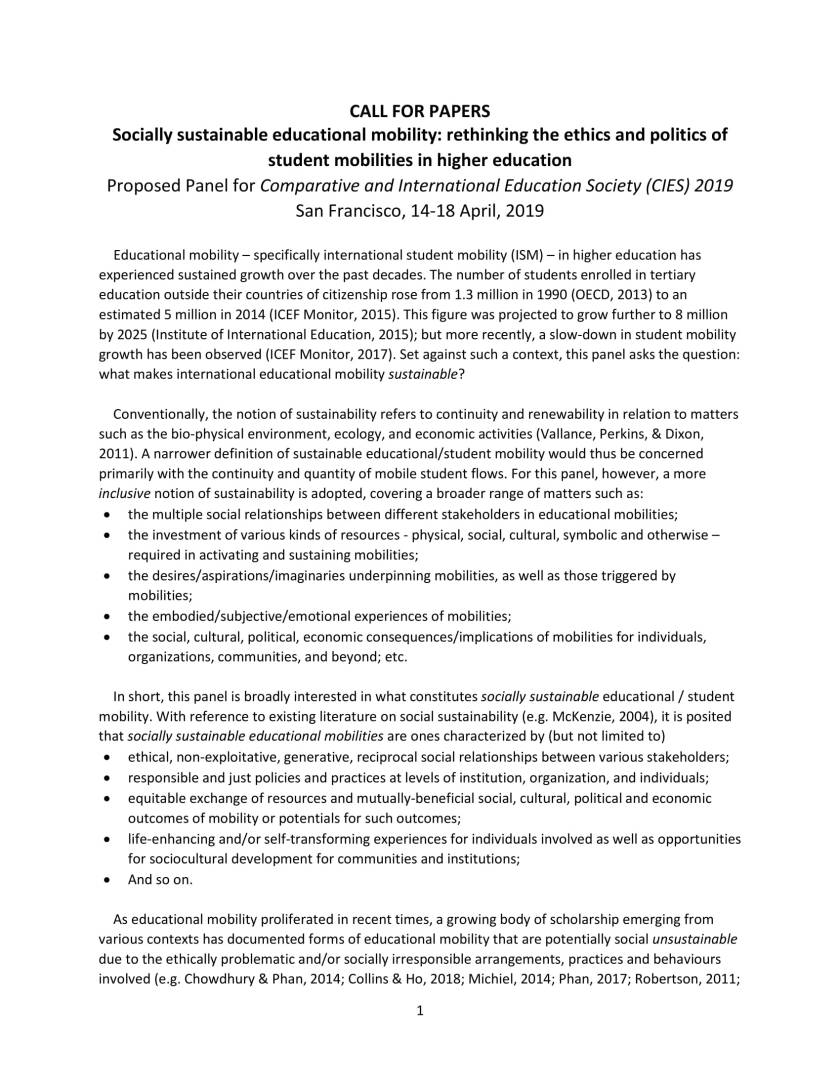
Proposed Panel for Comparative and International Education Society (CIES) 2019
San Francisco, 14-18 April, 2019
Submission
For more information, please contact the panel organizer Dr Peidong Yang, National Institute of Education, Nanyang Technological University, Singapore. peidong.yang@nie.edu.sg
Please email an extended abstract (400-500 words) and a biographic note (up to 100 words) to the above email address by 15 September, 2018. Early submission is encouraged.
This research project examines changes in global mobility of Asian students and highly skilled workers. Our project features an intensive investigation into the recent students’ mobility to, and from, China. The study attempts to explore changes in funding structures of postsecondary education when transnational mobility is increasing under globalization. Specifically the project consists of the following four investigations:
To analyze the increase in the transnational movement of students and highly-skilled workers in Asia, and the conditions under which they move,
To clarify how costs are shared regionally and between the public and private sectors in higher education,
Theoretical and empirical inquiry into the relation between the cost sharing and conditions resulting in migration,
To present policy and system for higher education funding that would offer educational opportunities in response to mobility.
Research Method
We are in the second year of our research project. In the fiscal year 2017, we first studied theories and hypotheses that explain recent mobility in the higher education community. We examined theories that would explain the “causes” of mobility as well as the “results” of mobility in different fields of academic discipline, which were enabled by a collaborative work by researchers from different academic areas yet adhering to a common interest in higher education mobility
The following figure shows the summary of the theories and concepts that we examined.
In the first year, we also developed a mobility database mainly using macro data. The macro data was constructed for this specific project to analyze higher education mobility by integrating various datasets provided by UNESCO, OECD, and the World Bank, which we have named “Database for Higher Education Mobility Study (DHEMS).” By using the database, we conducted statistical analyses to investigate the recent trend of mobility of post-secondary students and the reasons for and impact of such mobility with special focus on Asian and Pacific students flows. The results were presented in the annual conference of Comparative and International Education Society (CIES), which was held in Mexico in March 2018.
From the second year on, we have been and will be developing micro-level data to investigate the cost structure of the highly skilled who move. The aims of the rest of the project are as follows:
To construct and analyze micro-level data on researchers’ backgrounds that clarifies the cost structure of the highly skilled who move,
To clarify the relationship between mobility and costs through a) a pooled analysis of macro- and micro-level data, and b) a survey of government and universities, and
To combine and create a database from the above three results to develop a four-stage benchmark for finances based on a comprehensive analysis.
The outline along with the research timeline is what follows:
This research combines theory and quantitative and qualitative research to illuminate the issue and conduct collaborative research with overseas researchers who have previously engaged in this research by allotting each of them a country to be analyzed. The results will be discussed in and with the academic group and network that specialize research in mobility and Asian education such as NRCEM, and will be publicized at symposiums at international conferences, and through submissions to journals and books.
Authors’ Bio
Yukari Matsuzuka
Contact information:
#422 Isono Building, Hitotsubashi University
Naka 2-1, Kunitachi City, Tokyo 186-8601 Japan
Yukari Matsuzuka is Professor in Economics of Education at Hitotsubashi University. She received her Ph.D. in Economics and Education from Columbia University, New York. Her work experiences include Research Associate at Institute of Economics of Education at Columbia University, Professor at the Research and Development Center for Higher Education in Hitotsubashi University, and Visiting Professor at Shanghai University of Finance and Economics. Her recent research focuses on internationalization and global student mobility in higher education, changing in postsecondary funding structure, and tertiary education reform in Asia, which activities are conducted at the following institute established primarily for the study of mobility: http://arinori.hit-u.ac.jp/
Yuriko Sato
I am studying on the cause and effect of Asian student mobility, such as policy, economic and cultural impact.
Currently, I am the representative of research project on “Empirical Study on Brain Circulation of International Students with Science and Engineering Majors” supported by Grant-in-Aid for Research of Japanese government (2015-2019)
Paper related to Chinese student mobility
Dou, Shuohua & Yuriko Sato (2017) Study on the Factors Which Influence the Stay/Return of Chinese Graduates of Japanese Universities and Their Working and Living Environment: Comparison by Their Majors and Type of Workplaces, Migration Policy Review, 9: 89-105
This post was originally published at the FERSA blog.
During my PhD career at Cambridge (September 2012 to July 2016), I spent around 95 per cent of my time in a magical sphere called the University of Cambridge Writing Group. In this space, I wrote nearly my entire thesis, published three peer-reviewed journal articles, won a Best Paper Award and landed a job as Lecturer in Education immediately after graduation. I now have friends who write to me from time to time to get my advice on time management, on job hunting and on work-life balance. While I keep emphasising to them that publication is the most important, I feel obliged to tell the ‘truth’ behind all these ‘hard facts’ or what some people would call ‘achievements’.
Cora Lingling Xu
The truth is, when my current Head of School asked me how I found my experience at Cambridge, I told him that these have been the best four years of my life so far. This is the truth. Yet this is not all the truth. There were difficult periods throughout my PhD, moments of doubt, agony, and despair—this is no news to anybody pursuing or holding a PhD. What I want to share in this post, therefore, is how I have survived all the difficult moments. I want to offer three reflective moments.
Moment 1
Venue: Tea Room, Sociology Department, Free School Lane
Date: 31st December 2012
Attendees: Moira, Christine, Dee and Emma
Event: This was probably the second Writing Group session that I had attended. Moira, Christine, Dee and Emma were all senior PhD students finishing their PhD theses. These were the people that I later looked up to and often sought advice from. During one break, Moira made a comment about minding her ‘authorial voice’. This little phrase stuck with me ever since. I started to realise that the PhD experience (at least for social sciences) was really about developing an academic identity that is primarily represented by one’s written work.
Moral: This revelation was pivotal in that I made a conscious decision to frequent the Writing Group, because this was so much more than a writing space. It was a place for me to get inspiration, seek advice and develop friendship; it was my support network and my ‘security net’. I am not asking everybody who reads this post to join the Writing Group (although it is a worthwhile idea), but rather I am suggesting that buddies at the Writing Group were the ones who helped me survive all the self-doubts, agony and despair. It is essential for PhD students to feel secure and supported among like-minded friends. So, your first task is to seek such a space and grow with it.
Moment 2
Venue: Barbara White Room, Newnham College
Date: April 2014
Attendees: Writing Group buddies
Event: I received a notification from the European Educational Research Association (EERA) that my article had won the Best Paper Award and that it would be published in the European Educational Research Journal (EERJ).
Moral: Start publishing as early as you can. I learned about the EERA Best Paper Award competition when I attended the European Conference on Educational Research (ECER) in 2013. The prospect of publishing a paper at the EERJ was appealing. I carefully studied previous winning essays and prepared my article while I was conducting fieldwork. At that time, I only had some preliminary analysis of the first round of interviews. However, I wrote up my analysis and got helpful feedback from my supervisor Professor Diane Reay and my friends, including Dr Erin Spring, who was then a PhD student. This was my first article, published in early 2015.
When I nearly finished my first phase of fieldwork in March 2014, I wrote another article for a conference in Denmark. This article was based on more comprehensive analysis of the bulk of my empirical data. Although the analysis was relatively crude and broad-stroked, I gained some valuable feedback at the conference and my article was included in a special issue, published in October 2015.
As I was writing my findings chapters, I began to write my third article, which was submitted to the British Journal of Sociology of Education in early 2015. I received reviewers’ ‘ruthless’ feedback in July 2015, which, when I look back now, was hugely beneficial to strengthening the rigour of my analysis. I submitted my revised version in September 2015 and the article was accepted in February 2016.
To summarise, it is never too early to write for publications during your PhD. I began writing for publication as soon as I had some data at hand to analyse. I was constantly thinking about the next article and how I could make sure that I had a worthwhile message to communicate to readers of my targeted journals. My motto, which I have inherited from my wise Writing Group buddies, is that you write (a lot) to become a good writer and similarly, you write (a lot of articles) to become a good published author.
What I found most beneficial was that I had supportive but critical colleagues to comment on my drafts. At Cambridge I co-organised a reading group with Dr Selena Yuan in which we regularly critiqued on each other’s works and helped each other publish more effectively. Cambridge is a gold mine of talented and critical friends, so start building a network to support each other’s publication journeys.
Moment 3
Date: Some time in 2015
Venue: Origin 8 Café, FOE
Attendees: Elizabeth and Pu Shi
Event: I came out of GS4 and ran into Elizabeth and Pu Shi, who were having a meeting at the café. Upon learning that I was acting as a Teaching Assistant to facilitate a Master’s research methods class, Elizabeth commented that I was career-oriented.
Moral: Yes, I was quite strategic about gaining teaching experience during the PhD. Since 2013 I had been supervising Tripos Sociology papers and Research and Investigating projects. However, I ensured that such teaching did not take up too much of my time. Now that I think about it, I spent around ten to fifteen per cent of my time doing supervisions and acting as a teaching assistant. I also gave some guest lectures at different universities, such as the University of Northampton and the Open University of Hong Kong. These experiences proved instrumental for informing my pedagogical understanding and helpful in allowing me to construct a coherent narrative about my repertoire of teaching experience.
To return to what I set out to answer in this post: How did I manage my time during PhD in order to balance finishing the thesis, writing publications and gaining teaching experience? Firstly, I established an important network of support from which I gained inspirations, friendship, and a sense of security. Secondly, I began writing for publication as soon as the early stages of my data collection, and I kept writing for publications throughout the PhD journey. Lastly, I strategically sought opportunities to gain teaching experience, while ensuring that teaching did not take up too much of my time.
Author Bio
Dr Cora Lingling Xu (PhD, Cambridge, FHEA) is Assistant Professor at Durham University, UK. She is an editorial board member of British Journal of Sociology of Education, Cambridge Journal of Education and International Studies in Sociology of Education. In 2017, Cora founded the Network for Research into Chinese Education Mobilities. Cora has published in international peer-reviewed journals, including British Journal of Sociology of Education, The Sociological Review, International Studies in Sociology of Education, Review of Education, European Educational Research Journal and Journal of Current Chinese Affairs. Her research interests include Bourdieu’s theory of practice, sociology of time, rural-urban inequalities, ethnicity, education mobilities and inequalities and China studies. She can be reached at lingling.xu@durham.ac.uk, and via Twitter@CoraLinglingXu. Download her publications here.






 Network for Research into Chinese Education Mobilities (NRCEM)