Conference Venue: St. Anne’s College, Oxford University
We are pleased to announce that the 3rd Annual Conference of the International Chinese Sociological Association (ICSA) will be held on July 4-5, 2020 at Oxford, UK. The conference will be hosted by Dept. of Sociology, University of Oxford, UK.
The International Chinese Sociological Association (ICSA) is a nonprofit organization, registered in California, USA, which aims to promote social scientific research on Chinese societies, cultures, and populations in the world. The 2020 conference theme is “Family Change and Inequality in Chinese Societies and beyond.” The conference also welcomes submissions on other topics of interest to the ICSA members. Papers offering comparative perspectives on are particularly welcome. Both complete papers and extended paper abstracts in English will be considered. Paper abstracts must contain sufficient details to suggest timely completion (normally, 5 pages or more). Please provide all authors’ names, organizational affiliations, and email addresses.
Graduate students are invited to compete for the ICSA 2020 Nan Lin Graduate Student Paper Award. One paper (published or unpublished) will be selected and the award will be announced and presented with a plaque and a check of USD 500 at the conference, as well as a travel subsidy.
Papers to be considered for the Nan Lin Paper Award must be (1) authored by student(s) only, (2) in English, and (3) to be presented at the 2020 ICSA Conference. Student status must be valid as of the end of Spring 2020. Only complete papers will be considered. Please mark *Nan Lin Paper Award* in the Subject Area when submitting online.
Instructions for Paper SubmissionsThe ICSA Paper Submission Information Submission Site is available on February 10th at https://www.icsa-sociology.org. The submission deadline is May 8th, 2020. In the event of any technical difficulties, submissions may be emailed to Shaoping She (spshe@ust.hk). For general enquiries, please contact Maggie Ku (icsa@caser.ust.hk).
Please note that conference participation requires membership in the ICSA. If you are not an active member yet, please become a member first through ICSA’s new homepage: https://icsa-sociology.org. The membership fees: $10 for student memberships, $30 for regular membership fee, and $600 for the lifetime membership fee.
Important Dates
Feb 7, 2020: On-line submission site opens.
May 8, 2020: Submission deadline.
May 22, 2020: Formal acceptance letters distributed for visa applications.
June 19, 2020: Provisional proram available on the website.
June 30, 2020: Full papers due to organizers/ presiders/ discussants.
July 4-5 2020: Conference
Selected papers presented in the conference will be invited for submission to the following peer review journals: 1. Chinese Journal of Sociology (CJS) (eISSN: 20571518 | ISSN: 2057150X), founded in 2015 and published by SAGE, is a peer-reviewed, international journal issued by Shanghai University and co-sponsored with Princeton’s Center on Contemporary China (CCC), with an aim to building an academic platform for in-depth discussion of the issues facing contemporary Chinese society from the sociological perspectives. 2. China Review (ISSN: 16802012), published by Chinese University Press in Hong Kong, is the only China-based English journal devoted to the study of Greater China and its people. The journal’s SSCI Impact Factor 0.694 in 2017, being ranked in Q2, 32/68 in area studies. 3. Chinese Sociological Review (CSR) (Print ISSN: 2162-0555 Online ISSN: 2162-0563), founded in 1968, now published by Taylor & Francis Inc. 530 Walnut Street, Suite 850, Philadelphia, PA 19106. The journal’s SSCI impact factor is 2.3 in 2017, being ranked in Q1, 21/146 in sociology.
The rapid internationalizations of higher education globally over the last few decades have had profound impacts on domestic sectors around the world. While global mobility and partnerships have reached all-time highs, there have been some resulting growing pains. Considering higher education on the international stage is more complex and everchanging than at any time before. To make sense of these complexities, actors in the sector rely on indicators to provide key information. Oftentimes, these indicators are built from a set of metrics that have been formulated by another agency or institution and then organized into a ranking.
This act of taking a complex idea and simplifying it down to a set of metrics is known as commensuration. Commensuration reduces the expertise a stakeholder needs for decision-making as numbers and metrics have been lionized as objective truths. This process provides an appearance of objectivity because it is seen as a type of science. Even as these types of metrics are met with critique, they have inundated decision-making bureaucracies across the world, especially in higher education.
University rankings are one of the most common examples of commensuration in the sector, as these schemes attempt to define quality or excellence in education through a simple indicator. But studies on commensuration have mainly been considered in Western settings, namely the United States and the United Kingdom. However, commensuration is useful in contextualizing the global higher education sector and the obsession with the world-class university, a concept that is often quoted but difficult to define in the complex and expansive landscape.
Chinese Universities and Commensuration
Chinese universities have been at the forefront of the internationalization trends in higher education, explicitly chasing world-class status over the last few decades. Because of these efforts, commensuration is especially useful when studying Chinese universities. During six months of field research in China in 2017, I explored how university rankings have become commensurate measures of the world-class university concept in China. I visited campuses, attended conferences and classes, and met with countless students, researchers, academics, and administrators. For this analysis, I relied on formal interviews with 48 administrators and professors at Chinese universities.
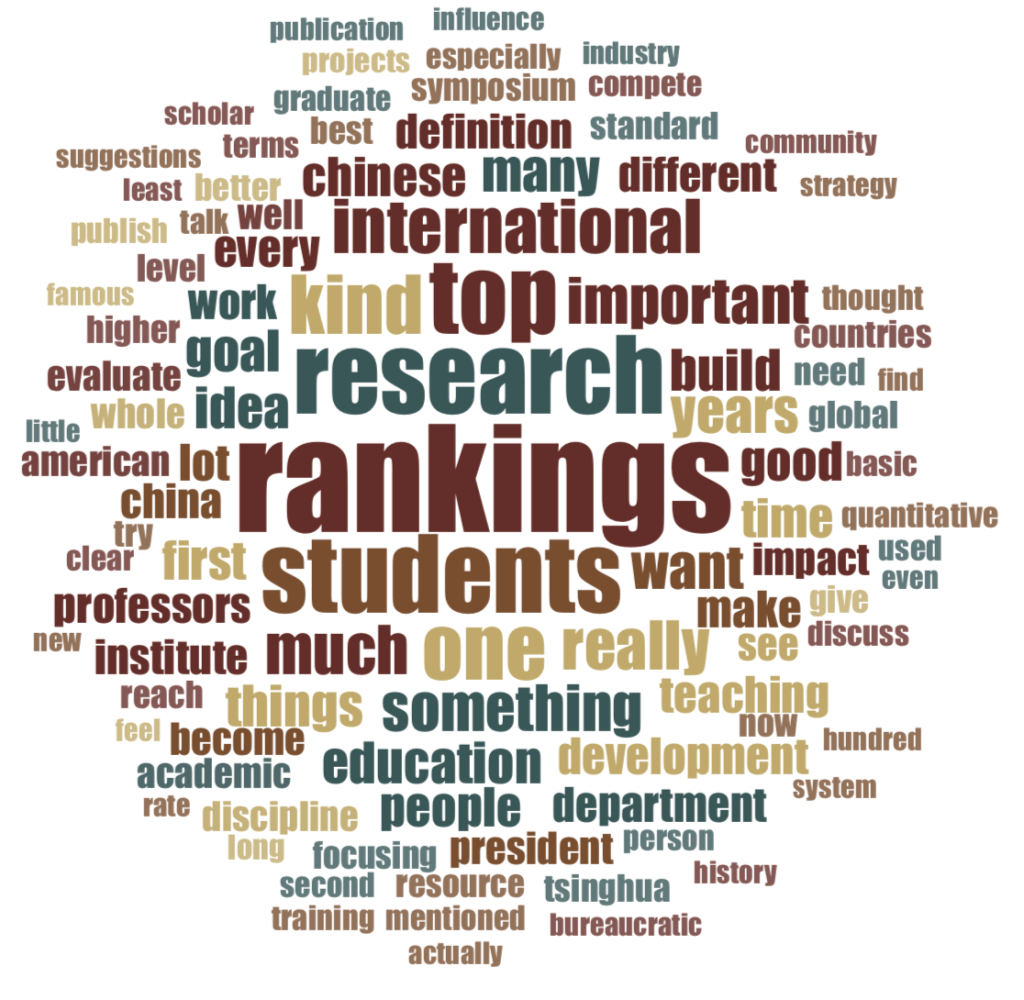
The interviewees in my sample had difficulties in providing a consensus definition of a world-class university. Despite claiming to hear the term used almost “every day,” the conception was still amorphous. Some described excellent students, others mentioned impactful research, and a few used examples of the global elite like “Harvard” or “Cambridge.” Using a word frequency query, though, showed that the most used descriptor was “rankings,” as seen in the following illustration. Even when considering a multitude of definitions, university rankings were still implicitly (or explicitly, in some cases) connected to the elite status.
Word Cloud of Interviewees’ Conceptions of World-Class Universities
Note: Common words such as “like” and “the” have been removed and stem words have been grouped together.
The group most often mentioned four specific rankings: Quacquarelli Symonds (QS) World University Rankings; Times Higher Education (THE), Academic Ranking of World Universities (ARWU), and US and World News Report (US News). The makeup of each of these rankings is slightly different, but they all have strong considerations for research. Although, three also had reputational components that sparked ire from many faculty members in the sample. Encapsulating the complaint, one senior professor said, “Among its many flaws, one of them is the halo effect, so people will say, ‘Cambridge has a great department of X,’ even if they don’t have one. These places have higher reputations, whether they actually teach a program or not.”
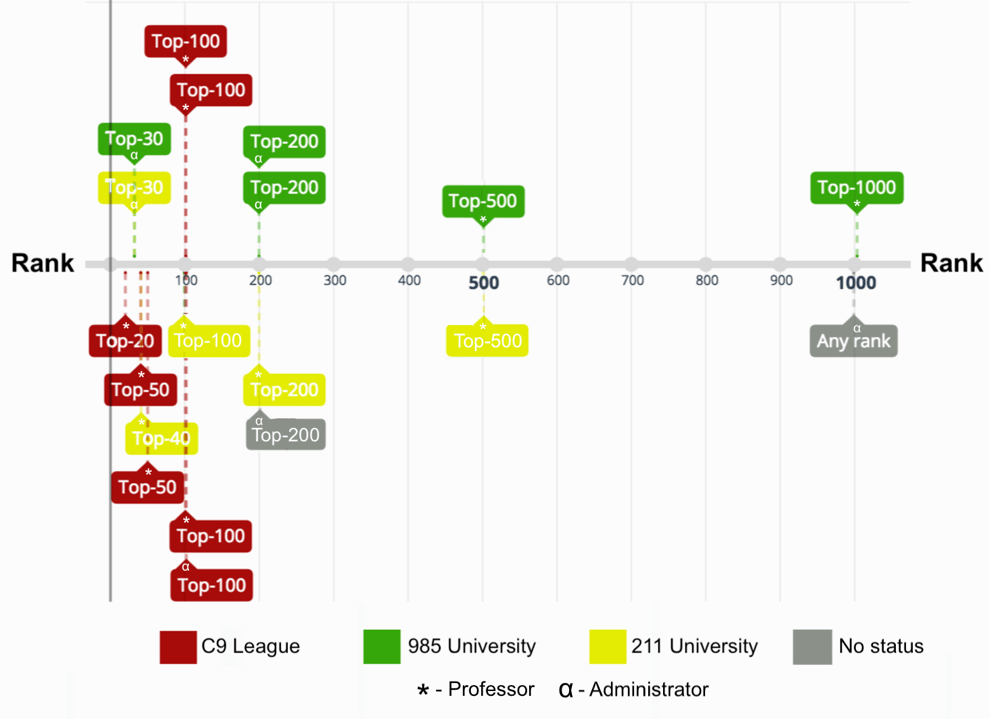
The four common schemes most often mentioned each rank institutions in strict ordinal form. The ordinal rank offers institutions a proxy for world-class status. While not all the interviewees believed there were strict cutoffs for this concept, 19 gave explicit points that they or their institution would use for a proxy. There was some variation in cutoffs, which can be seen in the following chart, including simply being included in the rankings. However, the top-100 mark was the most stated answer of the group, especially for those already in the more elite segment of the Chinese higher education hierarchy (C9 League).
The specific cutoff for determining world-class universities by university type
Source: Qualitative interviews conducted in this research.
A senior professor with an academic focus on rankings encapsulated this finding, “The idea of world-class, it’s hard to define . . . But for practical usage, actually the top-100 is more or less agreed as world-class university. Not everyone agrees, but it’s a much more agreed than the definition itself. It’s much more difficult to get a definition for world-class university itself than the practical use from ranking. So, top-100 is more or less.”
Even as some of the faculty members and administrators argued against using specific cutoffs, almost all of them agreed that rankings impacted various actions by their university, especially in regards to institutional partnerships. Overall, 36 of the 48 respondents claimed rankings have a connection to decisions related to partnerships. Even those who argued that their first priority is related to familiarly or other points, admitted that rankings play a factor institutionally. “We start with those whom we have personal connections… [But] of course everybody want to befriend those highly ranked institution,” conceded one junior faculty member.
Some of the respondents were quite open with this commensurate proxy to rankings. “Because [we are a] world-class oriented university and it aims highly to only pursue highly ranking universities all over the world… If the universities were not highly ranked, we would not consider them to be partners,” said one mid-level administrator tasked with global outreach. Another administrator even admitted her institution was looking to sever ties with their long-standing partner abroad because the other university was not ranked high enough. Others also claimed that their administrations would not support requests for China Scholarship Council research funding abroad unless the host university was ranked within the top-100.
Research indicators are critical to university ranking metrics, meaning that as league table position becomes more important, pressures to publish will be even more burdensome. Almost all the academics in the study reported that their institutions were obsessed with highly cited indexes, such as the Social Sciences Citation Index (SSCI). Multiple respondents even made the same joke, calling the SSCI “stupid Chinese ideas.” Even those who claimed to not pay attention to the rankings reported pressures to publish in these highly cited journals. These indices are key metrics in the university rankings reported to be the most widely used by my respondents.
There were some disparities in how actors perceived these pressures from internationalizations. Over half of the administrators did not report the pressures to publish, while a majority of the professors complained of increased pressures. The exceptions were late-career academics, who were split 50-50 on this topic. These disparities point to diverging awareness of the effects of internationalizations on the sector. It is likely that administrators and older, established academics do not face the full force of these burdens, as the younger, unproven faculty members have more expectations of producing in these international publications.
The research shows how university rankings offer a proxy for the world-class definition. While the commensuration concept has mostly been used in Western-focused studies, it is also useful for understanding the Chinese context and the sector’s intense focus on internationalizations. Commensuration is a powerful force within education, impacting decisions at all levels of the university. As the sector in China becomes more global and complex, stakeholders will continue to use indicators and metrics for a variety of decisions, such as evaluation of research agendas and institutional partnerships. Future work should continue to contextualize China and other sectors through the understanding of the commensuration processes and their outcomes.
Author Bio
Ryan M. Allen is an assistant professor at Chapman University’s Donna Ford Attallah College of Educational Studies. He primarily works with the college’s doctoral program partnered with Shanghai Normal University. His research focuses on internationalizations of higher education, EdTech, academic publishing, and the East Asian region. He serves on the Executive Board of the Study Abroad and International Student SIG within the Comparative and International Education Society, where he shares his passion for supporting international students and promoting study abroad. You can find Dr. Allen’s daily musings on Twitter at @PoliticsAndEd.
The Overseas Young Chinese Forum is pleased to announce that the 2020 OYCF-Chow Fieldwork Fellowship is open to application from graduate students in humanities, social science and policy studies in a U.S. or Canadian university to conduct fieldwork in China for their thesis projects. In addition, another $500 will be offered as postfieldwork award to the fellowship recipients who demonstrate productive use of the fellowship in a post-fellowship report. Fellowship recipients will be announced on the OYCF website as OYCF-Chow Fellows.
Since 2018, the Overseas Young Chinese Forum has provided several fellowships each year to support field research in China. The fellowship is funded by the contributions of OYCF members and the generous donation by distinguished Princeton University professor emeritus Gregory C. Chow and his wife Paula K. Chow.
For deadline, eligibility and other requirements, please click the link above. You may also view the research page for information on past recipients and their projects.
Chinese universities are actively pursuing cross-border collaborations in the form of transnational higher education (TNHE) programmes. The complexities of designing and implementing programmes that involve internationalisation of the curriculum often reveal gaps between policies and practices (Fischer & Green, 2018). Students in articulation programmes are uniquely positioned to reveal potential cross-system gaps, having shared the lived experiences of learning in such curricular contexts and to inform any programmatic curriculum reform processes. Our study captures the experiences of Chinese students to illuminate how they navigate their learning journeys in a China-Australia articulation programme. To communicate the complexity of learning in modern transnational higher education programmes, we employed activity theory as the theoretical framework to explore cross-cultural contradictions shaping students’ experiences of learning. Assessment, programme rules, teaching strategies, and class and campus settings created contradictions that students had to negotiate as in-between learning spaces. We argue that cross-system contradictions play important roles in transnational higher education programmes. Therefore, instead of seeking to eliminate these contradictions or smooth cross-educational differences, these contradictions should be leveraged as learning opportunities to enrich transnational higher education programmes.
Methods
An exploratory qualitative study was adopted to investigate a group of Chinese students’ learning experiences in an articulation programme. We adopted a purposive sampling method to invite students from an undergraduate 2+2 articulation programme (two years in China followed by two years in Australia to complete a degree) with Digital Design as the major to participate in this research. To explore the students’ learning experiences, we used semi-structured individual interviews to collect data. Transcripts were exported into NVivo 11 software for analysis. We employed an iterative cycle of inductive and deductive analysis that involved coding to AT concepts along with emergent themes arising from our reading of the transcripts. We selected extracts from the interviews to offer thick and rich descriptions to illuminate participants’ experiences in their own words.
Findings and Discussion
The experiences of the students in our study provided insight into learning in transnational higher education, which response to the call from Qin and Te (2016) for researchers to capture student voices in cross-system programmes. By using AT, we illuminated cross-system contradictions that students navigated between two activity systems in a single TNHE degree programme where some students saw bridges to cross while others saw only the obstacles of learning gaps. Contradictions emerged among students’ learning goals, their practices, and programme rules within and between two partners. Our findings showed numerous cross-system contradictions that students had to face and navigate, in different ways and with varying degrees of success, during their cross system educational experiences. Assessment modes, teaching strategies, and class and campus settings were the key factors that generated cross-system learning contradictions for students. The differences in these aspects between Chinese and other Western contexts were not surprising, which further affirm several existing findings (Kember, 2016; Tweed & Lehman, 2002). The academic or contextual contradictions we have revealed several issues in operating TNHE as sources for change and development (Engeström, 1999, 2001). Learning through different contradictions in and between two partners will appeal to many students, though not all. For some students, tensions and contradictions motivated them to alter their learning goals and approaches in the cross-system transition (Engeström, 1999).
Conclusion
While we argue that it is essential for policymakers and educators to enhance cross system communications in the process of operating articulation education to improve students’ learning experiences, the intention should not be to diminish cultural differences or assert the dominance of one provider over the other. Instead, curricular planning should prepare students for the richness of global learning that will challenge their cultural assumptions. Learning in this combined setting, students were positioned between the two partners with a complicated sense of agency. Some students navigated the cross-system experiences with ease while others struggled. These multiple responses could help universities, lecturers, and policymakers to strategically design and manage such articulation programmes to enhance the quality of cross-system education under the growing trend of internationalisation of higher education. Prospective studies could investigate how lecturers and policymakers understand cultural and educational differences between different systems and how they might productively use these differences to improve international education cooperation.
Authors’ Bio:
Kun Dai is a Postdoctoral Research Fellow (funded by China International Postdoc Exchange Program) at the Graduate School of Education, Peking University, China. His research focuses on transnational education, intercultural learning and adjustment, and students’ cross-cultural learning experiences. Dr Dai services as an associate editor of the Journal of International Students.
Kelly E Matthews is an Associate Professor in Higher Education in the Institute for Teaching and Learning Innovation at the University of Queensland in Brisbane, Australia, and an Australian Learning and Teaching Fellow.
Peter Renshaw is a Professor at the School of Education, the University of Queensland in Brisbane, Australia. Professor Renshaw’s research has focused on learning and teaching processes both at school and tertiary level. Professor Renshaw was President and Secretary of Australian Association for Research in Education (AARE) and a member of the Executive for over a decade (1991-2002).
China and Myanmar share a borderline of over 2,200 kilometers. Like many other borders in the world, the demarcation of the geographical border does not always overlap with the cultural and linguistic borders. Over centuries of historical, economic and cultural development, the China-and-Myanmar border has acquired strategic meanings for both countries and is now becoming the land-bridge of China’s expansion overseas and the main artery of Myanmar’s economy. This article examines how language ideologies shape the educational trajectories of a group of Myanmar ethnic minority students who were born and brought up at Myanmar’s border towns next to Yunnan, the Southwest of China.
The article focuses on their language learning experiences both at Myanmar government schools and Chinese supplementary schools. Due to the mismatch between their home language(s) and class instruction language and the limited distribution of linguistic and educational resources at border regions, Myanmar ethnic minority students with limited proficiency in Burmese language experience exclusionary treatments and stereotypes at Myanmar government schools. Although the majority of our participants did not complete their primary education at Myanmar government schools, they did not simply drop out, look for a job, become a farmer, or help in their families’ businesses. These students did not see their drop-out as an educational failure. Rather they considered that their marginalization in government schools was offset by their empowerment in Chinese supplementary schools. They experienced an enormous contrast between the two educational systems, which reshaped their language learning beliefs and motivations. Their efforts to improve their proficiency in Putonghua may have been self-motivated or in response their parents’ desire to maintain their ethnic Chinese heritage, and were reinforced by the availability of China-related resources at Myanmar’s border. Their beliefs in the importance of learning Putonghua for future transnational mobility and for improving their life prospects contrasted with their experiences of failure in the educational system offered by the Myanmar government in question.
However, the article also points out the contestation and ideological conflict of learning Putonghua at Myanmar-border. In the context of China’s rapid development, tensions and negotiations over what it means to speak and write Putonghua are related to contestation of the authenticity of ‘mother-tongue’ versus ‘non-heritage learners, and over the economic or symbolic capital of Putonghua ad Chinese as a marker of a heritage identity. Given the promotion of Putonghua and the increasing influence of China’s economy in Myanmar, it can be expected that this tension is going to become more pronounced in the future.
Based upon the evidence, the article suggests that Myanmar education system and language policy makers should take into account the dynamic and diverse border realities by considering these ethnic minority students’ learning difficulties ad their diverse backgrounds, rather than simply implementing a centralized language policy. It would benefit borderland students if the Myanmar government allowed for diversity when it distributes educational resources, rather than leaving learning responsibilities to individual students who struggle to bridge the gap between home culture and school culture. The analysis of Myanmar ethnic minority students’ everyday learning trajectories illuminates the interconnections between language ideologies and linguistic practices. By locating their everyday language practices in the wider setting of Myanmar and China’s socio-economic transformation and China’s expansion to Southeast Asia and South Asia, the article contributes to the understanding of grassroots multilingualism and highlights the multiple, conflictual and context-specific aspects of language ideologies as well as proposing a possible solution for this issue in the long term.
Authors’ bio
Dr. Jia Li is an Associate Professor at the School of Foreign Languages of Yunnan University, Kunming, China. Her research concerns multilingualism, language-in-education, and promoting Putonghua as a global language. She can be contacted by email: jia_li_yunnan@qq.com.
Dr. Bin Ai is an Associate Professor at the School of Foreign Studies of Shanghai University of Finance and Economics, Shanghai, China. His research interests involve a wide range of topics including intercultural communication, higher education, and applied linguistics. Dr. Ai has published widely in many international peer-reviewed journals.
Dr. Jie Zhang is an Associate Professor at the School of Foreign Languages of Zhongnan University of Economics and Law, Wuhan, China. Her research interests range from intercultural communication, language policy and planning to language-in-education. Dr. Zhang has published widely in both Chinese and English peer-reviewed journals, and she is on the editorial board of Journal Multilingua.







 Network for Research into Chinese Education Mobilities (NRCEM)