Local and non-local doctoral students in Hong Kong: Do stressors differ with students’ origins?

Jung, J. (2019). Local and non-local doctoral students in Hong Kong: Do stressors differ with students’ origins? International Journal of Chinese Education, 8, 160-185.

Dr Jisun Jung, University of Hong Kong

How did this study begin? A short introduction to the project

The rapid growth of Asian higher education in the last four decades, in terms of scale and quality, has garnered significant attention in global higher education. In particular, East Asian universities have focused extensively on knowledge production, research capacity building, global ranking and global talent recruitment. However, many of the top universities in Asia still tend to hire overseas doctoral graduates for academic positions in the home country. Is that because they do not have the capacity to train their own doctoral graduates? What is the current landscape of doctoral training in East Asian countries? How do doctoral students in East Asian research universities perceive their learning experiences, and how do they plan their career paths? What are the unique characteristics of doctoral education in East Asian research universities? Based on these questions, some scholars in East Asian countries have developed a comparative research project entitled ‘A Comparative Study of Doctoral Education in Asian Flagship Universities’, conducted a collaboratively developed survey and shared their findings through conferences, seminars and workshops. More findings from this project can be found in two journal special issues: ‘Research Universities in East Asia: Graduate, Student and Faculty Perspectives’ (Asia Pacific Educational Review, 16(2), edited by Kong Chong Ho, Gerard A. Postiglione and Futao Huang) and ‘Introduction to Doctoral Education and Beyond: Learning Experiences, Competence and Career Plans in East Asia’ (International Journal of Chinese Education, 8(2), edited by Jung Cheol Shin and Futao Huang).

What was my research focus? A short summary of the paper

I was privileged to join the Hong Kong team for the project, and I identified my research questions about doctoral students in Hong Kong. As an international academic working in Hong Kong, I was always fascinated to see doctoral students’ diverse backgrounds and their dynamics on my campus. There is also a unique expression we use in Hong Kong to distinguish students as either local or non-local, which a lot of outsiders are puzzled by. The term non-local students used in this study is defined as “a politically correct term that refers to both foreign students originating outside of the administrative region and Mainland students from China” (Yu & Zhang, 2016; p. 2) in the Hong Kong context. In demographic terms, Hong Kong students can be divided into three groups: Hong Kong local, mainland, and international, with the latter two defined as non-local. My question was whether these different backgrounds of doctoral students have different learning styles, preferred supervising styles, and whether they are stressed with different factors.

Several studies have explored how Chinese students study overseas in Western countries, but little is known about the acculturation experiences of Chinese students in Asian contexts, including Hong Kong. Some recent studies have explored their motivations for choosing Hong Kong for their studies, but most focused on the undergraduate level (i.e. Li & Bray, 2007). Few comparisons of the three groups (local, mainland, and international) have been conducted in terms of who they are, what and how they learn differently, what makes their learning experiences satisfactory, and what factors influence their stress.

How did I conduct the analysis and what were major findings?

Based on 482 responses from the survey, the analysis of variance (ANOVA) test and a multiple regression were conducted. The results showed that doctoral students have different perceptions of their competency depending on their origins. They also assess their supervisory styles and learning environments differently. For example, international students tend to perceive their research capacity highly compared to Chinese students (Hong Kong local and mainland). Chinese students have clearly different perceptions from international students about how they regard their relationships with supervisors. Stress factors were also different. Hong Kong local students were stressed about their perceived competency and by an authoritarian supervisory style, while they felt less stress when the institutional environment was supportive. Doctoral students from the Mainland China were stressed about their perceived competency and by research- and resource-oriented cultures, but their stress was reduced when they felt their relationship with their supervisor was more professional. International students were stressed by their dissertation requirements and by a collegial supervisory style, but they felt less stress in an autonomous culture.

What are the implications?

The study demonstrates the importance of understanding the characteristics of different groups of doctoral students and of providing appropriate support for their doctoral journey. Although students’ cultural backgrounds affect their perceived level of stress, their perception can be transformed through the positive learning experience in a multicultural learning environment. Arranging mutual learning experiences for all students, no matter where they originate from, is important, along with providing the synergy to encourage them to understand each other’s strengths in terms of their learning styles. Previous studies have consistently emphasised the importance of crosscultural experiences (i.e., Sit et al., 2017). However, in doctoral programmes, this should not only be in terms of cultural exchange but should also be linked with their research experiences, thus helping them to be independent researchers with an active and dynamic interaction with learning community.

References

Li, M., & Bray, M. (2007). Cross-border flows of students for higher education: Push-pull factors and motivations of mainland Chinese students in Hong Kong and Macau. Higher Education, 53(6), 791–818.

Sit, A., Mak, A. S., & Neill, J. T. (2017). Does cross-cultural training in tertiary education enhance cross-cultural adjustment? A systematic review. International Journal of Intercultural Relations, 57, 1–18.

Yu, B., & Zhang, K. (2016). ‘It’s more foreign than a foreign country’: Adaptation and experience of Mainland Chinese students in Hong Kong. Tertiary Education and Management, 22(4), 300–315

Author Bio

Jisun Jung is an Assistant Professor in the Faculty of Education at the University of Hong Kong since September, 2015. She received a Ph.D. from Seoul National University, Korea, in 2011, and she was a postdoctoral fellow at the University of Hong Kong. She has been involved in the international comparative project ‘The Changing Academic Profession’ since 2009. Her current research focuses on academic profession, doctoral education, employment and postgraduate studies and higher education research in Asia. She is the co-editor of two journal special issues, ‘Higher Education Research in East Asia: Regional and National Evolution and Path-Dependencies’ in Higher Education Policy and ‘Graduate Employment and Higher Education in East Asia’ in International Journal of Chinese Education, and also a co-editor of the two books ‘The Changing Academic Profession in Hong Kong’ published by Springer in 2018 and ‘Researching in Higher Education in Asia’ by Springer in 2019. She is currently co-editor of Higher Education Research & Development.
Jobs: HKUST (Guangzhou) Professor/Associate Professor/Assistant Professor in Urban Governance and Design

Job Title: Professor/Associate Professor/Assistant Professor
Institution: The Hong Kong University of Science and Technology (Guangzhou)


The Hong Kong University of Science and Technology (HKUST) is a world-renowned international research university. The Ministry of Education of People’s Republic of China officially approved the preparatory status of HKUST (GZ) in September 2019. The Guangzhou campus covers 1.13 square kilometers and the first phase of construction is expected to be completed in 2022. At steady state, the number of undergraduate and postgraduate students will reach a total of 10,000. The intended areas of focus in the GZ Campus will be thematic and cross-disciplinary in nature, synergistic with HKUST without overlapping academic degrees or structures. 4 Academic Hubs (equivalent to school) with 16 Thrust Areas (equivalent to department) are being planned.


As one of the four transdisciplinary hubs at GZ campus, the Society Hub, aims to conduct cutting-edging research and disseminate knowledges to assist in the economic and social development of the Greater Bay Area (GBA) and beyond. The Society Hub now invites applications or nominations for faculty openings at all levels of Professor, Associate Professor and Assistant Professor in the Thrust Area Urban Governance and Design. We welcome applicants who employ quantitative methods to conduct transdisciplinary research on social and economic issues (e.g., education/human capital, health and aging, inequality/poverty, population and migration, transportation and communication networks, smart city, etc.).


Applicants must have a PhD degree in relevant fields. Senior academics should have proven teaching commitment and performance, experience and readiness in cross disciplinary curriculum and program design, and demonstrated service to the academic community and/or the public. Successful candidates will contribute to a post-graduate training program focusing on urban research and policy.


Salary is highly competitive of international standard and will be commensurate with qualifications and experience. Start-up research funds and excellent research equipment and support will be provided.


English is the medium of instruction and administration at HKUST (GZ) campus. HKUST (GZ) is committed to diversity in recruitment and equal opportunity employment and we strongly encourage suitable candidates of diverse backgrounds to submit their applications.


Application Procedure
Applications/Nominations should be sent to gzrecruit soc @ust.hk toget h er with (i) full CV; (ii) a statement of research, t eaching, and service , if any ; (i i i ) three most representative samples of research, all in PDF formats; (iv ) record s of teaching performance, if any . Junior and m id career applicants should arrange for 3 letters of recommendation to be sent.

Deadline: Review of applications will commence on March 2nd 2020 and will continue until the positions are filled.


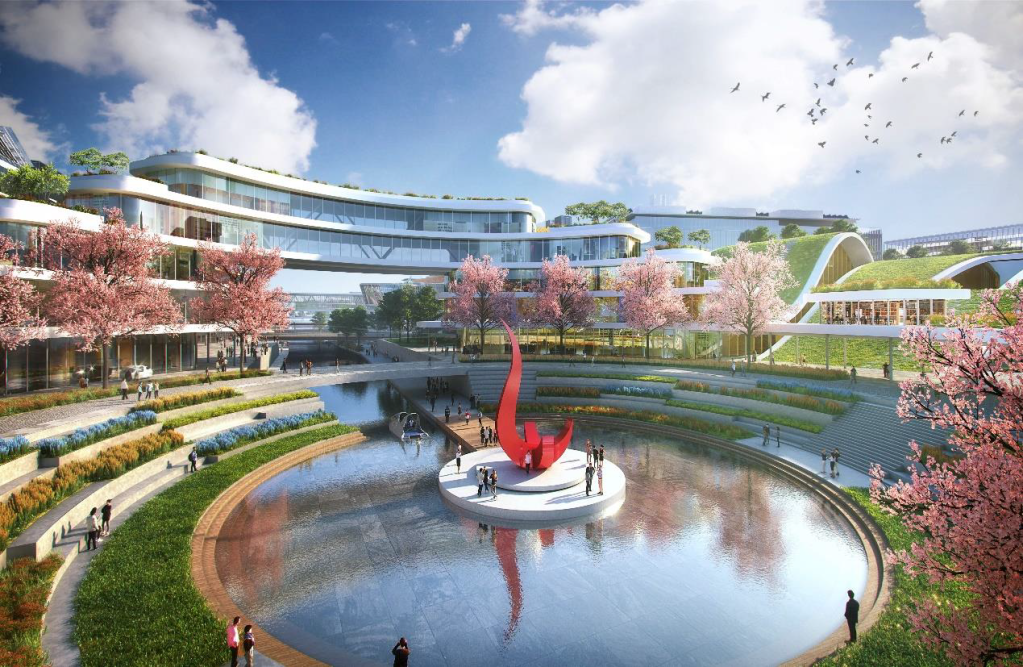
HKUST (GZ) Campus under Construction

Publish Internationally or Perish? Incentive Schemes for International Publications in the Chinese Humanities and Social Sciences (HSS)

Research highlighted:

Xin Xu (2020). Performing ‘under the baton of administrative power’? Chinese academics’ responses to incentives for international publications. Research Evaluation, 29(1): 87-99. https://doi.org/10.1093/reseval/rvz028

Xin Xu, Heath Rose & Alis Oancea (2019). Incentivising International publications: institutional policymaking in Chinese higher education. Studies in Higher Education, 1-14. http://doi.org/10.1080/03075079.2019.1672646

Xu, X. (2019). China ‘goes out’ in a centre-periphery world: Incentivising international publications in the humanities and social sciences, Higher Education, https://link.springer.com/article/10.1007/s10734-019-00470-9

The research context: Incentives for HSS international publications

Publications in internationally-indexed journals are becoming essential for global university rankings, institutional assessments, and academics’ career development (Ammon, 2001; Hazelkorn, 2015; Hicks, 2012). China is taking the lead in the volume of such publications in global science and technology, ranking first as a single country in terms of science and engineering publications (US National Science Foundation, 2018).

However, its international publications in the humanities and social sciences (HSS) are still less visible in the world (Liu, Hu, Tang, & Wang, 2015). In response, many Chinese universities have formulated incentive schemes to offer financial rewards and/or career-related benefits to encourage HSS academics to publish internationally (Xu, Rose, & Oancea, 2019). Such incentives are growing rapidly, which has provoked heated debates (see for example: Dang, 2005; Qin & Zhang, 2008).

Research methods

Dr Xin Xu’s doctoral research examined how Chinese universities have attempted to incentivise academics in the HSS to publish in internationally-indexed journals, and how such incentives have influenced HSS academics’ research and careers. It drew on a documentary analysis of 172 institutional policies and a qualitative case study of six universities in China, including 75 in-depth interviews with HSS academics, university policymakers, and journal editors.

This article reports findings from three recent publications based on the thesis.

Research findings

A national landscape of incentivising HSS international publications

The research found that by 2016, 84 out of all 116 universities designated as ‘985’ and ‘211’ in China had formulated university-level incentive schemes (Xu et al., 2019). They provided financial rewards and/or career-related benefits to encourage HSS publications in internationally-indexed journals. The publication-related incentives varied in their aims, in the level of benefits, and in the specific requirements. However, higher prestige was often attached to publications in international journals indexed by the Social Science Citation Index (SSCI) and the Arts and Humanities Citation Index (A&HCI). Compared with publications in Chinese-medium journals, SSCI and A&HCI publications were associated with higher bonus value and higher status in academics’ career development (Xu et al., 2019).

Take the bonus values for instance. Among the 172 incentive documents collected, 94 documents had provisions for giving monetary bonuses for SSCI publications, 78 documents provided monetary bonuses for A&HCI publications, and 61 documents offered bonuses for publications in Chinese HSS journals. Among them, 54 also offered special bonuses for publications in Nature and Science, and 59 provided bonuses for SCI publications. The bonus value varied between publications in different types of journals: SSCI and A&HCI publications, CSSCI publications, and SCI publications. Table 1 shows the hierarchical bonus values attached to different kinds of publications.

A screenshot of a cell phone

Description automatically generated
Source: Xu et al., 2019. [1 CNY (¥) ≈ 0.11 GBP (£) ≈ 0.14 USD ($)]

Influences of the incentive schemes

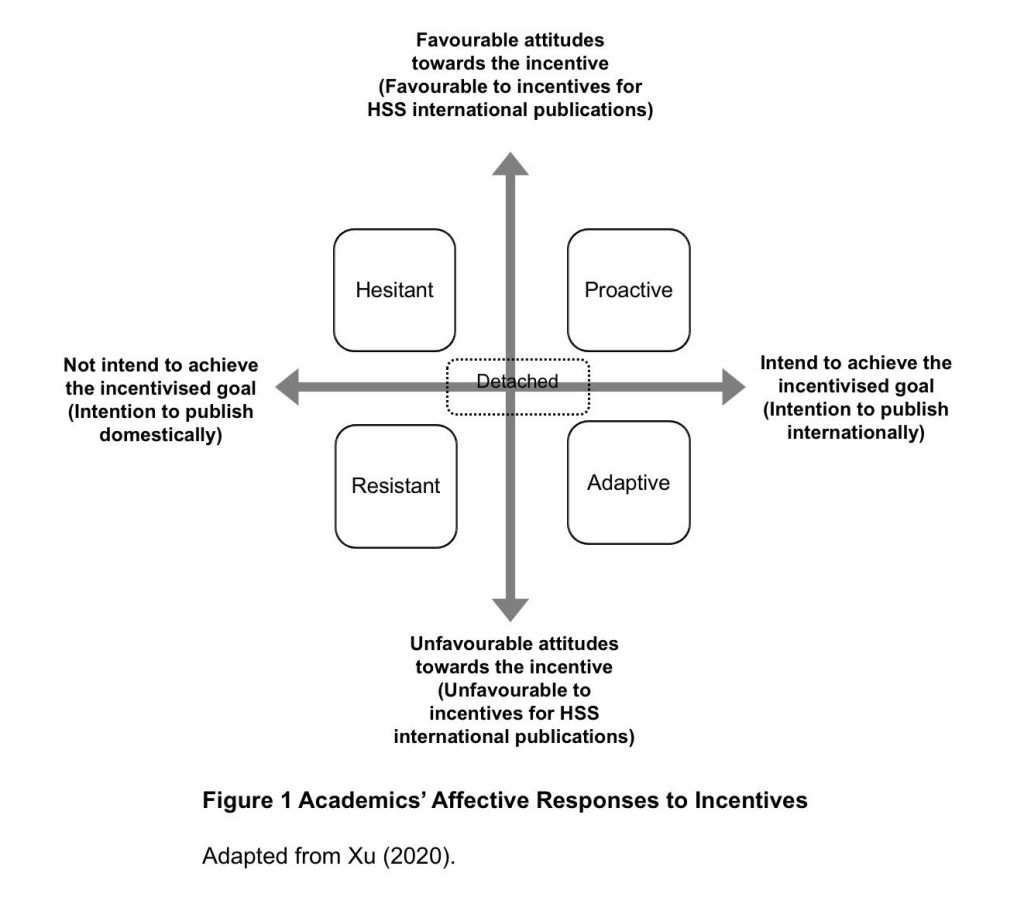
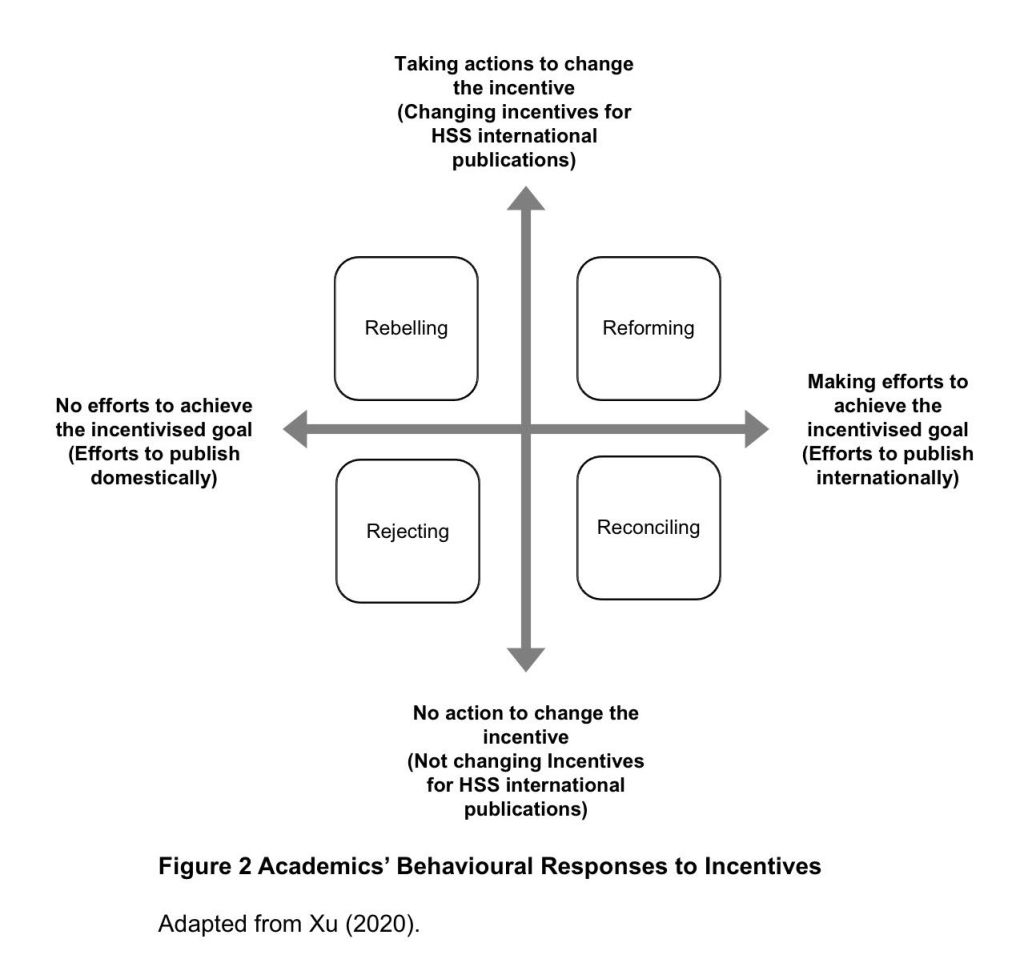
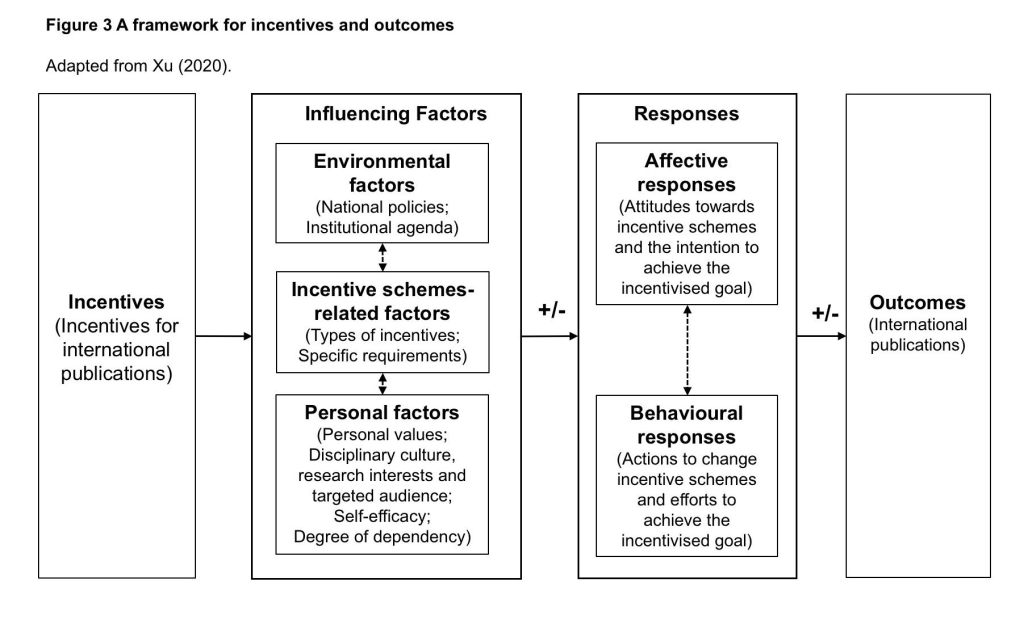
Xu (2020) proposes two typologies to categorise academics’ affective responses (proactive, adaptive, resistant, hesitant, and detached) (see Figure 1) and behavioural responses (reconciling, rejecting, reforming, and rebelling) (see Figure 2) to research incentives. Academic interviewees from different sub-groups and various backgrounds demonstrated mixed responses, and reported that incentive schemes had direct and indirect impacts on their research (see Figure 3) (Xu, 2020).

A screenshot of a cell phone

Description automatically generated
A screenshot of a cell phone

Description automatically generated
A screenshot of a cell phone

Description automatically generated

Some of the influences of incentive schemes appeared to be undesirable. For example, incentive schemes could create a ‘Matthew Effect’ in global HSS publishing, enabling SSCI and A&HCI journals to flourish, while deepening the divide between these and other journals (Xu et al., 2019). If constantly imposed through administrative and managerial power, external incentive schemes could also challenge the intrinsic value of academic research, thus putting academics’ agency at risk (Xu, 2020).

Dynamics between the internationalisation and indigenisation of HSS

Incentive schemes also reflect the dynamics between the internationalisation and indigenisation of Chinese HSS. As showcased by the data, there is a ‘going-out’ in theory and ‘borrowing-from-the-west’ in practice. While incentive schemes were initiated to promote the ‘going-out’ of Chinese HSS, they were formulated and implemented with the heavy adoption of Western norms and standards. Those norms are not unchallenged in Western contexts, such as the value and use of impact factors, and the linguistic, geographical, and cultural inequity in citation indices like SSCI. However, the research revealed a lack of critical engagement with those debates from Chinese universities (Xu et al., 2019).

The prestige of international publications in China has reinforced inequities in the international publishing regime, being associated with a hierarchical divide in global HSS academia, and generated disincentives for HSS academics to publish work focused specifically on local/national concerns, or work that generated original indigenous theorisations or methods not part of prior global literature. Moreover, HSS research is contextually rooted in certain cultures, languages, and traditions. Consequently, prioritising publications in international journals (mostly English-language journals published in global knowledge centres) could impair the development of domestic HSS (Xu, 2019).

However, the research has identified specific dynamics in Chinese HSS, which challenge the ‘centre-periphery’ model commonly used to describe the hierarchical divide in the global knowledge system and explain lower income countries’ dependency on more economically advanced countries in their research economy. For instance, some academics called for a more proactive role promoted by Chinese scholars in asserting distinctively Chinese ideas. There is an increasing number of HSS academics engaging substantially with international journals as reviewers and editors, thereby becoming more active global agents in their own right. Meanwhile, some universities had revised their incentive documents to enhance the value ascribed to the leading domestic publications (Xu, 2019).

The study has practical implications for government and institutional policymaking, which apply not only to China, but to other countries traditionally associated with the global ‘knowledge periphery’, especially other non-English speaking countries. In particular, it suggests that strategies to internationalise HSS should not simply seek to adapt to what is perceived as the global knowledge centre, nor simply to reproduce the hierarchies in domestic academia. In China, one of the unintended effects of current incentives was to reinforce the peripheral status of Chinese HSS in the domestic domain. Alternatively, universities could work to challenge the unequal power relations within global HSS. This calls for more attention to the balance between international and indigenous knowledge, and the balance between English-language publications and publications in other languages, particularly in the mother tongue language (Xu, 2019).

Acknowledgements

The research leading to this article has been generously funded by the Economic and Social Research Council (Grant number: ES/T006153/1); Clarendon Fund, University of Oxford; Universities’ China Committee in London Research Grant; Santander Academic Travel Awards, University of Oxford.

Authors’ biography

Dr Xin Xu (许心) is an ESRC Postdoctoral Research Fellow at the Centre for Global Higher Education, Department of Education, and a Junior Research Fellow at Kellogg College, University of Oxford. She completed her doctoral research at the University of Oxford, examining the incentives for international publications in the humanities and social sciences, and their impacts on academics’ research and careers. She has strong research interests in higher education, internationalisation and globalisation, academic and research life, and research assessment and impacts.

Email: xin.xu@education.ox.ac.uk Twitter: @xinxulily

Dr Heath Rose is an Associate Professor of Applied Linguistics, who researches the impact of globalisation on English language education in higher education. He has conducted policy-related research in Japan and China surrounding the ‘Englishisation’ of international programs. He has authored several books associated with globalisation and language education.

Email: heath.rose@education.ox.ac.uk

Prof. Alis Oancea is Professor of Philosophy of Education and Research Policy and Director of Research in the department. Her research has focused on: research on research, including research policy and governance, research assessment and evaluation, incentives and criteria for worthwhile research (including openness, quality, impacts, ethics), and research capacity building; higher education policy and reform; teacher professionalism and teacher education in international contexts; philosophy of education; empirical, and philosophical exploration of different modes of research and methodological theory; and the cultural value of research in the arts and the humanities. Alis is the joint editor of the Oxford Review of Education, and was founding editor of the Review of Education

Email: alis.oancea@education.ox.ac.uk  Twitter: @ciripache

References

Ammon, U. (Ed.). (2001). The dominance of English as a language of science: Effects on other languages and language communities. Berlin; New York: Berlin : Mouton de Gruyter.

Dang, S. (2005). Meiguo biaozhun neng chengwei Zhongguo Renwensheke chenguo de zuigao biaozhun ma?——Yi SSCI weili. [Can American standards set the highest evaluation benchmark for Chinese Social Sciences? – Take SSCI as an example]. Social Sciences Forum, 4, 62–72.

Hazelkorn, E. (2015). Rankings and the reshaping of higher education: The battle for world-class excellence (2nd ed.). Basingstoke: Palgrave Macmillan.

Hicks, D. (2012). Performance-based university research funding systems. Research Policy, 41(2), 251–261. https://doi.org/10.1016/j.respol.2011.09.007

Liu, W., Hu, G., Tang, L., & Wang, Y. (2015). China’s global growth in social science research: Uncovering evidence from bibliometric analyses of SSCI publications (1978–2013). Journal of Informetrics, 9(3), 555–569. https://doi.org/10.1016/j.joi.2015.05.007

Qin, H., & Zhang, R. (2008). SSCI yu gaoxiao renwenshehuikexue xueshupingjia zhi fansi [Reflections on SSCI and academic evaluation of Humanities and Social Sciences in higher education institutions]. Journal of Higher Education, 3, 6–12.

US National Science Foundation. (2018). Science and engineering indicators 2018: Academic research and development.

Xu, X. (2019). China ‘goes out’ in a centre–periphery world: Incentivizing international publications in the humanities and social sciences. Higher Education, 1–16. https://doi.org/10.1007/s10734-019-00470-9

Xu, X. (2020). Performing under ‘the baton of administrative power’? Chinese academics’ responses to incentives for international publications. Research Evaluation, 29(1), 87–99. https://doi.org/10.1093/reseval/rvz028

Xu, X., Rose, H., & Oancea, A. (2019). Incentivising international publications: institutional policymaking in Chinese higher education. Studies in Higher Education, 1–14. https://doi.org/10.1080/03075079.2019.1672646

Migration, intersectional identity and habitus re-structuring: struggling between marginalisation and inclusion in Chinese urban schools

Dr Hui Yu, South China Normal University, China

Highlighted research:

Yu, H. (2019). The making of “incompetent parents”: intersectional identity, habitus and Chinese rural migrant’s parental educational involvement. Australian Educational Researcher, 1-16. doi: https://doi.org/10.1007/s13384-019-00361-z

Yu, H. (2019). Inheriting or re-structuring habitus/capital? Chinese migrant children in the urban field of cultural reproduction. Educational Philosophy and Theory, 1-13. doi: https://doi.org/10.1080/00131857.2019.1689814

Abstract

This paper presents the findings of my recent study on Chinese rural-to-urban migrants and cultural reproduction. Drawing on Bourdieu’s theoretical lens, it examines how the intersection of rural origin, migration status and working-class identities shapes the parents and children’s habitus and their exertion of capital in the urban field of education. Semi-structured interviews were conducted in Beijing and Shanghai with 64 teachers, rural migrants and local parents and students. The findings reveal the intersection of two aspects of the migrant parents’ habitus – one, resulting from their rural background, this habitus leads them not to treat themselves as academic educators, and a second, arising from their migrant working-class status, they perceived the necessity to ‘strive for survival’. As for the children, they have experienced re-structuring of habitus, which is illustrated by their internalization of standard Mandarin as the normal way of speaking, their urbanized bodily hexis in terms of dress, appearance and behaviour, and their appreciation of extra-curricular activities. In urban schools, the migrant parents are identified as ‘incompetent’, since their actions do not match with the teachers’ expectations of home-school cooperation, while a well-integrated relationship can be identified between migrant and local children. This situation contributes to the production of a generation of ‘new urban citizens’, yet in the meantime reproduces the migrant families’ class status as low-skilled labourers. This study extends the extant Bourdieusian theorisations of the intersectional positionality of working-class parents in the field of education by adding the less examined axes of rural origin and migration status. It also extends Bourdieusian reflexive sociological thinking by calling for a holistic view of the studies of cultural and social reproduction of migration in Chinese context.

Changing landscape of migration and education in China

Within contemporary Chinese social structural changes, urbanisation and industrialisation processes break through the rural/urban boundary and bring rural migrant labourers into a new arena. Over the past decade, the state school sector has accommodated around 77-80% of migrant children nationwide, indicating that the majority of migrant children are offered access to state schools. In some metropolitan cities, such as Beijing and Shanghai, the number of migrant children accounts for around half of the total student population of compulsory education age. In the meantime, the demographic characteristics of migrant children has been changed: in Beijing and Shanghai, most of the so-called ‘migrant children’ are now born and/or raised in urban areas and are second-generation migrant children.

Research question

Drawing on Bourdieu’s theoretical lens, this paper examines how the intersection of rural origin, migration status and working-class identities shapes the parents and children’s habitus and their exertion of capital in the urban field of education.

Methodology

Three months of fieldwork were carried out in a total number of 14 schools and one nursery in Beijing and Shanghai. The data was generated through semi-structured interviews with 17 teachers (including headtechers), 26 migrant parents, 12 migrant children, five local parents, and four local children. The development of the interview questions was guided by the key research questions: how involved are rural migrant parents in their children’s education inside and outside of school? What is the relationship between migrant and local children? How are these relationships influencing migrant children’s study and social inclusion? Are there any pressing issues for the teachers concerning migrant parents and children?

The making of ‘incompetent parents’: rural migrant labourers and intersectional identity

For the migrant parents, even after migration their rural disposition of not treating themselves as educators is partly retained. In the meantime, their working-class habitus has been restructured by the intensified social and financial disadvantages of urban areas, producing a disposition of striving for survival. The parents’ habitus shapes their understanding of parental educational responsibility and their exertion of cultural capital, producing a child rearing approach of ‘accomplishment of natural growth’ (Lareau, 2002). Not perceiving themselves as educators, communicating with the teacher was the main channel through which the parents responded to their children’s educational strengths. Many of them were reluctant to deploy their (weak) literacy as cultural capital to support their children.

Producing a generation of ‘new urban citizens’: re-structuring habitus and capital in the urban space

The second-generation migrant children have experienced re-structuring of habitus and accumulation of new forms of cultural capital in the urban field of cultural reproduction. With the logic of reproducing and validating urban-specific cultural configurations, this field offers rural-to-urban migrant spaces and forms of socialization, which shape the children’s habitus and capital in different ways and in contrast to their parents’. This is illustrated by the children’s internalization of standard Mandarin as the normal way of speaking, their urbanized bodily hexis in terms of dressing, appearing and behaving, and their appreciation of extra-curricular activities. These are valuable and valued forms of cultural capital in the urban field of education.

Towards marginalisation or social inclusion?

The migrant parents’ child rearing approach does not match with the teachers’ expectations, since the urban school field has a logic of home-school cooperation. As a result, these parents are vulnerable to being judged as failures. Their weak position in the field of urban schooling is a result of their intersectional disadvantaged status of having formerly lived in rural areas and then migrated to urban areas, yet they continue to engage in labouring occupations. Unlike their parents, a well-integrated relationship between migrant and local children can be identified in schools, which reinforces the children’s sense of belonging to urban society, producing a generation of ‘new urban citizens’. However, these children might well become a new generation of the urban working-class, since their opportunities for upward social mobility are still limited because of their weak urban-specific familial cultural resources. The majority of them later on end up with a high school or vocational school qualification, continuing their parents’ occupational paths as low-skilled or unskilled workers. This situation does not match the achievements of their local classmates.

Theoretical implications

This study recognises the necessity and usefulness of intersectionality theory (Crenshaw, 1991) and highlights its explanatory power in the Chinese context. It extends the extant Bourdieusian theorisations of the intersectional positionality of working-class parents in the field of education by adding the less examined axes of rural origin and migration status. Furthermore, it extends Bourdieusian reflexive sociological thinking by highlighting the fluid nature of habitus/capital and calling for a holistic view of the studies of cultural and social reproduction of migration. That is to say, there is a need to examine both the unchanged and re-structured aspects of habitus/capital, and to recognise the intra-group and intergenerational differences in the migrant group in Chinese context. The theorisations of this study offer implications for international studies on the parental involvement of migrant labourer groups, especially those from disadvantaged cultural or national backgrounds, such as domestic workers, travellers, and refugees.

Author Bio

Hui Yu (PhD, IOE) is a senior research fellow at School of Education, South China Normal University. As a Bourdieusian-informed sociologist, Dr Yu’s particular research interests include educational policy enactment and cultural reproduction of rural migrant family in urban China. His research focuses on: 1) how the cross-field effects shape the logic of the educational policy field and generate policy changes; 2) how the intersection of rural origin, migration status and working-class identities shapes the migrant families’ habitus. Email: hui.yu@m.scnu.edu.cn