Making sense of one’s feelings: The emotional labour of Chinese international students in Canadian universities

Research Highlighted

Dr Jean Michel Montsion, York University Canada

Montsion, J. M. (2020). Making sense of one’s feelings: The emotional labour of Chinese international students in Canadian universities. Migration, Mobility, & Displacement, 5, 3-19. doi:10.18357/mmd51202019619

Since the early 2000s, Canadian state authorities have been promoting the economic benefits of international students and Canadian universities, similarly, have steadily increased their focus on recruiting and retaining Chinese international students. The focus of this article is not on how state authorities and universities benefit from these increases but on the international student migrants themselves and the role that emotions play in giving coherence to their study and migration journeys. In light of the work of Sara Ahmed (2004) and Arlie Russell Hochschild (2003), I seek to understand how Chinese international students feel and how they are asked to feel about studying at Canadian universities, which has led me to explore how Chinese student migrants are affected by and contribute to a shared affective atmosphere for their years of study in Canada.

This article is based on qualitative research, conducted with ethnographic sensibilities, in 2008 and in 2015 in the Canadian provinces of British Columbia and Ontario. It is based on 12 semi-structured interviews but the stories of four Chinese international students are highlighted more prominently. Insights from university personnel are used to shed light on the institutional expectations about this student group. This research is heuristic in nature, as it attempts to explore the usefulness of key concepts in the growing interdisciplinary field of emotion studies to highlight under-explored connections and social realities of Chinese international students at Canadian universities.

Framing emotions as an active and productive component of how one navigates one’s participation in society, this paper emphasizes emotional labour, or the ways in which people can support, hinder, or re-orient the feelings of others in ways that incite a desired reaction and state of mind (Hochschild, 2003). The emotional labour performed by some can be helpful to others in providing ‘feeling rules,’ which help individuals know the proper ways to act and feel in given situations, based on various ideological precepts or the prescriptions by authoritative sources.

For student migrants in particular, emotional labour is necessarily performed in ways that give coherence to a mix of positive and uneasy feelings that come with the contradictory stances occurring at the intersection of an international migration experience and one’s studies. How student migrants navigate such situations and related feelings is not only an individual reality – they also learn from and support one another as they are influenced by and actively shape a shared affective atmosphere (Anderson, 2009). The social dimension of this emotional journey connects to Ahmed’s (2004) notion of the ‘skin of the collective,’ as student migrants may have nothing in common other than a similar set of feeling rules and the performance of similar emotional labour in adapting to their new life and study conditions.

The key takeaways from this study are based on the stories of the student participants whose emotional labour contributed to a similar, broadly defined migration narrative of Chinese international students at Canadian universities. While the first-year students shared their anxieties and desires pertaining to their transition to and first months of studying in Canada, the more senior students highlighted how community involvement and leading peer support efforts ended up being key to providing meaning to their journeys.

In their emotional journeys, the definition of a shared sense of home started with these students developing social networks with other students from the People’s Republic of China (PRC). They emphasized a feeling rule of comfort in the cultural proximity they experienced through the various events they participated in or led. Spending time with other Chinese international students from the PRC resulted in associating cultural proximity with emotional closeness, as these students developed similar social boundaries and created a common history.

Through their emotional labour, these students all participated in reproducing with their peers expectations about how to feel as a Chinese international student in Canada, while also showing how their desires and anxieties can be reconciled. These shared expectations have led to the emergence of specific feeling rules. For instance, they all expressed how initial feelings of isolation and confusion had to be replaced by self-reliance, and they made it a point to interpret their own experiences in learning this lesson as a difficult emotional journey. As such, the performance of struggling and engaging with specific feelings becomes key to understanding the contours of the shared affective atmosphere, as students help to identify and interpret key academic, social, and emotional milestones in the student migrant experience and make them productive and meaningful in concrete ways, both for themselves and for others in the same situation.

Finally, it is important to note that various actors in positions of authority, such as university personnel, governments, families, and third-party recruitment agents, also contribute to shaping these feeling rules, including how Chinese international students should feel while studying in Canada. For Canadian universities, their interest is in transforming Chinese international students into mainstream students and into future alumni who contribute to Canadian society by possibly joining the Canadian workforce. As proximate actors, they come into contact in various ways with the skin of the collective and imbue the narrative of what Chinese international students want for themselves with a specific ideological bent. For instance, activities such as improving English language skills are framed as being closely connected to the support provided by the university for a successful post-graduate job search, preferably in Canada.

References

Ahmed, S. (2004). Affective economies. Social Text 79, 22(2), 117-39.

Anderson, B. (2009). Affective atmospheres. Emotion, Space and Society, 2, 77-81.

Hochschild, A.R. (2003). The managed heart: Commercialization of human feeling. Berkeley: University of California Press.

Author Bio

Jean Michel Montsion is an Associate Professor of Canadian Studies at Glendon College, York University, Canada, and the Associate Director of the York Centre for Asian Research (YCAR). His work is found at the intersections of ethnicity, mobility, and urbanity in cities such as Toronto and Vancouver, focusing the experiences of specific social groups linking Canada to Asia. He is currently leading a Canada-wide team looking into the racialization of Chinese, Indian and Korean international students in five Canadian universities. He has published in Asian Ethnicity, Environment and Planning D: Society and Space, Ethnic and Racial Studies, and Geoforum.

How Do Chinese International Students View Seeking Mental Health Services?

Research Highlighted:

Chen, H., Akpanudo, U., & Hasler, E. (2020). How Do Chinese International Students View Seeking Mental Health Services? Journal of International Students, 10(2), 286-305. doi:https://doi.org/10.32674/jis.v10i2.765

Lillian Huan Chen, University of North Texas

The COVID-19 global pandemic has taken an emotional and physical toll on individuals cross countries, and many university international students have been facing the challenges of uncertainties in their academic degree plan, living arrangements in between semesters, lack of social interaction due to quarantine, and unexpected financial adjustment. Prior to the current stressors, international students encounter various cultural barriers that are often overlooked, such as language barriers, identity conflicts, and unfamiliar cultural norms (Jibreel, 2015), which all can impact their mental wellness. While international students may be aware of their anxiety level, they tend to focus more on pressing concerns like academic performances. Though mental health plays an important role in students’ self-identity, there seems to be a disconnect between feeling it and attending to it. Unfortunately, such disconnect extends to the international student affairs units where many schools do not prioritize addressing the mental health concerns and meeting the mental health needs of international students (Qu, 2018). Therefore, this article aims to understand specifically the Chinese international students’ attitude toward seeking mental health services and intends to advocate for these students to higher education practitioners. The article proposes the following research questions: 

1. To what extent does gender and length of stay in the United States influence the attitudes toward seeking mental health services among Chinese students?

2. To what extent does gender and awareness of on-campus counseling services influence the attitudes toward seeking mental health services among Chinese students?

Method

The researchers used convenience sampling and were able to obtain responses of 113 Chinese international students from two southeastern universities in the United States. Attitude Toward Seeking Professional Psychological Help Scale – Short Form (ATSPPH-SF) was utilized as the assessment to collect students’ responses, and a total of 110 valid responses were included for data analysis. Of the participants, 57 were males and 53 were females. 34 participants reported to be in the U.S. for less than one year; 57 participants stayed between one to two years, and 19 residing in the U.S. for more than 3 years. The ATSPPH-SF is a widely used instrument for assessing attitudes toward seeking mental health treatment (Elhai, Schweinle, & Anderson, 2008). The ATSPPH-SF comprises 10 items on a four-point Likert scale (0 = “Disagree”, 1= “Partly Disagree”, 2 = “Partly Agree”, 3 = “Agree”) of which five are reverse scored (Picco et al., 2016). Scores on the scale range from 0 to 30, with higher scores indicating a more favorable attitude toward seeking mental health services (Elhai et al., 2008).

Findings

There was no statistical significance found on the interaction between gender and the length of stay in the U.S. for Chinese international students’ attitudes toward seeking mental health services. Neither the main effect of gender nor length of stay yielded statistical significance. However, there was a general pattern in both genders that as students’ length of stay increased a more positive attitude was presented. In addition, the standard deviation for the total mean score for both genders decreased when a longer length of stay was reported, which possibly indicates that students who have spent a longer time in the U.S. resulted in a more unified and positive attitude toward mental health. 

Among the 110 responses, 88 reported their acknowledgment of counseling center on campus, and within those 88 responses, a statistical significance was found on the interaction between male and female students’ attitudes toward seeking professional mental health services and their awareness of a counseling center on campus. There was a significant difference in attitude among gender for students who were not aware of the on-campus counseling center. Among those who are unaware of the availability of on-campus counseling services, male students have attitudes that are significantly less positive toward seeking mental health services than do female students. 

Conclusion

The findings of this study are particularly relevant as these add to the literature regarding the influence that gender, cultural adjustment, and knowledge of on-campus opportunities to receive mental health services may have on mental health help-seeking among international students. Baer (2017) reported that though universities have interventions in place for students who need academic support, typically a narrower range of interventions exists for students with difficulty adjusting to campus life and feeling safe on campus. Academic performances and integrity remained the priority of higher education’s concerns. However, universities are aware of the emotional needs of their international students by placing providing resources on cultural differences between China and the United States, as well as hiring Chinese-speaking international student services staff/counselor following after the academic requirements. Several recommendations were presented in the implications of this article. 

By attending to the emotional needs international students have for their continuous growth in academic settings, universities ought to consider offering mental health care-related events to raise students’ awareness of the importance of mental health. Institutions might also provide opportunities for students to feel personally cared for by recommending support groups or individual counseling therapeutic relationships. As international students are already conceiving of themselves as the minority population on campus, they may have been underrepresented in the campus climate, and the responsibility falls on the international student affairs office to advocate for those students as well as implementing effective interventions. 

References:

Baer, J. (2017). Fall 2017 International Student Enrollment Hot Topics Survey. Retrieved from https://www.iie.org/Research-and-Insights/Open-Doors/Data/Fall-International-Enrollments-Snapshot-Reports

Elhai, J. D., Schweinle, W., & Anderson, S. M. (2008). Reliability and validity of the attitudes toward seeking professional psychological help scale-short form. Psychiatry Research, 159(3), 320-329.

Jibreel, Z. (2015). Cultural identity and the challenges international students encounter (master’s thesis). Retrived from http://repository.stcloudstate.edu/cgi/viewcontent.cgi?article=1022&context=engl_etds

Picco, L., Abdin, E., Chong, S. A., Pang, S., Shafie, S., Chua, B. Y., … & Subramaniam, M. (2016). Attitudes toward seeking professional psychological help: Factor structure and socio-demographic predictors. Frontiers in psychology, 7.

Qu, H. (2018). International student engagement in American higher education: Perspectives of international students toward services provided by the Office of International Services. [Dissertation] ProQuest LLC.

Authors’ Bio:

Huan (Lillian) Chen is a doctoral student focusing her studies in Counselor Education at the University of North Texas. Her clinical experiences in counseling include play therapy, filial therapy, young adult counseling, and multicultural counseling. She has strong research interests in the effectiveness of Child-Parent Relationship Therapy (CPRT) among families cross culture, Chinese speaking population’s perspective on counseling, and training and supervising counselors-in-training. She hopes to continue her pursuit in advocating for multicultural competency and the development of mental health awareness in Chinese-speaking cultures. She can be contacted: huanchen@my.unt.edu, hchen2@harding.edu

Dr. Usenime Akpanudo is an Associate Professor of Educational Leadership and Director of Research Initiatives at the CannonClary College of Education, Harding University in Searcy, Arkansas. His research interests include schools as organizations, the intersection of schools and culture, and social vulnerability. Contact: uakpanud@harding.edu

Erin Hasler graduated from Harding University receiving a B.S. in Psychology, an M.S. and an Ed.S. in Clinical Mental Health Counselling. During her time in graduate school, she developed an interest in research and data analysis, using those skills in her work as a graduate assistant for Harding’s Educational Leadership department. Erin currently works in education in the state of Maine. Contact: ehasler@harding.edu

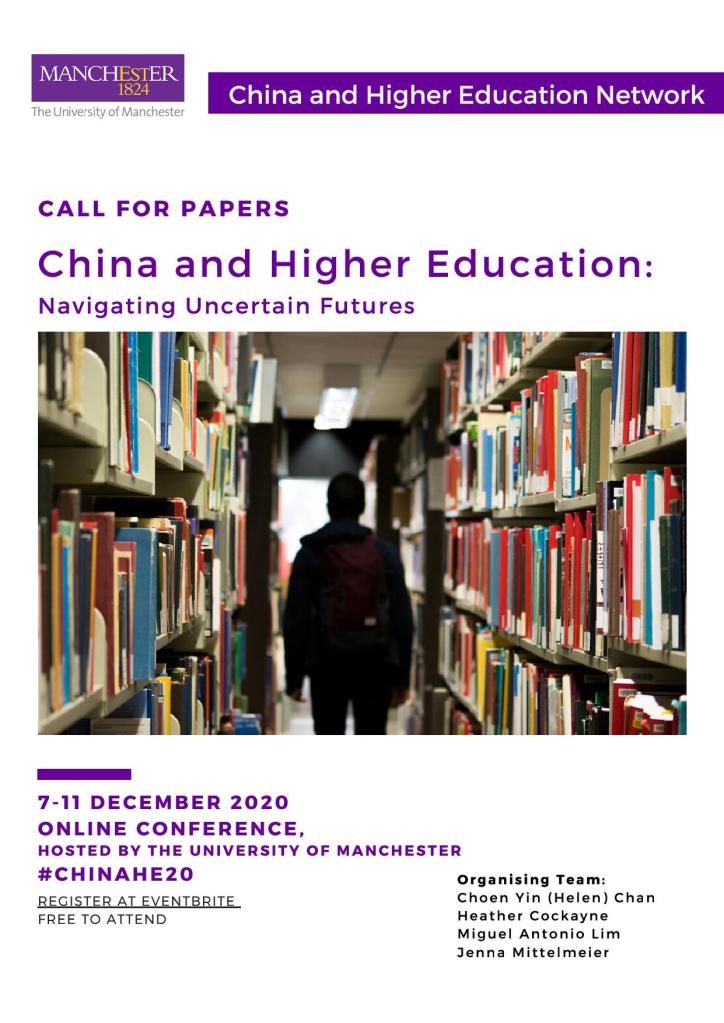
CfP: China and Higher Education: Navigating Uncertain Futures

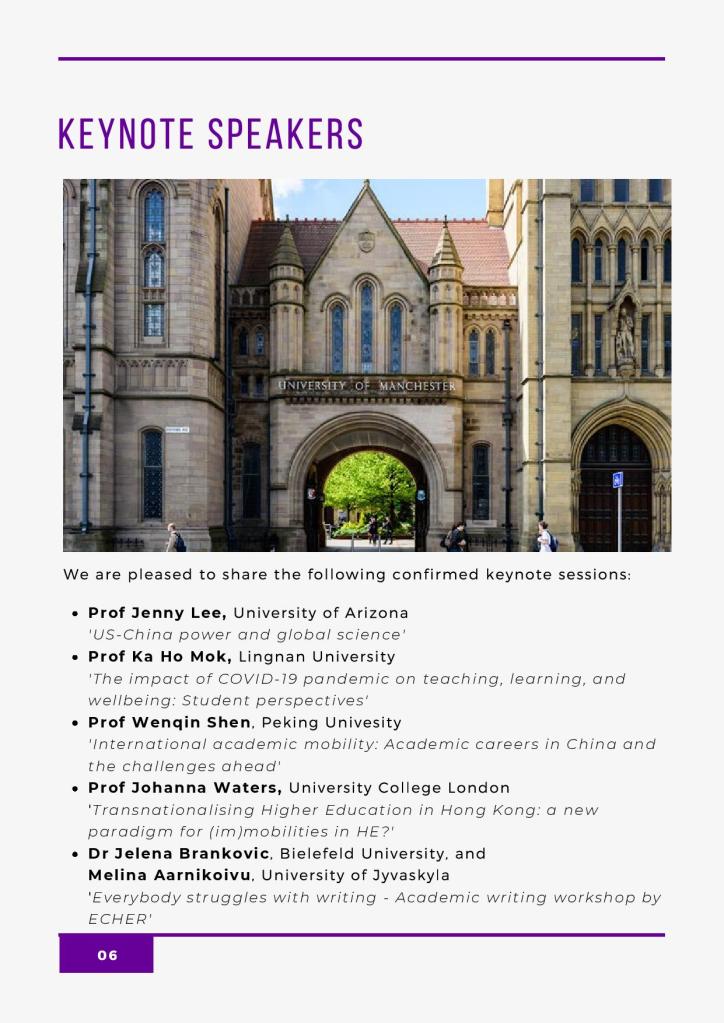
The conference will take place online on 7-11 December 2020. This is the third in an annual series of conferences on China and Higher Education hosted by the University of Manchester.

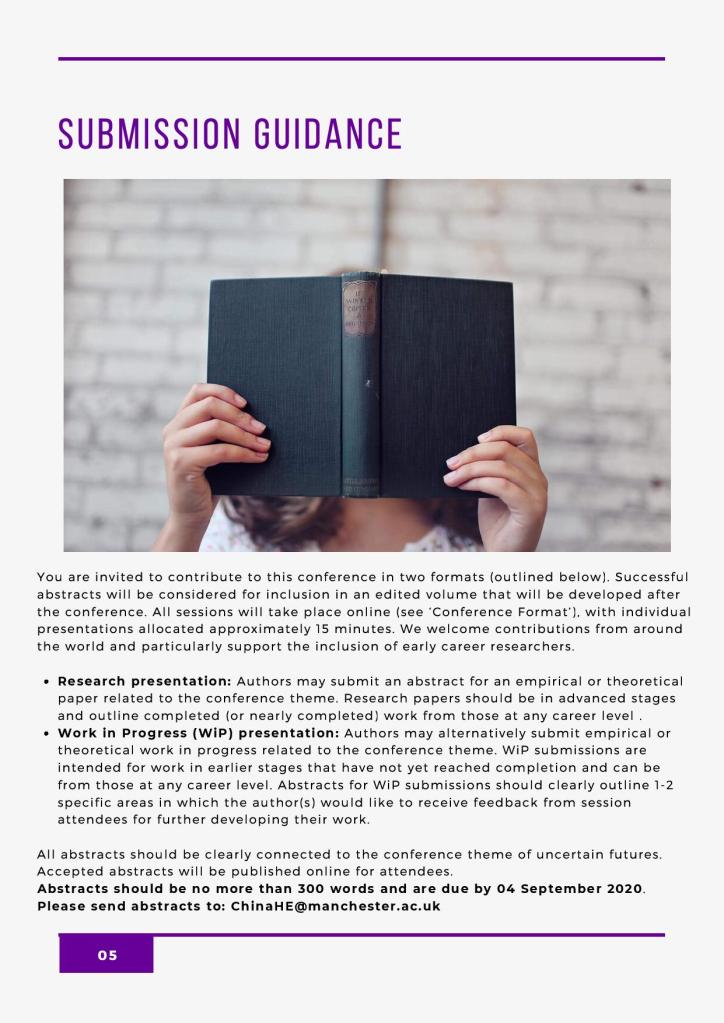
The attached Call for Papers, also available at the link below, provides details about the conference theme and the guidelines for abstract submissions. Please email abstracts of 300 words to ChinaHE@manchester.ac.uk by 4 September 2020.

https://spark.adobe.com/page/Qe6DB0fHirUyI/

The conference is free to attend. Please register here.

We look forward to connecting with you at the conference!

Call for Applications: “Migration Matters: Ethnicity, Race, Labor and Politics across Borders” at Boston University

Department of Anthropology
Boston University
Call for Applications
An Emerging Scholars Program on:
Migration Matters: Ethnicity, Race, Labor and Politics across Borders

Photo by Artem Beliaikin from Pexels

The Department of Anthropology at Boston University invites applications from junior scholars in Anthropology, Sociology, Political Science, Critical Race Studies, Ethnicity Studies, Gender Studies and related fields for a workshop on “Migration Matters: Ethnicity, Race, Labor and Politics across Borders.”


Selected participants will be invited to the BU campus in Spring 2021 for a two day-long event, featuring a public keynote lecture by Professor Miriam Ticktin of the New School for Social Research, two panel sessions that will showcase the work of the participating emerging scholars, a graduate student workshop, and an open roundtable discussion. Selected scholars will also participate as a guest lecturer for one session via Zoom in Fall 2020 in the graduate seminar on
“Migration, (Im)mobilities and Precarity,” where they will meet the graduate students who will subsequently attend the workshop in the Spring.

The goal of the program is to bring together some of the most promising scholars from groups that have historically been underrepresented in the academy in order to provide a platform for close engagement between these young scholars, our diverse graduate student body as well as BU faculty working on related issues in Anthropology and other cognate programs.


We are soliciting applications from historically underrepresented, emerging scholars who pursue cutting edge forms of inquiry in the field of migration, border studies, citizenship, critical race studies, and indigenous studies on topics including but not limited to: practices of inclusive exclusion; racialization and displacement; precarious labor; containment at the border;
technologies and archaeologies of the border; re-imaginations of the border by migrants, scholars and activists; and changing notions of territoriality and boundary-making.

Some of the questions we are especially interested in pursuing together are: How can we produce nuanced ethnographies of those spaces between privilege and precarity, between movement and immobility, between subjection and subjectivity and between the “West” and the “Global South”? How do the interconnections between legal status, economic precarity, and racial marginalization impact practices of differentiated citizenship as well as political mobilization? How do ethnic and religious identifications regulate and redefine borders? How might we capture the changing dynamics of an increasingly albeit unevenly connected world without falling into the trap of presentism, exceptionalism or the often sensationalist discourses of crisis?
What are the ethical, methodological and political challenges peculiar to the study of movement across militarized and heavily policed borders as well as the racialized borders and boundaries of settler states? In what ways do we need to reconsider the links between methodology and epistemology and between empirical and engaged scholarship in the study of migration and borders?

Early career Assistant Professors, postdocs and ABDs who will be completing their PhD by June 2022 are eligible to apply. Invited junior scholars will be guests of the Department of Anthropology in Spring 2022 from Friday April 16th through the morning of Sunday, April 18th. All travel expenses will be covered by Boston University. The symposium will commence on April 16th with a keynote lecture by Dr. Miriam Ticktin, Associate Professor of Anthropology at the New School for Social Research and former codirector
of the Zolberg Institute on Migration and Mobility, followed by a general reception.


Participants will present their research on April 17th. Each morning session will feature three invited scholars and one discussant from BU faculty. After a luncheon with graduate students, the symposium will reconvene with a roundtable workshop. Graduate students in Anthropology and related fields will workshop their research projects and have the invited scholars comment on their work. The symposium will conclude with an open discussion highlighting new directions in the field of migration, border studies and critical race studies.

To apply, please submit:
§ A 300-word abstract describing your proposed research presentation
§ A cover letter that summarizes research interests and professional goals. Please include a discussion of how the abstract is connected to your broader research agenda and how participation in the program would enhance your career trajectory and contribute to making the academy a more inclusive environment.
§ Current CV


Materials should be submitted to Veronica Little (email) by August 10, 2020. Participants will be notified of acceptance in early September, 2021. Questions may be addressed to Dr. Ayşe Parla (parlaa@bu.edu)

Call for Participants: “Students/graduates form Belt-and-Road countries in China: migration network and career trajectory”

Hello, I am Dr. Mengwei Tu. I am a lecturer in Sociology at East China University of Science and Technology. My project, “Students/graduates form Belt-and-Road countries in China: migration network and career trajectory”, investigates the studying and job-seeking experience of international students/graduates in China, in order to better facilitate international graduates’ study-to-work transition.  

I welcome your participation:

I am looking for final year postgraduate degree students who are interested in sharing their experiences in China.

I also seek to interview former international students who have graduated and are living in China.

Interviews will be conducted online and last for about an hour. (Your privacy will be strictly protected, any information which may reveal your identity will not be made public. A consensual agreement will be signed to guarantee your anonymity.)

In return, I am happy to provide free consultancy regarding working and further study in China.

Please do not hesitate to contact me for more information.

Mengwei Tu

PhD in Sociology (Kent, UK)

East China University of Science and Technology, Shanghai 

http://cpsa.ecust.edu.cn/2017/0926/c6396a69239/page.htm

Email: mtu702@outlook.com

Mobile/wechat: 18958231600

Mengwei Tu

PhD in Sociology (Kent, UK)

East China University of Science and Technology, Shanghai 

http://cpsa.ecust.edu.cn/2017/0926/c6396a69239/page.htm

Email: mtu702@outlook.com

Mobile/wechat: 18958231600

你好,我是华东理工大学社会学系的屠梦薇老师。我正在进行一个名为“一带一路沿线国在华留学生移民网络和职业发展研究”的课题。本课题希望对留学生毕业前后进行观察,了解每个人的经历和感受,讨论来华留学的影响和作用。

留学生群体是多样的,本课题也需要各种背景的来华学生、来华毕业生的参与。我正在寻找符合以下三条要求的留学生:

      1. 来自“一带一路”沿线国

    (如果不确定自己的国家是否符合,可以先和我取得联系)。

      2. 2020年毕业。

      3. 进行研究生课程学习的学生(硕士或博士)。

同时,我们也非常欢迎已经毕业并且继续留华工作的留学毕业生参与访谈。

访谈以线上访谈为主,约一个小时左右(您的个人信息将被严格保密,访谈内容只会用于学术研究,每一次访谈都会签署保密协议)。

作为对您参与的感谢,我十分乐意对您提供关于来华就业和继续深造的免费咨询。

请联系:屠梦薇

Email:mtu702@outlook.com

手机/微信:18958231600