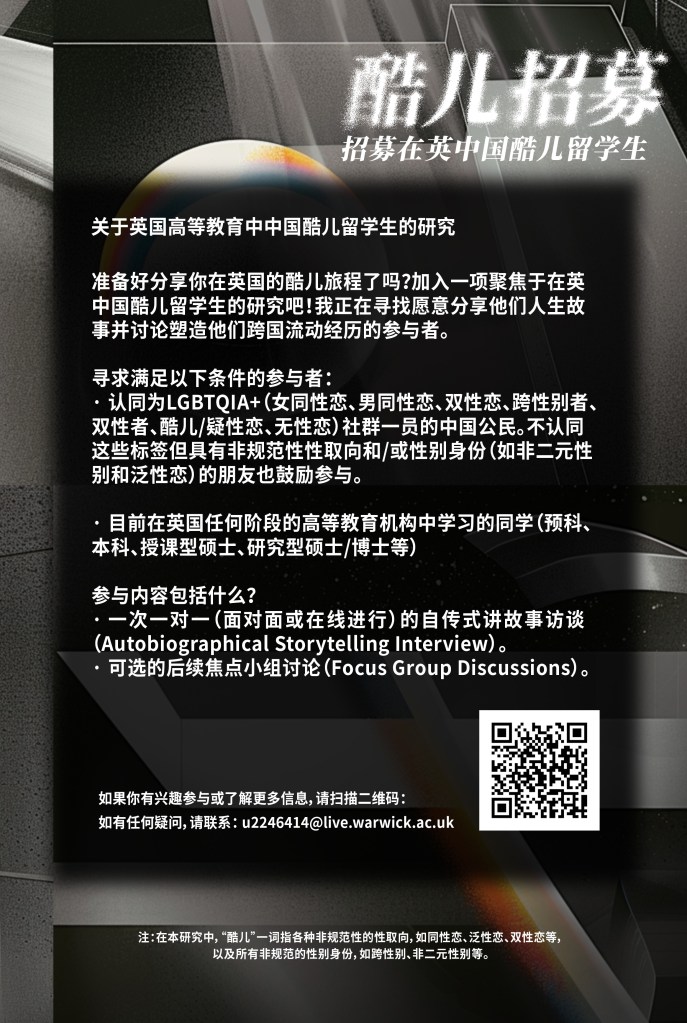
Call for Participants: Exploring the Experiences of LGBTQIA+ Chinese Students in the UK

Haoxi Ou at the University of Warwick is seeking LGBTQIA+ Chinese international students in the UK to participate in a research project exploring their experiences and the kinds of desires that animate international mobility.

Managing Editor: Tong Meng

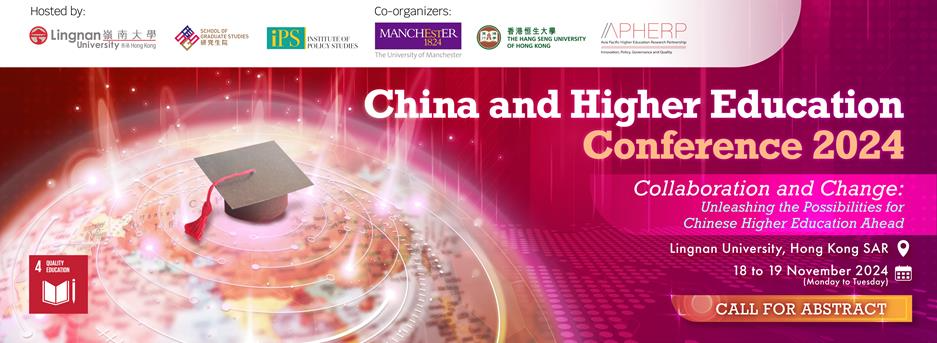
[Call for Abstracts] China and Higher Education Conference 2024|Lingnan University and University of Manchester

Dear Professors and Friends,

Greetings from Lingnan University! We are honored to extend this invitation to your faculty and postgraduate students to contribute and attend the China and Higher Education Conference 2024 (ChinaHE) from 18 to 19 November 2024 (Monday to Tuesday). The conference theme is Collaboration and Change: Unleashing the Possibilities for Chinese Higher Education Ahead.

Keynote Speakers:

With the above theme, the following key questions will be discussed at the conference include, but are not limited to: 

1.          How are collaborations between Chinese and international HEIs reshaping academic research, pedagogy, and students’ learning experiences?

2.          How are emerging technologies and digital platforms facilitating collaboration and knowledge sharing among HEIs, and what are the implications for academic research, teaching, and learning?

3.          What strategies are effective in promoting interdisciplinary collaboration within Chinese HEIs, and how can interdisciplinary approaches address complex societal challenges?

4.          How are collaborations between Chinese HEIs and government agencies driving policy reform, regulatory changes, and institutional autonomy within the higher education sector?

5.          What roles does industry-academia collaboration play in fostering innovation, entrepreneurship, and workforce development within Chinese higher education?

6.          How can collaborative partnerships between Chinese HEIs and non-profit organizations or civil society groups contribute to social equity, community engagement, and sustainable development goals?

7.          What opportunities and challenges arise from international collaboration initiatives, such as the Belt and Road Initiative, in shaping the globalization of Chinese HEIs?

8.          As under-studied stakeholders, what are the roles of international students and professional staff in Chinese HEIs in building national and inter-national collaborations?

9.          What are the roles of educational leaders in promoting collaboration among Chinese and international HEIs to thrive on the changes while addressing the deep-seated educational issues? 

Call for Abstract We invite you to submit your scholarly abstracts and present your latest research at Lingnan University to an international audience.
Submit Now: Click Here [lingnan.asia.qualtrics.com]
Due date: 15 September 2024 at 23:59 HKT (GMT+8)

We also encourage you to share this conference within your professional network to enhance our collective impact.

For further information, kindly visit the webpage provided here [ln.edu.hk]. If you have any inquiries, please feel free to contact the Conference Organizing Committee at ChinaHE@LN.edu.hk .

Managing Editor: Tong Meng

2025 ICSA Annual Conference Digitization and Social Development

The swift advancement of digital technology has significantly reshaped numerous facets of society, exerting profound influence on modes of interaction, governance, learning, and professional engagement. Against this backdrop, this conference endeavors to delve into the intricate interplay between digitization and societal progress, embracing a diverse array of disciplines and perspectives. We cordially invite submissions of scholarly papers aligned with the thematic areas delineated below, while also extending an inclusive invitation for contributions spanning broader dimensions of scientific inquiry.

The ICSA program committee welcomes submissions on topics related to this main theme, as well as on other topics, both theoretical work and empirical analysis. Papers offering comparative perspectives and cross-disciplinary approaches are particularly welcome. Both complete papers and extended paper abstracts in English will be considered. Extended abstracts must contain sufficient details to suggest timely completion (normally, 5 pages or more).

Graduate students are invited to compete for the ICSA 2025 Nan Lin Graduate Student Paper Award. One paper (published or unpublished) will be selected and the award will be announced in the conference and presented with a plaque and a check of USD 500 (by mail). The selected paper must be presented in person at the conference in person. Five travel awards valued $500 will be offered to students based on their submission for the paper award.

To be considered for the Nan Lin Paper Award, papers must be (1) authored by student(s) only, (2) in English, and (3) to be presented at the 2024 ICSA Conference. Student status must be valid as of the end of 2025. Only complete papers will be considered. Please mark *Nan Lin Paper Award* in the Subject Area when submitting online.

The International Chinese Sociological Association (ICSA) invites nominations for the Yu Xie Early Career Award. The ICSA Yu Xie Early Career Award recognizes and honors individuals who have made an outstanding contribution to Sociology within 10 years of completing their doctoral degree. The award includes a certificate and USD1,000. The winner will be honored during the Annual Meeting. The deadline for the nomination is to be determined. See details in the award page.


Instructions for Paper Submissions
The ICSA Paper Submission Information Site will be available on September 1, 2024, at https://icsa-sociology.org. The submission deadline is October 13, 2024. In the event of any technical difficulties, submissions may be emailed to master@icsociology.org, or socywj@nus.edu.sg.

Please note that conference participation requires membership in the ICSA. If you are not an active member yet, please become a member through ICSA’s new homepage: https://icsa-sociology.org. The membership fees: $10 for a student membership, $30 for a regular membership, and $600 for a lifetime membership. 


The ICSA is a nonprofit organization, registered in both California, USA and Hong Kong SAR, China. It aims to promote social scientific research on Chinese societies, cultures, and populations in the world.

Conference Committee

(ICSA)
Wen Ming (Co-Chair)
Tong Yuying
Song Xi
Zhang Zhuoni


(SWUFE)
Ho Longtao (Co-Chair)
Haiyang Yang
Min Yue
Xiangshu Deng

Important Date

Sept 1, 2024: On-line submission site opens

Oct 13, 2024: Deadline for submitting Abstracts 

Oct 31, 2024: Formal acceptance letters by email

Nov 25, 2024: Deadline for confirming attendance by authors 

Dec. 19, 2024: Provisional program available on the website

May 15, 2025: Full papers due to organizers/presiders

May 31, June 1, 2025: Conference

Managing Editor: Xin Fan

International Education in Transition: Perceptions of Expatriate Leadership at a Chinese School Delivering an Australian Curriculum

Cutri, J., Bunnell, T., & Poole, A. (2024). International education in transition: perceptions of expatriate leadership at a Chinese school delivering an Australian curriculumCompare: A Journal of Comparative and International Education, 1-18.

In recent years, private ‘non-traditional’ English-medium international schooling has grown significantly, particularly in mainland China, which has housed the most international schools since 2019. Most international schools (52%) offer a UK-based curriculum, driven by demand from a ‘new rich’ entrepreneurial class seeking ‘flexible citizenship’ and ‘positional advantages’ in the global higher education and labour market (Young, 2018; Ma & Wright, 2023; Wright, 2024). This shift marks a transition from a Western-led, values-inspired dimension focused on global peace to a globalist approach characterised by international standards and imagined futures in the Global West (Cambridge & Thompson, 2004). However, the dynamics between expatriate and host country cultures within this evolving landscape remain unexplored (Gibson & Bailey, 2023). ISC Research recently highlighted that a third of all international schools are bilingual, offering an English-speaking curriculum alongside a host nation-based curriculum.

In China, the rapid emergence of bilingual international schools catering to local students has led to 32% offering British-based Advanced Level, 15% American-oriented Advanced Placement, and 27% the IB Diploma Programme (Probert, 2022). These schools, constituting 66% of all international schools in China, provide an alternative pathway to international education for local students without overseas passports, though parental motivations remain underexplored (Keeling, 2019; Wright et al., 2022; Wu & Koh, 2023). Unofficially termed ‘Chinese Internationalised Schools’ (CIS), these institutions are reshaping the international school sector in China through local processes (Wu & Koh, 2022).

Set within this context, this article focuses on a Chinese senior school offering an Australian-accredited curriculum, the Victoria Certificate of Education (VCE), to Chinese children, offering a direct pathway to Australian universities. Interviews with the expatriate Australian leadership team based in China demonstrate how a pragmatic model has emerged that offers an alternative, high-quality, branded pathway for Chinese children to enter Higher Education beyond China (mainly in Australia) yet is delivered within the cultural/social/political boundaries that the Chinese state will accept. The arrangement is strictly overseen and regulated and open to sudden, unanticipated changes. We speculate that this might be a model that other nation-states might follow as more local parents/children buy into private ‘non-traditional’ international schooling. Furthermore, the expatriate leadership are crucial in managing and expanding the VCE program in China, ensuring that it aligns with Australian educational standards and Chinese cultural expectations. Our paper extends this metaphor through the example of the VCE program, accredited by the Victorian Curriculum Assessment Authority and delivered in Chinese schools under the supervision of Australian partner schools.

The VCE-in-China program, overseen by Chinese and Australian leadership, allows Chinese students to complete an Australian curriculum and enter foreign universities. This initiative represents China importing international education rather than exporting a foreign model. The Australian school facilitates the operation of its curriculum within a Chinese setting, adhering to Chinese regulations and cultural norms. This model, not widely discussed in international education scholarship, exemplifies ‘Sinicisation’—aligning foreign education with Chinese socialist market models to support economic development (Wang, 2015). The power of the Chinese state in providing alternative pathways for local students is evident, with new regulations introduced in 2021 further shaping this landscape (Wu & Koh, 2023).   

The study delves into the perceptions of expatriate leadership at the Sino-Australian Academy (SAA), a Chinese school delivering the Victorian Certificate of Education (VCE) curriculum. This initiative is set against the backdrop of China’s post-2001 market reforms and the increasing internationalisation of education. The expatriate leadership team faced significant challenges reconciling their leadership norms with the realities of the Chinese educational context. The VCE brand, associated with a prestigious Australian private school, highly appeals to Chinese parents, offering a pathway to higher education in Australia and beyond. This appeal aligns with the trend of non-traditional international schools providing perceived distinction and positional advantage.

The study revealed five major themes: Chinese educational culture, bilateral educational partnership, agency and identity, transnational aspirations, and Australian academic adjustments. This reflexive and interpretative process aimed to preserve participants’ voices and faithfully represent their stories. The study highlights the complexities of leadership dynamics in Sino-foreign educational ventures, emphasising the importance of cultural sensitivity, effective branding, and regulatory compliance.

The research highlights the complexities of operating within the Chinese regulatory framework, emphasising the need for cultural sensitivity. Expatriate leaders must balance upholding educational standards with adhering to local regulations under the oversight of the Chinese Executive Principal (CEP), who ensures compliance with national sovereignty and cultural values. This study is significant in international education as it reveals the unique challenges expatriate leaders face and their influence on students’ educational experiences in a cross-cultural context. It contributes to understanding leadership in international schools, particularly in non-Western settings, and offers insights into the evolution of international education in a globalised world.

The findings suggest that the pragmatic model of international education provides a reliable pathway for Chinese students to access higher education abroad while retaining their national identity.  The study provides valuable insights into the leadership dynamics, regulatory challenges, and cultural adaptations of delivering an Australian curriculum in a Chinese school, emphasising the importance of a localised approach to international education. It highlights the need for a nuanced understanding of how Western educational systems operate in non-Western settings. Hence, the research challenges Western-centric notions, advocating for models that respect international aspirations and local cultural norms and calls for further investigation into the long-term outcomes and adaptability of such educational models in China. This model represents a shift in international education, advocating for models that respect international aspirations and local cultural norms.

References

Cambridge, J., & J. Thompson. (2004). “Internationalism and Globalization as Contexts for International Education.” Compare: A Journal of Comparative and International Education 34 (2): 161–175.

Gibson, M. T., & L. Bailey. (2023). “Constructing International Schools as Postcolonial Sites.” Globalisation, Societies & Education 21 (3): 405–416. https://doi.org/10.1080/14767724.2022. 2045909. 

Liu, S. (2018). “Neoliberal Global Assemblages: The Emergence of ‘Public’ International High-School Curriculum Programs in China.” Curriculum Inquiry 48 (2): 203–219. https://doi.org/10. 1080/03626784.2018.1435977217.

Ma, Y., & E. Wright. (2023). “Expanding Flexible Citizenship: Chinese International School Students and Global Mobilities for Higher Education.” Social Transformations in Chinese Societies 19 (2): 101–114. https://doi.org/10.1108/STICS-05-2022-0010 .

Keeling, A. (2019). “Education in China – A Growing Market.” International Teacher Magazine, April.

Probert, S. (2022). “China: The Under-Researched Nexus of Activity.” Journal of Research in International Education 21 (3): 228–241. https://doi.org/10.1177/14752409221140627 .

Tan, C. (2019). “Neoliberalism as Exception: The New High-Quality School Project in Shanghai.” Discourse: Studies in the Cultural Politics of Education 40 (4): 443–457. https://doi.org/10.1080/ 01596306.2017.1349736 .

Wright, E. (2024). “The Proliferation of International Schools: Implications for Educational Stratification.” Compare A Journal of Comparative and International Education 1–20. https:// doi.org/10.1080/03057925.2024.2322647 .

Wright, E., Y. Ma, & E. Auld. (2022). “Experiments in Being Global: The Cosmopolitan Nationalism of International Schooling in China.” Globalisation, Societies & Education 20 (2): 236–249. https://doi.org/10.1080/14767724.2021.1882293 .

Wang, N. (2015). “Globalisation as Glocalisation in China: A New Perspective.” Third World Quarterly 36 (11): 2059–2071. https://doi.org/10.1080/01436597.2015.1068113 .

Wu, W., and A. Koh. 2022. “Being ‘International’ Differently: A Comparative Study of Transnational Approaches to International Schooling in China.” Educational Review 74 (1): 57–75. https://doi.org/10.1080/00131911.2021.1887819 .

Wu, W., and A. Koh. 2023. “Reigning in the International: How State and Society Localised International Schooling in China.” British Journal of Educational Studies 71 (2): 149–168. https://doi.org/10.1080/00071005.2022.2048630 .

Young, N. A. (2018). “Departing from the Beaten Path: International Schools in China as a Response to Discrimination and Academic Failure in the Chinese Educational System.” Comparative Education 54 (2): 159–180. https://doi.org/10.1080/03050068.2017.1360566 .

Authors’ Bio 

Jennifer Cutri, Swinburne University of Technology, Australia

Jennifer Cutri is a lecturer and researcher at Swinburne University of Technology’s Department of Education. She is the course director for the Bachelor of Education Early Childhood Teaching and Bachelor of Education Studies. Inspired by her international teaching experience in Hong Kong, her doctoral research focused on the Chinese educational context. Jennifer’s current research explores the impact of digital technology in early childhood education and international student mobility within the Asia-Pacific region.

Tristan Bunnell, University of Bath, United Kingdom

Tristan Bunnell is a Senior Lecturer in International Education at the University of Bath. Prior to 2014, he had taught International Baccalaureate Diploma Programme economics for 25 years, including ten years at Copenhagen International School. His current research interests concern trends and developments in English-medium international schooling, particularly the growth and significance of ‘non-traditional’ models involving the exportation of British private school brands into China.

Adam Poole, The Education University of Hong Kong, Hong Kong

Adam is an Assistant Professor in the Department of Education Policy and Leadership, Education University of Hong Kong. His research interests include the internationalisation of private secondary education, professional development for English teachers, and education policy.

Managing Editor: Tong Meng

The influence of the Chinese hukou system in motivating and shaping the geography of Chinese international student mobility

Research Highlighted: 

Kang, E. (2024). The influence of the Chinese hukou system in motivating and shaping the geography of Chinese international student mobility. Population, Space and Place30(1), e2734. https://doi-org.ezphost.dur.ac.uk/10.1002/psp.2734

International student mobility (ISM) refers to the processes of movement of ‘internationally mobile students’, defined as people who leave their country of citizenship primarily for education (UNESCO Institute for Statistics, 2014). Scholars have found that institutional barriers significantly influence the ISM process (Lomer, 2018; Lulle & Buzinska, 2017). However, this understanding usually refers to international migration. There is little knowledge about how institutional barriers to internal migration affect ISM. To fill the important gap, this paper relates to the data from 50 semistructured interviews with returning master’s graduates in Shanghai to examine the effect of the Chinese hukou system on different stages of ISM experience, including pre-departure, upon and after return, among Chinese international students. Specifically, this paper asks whether the hukou restriction of internal migration may motivate some students to study abroad. If so, how does the hukou system affect the ISM experience of middle-class Chinese international students? The main contribution of this paper is the revealing of the thus far underacknowledged relationship between ISM and domestic institutional barriers to mobility. 

The Chinese hukou system is an appropriate starting point for exploring how domestic institutional barriers affects ISM. This is partially because China is one of the largest ISM-sending countries in the world (Wen & Hu, 2019).These students came from different regions of China, but upon their return were concentrated in several developed coastal cities, such as Shanghai and Guangzhou (Chinese Service Center for Scholarly Exchange CSCSE, 2018). In other words, returnees were often internal migrants within China. Additionally, the hukou system is an important social institution to control internal migration in China. The hukou system is a household registration system in China that classifies the population according to two frameworks: hukou type (agricultural or nonagricultural) and place of registration (local or nonlocal) (Song, 2014). The hukou system significantly influence on internal migration in the country (Qian et al., 2020; Song, 2014). On the one hand because individuals’ citizenship rights are connected with their hukou registered regions (Song, 2014). It is difficult for internal migrants to access diverse welfare benefits without local hukou status in their destinations (Chan & Buckingham, 2008; Song, 2014; Zhou & Cheung, 2017; Zhou & Hui, 2022). On the other hand, changes in hukou status are highly regulated and are difficult for individuals to achieve (Qian & Qian, 2017; Zhou & Hui, 2022).  In recent years, hukou reforms have allowed returning international students to access hukou status in developed cities (Brooks & Waters, 2021; Zhai, 2020). These reforms provided enhanced potential opportunities for middle-class students in economically peripheral regions to access hukou status in core cities via ISM. The mechanism of this process is the focus of this paper. 

Based on an analysis of interviews with 50 returning students, this analysis generated three main findings that address important current limitations in understanding the effects of institutional barriers on ISM. First, overcoming restrictions from the hukou system motivates many Chinese students to study abroad. Young people hope to migrate from other parts of China to developed Chinese cities because of the regional inequalities that have occurred in Chinese urbanisation in recent decades (Zhai & Moskal, 2022). Students who belong to the ‘middle-category migration’ participate in ISM to achieve future internal migration. Second, the data demonstrate that students emphasise being away for a short study time, with some choosing specific destinations that are closer to China, lowering the emotional and monetary costs of ISM. This finding indicates that hukou can impact the geographies of ISM destinations because students belonging to the ‘middle category’ of migration could access hukou status by paying less to study internationally in specific destinations. Finally, this paper found that distinctive requirements for accessing hukou status in different areas affect returnees’ decisions regarding internal migration after returning. These findings have two major implications on ISM studies. 

First, this paper highlighted the effect of institutional barriers on the geography of ISM, which shapes the geographies of both ISM destinations and return destinations. Previous studies have focused on institutional barriers in ISM-receiving countries (Tuxen & Robertson, 2019). Only in recent years have some scholars identified the hukou system as an institutional barrier that influences ISM (Brooks & Waters, 2021; Zhai, 2020). However, this is the first study to explicitly demonstrate how the hukou system affects the ISM process. Second, this paper found that the hukou system helps scholars better understand the ISM experience of students from a ‘middle-category migration’ background. International students are usually regarded as a privileged group within ISM research. Students’ diversity in terms of socioeconomic and sociopolitical backgrounds is usually disregarded (Lipura & Collins, 2020). The hukou system provides a tool to distinguish ‘middle-category migration’ international students from the commonly held viewpoint that ISM involves students of a particularly elite class.  

Reference: 

Brooks, R., & Waters, J. (2021). International students and alternative visions of diaspora. British Journal of Educational Studies, 69(5), 557-577. 

Chinese Service Center for Scholarly Exchange (CSCSE) (2018). Zhongguo Liuxue Huiguo Jiuye Lanpishu (Blue Book of China’s returned employment) 2018. Beijing: Zhongguo Yanshi Chubanshe (China Yanshi Press). 

Chan, K. W., & Buckingham, W. (2008). Is China abolishing the hukou system?. The China Quarterly, 195, 582-606. 

Lomer, S. (2018). UK policy discourses and international student mobility: The deterrence and subjectification of international students. Globalisation, Societies and Education, 16(3), 308-324. 

Lipura, S. J., & Collins, F. L. (2020). Towards an integrative understanding of contemporary educational mobilities: A critical agenda for international student mobilities research. Globalisation, Societies and Education, 18(3), 343-359. 

Lulle, A., & Buzinska, L. (2017). Between a ‘student abroad’and ‘being from Latvia’: Inequalities of access, prestige, and foreign-earned cultural capital. Journal of Ethnic and Migration Studies, 43(8), 1362-1378. 

Qian, Z., Cheng, Y., & Qian, Y. (2020). Hukou, marriage, and access to wealth in Shanghai. Journal of Ethnic and Migration Studies, 46(18), 3920-3936. 

Qian, Y., & Qian, Z. (2017). Assortative mating by education and hukou in Shanghai. Chinese Sociological Review, 49(3), 239-262. 

Song, Y. (2014). What should economists know about the current Chinese hukou system?. China Economic Review, 29, 200-212. 

Tuxen, N., & Robertson, S. (2019). Brokering international education and (re) producing class in Mumbai. International Migration, 57(3), 280-294. 

UNESCO. (2014). Higher Education in Asia: Expanding Out, Expanding Up – The Rise of Graduate Education and University Research. Available at: http://uis.unesco.org/sites/default/files/documents/higher-education-in-asia-expanding-out-expanding-up-2014-en.pdf 

Wen, W., & Hu, D. (2019). The emergence of a regional education hub: Rationales of international students’ choice of China as the study destination. Journal of Studies in International Education, 23(3), 303-325. 

Zhou, J., & Hui, E. C. M. (2022). The hukou system and selective internal migration in China. Papers in Regional Science, 101(2), 461-482. 

Zhou, S., & Cheung, M. (2017). Hukou system effects on migrant children’s education in China: Learning from past disparities. International social work, 60(6), 1327-1342. 

Zhai, K. (2020). Social mobility and international graduates in China (Doctoral dissertation, University of Glasgow). 

Zhai, K., & Moskal, M. (2022). The Impact of Place of Origin on International and Domestic Graduates’ Mobility in China. International Migration Review, 56(1), 123-154. 

Authors’ Bio 

Erli is a PhD candidate in Human Geography at the University of St Andrews. Before moving to the UK, he worked as a researcher at Fudan University in China. Erli’s research has been funded by the University of St Andrews, the Government of Shanghai and the Ministry of Education, China. Erli’s research interests include international/internal migration, international higher education and social inequality. He has presented his studies at the 12th International Conference on Population Geographies and the RGS-IBG Annual International Conference and published part of his studies in Population, Space and Place.

Managing Editor: Xin Fan