Rural-Urban Migration and Agro-Technological Change in Post-Reform China

Watch this interview and listen to this interview with Lena.
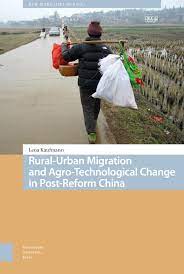
by Dr Lena Kaufmann, University of Zurich

Rural-Urban Migration and Agro-Technological Change in Post-Reform China (open access) investigates how rural Chinese households deal with the conflicting pressures of migrating into cities to work as well as staying at home to preserve their fields as safety net. Since the 1980s, about one fifth of the entire Chinese population has migrated within China, most of them to the big cities on the east coast. This corresponds to more than one third of Chinese farmers. In their places of arrival, most of these migrants work under highly precarious conditions. It is therefore crucial for them to preserve their resources at home as a safety net, especially their fields. However, this is particularly challenging for rice farmers, because paddy fields have to be cultivated continuously and by a sufficient number of people to retain their soil quality and value. Farming households therefore pursue a range of social and technical strategies to deal with this predicament and to sustain both migration and farming.

The book sets out, in a first step, by analysing the important policy and knowledge transformations since the 1950s that have given rise to the particular situation that farmers currently face. In a second step, it describes farmers’ contemporary responses to these transformations. Special attention is paid to the widespread, although commonly overlooked adoption of post-Green Revolution farming technologies that have not only set free agricultural labour and contributed to inducing farmers to migrate, but also given farmers new options for dealing with their predicament. Methodologically, the book draws on ethnographic fieldwork, including participant observation in rural and urban China and interviews with staying and migrating household members, as well as on written sources such as local gazetteers, agricultural reports and statistical yearbooks. Moreover, it also draws on proverb collections as a channel of knowledge transmission.

The book argues, first, that paddy fields play a key role in shaping farmers’ everyday strategies. Scholars from various disciplines have repeatedly stressed that fields play a crucial role in, and for, migration. Yet, the specific socio-technical challenges in preserving this key asset and the knowledge needed to do so remain largely unexplored. This book scrutinizes these challenges in more depth, proposing the need to look at the repertoires of knowledge that both staying and migrating farmers revert to.

Related to this, second, it argues that ostensibly technical farming decisions are always also social decisions that are closely interlinked with migration decisions. In taking seemingly operational decisions, farmers are actually pursuing various long-term and short-term projects that best match their current, fluctuating household situation. What looks like simple technical ability is, in fact, multi-dimensional reasoning for potentially manifold purposes. Applying skills practically and economically always includes simultaneously performing social responsibilities. This means that farming decisions also take into consideration aspects like educational, career, or marriage aspirations, child or elderly care, long-term engagements and future responsibilities and, more generally, the social and economic reproduction of the household and the patriline.

Overall, the book argues for the need to pay more attention to the material world of migration and the related knowledge and skills. It proposes that socio-technical resources are key factors in understanding migration flows and the characteristics of migrant-home relations. In the case of China, for example, a focus on such resources helps to explain why there are so many divided households, why migration is often circular, why relationships with home remain important, and why most migrants envision returning to rural areas in the future.

The book is located at the intersection of the literature on the anthropology of migration, agriculture, and skilled practice. On an empirical level, rather than focusing on the well-studied phenomenon of migrants in their places of destination, it provides a rare qualitative-ethnographic study of migrants’ origins and, in particular, the rural side of Chinese migration. Since the reform policies of the 1980s, Chinese mobility has sharply increased, both domestically and transnationally. In view of this augmented mobility, the book provides new socio-material insights relevant to understanding the most widespread pattern of migration within contemporary China: rural-urban migration from the inner provinces to the large cities of the east coast, which often results in households whose members reside separately in different locations. Focusing on the role of farmland in migration, this book contributes a new perspective on why this pattern remains so common. This entails comprehensively examining both those who stay and those who migrate, and acknowledging that both are part of a rural-urban farming ‘community of practice’. The members of this community of practice are connected through circular migration, embodied farming skills and joint efforts to preserve home resources.

Moreover, perceiving migration in this way lets us rethink the implications of China’s hukou system of household registration, which has strictly divided the population into either rural or urban, agricultural or non-agricultural since the 1950s. This system has long prevented rural Chinese from gaining permanent settlement rights or any entitlement to the welfare, pension and education system available to registered urban-dwellers. The recent reform of China’s hukou system in 2014 increasingly allows rural people to move and obtain an urban registration. In this regard, the book is part of a new strand of scholarship that discusses not only the obvious constraints, but also the advantages of being registered as ‘rural’. Highlighting the central role of land and land entitlement, it contributes to understanding why many rural inhabitants refuse to change their status into ‘urban’ citizens despite having lived in cities for years, and why the peasant smallholder model remains important, despite massive urbanization.

On a theoretical level, the book contributes especially to a recently-established subfield of migration studies, materialities of migration. It contributes to the material turn in migration studies a perspective on things that stay – paddy fields – and the related embodied skills. The latter are important socio-technical aspects of migration that, nevertheless, generally escape our attention because they usually remain tacit and are mostly transmitted beyond formal educational structures. Nevertheless, as the book suggests, such a socio-technical perspective is highly valuable for studying migration phenomena, as a way to offer new understandings of migrant-home relations and dynamics.

Finally, the book challenges prevailing narratives about backwardness and progress. Challenging public discourse which portrays Chinese peasants as passive and backward, it shows that farmers are, in fact, forward-looking decision-making agents who are actively shaping China’s modernity. Overall, this book provides rare insights into the rural side of migration and farmers’ knowledge and agency.

Author Bio

Dr Lena Kaufmann is a postdoctoral researcher at the University of Zurich, where she is a research associate in both the Department of History and the Department of Social Anthropology and Cultural Studies. Trained as an anthropologist and sinologist in Rome, Berlin and Shanghai, she holds a PhD in social anthropology from the University of Zurich. She spent four years in China and has conducted extensive research on Chinese migration in urban and rural settings. She is the speaker of the Regional Group China of the German Anthropological Association. Her current research project focuses on Swiss-Chinese entanglements in digital infrastructures. She can be reached via email at lena.kaufmann@uzh.ch.

“Living with Solitude”: Narrative of a female college student from rural China

Research Highlighted

Dr Yumei Li, Sichuan University-Pittsburgh Institute, China

Li, Y., Zou, Y. & White, C.(2021). “Living with solitude”: Narrative of a female college student from rural China. British Journal of Sociology of Education. https://doi.org/10.1080/01425692.2021.1962244.  

While rural–urban differences are the most important predictor for the level of social inequality, higher education in China has long been considered a levelling playground for rural people to climb the social ladder. However, rural students’ backgrounds having a detrimental effect on their college experiences. In view of the constraints rural students are reported to have on college campus and the possible transformations they may achieve, I conducted this narrative study to explore in depth the experience of one female rural student. Adopting the thinking tools of habitus and reflexivity, the paper offers a lens into her own narrative in China’s social and educational milieu and to gain a better understanding of the detailed approaches through which she navigates the urban college. This study focuses on two major research questions: What constraints has a female rural college student experienced? How did she mediate those constraints?

I used my personal network to recruit participants in order to guarantee the solidarity and rapport between the potential participants and the researcher. Ying (pseudonym) was one of the participants who came from rural poor areas in China and were engineering seniors at a university located in a metropolitan area in northern China. She came from a village located in a nationally designated poor county in China. I conducted open-ended, in-depth interviews with her in Chinese and translated them into English when quoting in the paper.

To analyze the data, this paper used narrative as the method and form of representation. It first delineated Ying’s learning trajectory from her childhood to college and presented a full map of her social mobility with her family, schools and society placed in the background. The findings highlighted the restraints and gains Ying had experienced and how she constructed her own narrative of conflicts and agency in China’s higher education.

Key findings

The first finding was how the participant experienced pride and inferiority at the same time due to her appearance and her excellence in learning. She was very self-conscious of her appearance since “a young girl ran after [her] and called [her] a ‘fatty’” in her childhood years. On the other hand, Ying’s excellence at learning since childhood gave her a sense of “pride near arrogance”. The mixed feelings of pride and inferiority largely led to her earlier failure to blend into the campus culture. When the researcher asked her about how she felt at the time of the interview, she claimed that she “had grown out of that sentiment of caring much about outer appearance”. In addition, she added that she was going on a diet at the time and claimed that society always placed too much criteria on women.

The second finding was how the rural-urban educational disparity was affecting this rural college student. The narrow scope of knowledge posed a great challenge for her as a student from rural China and resulted in her lack of confidence. She was feeling inferior at the beginning but was trying to broaden her knowledge scopes in the university. She was also taking a critical stance towards the view about talent. In the college, she spent much time in the university library and read books she had no access to in her previous school years. Reading and learning in college broadened her mind and enabled her to critically examine her own strengths and those of others. She elaborated on her change of feelings:

I was filled with inferiority, complaint and dissatisfaction at the beginning concerning the urban-rural divide and my narrow scope of knowledge. However, currently I believe a better way for me is first to realize the gap and also learn from my friends who come from affluent backgrounds.

Ying

While she was not as versatile as students who received training in music, dance or arts in their childhood, Ying was starting to appreciate her own experiences with crops and farm work.

The third finding was how Ying was seeking for financial self-reliance in order to walk away from the stigma of rural poverty. She did not apply for scholarships the university set up for needy students. She believed these were for students who were “really in dire need”. She mentioned her high school experience:

When I was a high school junior, my teacher advised me to apply for scholarships for students from impoverished families. She might have noticed my unstylish dress. When my father learnt about it, he declined the offer, insisting we did not need it as long as he could support me financially. My father is a very hardworking man with high self-esteem. I am so proud of him.

Ying

The last major finding was how she thought about the meaning of college life to her. In her senior year, she was preparing for the graduate entrance exam to a very prestigious university in eastern China but did not meet the benchmark score. When the clock of college life for her was ticking its last days, Ying was preparing for her graduation, continuing her tutoring job while doing another internship at a marine engineering company. She had not found a job yet. She planned to take the graduate entrance exam for a second time in the coming year. Facing all these uncertainties, Ying revealed that she had a “sense of anxiety, powerlessness, and failure” but still tried to calm down and made the best of her final time in the college.

Conclusion

This paper employed the concepts of both habitus and reflexivity to interpret the research participant Ying’s educational experience. As a female student from rural China, Ying has felt the constraints placed upon her by the intersection of gender and rurality, experienced the sense of inferiority as a consequence of lacking financial and cultural capital desired by the urban campus and society. While higher education has confronted her with all those constraints, it also served as a venue for her to examine these factors and to search for her own self-worth and self-improvement through internal conversations. With the unfolding of her story, this paper illustrated her reflexivity when she was exposed to a world larger than herself and experienced the dislocation of habitus. Reflexivity is also constantly exhibited as a regular practice for her self-cultivation. While Ying’s story underscores the importance of agency showcased in reflexivity, her struggle and “feeling of powerlessness” reveals the fact that agency is socially embedded and relational. Meanwhile, habitus transformation also comes in tandem with resistance and acquiescence through reflexivity. It might also be reproduced without the agent being aware of it. The research suggests the important responsibility of our society and our education to challenge the unequal social structures and to level the playground by providing more resources to rural areas.

Author Bio

Yumei Li is currently an assistant professor in Sichuan University-Pittsburgh Institute in China. Her research centers on international education, language, culture, and social justice in education.  

Survey Invitation: How international students make decisions about study destinations

Survey link for international students in the UK

Survey link for international students in Australia

This survey questionnaire asks international students about how they made decisions to study in British universities.  It is part of a research project called Governing complexity: future-proofing higher education internationalization in times of uncertainty.  This project is being conducted by Assistant Professor Dr Cora Xu from Durham University (United Kingdom), Associate Professor Dr Catherine Gomes from RMIT University (Australia), Dr Will Shannon from the University of Canterbury (New Zealand), and Dr Conrad King from Kwantlen Polytechnic University (Canada).  The overall results of this survey could be shared with the public via academic publications, conferences or reports.   

You are invited because you are currently an international student in the UK. This survey is anonymous.  Any personal identifying information will not be stored with your anonymous survey responses, and your survey responses will be managed in a separate database.    

Participation in this research is voluntary. If you don’t wish to take part, you don’t have to.  You can withdraw at any time by simply closing your web browser prior to completing the survey. If you decide to continue to fill out this survey and click ‘submit’, you are giving your written consent for your data to be included in this research anonymously. Please kindly note that since this data will be kept anonymously, once you submit your answers it will not be possible to withdraw your data from this research.

The survey questionnaire contains 14 questions and should take about 15 minutes to complete. 

Survey link for international students in the UK

Survey link for international students in Australia

Educating the Cosmopolitan Citizen in Confucian Classical Education in Contemporary China

Research Highlighted

Wang, C. (2020). Educating the Cosmopolitan Citizen in Confucian Classical Education in Contemporary China. Chinese Education & Society, 53 (1-2): 36-46, https://doi.org/10.1080/10611932.2020.1716613.

Dr Canglong Wang, University of Hull, UK

This article explores the connotations of cosmopolitanism and its role in citizen formation in the context of Confucian education in contemporary China. Since the mid-1990s, Confucian education has been rejuvenated throughout the country, demonstrating a trend of diversification in educational theories, methods and approaches. It is true that the revival of Confucian education is always sophisticated with complex nationalist sentiments, for instance, national superiority and inferiority. It also presents a distinct orientation of cosmopolitanism beyond national concerns, but this has yet received attention from researchers.

To uncover the meaning of cosmopolitan citizenship in the context of Confucian classical education, this article first goes into the theory of classics-reading education proposed by Wang Caigui who is popularly recognized as the leading figure of the Confucian education movement. Wang emphasized that contemporary Chinese citizens should not cast off their responsibility to carry forward Chinese traditional culture, arguing that the sense of national and cultural responsibility is derived from the common humanity that transcends racial, ethnic and national boundaries. Based on the common humanity, he stated that classics of all cultures in the world, regardless of which nation-state they belong to, are worth learning as they conform to human nature. Cosmopolitanism, associated with the thesis of human commonality and cultural universalism, is extensively distributed in the theoretical discourses on Confucian classical education. As classics are conceived to contain universal truth or eternal wisdom (changli) that surpasses national boundaries, reading classics is proposed to be the most reasonable approach to calling on human nature.

The cosmopolitanism espoused by classical education has exerted profound influences on the teaching and learning practice. In terms of teaching content, Wang Caigui strongly advised that students should not only read Chinese classics, but also engage in learning western great works, including English, German and Sanskrit classics. Mechanical memorization of classics is recommended as the principal way to cultivate cosmopolitan cultural talents in Wang’s theory. On the one hand, repeated learning is assumed to take full advantage of one’s memory, which is believed to be in line with the theory of children’s natural growth. On the other hand, the memorized classic texts are considered as the crystallization of the eternal and universal human wisdom, and this is argued in coherence with common humanity.

Drawing the sketch of the cosmopolitan civility suggested by Wang’s theory, I come to three points. Firstly, the Confucian-inspired form of cosmopolitan citizen is essentially a cultural subject, rather than a civil or political subject, whose fundamental quality is the sophistication in both Chinese and western classics. Secondly, the type of cosmopolitan citizen in Confucian education is responsible to carry forward Chinese traditional culture and also assumes the obligation to grasp western culture and promote global cultural integration. The sense of cultural responsibility derives from her/his examination and interrogation upon self, whereby s/he involves her/himself with the wellbeing of common world and humankind. Finally, learning classics, both Chinese and western, can be understood as a cultural and civic action that is associated with the broad revival of Chinese nation and the imagined fusion of Chinese and western cultures. This cultural and civic action manifests in a private and individual form but is also intimately connected to national and cosmopolitan concerns. To sum up, cosmopolitan citizenship in contemporary Confucian education is imagined to be a subject of culture, responsibility, and action, requiring one to substantiate his civic identity through memorizing both Chinese and western classics.

All the above are reflected in the teaching practice of cultivating Confucian cosmopolitan citizen at Yiqian School, where I conducted fieldwork. First of all, the School claimed to cultivate cosmopolitan citizen through classics learning and highlighted the dimension of ethical virtue. The image of cosmopolitan citizen drawn by the School referred to a moral subject with civic qualities, for instance, the obedience to social order and the spirituality of public participation, all of which are respected as the foundation to become a true human. Second, Yiqian School adopted the memorization-based pedagogy recommended by Wang Caigui and regarded it as the fundamental approach to transform students into cosmopolitan citizens. While Wang Caigui asserted that memorization is in line with the law of human development, the actual teaching practices encountered difficulties and contradictions. 

The international literature on cosmopolitan education highlights a moral imperative upon educators and educational institutions to promote students a cosmopolitan attitude, an “other-oriented” character, a disposition of tolerating and respecting different cultures, and the moral obligation for the word community. To a large extent, what lies at the center of cosmopolitan education is the moral and cultural form of cosmopolitanism, rather than the political or the legal. Owing to the moral inclination of cosmopolitan education, the international implications of the Confucian school case could be identified. Confucian education regards one’s moral endeavor and cultural competence as the most essential to overcome restrictions of patriotism and nationalism and to become citizens of the world. Confucian virtues such as spontaneous reactions to everyday life and affective connections share much commonality with those derived from ancient-Greek such as self-examination and narrative imagination. Mechanical memorization serves as a holistic approach to impart comprehensive knowledge of western and Chinese classics, insofar as to intensify learners’ moral awareness of cosmopolitanism. Nonetheless, the discord between teaching theory and practice implies the potential impairment of generalizing the memorization-based pedagogy for the nurture of cosmopolitan citizen.

Researcher’s bio

Dr Canglong Wang, University of Hull, UK

Canglong Wang is a lecturer in Chinese Studies at the University of Hull. His research explores the cultural, social and political implications of the revival of Confucian education in modern China. He is working as a co-guest editor for two special issues: one is about Confucian education revival for the journal China Perspectives, and the other is about Chinese education and civic actions for the journal Social Transformations in Chinese Societies. He is also leading an international collaboration project about the reemerging spaces of Confucian cultivation. His monograph entitled Cultivating the Confucian individual: Subjectification and classical schooling in China can be expected in 2022.  

The Chinese language classroom as a pedagogic emancipatory space: cultural capital in multilingual Australia

Research highlighted:

Xu, W., & Knijnik, J. (2021). Critical Chinese as an Additional Language education in Australia: A journey to voices, courage and hope. British Educational Research Journal, 1-17. doi:10.1002/berj.3747

Languages education plays a central role in constructing hegemony and boundaries, while also being commodified as a technical skill with symbolic added value in the globalised new economy (Heller & Duchêne, 2012). In spite of the continuous politicisation of the Chinese language in New South Wales (NSW) Australia and internationally in the western countries, Chinese is still being recognised as a central language for Australian students (Weinmann, Arber, & Neilsen, 2021); hence, in 2019, the NSW Department of Education invested substantially in a substitutional program and is committed to delivering ‘first-class Chinese-language and cultural programs’ in NSW public schools (Baker & Chung, 2019). This ambiguous discourse has paralleled with the status of foreign language education in China.

In our paper ‘Critical Chinese as an Additional Language education in Australia: A journey to voices, courage and hope’ recently published in the British Journal of Educational Studies (Xu & Knijnik, 2021),we consider the discursive construction of politicised and racialised language ideologies and ‘profit’, or language as capital provides the cultural and social context for our research. We handled contradictions and recast Chinese as an Additional Language (CAL) education as a dynamic pedagogic space for critical language and cultural awareness. Though trumpeted as an open, democratic and multilingual society, inequity, social stratification and exclusion are perennial issues in Australia. Learning additional languages, often associated with elite education, is likely to afford students from disadvantaged families with valuable resources, such as employment, sustainable livelihoods, alternative ways of thinking and a sense of achievement (Piller & Takahashi, 2011; Xu & Stahl, 2021).

In our article we drew upon Freire’s conceptualisation of dialogic practices and conscientização to unpack a journey to voices, courage and hope of a cohort of socially, linguistically and economically disadvantaged students in Western Sydney, one of the most culturally diverse regions in the country. Their experiences, responses, dreams and understanding of CAL education in multicultural Australia were thus captured. For example, a girl named Ally, who came from a challenging background, expressed a critical awareness of the importance of Chinese language to her future capacity to have-white collar, high skilled jobs as opposed to more traditionally feminised roles or occupations that do not require strong educational background.

By arguing that emancipatory and critical practices could enhance students to achieve consciousness and collective self-transformation, we challenged the permeability of raciolinguistic ideologies that exacerbate social exclusion and inequality in linguistically diverse Australia, while making a contribution to the literature on CAL and languages education, which all too often isolate from broader issues in educational theory (Pennycook, 1990). We end with a call for broadening research and teaching imagination, and writing CAL and all additional languages more firmly into the social inclusion agenda in both Australia and beyond (Piller & Takahashi, 2011).

Author bios

Dr Wen Xu, East China Normal University

Dr. Wen Xu is a post-doc research fellow at East China Normal University, China. Her research interests focus on language(s) education and society, socio-cultural studies of education, learner identities, and equity/inequality. Considering the worldwide growing upheaval and scepticism around Chinese language education, she writes extensively on how Chinese literacy can be theorised as a pathway towards equity and upward social mobility for Australian students, especially those from underprivileged backgrounds. She can be contacted via email: xuwen0826@gmail.com.

Dr Jorge Knijnik, Western Sydney University

Dr. Jorge Knijnik is an associate professor in the School of Education and a researcher in the Institute for Culture and Society and the Centre for Educational Research at Western Sydney University, Australia. In the mid-1980s he was a student-teacher at Universidade de São Paulo (Brazil) where he was presented to Paulo Freire’s ideas by Freire’s core group of collaborators. In the late 1980s, he worked as an educator under Paulo Freire’s administration of São Paulo city educational department, when Freire’s concept of dialogic education spread rapidly across the municipality’s school, and an educational revolution took place in South America’s largest city.

References

Baker, J., & Chung, L. (2019). NSW schools to scrap Confucius Classroom program after review. Retrieved from https://www.theage.com.au/national/nsw/nsw-schools-to-scrap-confucius-classroom-program-after-review-20190822-p52juy.html

Heller, M., & Duchêne, A. (2012). Language in late capitalism: Pride and profit. In A. Duchêne & M. Heller (Eds.), Pride and profit: changing discourses of language, capital and nation-state (pp. 1-21). New York: Routledge.

Pennycook, A. (1990). Critical pedagogy and second language education. System, 18(3), 303-314.

Piller, I., & Takahashi, K. (2011). Linguistic diversity and social inclusion. International Journal of Bilingual Education and Bilingualism, 14(4), 371-381. doi:10.1080/13670050.2011.573062

Weinmann, M., Arber, R., & Neilsen, R. (2021). Interrogating the ‘normal’: (Noting) discourses of legitimacy, identity and difference in languages education. In R. Arber, M. Weinmann, & J. Blackmore (Eds.), Rethinking Languages Education: Directions, Challenges and Innovations (pp. 84-97). Abingdon: Routledge.

Xu, W., & Knijnik, J. (2021). Critical Chinese as an Additional Language education in Australia: A journey to voices, courage and hope. British Educational Research Journal, 1-17. doi:10.1002/berj.3747

Xu, W., & Stahl, G. (2021). Working-class girls’ construction of learner identities and aspirations through engagement in Chinese language education in Australia. Discourse: Studies in the Cultural Politics of Education. doi:10.1080/01596306.2021.1918061