Publish Internationally or Perish? Incentive Schemes for International Publications in the Chinese Humanities and Social Sciences (HSS)

Research highlighted:

Xin Xu (2020). Performing ‘under the baton of administrative power’? Chinese academics’ responses to incentives for international publications. Research Evaluation, 29(1): 87-99. https://doi.org/10.1093/reseval/rvz028

Xin Xu, Heath Rose & Alis Oancea (2019). Incentivising International publications: institutional policymaking in Chinese higher education. Studies in Higher Education, 1-14. http://doi.org/10.1080/03075079.2019.1672646

Xu, X. (2019). China ‘goes out’ in a centre-periphery world: Incentivising international publications in the humanities and social sciences, Higher Education, https://link.springer.com/article/10.1007/s10734-019-00470-9

The research context: Incentives for HSS international publications

Publications in internationally-indexed journals are becoming essential for global university rankings, institutional assessments, and academics’ career development (Ammon, 2001; Hazelkorn, 2015; Hicks, 2012). China is taking the lead in the volume of such publications in global science and technology, ranking first as a single country in terms of science and engineering publications (US National Science Foundation, 2018).

However, its international publications in the humanities and social sciences (HSS) are still less visible in the world (Liu, Hu, Tang, & Wang, 2015). In response, many Chinese universities have formulated incentive schemes to offer financial rewards and/or career-related benefits to encourage HSS academics to publish internationally (Xu, Rose, & Oancea, 2019). Such incentives are growing rapidly, which has provoked heated debates (see for example: Dang, 2005; Qin & Zhang, 2008).

Research methods

Dr Xin Xu’s doctoral research examined how Chinese universities have attempted to incentivise academics in the HSS to publish in internationally-indexed journals, and how such incentives have influenced HSS academics’ research and careers. It drew on a documentary analysis of 172 institutional policies and a qualitative case study of six universities in China, including 75 in-depth interviews with HSS academics, university policymakers, and journal editors.

This article reports findings from three recent publications based on the thesis.

Research findings

A national landscape of incentivising HSS international publications

The research found that by 2016, 84 out of all 116 universities designated as ‘985’ and ‘211’ in China had formulated university-level incentive schemes (Xu et al., 2019). They provided financial rewards and/or career-related benefits to encourage HSS publications in internationally-indexed journals. The publication-related incentives varied in their aims, in the level of benefits, and in the specific requirements. However, higher prestige was often attached to publications in international journals indexed by the Social Science Citation Index (SSCI) and the Arts and Humanities Citation Index (A&HCI). Compared with publications in Chinese-medium journals, SSCI and A&HCI publications were associated with higher bonus value and higher status in academics’ career development (Xu et al., 2019).

Take the bonus values for instance. Among the 172 incentive documents collected, 94 documents had provisions for giving monetary bonuses for SSCI publications, 78 documents provided monetary bonuses for A&HCI publications, and 61 documents offered bonuses for publications in Chinese HSS journals. Among them, 54 also offered special bonuses for publications in Nature and Science, and 59 provided bonuses for SCI publications. The bonus value varied between publications in different types of journals: SSCI and A&HCI publications, CSSCI publications, and SCI publications. Table 1 shows the hierarchical bonus values attached to different kinds of publications.

A screenshot of a cell phone

Description automatically generated
Source: Xu et al., 2019. [1 CNY (¥) ≈ 0.11 GBP (£) ≈ 0.14 USD ($)]

Influences of the incentive schemes

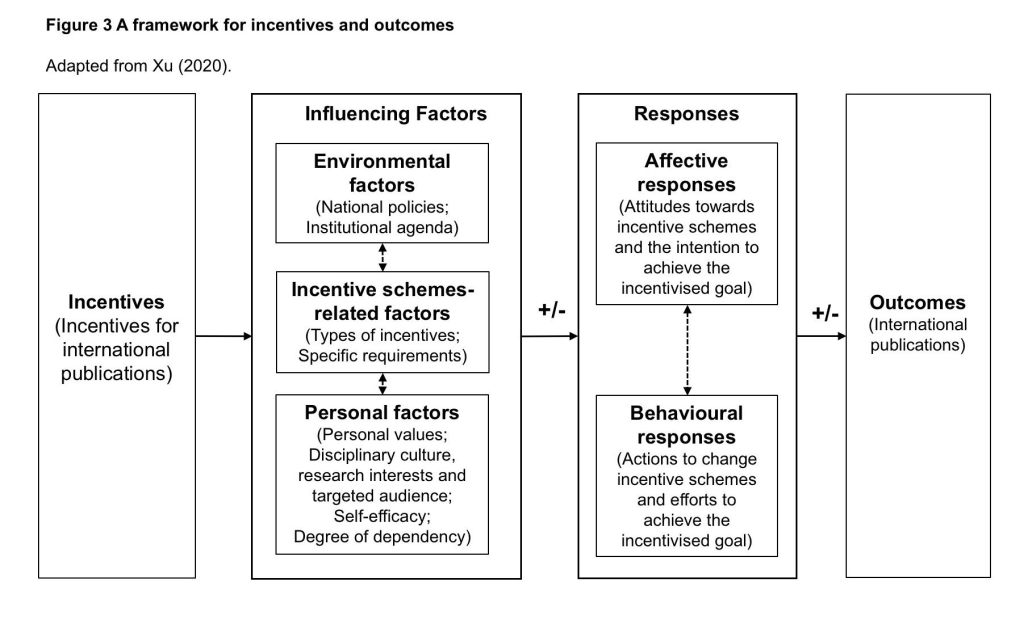
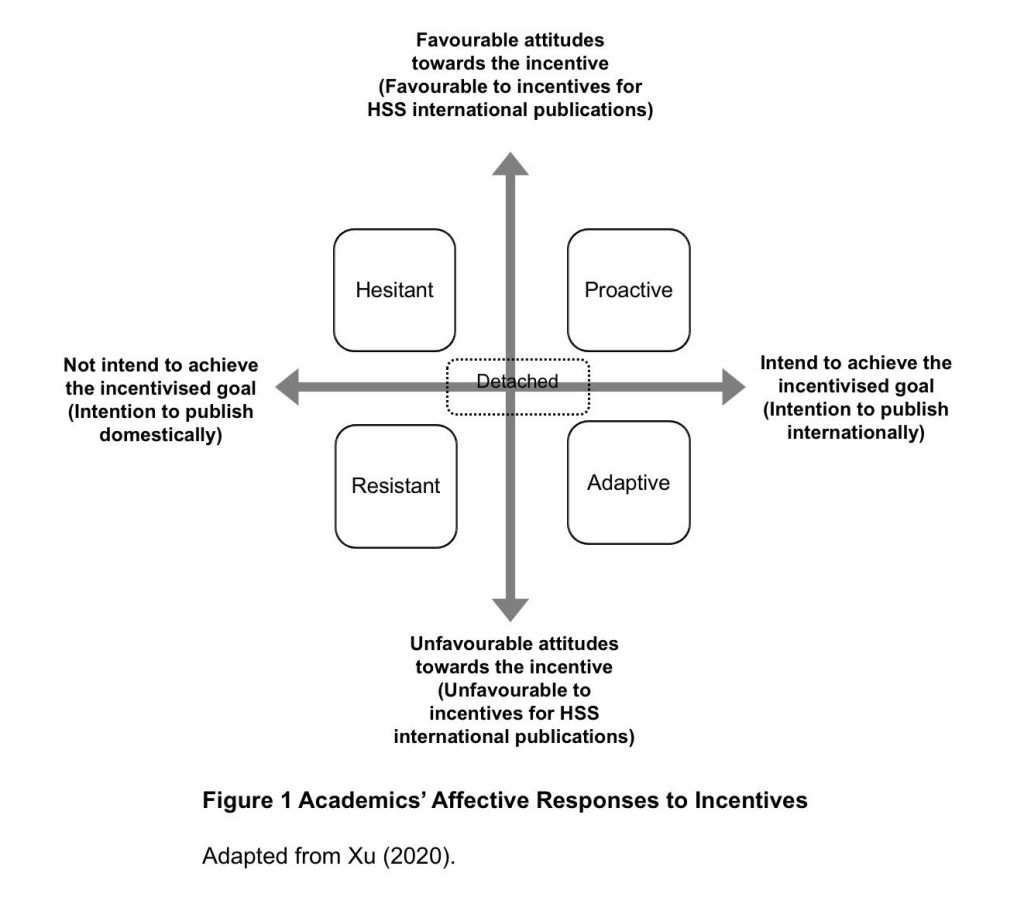
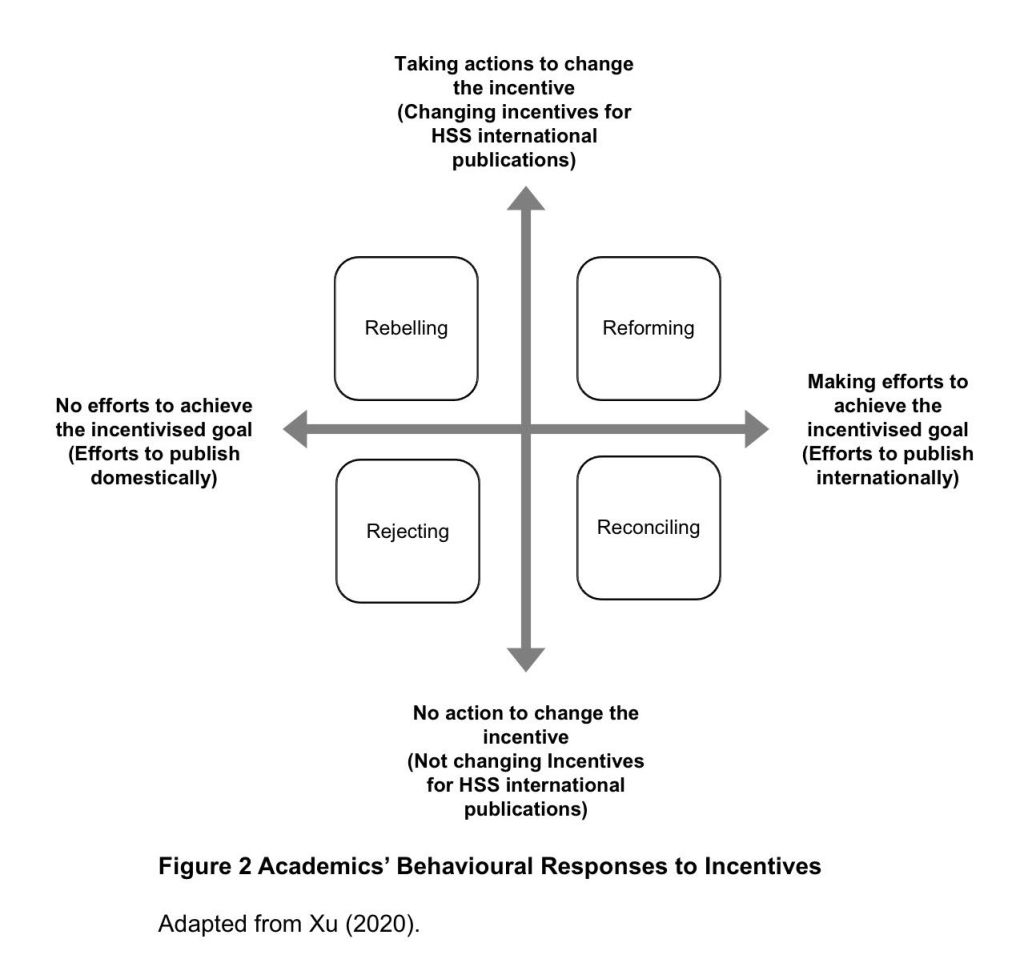
Xu (2020) proposes two typologies to categorise academics’ affective responses (proactive, adaptive, resistant, hesitant, and detached) (see Figure 1) and behavioural responses (reconciling, rejecting, reforming, and rebelling) (see Figure 2) to research incentives. Academic interviewees from different sub-groups and various backgrounds demonstrated mixed responses, and reported that incentive schemes had direct and indirect impacts on their research (see Figure 3) (Xu, 2020).
A screenshot of a cell phone

Description automatically generated
A screenshot of a cell phone

Description automatically generated
A screenshot of a cell phone

Description automatically generated

Some of the influences of incentive schemes appeared to be undesirable. For example, incentive schemes could create a ‘Matthew Effect’ in global HSS publishing, enabling SSCI and A&HCI journals to flourish, while deepening the divide between these and other journals (Xu et al., 2019). If constantly imposed through administrative and managerial power, external incentive schemes could also challenge the intrinsic value of academic research, thus putting academics’ agency at risk (Xu, 2020).

Dynamics between the internationalisation and indigenisation of HSS

Incentive schemes also reflect the dynamics between the internationalisation and indigenisation of Chinese HSS. As showcased by the data, there is a ‘going-out’ in theory and ‘borrowing-from-the-west’ in practice. While incentive schemes were initiated to promote the ‘going-out’ of Chinese HSS, they were formulated and implemented with the heavy adoption of Western norms and standards. Those norms are not unchallenged in Western contexts, such as the value and use of impact factors, and the linguistic, geographical, and cultural inequity in citation indices like SSCI. However, the research revealed a lack of critical engagement with those debates from Chinese universities (Xu et al., 2019).

The prestige of international publications in China has reinforced inequities in the international publishing regime, being associated with a hierarchical divide in global HSS academia, and generated disincentives for HSS academics to publish work focused specifically on local/national concerns, or work that generated original indigenous theorisations or methods not part of prior global literature. Moreover, HSS research is contextually rooted in certain cultures, languages, and traditions. Consequently, prioritising publications in international journals (mostly English-language journals published in global knowledge centres) could impair the development of domestic HSS (Xu, 2019).

However, the research has identified specific dynamics in Chinese HSS, which challenge the ‘centre-periphery’ model commonly used to describe the hierarchical divide in the global knowledge system and explain lower income countries’ dependency on more economically advanced countries in their research economy. For instance, some academics called for a more proactive role promoted by Chinese scholars in asserting distinctively Chinese ideas. There is an increasing number of HSS academics engaging substantially with international journals as reviewers and editors, thereby becoming more active global agents in their own right. Meanwhile, some universities had revised their incentive documents to enhance the value ascribed to the leading domestic publications (Xu, 2019).

The study has practical implications for government and institutional policymaking, which apply not only to China, but to other countries traditionally associated with the global ‘knowledge periphery’, especially other non-English speaking countries. In particular, it suggests that strategies to internationalise HSS should not simply seek to adapt to what is perceived as the global knowledge centre, nor simply to reproduce the hierarchies in domestic academia. In China, one of the unintended effects of current incentives was to reinforce the peripheral status of Chinese HSS in the domestic domain. Alternatively, universities could work to challenge the unequal power relations within global HSS. This calls for more attention to the balance between international and indigenous knowledge, and the balance between English-language publications and publications in other languages, particularly in the mother tongue language (Xu, 2019).

Acknowledgements

The research leading to this article has been generously funded by the Economic and Social Research Council (Grant number: ES/T006153/1); Clarendon Fund, University of Oxford; Universities’ China Committee in London Research Grant; Santander Academic Travel Awards, University of Oxford.

Authors’ biography

Dr Xin Xu (许心) is an ESRC Postdoctoral Research Fellow at the Centre for Global Higher Education, Department of Education, and a Junior Research Fellow at Kellogg College, University of Oxford. She completed her doctoral research at the University of Oxford, examining the incentives for international publications in the humanities and social sciences, and their impacts on academics’ research and careers. She has strong research interests in higher education, internationalisation and globalisation, academic and research life, and research assessment and impacts.

Email: xin.xu@education.ox.ac.uk Twitter: @xinxulily

Dr Heath Rose is an Associate Professor of Applied Linguistics, who researches the impact of globalisation on English language education in higher education. He has conducted policy-related research in Japan and China surrounding the ‘Englishisation’ of international programs. He has authored several books associated with globalisation and language education.

Email: heath.rose@education.ox.ac.uk

Prof. Alis Oancea is Professor of Philosophy of Education and Research Policy and Director of Research in the department. Her research has focused on: research on research, including research policy and governance, research assessment and evaluation, incentives and criteria for worthwhile research (including openness, quality, impacts, ethics), and research capacity building; higher education policy and reform; teacher professionalism and teacher education in international contexts; philosophy of education; empirical, and philosophical exploration of different modes of research and methodological theory; and the cultural value of research in the arts and the humanities. Alis is the joint editor of the Oxford Review of Education, and was founding editor of the Review of Education

Email: alis.oancea@education.ox.ac.uk  Twitter: @ciripache

References

Ammon, U. (Ed.). (2001). The dominance of English as a language of science: Effects on other languages and language communities. Berlin; New York: Berlin : Mouton de Gruyter.

Dang, S. (2005). Meiguo biaozhun neng chengwei Zhongguo Renwensheke chenguo de zuigao biaozhun ma?——Yi SSCI weili. [Can American standards set the highest evaluation benchmark for Chinese Social Sciences? – Take SSCI as an example]. Social Sciences Forum, 4, 62–72.

Hazelkorn, E. (2015). Rankings and the reshaping of higher education: The battle for world-class excellence (2nd ed.). Basingstoke: Palgrave Macmillan.

Hicks, D. (2012). Performance-based university research funding systems. Research Policy, 41(2), 251–261. https://doi.org/10.1016/j.respol.2011.09.007

Liu, W., Hu, G., Tang, L., & Wang, Y. (2015). China’s global growth in social science research: Uncovering evidence from bibliometric analyses of SSCI publications (1978–2013). Journal of Informetrics, 9(3), 555–569. https://doi.org/10.1016/j.joi.2015.05.007

Qin, H., & Zhang, R. (2008). SSCI yu gaoxiao renwenshehuikexue xueshupingjia zhi fansi [Reflections on SSCI and academic evaluation of Humanities and Social Sciences in higher education institutions]. Journal of Higher Education, 3, 6–12.

US National Science Foundation. (2018). Science and engineering indicators 2018: Academic research and development.

Xu, X. (2019). China ‘goes out’ in a centre–periphery world: Incentivizing international publications in the humanities and social sciences. Higher Education, 1–16. https://doi.org/10.1007/s10734-019-00470-9

Xu, X. (2020). Performing under ‘the baton of administrative power’? Chinese academics’ responses to incentives for international publications. Research Evaluation, 29(1), 87–99. https://doi.org/10.1093/reseval/rvz028

Xu, X., Rose, H., & Oancea, A. (2019). Incentivising international publications: institutional policymaking in Chinese higher education. Studies in Higher Education, 1–14. https://doi.org/10.1080/03075079.2019.1672646

Migration, intersectional identity and habitus re-structuring: struggling between marginalisation and inclusion in Chinese urban schools

Dr Hui Yu, South China Normal University, China

Highlighted research:

Yu, H. (2019). The making of “incompetent parents”: intersectional identity, habitus and Chinese rural migrant’s parental educational involvement. Australian Educational Researcher, 1-16. doi: https://doi.org/10.1007/s13384-019-00361-z

Yu, H. (2019). Inheriting or re-structuring habitus/capital? Chinese migrant children in the urban field of cultural reproduction. Educational Philosophy and Theory, 1-13. doi: https://doi.org/10.1080/00131857.2019.1689814

Abstract

This paper presents the findings of my recent study on Chinese rural-to-urban migrants and cultural reproduction. Drawing on Bourdieu’s theoretical lens, it examines how the intersection of rural origin, migration status and working-class identities shapes the parents and children’s habitus and their exertion of capital in the urban field of education. Semi-structured interviews were conducted in Beijing and Shanghai with 64 teachers, rural migrants and local parents and students. The findings reveal the intersection of two aspects of the migrant parents’ habitus – one, resulting from their rural background, this habitus leads them not to treat themselves as academic educators, and a second, arising from their migrant working-class status, they perceived the necessity to ‘strive for survival’. As for the children, they have experienced re-structuring of habitus, which is illustrated by their internalization of standard Mandarin as the normal way of speaking, their urbanized bodily hexis in terms of dress, appearance and behaviour, and their appreciation of extra-curricular activities. In urban schools, the migrant parents are identified as ‘incompetent’, since their actions do not match with the teachers’ expectations of home-school cooperation, while a well-integrated relationship can be identified between migrant and local children. This situation contributes to the production of a generation of ‘new urban citizens’, yet in the meantime reproduces the migrant families’ class status as low-skilled labourers. This study extends the extant Bourdieusian theorisations of the intersectional positionality of working-class parents in the field of education by adding the less examined axes of rural origin and migration status. It also extends Bourdieusian reflexive sociological thinking by calling for a holistic view of the studies of cultural and social reproduction of migration in Chinese context.

Changing landscape of migration and education in China

Within contemporary Chinese social structural changes, urbanisation and industrialisation processes break through the rural/urban boundary and bring rural migrant labourers into a new arena. Over the past decade, the state school sector has accommodated around 77-80% of migrant children nationwide, indicating that the majority of migrant children are offered access to state schools. In some metropolitan cities, such as Beijing and Shanghai, the number of migrant children accounts for around half of the total student population of compulsory education age. In the meantime, the demographic characteristics of migrant children has been changed: in Beijing and Shanghai, most of the so-called ‘migrant children’ are now born and/or raised in urban areas and are second-generation migrant children.

Research question

Drawing on Bourdieu’s theoretical lens, this paper examines how the intersection of rural origin, migration status and working-class identities shapes the parents and children’s habitus and their exertion of capital in the urban field of education.

Methodology

Three months of fieldwork were carried out in a total number of 14 schools and one nursery in Beijing and Shanghai. The data was generated through semi-structured interviews with 17 teachers (including headtechers), 26 migrant parents, 12 migrant children, five local parents, and four local children. The development of the interview questions was guided by the key research questions: how involved are rural migrant parents in their children’s education inside and outside of school? What is the relationship between migrant and local children? How are these relationships influencing migrant children’s study and social inclusion? Are there any pressing issues for the teachers concerning migrant parents and children?

The making of ‘incompetent parents’: rural migrant labourers and intersectional identity

For the migrant parents, even after migration their rural disposition of not treating themselves as educators is partly retained. In the meantime, their working-class habitus has been restructured by the intensified social and financial disadvantages of urban areas, producing a disposition of striving for survival. The parents’ habitus shapes their understanding of parental educational responsibility and their exertion of cultural capital, producing a child rearing approach of ‘accomplishment of natural growth’ (Lareau, 2002). Not perceiving themselves as educators, communicating with the teacher was the main channel through which the parents responded to their children’s educational strengths. Many of them were reluctant to deploy their (weak) literacy as cultural capital to support their children.

Producing a generation of ‘new urban citizens’: re-structuring habitus and capital in the urban space

The second-generation migrant children have experienced re-structuring of habitus and accumulation of new forms of cultural capital in the urban field of cultural reproduction. With the logic of reproducing and validating urban-specific cultural configurations, this field offers rural-to-urban migrant spaces and forms of socialization, which shape the children’s habitus and capital in different ways and in contrast to their parents’. This is illustrated by the children’s internalization of standard Mandarin as the normal way of speaking, their urbanized bodily hexis in terms of dressing, appearing and behaving, and their appreciation of extra-curricular activities. These are valuable and valued forms of cultural capital in the urban field of education.

Towards marginalisation or social inclusion?

The migrant parents’ child rearing approach does not match with the teachers’ expectations, since the urban school field has a logic of home-school cooperation. As a result, these parents are vulnerable to being judged as failures. Their weak position in the field of urban schooling is a result of their intersectional disadvantaged status of having formerly lived in rural areas and then migrated to urban areas, yet they continue to engage in labouring occupations. Unlike their parents, a well-integrated relationship between migrant and local children can be identified in schools, which reinforces the children’s sense of belonging to urban society, producing a generation of ‘new urban citizens’. However, these children might well become a new generation of the urban working-class, since their opportunities for upward social mobility are still limited because of their weak urban-specific familial cultural resources. The majority of them later on end up with a high school or vocational school qualification, continuing their parents’ occupational paths as low-skilled or unskilled workers. This situation does not match the achievements of their local classmates.

Theoretical implications

This study recognises the necessity and usefulness of intersectionality theory (Crenshaw, 1991) and highlights its explanatory power in the Chinese context. It extends the extant Bourdieusian theorisations of the intersectional positionality of working-class parents in the field of education by adding the less examined axes of rural origin and migration status. Furthermore, it extends Bourdieusian reflexive sociological thinking by highlighting the fluid nature of habitus/capital and calling for a holistic view of the studies of cultural and social reproduction of migration. That is to say, there is a need to examine both the unchanged and re-structured aspects of habitus/capital, and to recognise the intra-group and intergenerational differences in the migrant group in Chinese context. The theorisations of this study offer implications for international studies on the parental involvement of migrant labourer groups, especially those from disadvantaged cultural or national backgrounds, such as domestic workers, travellers, and refugees.

Author Bio

Hui Yu (PhD, IOE) is a senior research fellow at School of Education, South China Normal University. As a Bourdieusian-informed sociologist, Dr Yu’s particular research interests include educational policy enactment and cultural reproduction of rural migrant family in urban China. His research focuses on: 1) how the cross-field effects shape the logic of the educational policy field and generate policy changes; 2) how the intersection of rural origin, migration status and working-class identities shapes the migrant families’ habitus. Email: hui.yu@m.scnu.edu.cn

Contextualizing University Rankings and World-Class Status in Chinese Universities through Commensuration

Dr Ryan Allen, Chapman University, USA

Original Research:

Allen, R. M. (2019). Commensuration of the globalised higher education sector: how university rankings act as a credential for world-class status in ChinaCompare: A Journal of Comparative and International Education, 1-19.

Research Highlights

The rapid internationalizations of higher education globally over the last few decades have had profound impacts on domestic sectors around the world. While global mobility and partnerships have reached all-time highs, there have been some resulting growing pains. Considering higher education on the international stage is more complex and everchanging than at any time before. To make sense of these complexities, actors in the sector rely on indicators to provide key information. Oftentimes, these indicators are built from a set of metrics that have been formulated by another agency or institution and then organized into a ranking.

This act of taking a complex idea and simplifying it down to a set of metrics is known as commensuration. Commensuration reduces the expertise a stakeholder needs for decision-making as numbers and metrics have been lionized as objective truths. This process provides an appearance of objectivity because it is seen as a type of science. Even as these types of metrics are met with critique, they have inundated decision-making bureaucracies across the world, especially in higher education.

University rankings are one of the most common examples of commensuration in the sector, as these schemes attempt to define quality or excellence in education through a simple indicator. But studies on commensuration have mainly been considered in Western settings, namely the United States and the United Kingdom. However, commensuration is useful in contextualizing the global higher education sector and the obsession with the world-class university, a concept that is often quoted but difficult to define in the complex and expansive landscape.

Chinese Universities and Commensuration

Chinese universities have been at the forefront of the internationalization trends in higher education, explicitly chasing world-class status over the last few decades. Because of these efforts, commensuration is especially useful when studying Chinese universities. During six months of field research in China in 2017, I explored how university rankings have become commensurate measures of the world-class university concept in China. I visited campuses, attended conferences and classes, and met with countless students, researchers, academics, and administrators. For this analysis, I relied on formal interviews with 48 administrators and professors at Chinese universities.

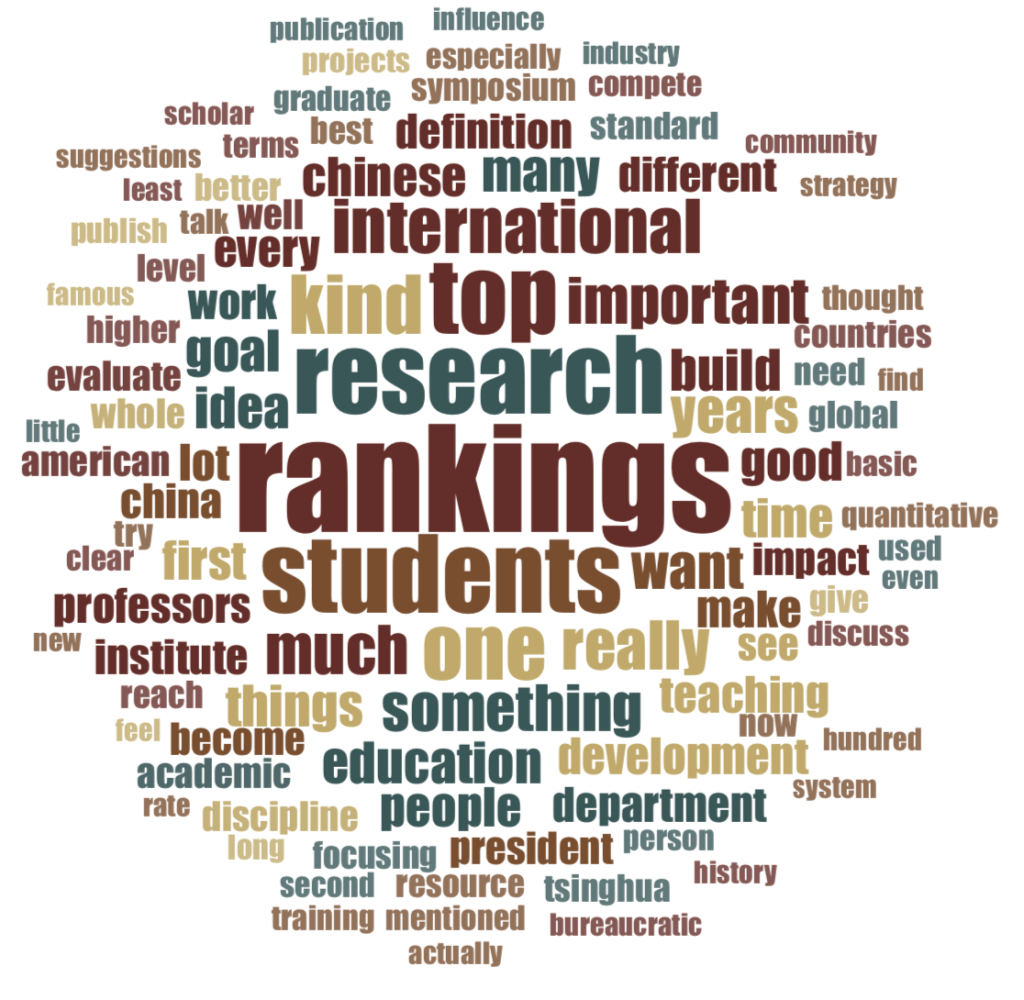
The interviewees in my sample had difficulties in providing a consensus definition of a world-class university. Despite claiming to hear the term used almost “every day,” the conception was still amorphous. Some described excellent students, others mentioned impactful research, and a few used examples of the global elite like “Harvard” or “Cambridge.” Using a word frequency query, though, showed that the most used descriptor was “rankings,” as seen in the following illustration. Even when considering a multitude of definitions, university rankings were still implicitly (or explicitly, in some cases) connected to the elite status.

Word Cloud of Interviewees’ Conceptions of World-Class Universities

Macintosh HD:Users:ryanmallen555:Desktop:Screen Shot 2019-06-20 at 3.18.48 PM.png
Note: Common words such as “like” and “the” have been removed and stem words have been grouped together.

The group most often mentioned four specific rankings: Quacquarelli Symonds (QS) World University Rankings; Times Higher Education (THE), Academic Ranking of World Universities (ARWU), and US and World News Report (US News). The makeup of each of these rankings is slightly different, but they all have strong considerations for research. Although, three also had reputational components that sparked ire from many faculty members in the sample. Encapsulating the complaint, one senior professor said, “Among its many flaws, one of them is the halo effect, so people will say, ‘Cambridge has a great department of X,’ even if they don’t have one. These places have higher reputations, whether they actually teach a program or not.”

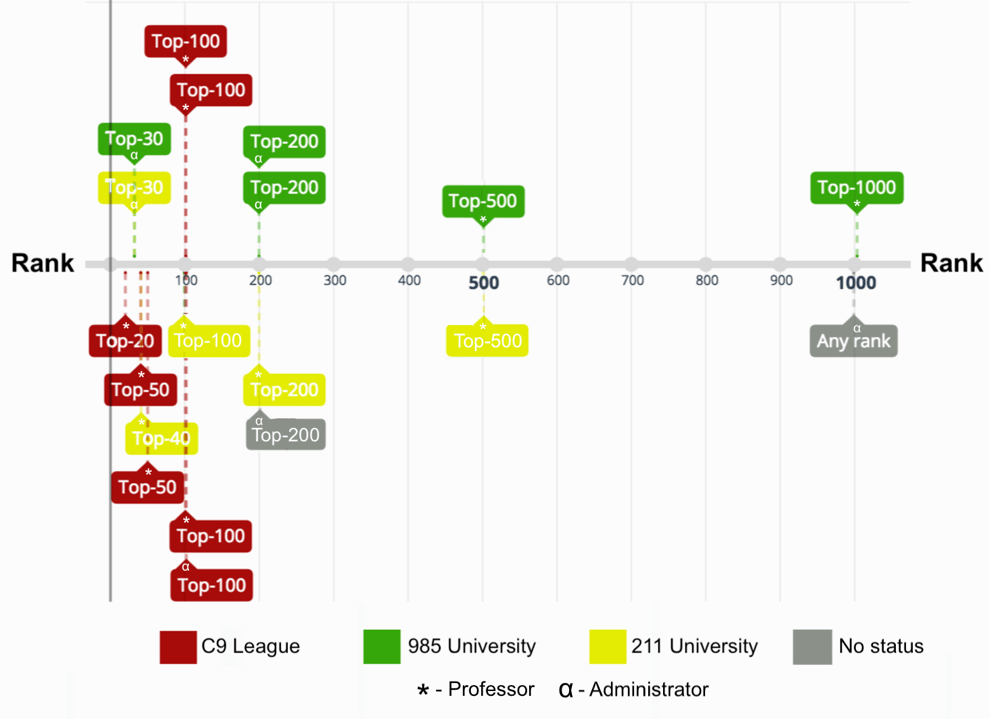
The four common schemes most often mentioned each rank institutions in strict ordinal form. The ordinal rank offers institutions a proxy for world-class status. While not all the interviewees believed there were strict cutoffs for this concept, 19 gave explicit points that they or their institution would use for a proxy.  There was some variation in cutoffs, which can be seen in the following chart, including simply being included in the rankings. However, the top-100 mark was the most stated answer of the group, especially for those already in the more elite segment of the Chinese higher education hierarchy (C9 League).

The specific cutoff for determining world-class universities by university type

Macintosh HD:Users:ryanmallen555:Dropbox:Dissertation:Parts:Chapter 4:Chart 2 world class and ranking.png
Source: Qualitative interviews conducted in this research.

A senior professor with an academic focus on rankings encapsulated this finding, “The idea of world-class, it’s hard to define . . . But for practical usage, actually the top-100 is more or less agreed as world-class university. Not everyone agrees, but it’s a much more agreed than the definition itself. It’s much more difficult to get a definition for world-class university itself than the practical use from ranking. So, top-100 is more or less.”

Even as some of the faculty members and administrators argued against using specific cutoffs, almost all of them agreed that rankings impacted various actions by their university, especially in regards to institutional partnerships. Overall, 36 of the 48 respondents claimed rankings have a connection to decisions related to partnerships. Even those who argued that their first priority is related to familiarly or other points, admitted that rankings play a factor institutionally. “We start with those whom we have personal connections… [But] of course everybody want to befriend those highly ranked institution,” conceded one junior faculty member.

Some of the respondents were quite open with this commensurate proxy to rankings. “Because [we are a] world-class oriented university and it aims highly to only pursue highly ranking universities all over the world… If the universities were not highly ranked, we would not consider them to be partners,” said one mid-level administrator tasked with global outreach. Another administrator even admitted her institution was looking to sever ties with their long-standing partner abroad because the other university was not ranked high enough. Others also claimed that their administrations would not support requests for China Scholarship Council research funding abroad unless the host university was ranked within the top-100.

Research indicators are critical to university ranking metrics, meaning that as league table position becomes more important, pressures to publish will be even more burdensome. Almost all the academics in the study reported that their institutions were obsessed with highly cited indexes, such as the Social Sciences Citation Index (SSCI). Multiple respondents even made the same joke, calling the SSCI “stupid Chinese ideas.” Even those who claimed to not pay attention to the rankings reported pressures to publish in these highly cited journals. These indices are key metrics in the university rankings reported to be the most widely used by my respondents. 

There were some disparities in how actors perceived these pressures from internationalizations. Over half of the administrators did not report the pressures to publish, while a majority of the professors complained of increased pressures. The exceptions were late-career academics, who were split 50-50 on this topic. These disparities point to diverging awareness of the effects of internationalizations on the sector. It is likely that administrators and older, established academics do not face the full force of these burdens, as the younger, unproven faculty members have more expectations of producing in these international publications.

The research shows how university rankings offer a proxy for the world-class definition. While the commensuration concept has mostly been used in Western-focused studies, it is also useful for understanding the Chinese context and the sector’s intense focus on internationalizations. Commensuration is a powerful force within education, impacting decisions at all levels of the university. As the sector in China becomes more global and complex, stakeholders will continue to use indicators and metrics for a variety of decisions, such as evaluation of research agendas and institutional partnerships. Future work should continue to contextualize China and other sectors through the understanding of the commensuration processes and their outcomes.  

Author Bio

Ryan M. Allen is an assistant professor at Chapman University’s Donna Ford Attallah College of Educational Studies. He primarily works with the college’s doctoral program partnered with Shanghai Normal University. His research focuses on internationalizations of higher education, EdTech, academic publishing, and the East Asian region. He serves on the Executive Board of the Study Abroad and International Student SIG within the Comparative and International Education Society, where he shares his passion for supporting international students and promoting study abroad. You can find Dr. Allen’s daily musings on Twitter at @PoliticsAndEd.

Crossing the ‘bridges’ and navigating the ‘learning gaps’: Chinese students learning across two systems in a transnational higher education programme

Research Highlighted

Dr Kun Dai, Peking University, China

Kun Dai, Kelly E. Matthews & Peter Renshaw (2020) Crossing the ‘bridges’ and navigating the ‘learning gaps’: Chinese students learning across two systems in a transnational higher education programmeHigher Education Research & Development, DOI: 10.1080/07294360.2020.1713731

Read about Kun’s other publication here.

Introduction

Chinese universities are actively pursuing cross-border collaborations in the form of transnational higher education (TNHE) programmes. The complexities of designing and implementing programmes that involve internationalisation of the curriculum often reveal gaps between policies and practices (Fischer & Green, 2018). Students in articulation programmes are uniquely positioned to reveal potential cross-system gaps, having shared the lived experiences of learning in such curricular contexts and to inform any programmatic curriculum reform processes. Our study captures the experiences of Chinese students to illuminate how they navigate their learning journeys in a China-Australia articulation programme. To communicate the complexity of learning in modern transnational higher education programmes, we employed activity theory as the theoretical framework to explore cross-cultural contradictions shaping students’ experiences of learning. Assessment, programme rules, teaching strategies, and class and campus settings created contradictions that students had to negotiate as in-between learning spaces. We argue that cross-system contradictions play important roles in transnational higher education programmes. Therefore, instead of seeking to eliminate these contradictions or smooth cross-educational differences, these contradictions should be leveraged as learning opportunities to enrich transnational higher education programmes.

Methods

An exploratory qualitative study was adopted to investigate a group of Chinese students’ learning experiences in an articulation programme. We adopted a purposive sampling method to invite students from an undergraduate 2+2 articulation programme (two years in China followed by two years in Australia to complete a degree) with Digital Design as the major to participate in this research. To explore the students’ learning experiences, we used semi-structured individual interviews to collect data. Transcripts were exported into NVivo 11 software for analysis. We employed an iterative cycle of inductive and deductive analysis that involved coding to AT concepts along with emergent themes arising from our reading of the transcripts. We selected extracts from the interviews to offer thick and rich descriptions to illuminate participants’ experiences in their own words.

Findings and Discussion

The experiences of the students in our study provided insight into learning in transnational higher education, which response to the call from Qin and Te (2016) for researchers to capture student voices in cross-system programmes. By using AT, we illuminated cross-system contradictions that students navigated between two activity systems in a single TNHE degree programme where some students saw bridges to cross while others saw only the obstacles of learning gaps. Contradictions emerged among students’ learning goals, their practices, and programme rules within and between two partners. Our findings showed numerous cross-system contradictions that students had to face and navigate, in different ways and with varying degrees of success, during their cross system educational experiences. Assessment modes, teaching strategies, and class and campus settings were the key factors that generated cross-system learning contradictions for students. The differences in these aspects between Chinese and other Western contexts were not surprising, which further affirm several existing findings (Kember, 2016; Tweed & Lehman, 2002). The academic or contextual contradictions we have revealed several issues in operating TNHE as sources for change and development (Engeström, 1999, 2001). Learning through different contradictions in and between two partners will appeal to many students, though not all. For some students, tensions and contradictions motivated them to alter their learning goals and approaches in the cross-system transition (Engeström, 1999).

Conclusion

While we argue that it is essential for policymakers and educators to enhance cross system communications in the process of operating articulation education to improve students’ learning experiences, the intention should not be to diminish cultural differences or assert the dominance of one provider over the other. Instead, curricular planning should prepare students for the richness of global learning that will challenge their cultural assumptions. Learning in this combined setting, students were positioned between the two partners with a complicated sense of agency. Some students navigated the cross-system experiences with ease while others struggled. These multiple responses could help universities, lecturers, and policymakers to strategically design and manage such articulation programmes to enhance the quality of cross-system education under the growing trend of internationalisation of higher education. Prospective studies could investigate how lecturers and policymakers understand cultural and educational differences between different systems and how they might productively use these differences to improve international education cooperation.

Authors’ Bio:

Kun Dai is a Postdoctoral Research Fellow (funded by China International Postdoc Exchange Program) at the Graduate School of Education, Peking University, China. His research focuses on transnational education, intercultural learning and adjustment, and students’ cross-cultural learning experiences. Dr Dai services as an associate editor of the Journal of International Students.

Kelly E Matthews is an Associate Professor in Higher Education in the Institute for Teaching and Learning Innovation at the University of Queensland in Brisbane, Australia, and an Australian Learning and Teaching Fellow.

Peter Renshaw is a Professor at the School of Education, the University of Queensland in Brisbane, Australia. Professor Renshaw’s research has focused on learning and teaching processes both at school and tertiary level. Professor Renshaw was President and Secretary of Australian Association for Research in Education (AARE) and a member of the Executive for over a decade (1991-2002).

Negotiating language ideologies in learning Putonghua: Myanmar ethnic minority students’ perspectives on multilingual practices in a borderland school

Jia Li, Bin Ai & Jie Zhang (2019). Negotiating language ideologies in learning Putonghua: Myanmar ethnic minority students’ perspectives on multilingual practices in a borderland school, Journal of Multilingual and Multicultural Development, DOI: 10.1080/01434632.2019.1678628

Dr Jia Li, Yunnan University, China

Chinese abstract

文章探讨了一组缅甸少数民族青少年的语言意识形态对其在中缅边境公立学校和汉语补习学校的普通话学习和教育发展前景的影响。研究者采用半结构式访谈和参与者的语言学习自传数据,指出由于缺乏缅语能力缅籍少数民族青少年在语言文化上处于不利地位,常被排斥在公立学校之外。学习普通话和接触与汉语相关资源让他们获得主体策略和发展资本,使他们脱离边境地区的不利态势,获取汉语资本、分享中国发展红利。论文关注了社会经济转型时期语言意识形态的多重性和竞争性特征,以及语言意识形态在学习者语言实践和社会结构之间的影响。同时,论文通过分析普通话的语言资本阐述了中国软实力对于邻国边境地区语言学习的影响。

Summary of article

China and Myanmar share a borderline of over 2,200 kilometers. Like many other borders in the world, the demarcation of the geographical border does not always overlap with the cultural and linguistic borders. Over centuries of historical, economic and cultural development, the China-and-Myanmar border has acquired strategic meanings for both countries and is now becoming the land-bridge of China’s expansion overseas and the main artery of Myanmar’s economy. This article examines how language ideologies shape the educational trajectories of a group of Myanmar ethnic minority students who were born and brought up at Myanmar’s border towns next to Yunnan, the Southwest of China.

The article focuses on their language learning experiences both at Myanmar government schools and Chinese supplementary schools. Due to the mismatch between their home language(s) and class instruction language and the limited distribution of linguistic and educational resources at border regions, Myanmar ethnic minority students with limited proficiency in Burmese language experience exclusionary treatments and stereotypes at Myanmar government schools. Although the majority of our participants did not complete their primary education at Myanmar government schools, they did not simply drop out, look for a job, become a farmer, or help in their families’ businesses. These students did not see their drop-out as an educational failure. Rather they considered that their marginalization in government schools was offset by their empowerment in Chinese supplementary schools. They experienced an enormous contrast between the two educational systems, which reshaped their language learning beliefs and motivations. Their efforts to improve their proficiency in Putonghua may have been self-motivated or in response their parents’ desire to maintain their ethnic Chinese heritage, and were reinforced by the availability of China-related resources at Myanmar’s border. Their beliefs in the importance of learning Putonghua for future transnational mobility and for improving their life prospects contrasted with their experiences of failure in the educational system offered by the Myanmar government in question.

However, the article also points out the contestation and ideological conflict of learning Putonghua at Myanmar-border. In the context of China’s rapid development, tensions and negotiations over what it means to speak and write Putonghua are related to contestation of the authenticity of ‘mother-tongue’ versus ‘non-heritage learners, and over the economic or symbolic capital of Putonghua ad Chinese as a marker of a heritage identity. Given the promotion of Putonghua and the increasing influence of China’s economy in Myanmar, it can be expected that this tension is going to become more pronounced in the future.

Based upon the evidence, the article suggests that Myanmar education system and language policy makers should take into account the dynamic and diverse border realities by considering these ethnic minority students’ learning difficulties ad their diverse backgrounds, rather than simply implementing a centralized language policy. It would benefit borderland students if the Myanmar government allowed for diversity when it distributes educational resources, rather than leaving learning responsibilities to individual students who struggle to bridge the gap between home culture and school culture. The analysis of Myanmar ethnic minority students’ everyday learning trajectories illuminates the interconnections between language ideologies and linguistic practices. By locating their everyday language practices in the wider setting of Myanmar and China’s socio-economic transformation and China’s expansion to Southeast Asia and South Asia, the article contributes to the understanding of grassroots multilingualism and highlights the multiple, conflictual and context-specific aspects of language ideologies as well as proposing a possible solution for this issue in the long term.

Authors’ bio

Dr. Jia Li is an Associate Professor at the School of Foreign Languages of Yunnan University, Kunming, China. Her research concerns multilingualism, language-in-education, and promoting Putonghua as a global language. She can be contacted by email: jia_li_yunnan@qq.com.

Dr. Bin Ai is an Associate Professor at the School of Foreign Studies of Shanghai University of Finance and Economics, Shanghai, China. His research interests involve a wide range of topics including intercultural communication, higher education, and applied linguistics. Dr. Ai has published widely in many international peer-reviewed journals.

Dr. Jie Zhang is an Associate Professor at the School of Foreign Languages of Zhongnan University of Economics and Law, Wuhan, China. Her research interests range from intercultural communication, language policy and planning to language-in-education. Dr. Zhang has published widely in both Chinese and English peer-reviewed journals, and she is on the editorial board of Journal Multilingua.