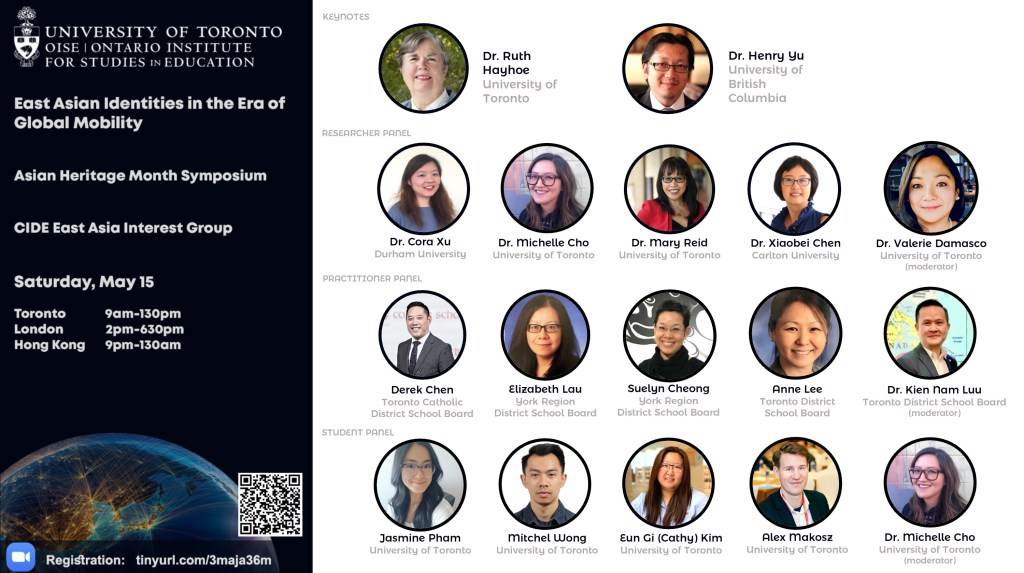
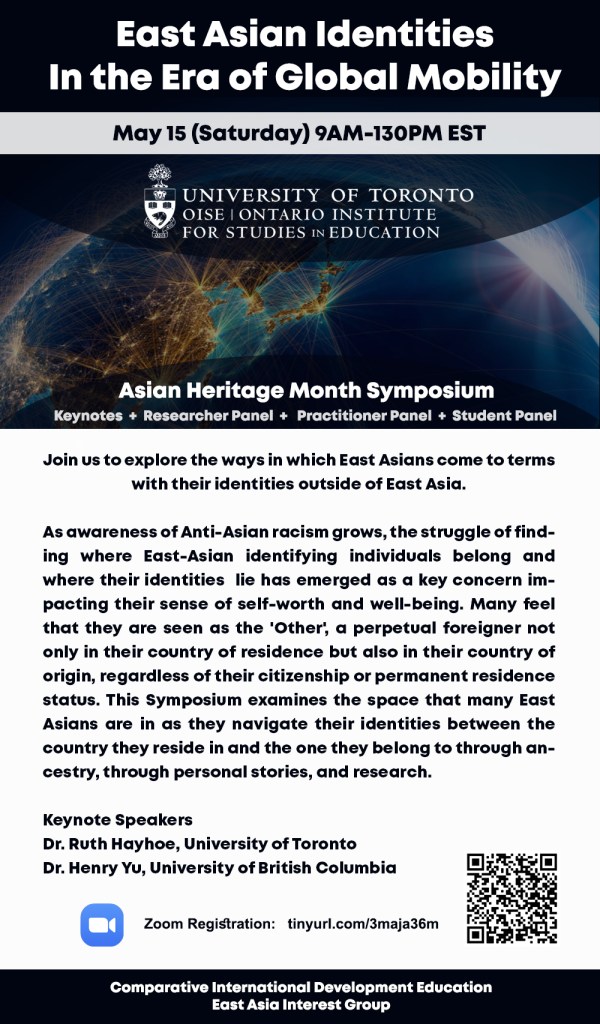
Register here.

Network for Research into Chinese Education Mobilities (NRCEM)
A research community about Chinese education mobilities
Research Highlighted
Li, X., Haupt, J., & Lee, J. (2021). Student mobility choices in transnational education: Impact of macro- , meso- and micro- level factors. Journal of Higher Education Policy and Management. https://doi.org/10.1080/1360080X.2021.1905496

From Program Assessment to Research Study
The idea of this study was originated from the program assessment work that my colleagues and I have been doing on University of Arizona (UA)’s transnational education (TNE) programs. Students in these programs receive two degrees, one from UA and one from the partner university. For undergraduate students, they can choose to complete all four years of study in their home country, while having the opportunity to physically study at UA for up to two years. Over the past years, our research team surveyed student mobility plans by asking where they intended to complete their studies, pursue a graduate degree, and find a job in both short and long term. We found that students’ mobility plans greatly varied among different partner universities. We began to realize that student mobility is likely related to the institutional and national contexts of the partner university. In order to understand whether/how the contexts matter, we conducted in-depth interviews with students in one of our oldest programs, in which UA collaborates with Ocean University of China (OUC), a Project 985 university[i], and offers a dual bachelor degree in law. In this study, we incorporated 167 survey responses and 13 interviews.
The Three-Level Contextual Framework
We adopted the three-level contextual framework from Haas & Hadjar (2020). Based on a review of the studies on higher education student trajectories, these authors found that student trajectories were often analyzed through the macro-, meso- and/or micro-level predictors. Macro-level factors are those related to national higher education structures and the larger social environment, such as the labor market situation. Meso-level factors mainly refer to the organizational context of higher education institutions, and the micro-level factors are those vary at the individual level, such as demographic attributes. Factors at each level are able to influence student trajectories independent of other factors, and factors within each level and across levels interact simultaneously to influence student trajectories through higher education. Guided by the framework, we examined student mobility choices at four transitional points: (a) initially when they choose to enroll in a TNE program, (b) during their program when they choose to study abroad or stay local to complete the program, (c) near graduation when they choose to apply for graduate school, and (d) near graduation or completion of graduate studies when they seek employment.
Key Findings: The Macro- and Meso-Level Contexts Matter
The macro-level context of the local university admission policies played a significant role in shaping student choice to enroll in the TNE program. For most students, they were aiming to go to a prestigious Chinese university instead of actively seeking international education opportunities. In the end, they perceived the dual degree program as an alternative path to attend a Project 985 university when they obtained a gaokao[ii] score that was not high enough for regular programs at a university at the same level.
A majority (58%) of the students intended to complete their degree in China, and student mobility at this stage was impeded by the meso-level factors (i.e., program structures). The first two years’ English education in the program turned out to be inadequate for some students to achieve the required TOEFL score. Also, studying at UA would hinder their preparation for kaoyan[iii].
In terms of pursuing a graduate degree, students showed a stronger interest in international education (64%). Macro-level factors, baoyan policy[iv] and different labor market situations in China and abroad, facilitated to retain students in China. At the meso level, on the contrary, the TNE program better prepared students to study abroad for graduate education through English medium teaching and an admission agreement with graduate law programs at UA. In addition, the program put students who needed to take kaoyan at a disadvantage.
Lastly, the majority (65%) envisioned their future in China in the short term, and even more students (76%) in the long term. Labor market at the macro level is a primary factor that made students who planned to attend graduate school overseas to intend to return. It would be difficult to find a job abroad despite an interest in doing so.
Implication: TNE’s Dual Role
The main argument we made in this study is that TNE needs to fulfil a dual role in facilitating mobility and supporting immobile students. As most students indicated an interest in pursuing a graduate degree in the US, our findings generally support previous studies that TNE can function as a stepping stone for physical mobility. However, we also found that the program structure restrained student intentions to study abroad during the program. To address this, TNE program could strengthen English language teaching in the first and second year to better prepare students to enter an English-only academic environment. Also, short-term study abroad could expose students to the host country in order to make more informed choices about graduate school.
Meanwhile, given that TNE programs are designed to provide students with access to a foreign education without mobility, they could better support students who plan to attend local graduate schools and apply their TNE to local contexts. This is particularly important during the COVID-19 pandemic when international mobility is not always available or safe. For TNE in China, specific approaches may include mitigating the course load in the semester when kaoyan takes place and expanding the availability of graduate-level TNE, so that students do not have to choose between a local or international graduate school. Also, TNE program may intentionally connect students with local employers who value their TNE experiences.
Author Bio
Xiaojie Li is a PhD candidate in the Center for the Study of Higher Education at the University of Arizona. She is also a graduate associate assessing the UArizona’s transnational programs and international student experiences. Xiaojie can be contacted via xiaojieli@email.arizona.edu or Twitter @xiaojieli6.
[i] Project 985 university: The goal of Project 985 is to found world-class universities. It includes less than 40 universities, which are usually seen as the most prestigious universities in China.
[ii] Gaokao: National College Entrance Examination
[iii] Kaoyan: Unified National Graduate Entrance Examination
[iv] Baoyan policy: a small portion of undergraduates from some universities can be referred to a master’s program in China without kaoyan, under the exam-free referral policy.
11th May, 12 noon UK time
You can register here.

This webinar will focus on education mobilities in East Asia. Prof Johanna Waters will share her findings on how families discuss their daily trans-border commutes for schooling, drawing on primary research with families in Hong Kong. Focusing on the prevalence of tiredness and exhaustion, Johanna argues that corporality and emotions in education mobilities are under-explored in the literature.
Jiexiu Chen will then present findings from her research in China on rural students’ experiences of settling down in the city. Building on Bourdieu to examine migration across social boundaries, Jiexiu proposes four orientations of habitus to demonstrate individuals’ tendencies to maintain continuity or embrace changes: urbanised habitus, liminal habitus, permeated habitus, and twisted habitus.
After the presentations, Dr Cora Xu (Durham University) will identify cross-cutting themes and will invite questions from webinar participants.
Presentation 1: Cross-boundary mobilities for education in East Asia: tiredness and exhaustion
Professor Johanna Waters, UCL Geography
My talk foregrounds and unpacks the significance of education for the mobilities of children in contemporary East Asia, drawing principally on primary research with families, undertaken in Hong Kong and across the political border with Mainland China (Shenzhen). Focusing on the example of cross-boundary schooling, the presentation explores households’ experiences of a daily trans-border commute, stressing the prevalence of tiredness and exhaustion in families’ narratives of their quotidian practices. The corporality and differentiated experiences of everyday mobilities for education are rarely explored in the extant literature and yet this has been one of the striking aspects of our findings. In this talk, I will briefly explore how families discussed cross-boundary schooling – the emotions and feelings evoked within our qualitative accounts.
About the author:
Johanna L. Waters is Professor of Human Geography and co-Director of the Migration Research Unit at UCL. She has worked for a number of years on aspects of transnational families, education and migration, with a particular interest in East Asia. She is presently editing a book with Brenda Yeoh (NUS) on Migration and the Family (forthcoming with Edward Elgar) and is looking forward, in the next few months, to the publication of Student Migrants and Contemporary Educational Mobilities (Waters, J. and R. Brooks, 2021, Palgrave). Johanna is proud to be elected as a Fellow of the Learned Society of Wales.
Presentation 2: Urbanised, liminal, permeated, and twisted: four orientations of habitus in rural students’ transitions to urban life
Jiexiu Chen, PhD candidate, UCL Institute of Education
In the Chinese context of a stratified education system and significant urban–rural inequality, rural students generally face limited possibilities for social mobility through higher education. Despite these structural constraints, some exceptional rural students manage to get themselves enrolled in urban universities. Drawing on 50 rural students’ life history interviews conducted in Beijing, Shanghai, and Ji’nan in 2018, I adopt Bourdieu’s conceptual tools to explore these students’ subjective experiences of migrating across social boundaries.
In this webinar, I will focus on rural students’ experiences of settling down in the city as well as their identity struggle between their rural origins and their current status as urban residents. I propose four orientations of habitus to demonstrate individuals’ tendencies to maintain continuity (rural) or embrace changes (urban) at the time they were interviewed: urbanised habitus, liminal habitus, permeated habitus, and twisted habitus. I find participants’ narratives generally demonstrate a degree of fluidity or conflict in their habitus transformation process, and the elements of these different possibilities are likely to concurrently exist. Their unique habitus reveals the geographical and emotional traces of their individual trajectories, like the experiences they encounter at different stages of their life and the forms and amounts of resources they accumulate along the way. Moreover, most participants tend to maintain close ties with their rural families, as repaying parents is one of the essential requirements of filial piety in the Chinese tradition. I suggest the contradictions and ambivalences aroused from the tension between rural origins and urban life appear in a nuanced form and reveal the distinctiveness of the Chinese rural context.
About the author:
Jiexiu Chen is a PhD candidate at the Institute of Education, University College London, UK. She was awarded a full PhD scholarship by the China Scholarship Council’s National Construction High-Level University Postgraduate Project. Her research interests include social mobility, urban-rural migration, cross-cultural adaptation, and higher education policy. She has an emerging journal article and book publication on rural students’ social mobility experiences and international scholars’ cross-cultural adaptations in China. Read about Jiexiu’s article here.
Registration and further details:
This webinar is the second of a five-part webinar series exploring youth mobility experiences in India, East Asia, Australia and the UK. The series is hosted by the UCL Centre for Global Youth and co-organised by Dr.Avril Keating (Director of the Centre), Dr Sazana Jayadeva (University of Cambridge) and Rachel Benchekroun (UCL-IOE). The series is funded by IOE International.
You can register here.
You can find out more about this webinar series here.
Journal of International Students
https://www.ojed.org/index.php/jis
Call for Papers for Special Issue
“International Students in China: Teaching, Learning and Management in the COVID-19 Pandemic”
Guest Editors:
Dr. Guangrui Wen, Xi’an Jiaotong University, China
Dr. Mei Tian, Xi’an Jiaotong University, China
Coupled with the rising trends of unilateralism and anti-globalization, the COVID-19 emergency has brought about huge challenges to international student mobility. Simultaneously, the crisis presents potential opportunities for reconceptualising and revisiting policies of and practices in international education.
In 2018 China hosted nearly half a million international students, ranking as the third most popular destination for international students. The outbreak of the pandemic crisis and the consequent international travel bans present immediate threats to Chinese international education. As a response to the pandemic, Chinese higher education has seen a rapid shift from face-to-face instruction to virtual education using various asynchronous and synchronous communication tools. The impact and effectiveness of these changes require prompt and critical evaluation to ensure the resilience of international education in China, and beyond.
In view of this, this special issue invites Chinese scholars and practitioners to critically reflect on the challenges, responses and impacts of the changes in Chinese international education during the COVID-19 pandemic.
The special issue considers original research articles (5000-6000 words), theoretical discussions (2000-4000 words) and reflections of personal experiences with wider implications (1000-2000 words). Manuscripts within the scope of this special issue may address the following topics in the COVID-19 situation:
Important dates:
Abstract due: 15st April 2021
Full manuscript due: 31th July 2021
Initial decision: 15th Sept. 2021
Revision due: 30th Oct. 2021
Final decision: 15th Dec. 2021
Individual manuscripts submitted for publication consideration can be in Chinese or English. Submit your abstracts (200-300 words)/full manuscript via email to Dr. Guangrui Wen (sie-xjtu@mail.xjtu.edu.cn) and Dr. Mei Tian (temmytian@mail. xjtu.edu.cn).
Note: Only selected, peer-reviewed manuscripts will be accepted and published on the JIS portal in late December of 2021.
About the Journal of International Students
The Journal of International Students (JIS) is a quarterly publication on international education. JIS is an academic, interdisciplinary, and peer-reviewed publication (Print ISSN 2162-3104 & Online ISSN 2166-3750) indexed in major academic databases including Web of Science Core Collection ESCI. The journal publishes scholarly peer-reviewed articles on international students in tertiary education, secondary education, and other educational settings that make significant contributions to research, policy, and practice in the internationalization of education worldwide. You may check sample articles here https://www.ojed.org/index.php/jis/issue/archive
国际学生期刊
https://starscholars.org/jistudents/
“新冠肺炎疫情背景下来华国际学生教学、学习与管理”特刊
征稿通知 特邀编委:
【中国】西安交通大学 温广瑞 博士
【中国】西安交通大学 田 美 博士
伴随单边主义和逆全球化的趋势加剧,新冠肺炎疫情给国际学生的流动带来了巨大的挑战。与此同时,此次危机为反思、重构国际教育的政策与实践提供了潜在机会。
2018年,来华国际学生人数接近50万,中国成为第三大最受欢迎的留学目的地国。疫情爆发的危机以及导致的国际旅行受阻,对中国的国际学生教育构成了很大影响。为了应对危机,各种同步及异步通信工具广泛使用,中国高等教育迅速从线下教学模式转向线上教学模式,并且未来将持续一段时间。这些变化的影响及有效性需要进行及时、深刻的评估,以确保中国国际教育具备较强的应变性。
对此,本期特刊邀请中国学者及管理人员,认真反思疫情背景下中国国际教育领域各种变化的挑战、应变与影响。本特刊征稿:原创型研究论文(5000-6000字),理论探讨(2000-4000字),或个人实践与思考(1000-2000字)。本特刊所征稿件之主题须以新冠肺炎疫情为背景:
时间要求:
摘要提交: 2021年4月15日截止
论文提交: 2021年7月31日截止
论文初审: 2021年9月15日
论文修改: 2021年10月30日截止
论文定稿: 2021年12月15日
投稿文章可采用中文或者英文两种语言。摘要(200-300字)及全文投稿请通过电子邮件寄送温广瑞博士(sie-xjtu@mail.xjtu.edu.cn)和田美博士 (temmytian@mail.xjtu.edu.cn)。
请注意:全部稿件将经过筛选与同行评审,通过的稿件将于2021年12月底在《国际学生期刊》刊发。
关于《国际学生期刊》
《国际学生期刊》(JIS)是一份关于国际教育的学术季刊(出版刊号ISSN 2162-3104/在线刊号ISSN 2166-3750),提倡学科交叉,执行同行评审流程,被Web of Science Core Collection ESCI等主要学术数据库所收录。本刊主要围绕高等教育、中等教育以及其他教育环境中的国际学生刊发学术同行评议文章,以促进全球教育国际化研究、相关政策的制定以及教育实践水平的提升。投稿请参考https://www.ojed.org/index.php/jis/issue/archive
https://www.ojed.org/index.php/jis
Dear colleagues,
(Dear students,)
May I ask for your help to disseminate our request for participants for our study on the COVID related experiences of safety and communication of Chinese university students (and students who consider that they have an East Asian appearance) in the UK?
The study is entitled “COVID and Chinese and East Asian University Students in the UK: Safety, Security, and Communication”.
The backdrop of our study is the reported increase in incidents against Chinese appearing persons in the UK in the early part of the pandemic. Our study hopes to review these experiences and how students communicate about their experiences one year after the first UK COVID lockdown in March 2020. We will analyse these insights together with data obtained through freedom of information requests from universities and police forces. Our study, based at the Manchester Institute of Education – University of Manchester, is supported by the British Academy (BA) Special COVID grants.
Please visit our Project’s website which contains more information about the study itself and how to participate.
https://studentsscuk.wixsite.com/online
If you would like to be interviewed, please see the information on the project website.
If you would like to complete the online survey, please click on the link below:
https://mci.fra1.qualtrics.com/jfe/form/SV_dfYTJmhHvWAsE06
If you consider yourself to be a UK university student with Chinese/East-Asian appearance and you are currently studying or have studied in the UK during the COVID-19 pandemic, we invite you to participate in this study.
The study aims to understand:
How you coped with the pandemic?
Did you experience any kind of COVID related aggression?
Whom did you share your stories experiences with and how during the pandemic?
The first 150 survey participants will receive a £5 Amazon token for their time. Please feel free to share this survey with other relevant participants.
Our survey is also available to complete in Chinese:
完成本问卷的前150名参与者将获得5英镑的亚马逊代金券! https://mci.fra1.qualtrics.com/jfe/form/SV_aguHTBFTEbqKl9Q
以上是一个有关于亚裔学生在新冠肺炎期间英国留学体验的调查。如果你(曾)在新冠疫情期间在任意一所英国大学就读,欢迎你参加这个调查!本调查旨在了解新冠期间在英国的亚裔留学生是否遇到交际、生活、学习上的困难,是否遇到语言或肢体上的歧视或伤害。希望通过研究帮助大学了解亚裔留学生的体验和困难, 促进英国高等教育政策的改进。完成本调查的前150名参与者将获得5英镑的亚马逊代金券,先到先得,赶快参加吧!!!欢迎转发!
Thank you very much for your help.
Miguel Lim
On behalf of the project team which includes:
Dr Hanwei Li
Dr Jingran Yu
Dr Katja Levy
Ammeline Wang
Boya Li
Xueting Ban
Dr Miguel Antonio Lim, FHEA
Senior Lecturer in Education and International Development
University of Manchester
Ellen Wilkinson Building B.4.7, Oxford Road, Manchester, UK, M13 9PL
miguelantonio.lim@manchester.ac.uk / +44 (0) 161 275 3797 / @miguel_a_lim
 Network for Research into Chinese Education Mobilities (NRCEM)