
Call for Papers: CHERN Workshop “Technology-Migration Interlinkages of Chinese Mobilities in Europe”

See the call & apply: China in Europe Research Network (CHERN) working group 5 (Labour and Migration) Workshop and Working Group Meeting
Date: 7–8 September 2023, Amsterdam

Building on calls to pay more attention to the material side of migration (e.g. Basu and Coleman 2008; Vilar Rosales 2018; Tazzioli 2023; Yi-Neumann et al. 2022), including in Chinese contexts (Wang, Zheng, and Gao 2020), this workshop draws attention to technologies as one specific material dimension. In particular, this workshop explores the still little-understood, complex interlinkages of technology and migration in relation to China in Europe. Hereby, technology is broadly understood to comprise “social-material networks or systems, including sets of techniques and equipment, but also trained personnel, raw materials, ideas and institutions […] generating material goods and social relationships […]” (Bray 2008, 320–21). In this sense, technologies play a key role in migration. Analogue technologies like maps, boats, trains, letters, and monetary remittances have long been central to migration (e.g. Chu 2010). More recently, digital technologies such as smartphones and the Internet have shaped migration in new ways (e.g. Sun and Yu 2022), including during the Covid-19 pandemic (Xiang 2022). At the same time, they have also enhanced our methodological toolkits for studying migration. Looking at both non-digital and digital technologies, this workshop asks how migration and migrants are shaped by technologies and how migrants employ and shape technologies.

The workshop invites papers that explores this theme, such as – but not restricted to – the following questions regarding China in Europe:

  • How do technologies such as passports, means of transportation, financial infrastructures, as well as platforms for job searches, studying abroad, immigration and dating enable migration?
  • How do technologies such as border fences, visas and surveillance cameras inhibit, transform or postpone migration?
  • How do technologies like computers, mobile phones and internet networks spur the imaginations and plans of future migrants?
  • How do remote working technologies facilitate “virtual migration” (Aneesh 2006), whereby people stay in their places of origin, but work remotely for companies based in other countries around the world?
  • How do migrants and their friends, relatives and colleagues who stay in China use technologies like WeChat and Alipay to stay connected and maintain social relationships?
  • How are technologies embodied in migrants, and how do they connect migrants and non-migrants, e.g. in the form of shared knowledge and techniques?
  • How do technologies shape migrants’ bodies, e.g. when consulting online doctors?
  • How do technologies and related knowledge and skills migrate alongside migrants,e.g. in view of knowledge migration and talent recruitment?

Please submit your abstract (max. 250 words) as well as a short biographical note, including your name and affiliation, by 30 April 2023 to Lena Kaufmann (lena.kaufmann@uzh.ch).

This interdisciplinary workshop is held on behalf of the Working Group 5 Labour and Migration of the COST Action CA18215 China in Europe Research Network (CHERN) and is open to all CHERN members. It will be organised in conjunction with the CHERN Joint Working Group Conference at the University of Amsterdam, on 7–8 September 2023. Funding of travel costs is available for workshop participants whose papers have been selected for presentation and who are eligible for reimbursement according to the e-COST criteria. For any questions regarding the eligibility of CHERN membership and reimbursement, please contact Alexandra Filius (a.filius@vu.nl).

References

Aneesh, A. 2006. Virtual Migration: The Programming of Globalization. Durham, NC: Duke University Press.

Basu, Paul, and Simon Coleman. 2008. “Introduction: Migrant Worlds, Material Cultures.” Mobilities 3 (3): 313–30.

Bray, Francesca. 2008. “Science, Technique, Technology: Passages between Matter and Knowledge in Imperial Chinese Agriculture.” The British Journal for the History of Science 41 (3): 319–44.

Chu, Julie Y. 2010. Cosmologies of Credit: Transnational Mobility and the Politics of Destination in China. Durham, NC: Duke University Press.

Sun, Wanning, and Haiqing Yu. 2022. WeChat and the Chinese Diaspora: Digital Transnationalism in the Era of China’s Rise. London: Routledge.

Tazzioli, Martina. 2023. “Counter-Mapping the Techno-Hype in Migration Research.” Mobilities 0 (0): 1–16.

Vilar Rosales, Marta. 2018. “Framing Movement Experiences: Migration, Materiality and Everyday Life.” Transitions: Journal of Transient Migration 2 (1): 27–41.

Wang, Cangbai, Victor Zheng, and Hao Gao. 2020. “Materialities and Corridors: The Chinese Diaspora and Connected Societies.” Asian and Pacific Migration Journal 29 (2): 133– 38.

Xiang, Biao. 2022. “Remote Work, Social Inequality and the Redistribution of Mobility.” International Migration 60 (6): 280–82.

Yi-Neumann, Friedemann, Andrea Lauser, Antonie Fuhse, and Peter J. Bräunlein, eds. 2022. Material Culture and (Forced) Migration: Materializing the Transient. London: UCL Press.

Managing editor: Lisa (Zhiyun Bian)
Call for Papers: Online Seminar “Chinese Educational Mobilities in Europe and Beyond”

Organizers: Sofia Gaspar (CIES-Iscte, Portugal), Fanni Beck (CEU, Hungary)
Date: 3rd February 2023 (Friday) 
Format: Online

Abstract: International student migration has been of scholarly interest for decades. However, most attention has been given to tertiary education, and educational mobility in the pre-university stage (between 5 and 16 years) has been neglected, despite its importance. Primary and secondary educational mobilities differ qualitatively from international student migration in two important regards: first, in these cases, it is (more obviously) the parent, who makes the decision to migrate, decides where to migrate and until when. And secondly, in the vast majority of cases at least one parent accompanies the child on the migratory journey, coupling the educational rationale with other concerns like his or her own employment and or investment opportunities. In the past decade, educational migration of middle-class Chinese families is becoming increasingly visible in Europe, an emerging destination following other more established educational locations in Asia (Singapore and Hong Kong), and the Anglophone world (US, UK, Canada, Australia). This results in important educational, social, economic, and political ramifications in sending and receiving states facilitating and facilitated by policies and mobility regimes across countries. Recent research has highlighted that motivations to move for primary and secondary education are related to a better quality of lifestyle, an escape from pollution and the rat-race of Chinese mega cities, and the desire for a less competitive and less commodified educational and social environment for children as well as for freedom.

The Seminar “Chinese Educational Mobilities in Europe and Beyond”, on the scope of WG5 Chinese migration of CHERN Cost Action, intends to explore and analyse this topic, with the contribution of several scholars who have been dedicated to understanding this phenomenon. As such, we invite scholars to send their proposal on one of the following topics (but not limited to):

I. China

– Chinese educational system and the desire for overseas education
– Preparing for overseas studies in China: transnational educational industry at home

– “Happy education”: defining childhood happiness, successful childhood, and the articulation of their reconciliation

II. Comparative analysis of educational destinations: motivations, regimes, and integration

– Socio-historical dynamics of Chinese educational migration to Europe and beyond – New trends in Chinese educational migration to Europe and beyond

– Comparative analysis of educational migration destinations across countries and continents

– Migration agencies and education migration to Europe and beyond
– Complexity of educational mobility regimes between China and Europe

III. Family

– Chinese families’ motivations to move abroad

– The role of migrant parents in children’s education

– Types of family arrangements in educational migration

– Educational integration of Chinese students and their parents in European schools

– Negotiating “childhood happiness” and success in the migratory environment, anticipating the future

***

Proposals should be sent until 20th November 2022 to the organizers (Sofia Gaspar, sofia.gaspar@iscte-iul.pt and Fanni Beck, Beck_Fanni@phd.ceu.edu ), and they need to include a title, abstract (250 words), and 4 keywords.

The papers will be included as part of a Special Issue to be published on a leading English peer-reviewed a journal.

Managing editor: Lisa (Zhiyun Bian)

Call for Papers: Online Seminar “Chinese Educational Mobilities in Europe and Beyond”

Organizers:
Sofia Gaspar, CIES-Iscte, Portugal
Fanni Beck, CEU, Hungary

Date: 1st December 2022 (Thursday) 

Format: Online

Abstract: International student migration has been of scholarly interest for decades. However, most attention has been given to tertiary education, and educational mobility in the pre-university stage (between 5 and 16 years) has been neglected, despite its importance. Primary and secondary educational mobilities differ qualitatively from international student migration in two important regards: first, in these cases, it is (more obviously) the parent, who makes the decision to migrate, decides where to migrate and until when. And secondly, in the vast majority of cases at least one parent accompanies the child on the migratory journey, coupling the educational rationale with other concerns like his or her own employment and or investment opportunities. In the past decade, educational migration of middle-class Chinese families is becoming increasingly visible in Europe, an emerging destination following other more established educational locations in Asia (Singapore and Hong Kong), and the Anglophone world (US, UK, Canada, Australia). This results in important educational, social, economic, and political ramifications in sending and receiving states facilitating and facilitated by policies and mobility regimes across countries. Recent research has highlighted that motivations to move for primary and secondary education are related to a better quality of lifestyle, an escape from pollution and the rat-race of Chinese mega cities, and the desire for a less competitive and less commodified educational and social environment for children as well as for freedom.

The Seminar “Chinese Educational Mobilities in Europe and Beyond”, on the scope of WG5 Chinese migration of CHERN Cost Action, intends to explore and analyse this topic, with the contribution of several scholars who have been dedicated to understanding this phenomenon. As such, we invite scholars to send their proposal on one of the following topics (but not limited to):

I. China

– Chinese educational system and the desire for overseas education
– Preparing for overseas studies in China: transnational educational industry at home

– “Happy education”: defining childhood happiness, successful childhood, and the articulation of their reconciliation

II. Comparative analysis of educational destinations: motivations, regimes, and integration

– Socio-historical dynamics of Chinese educational migration to Europe and beyond – New trends in Chinese educational migration to Europe and beyond

– Comparative analysis of educational migration destinations across countries and continents

– Migration agencies and education migration to Europe and beyond
– Complexity of educational mobility regimes between China and Europe

III. Family

– Chinese families’ motivations to move abroad

– The role of migrant parents in children’s education

– Types of family arrangements in educational migration

– Educational integration of Chinese students and their parents in European schools

– Negotiating “childhood happiness” and success in the migratory environment, anticipating the future

Deadline and submission instructions: Proposals should be sent until 14th October 2022 to the organizers (Sofia Gaspar, sofia.gaspar@iscte-iul.pt and Fanni Beck, Beck_Fanni@phd.ceu.edu ), and they need to include a title, abstract (250 words), and 4 keywords.

The papers will be included as part of a Special Issue to be published on a leading English peer-reviewed a journal.

Managing editor: Lisa (Zhiyun) Bian

Virtual SUPRA Programme

The Virtual SUPRA Programme is a four-week programme designed to develop PhD and MA students’ theses through supervision, peer review and academic feedback. The recipients also gain access to NIAS LINC e-resources and receive sessions on how to further their academic careers through public presentations, podcasts, publishing and social media.

Included in the Virtual SUPRA Programme is:

Access and thorough introduction to the NIAS LINCresources.
Individual academic mentoring
Student presentations of their thesis work with feedback
Sessions on publishing and career development
Sessions on creating an academic presence online
Sessions on academic podcasts – what to do and what to say
Upon completion of the programme, SUPRA students will receive a certificate of participation.

SUPRA programme alumni will have the opportunity to further engage with NIAS as contributors to our InFocus Blog or Nordic Asia Podcast.

Please contact us at supra@nias.ku.dk if you have any questions.

A dynamic research environment

With around 30 participants every year, the SUPRA programme provides students with an opportunity to spend time at a lively research institute, which also houses a team of cutting-edge postdoctoral researchers located within a leading Nordic university. While NIAS supports all areas of Asian studies, we are especially strong on contemporary and modern East and Southeast Asia. Themes emphasised by our researchers include geopolitics, democracy and human rights, climate and sustainability, food security, gender, and digitalization.

Applications

The programme runs four times during the Spring semester (following four weeks in either February, March, April and May) and three times during the Autumn (September, October and November). Please specify your preferred month of participation in the application form.

The application deadline for the programme in the Spring is 1 October. For a spot in the Autumn, the application deadline is 1 June.

The required documents for your application are:

  • The filled out application form (can be downloaded from the right hand menu)
  • Curriculum Vitae
  • Letter of recommendation from the supervisor of the thesis with which you apply for the SUPRA programme.

All students writing either an MA or PhD thesis are eligible to apply. However, students from institutions belonging to the Nordic NIAS Council (NNC) will be prioritised.

Applications should be submitted to: supra@nias.ku.dk, with the subject line: Application for SUPRA programme [Spring/Autumn], [Year].

For further information, e-mail: supra@nias.ku.dk.

Managing editor: Tong Meng

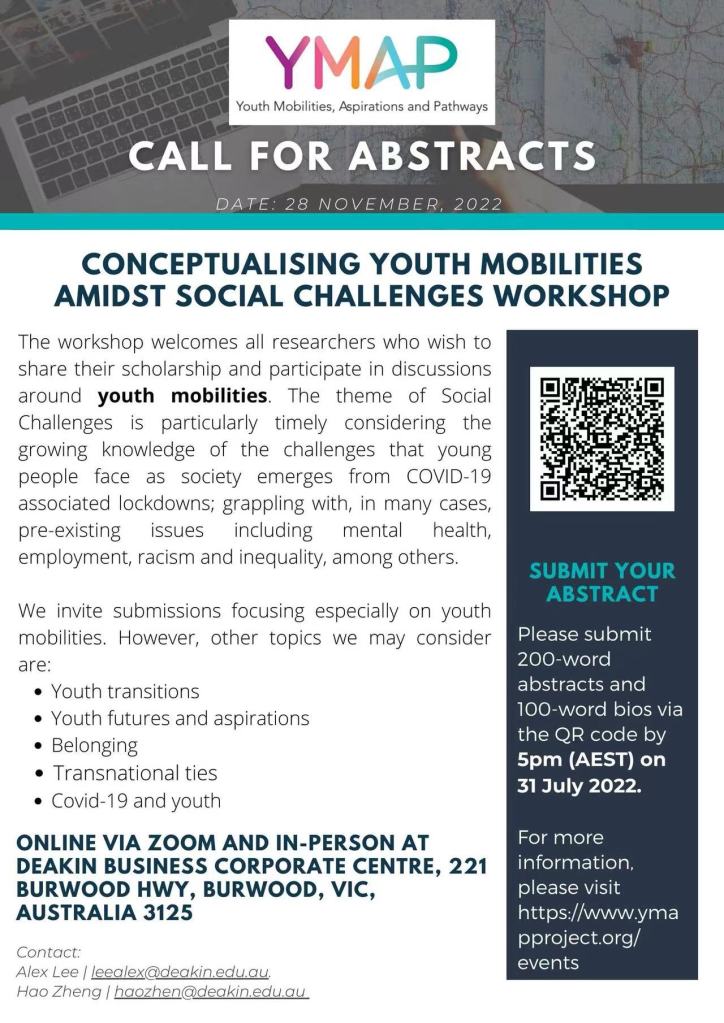
Call for Abstracts: Conceptualising Youth Mobilities amidst Social Challenges Workshop

Conceptualising Youth Mobilities amidst Social Challenges will bring together researchers with an interest in youth mobilities, from across the social sciences, for a one-day workshop. This workshop will be held on Monday, 28 November 2022, at Deakin Burwood Corporate Centre (BCC) and online on Zoom.  

The workshop welcomes all researchers who wish to share their scholarships and participate in discussions around youth mobilities. It seeks to provide an opportunity for attendees to build networks and connect with like-minded researchers at all stages of their careers, including early career and postgraduate. We seek to support research that has a connection to Australia. However, we also recognise that as youth mobilities research, this may likely include connections to places overseas.

We invite presentations that examine transnational youth mobilities amidst the social challenges of our contemporary world. What is the role of mobility in young people’s negotiation of social challenges? How might emerging forms of mobility (re)shape perceptions of adulthood and aspirations for youth transitions? How do young people construct belonging and place in a mobile world?


The theme of Social Challenges is particularly timely considering the growing knowledge of the challenges that young people face as society emerges from COVID-19 associated lockdowns; grappling with, in many cases, pre-existing issues including mental health, employment, racism and inequality, among others.  

We invite submissions focusing especially on youth mobilities. However, other topics we may consider are:
• Youth transitions
• Youth futures and aspirations
• Belonging
• Transnational ties
• Covid-19 and youth

Traditional academic papers and alternative presentations (e.g. creative readings, collective presentations, posters, etc.) are welcome. Please submit 200-word abstracts and 100-word bios via the Google Form by 5pm (AEST) on 31 July 2022. For questions or more information, please get in touch with Hao Zheng (haozhen@deakin.edu.au) or Alex Lee (leealex@deakin.edu.au).

Managing editor: Tong Meng