Call for Abstracts – Imagining Better Education Conference 2025

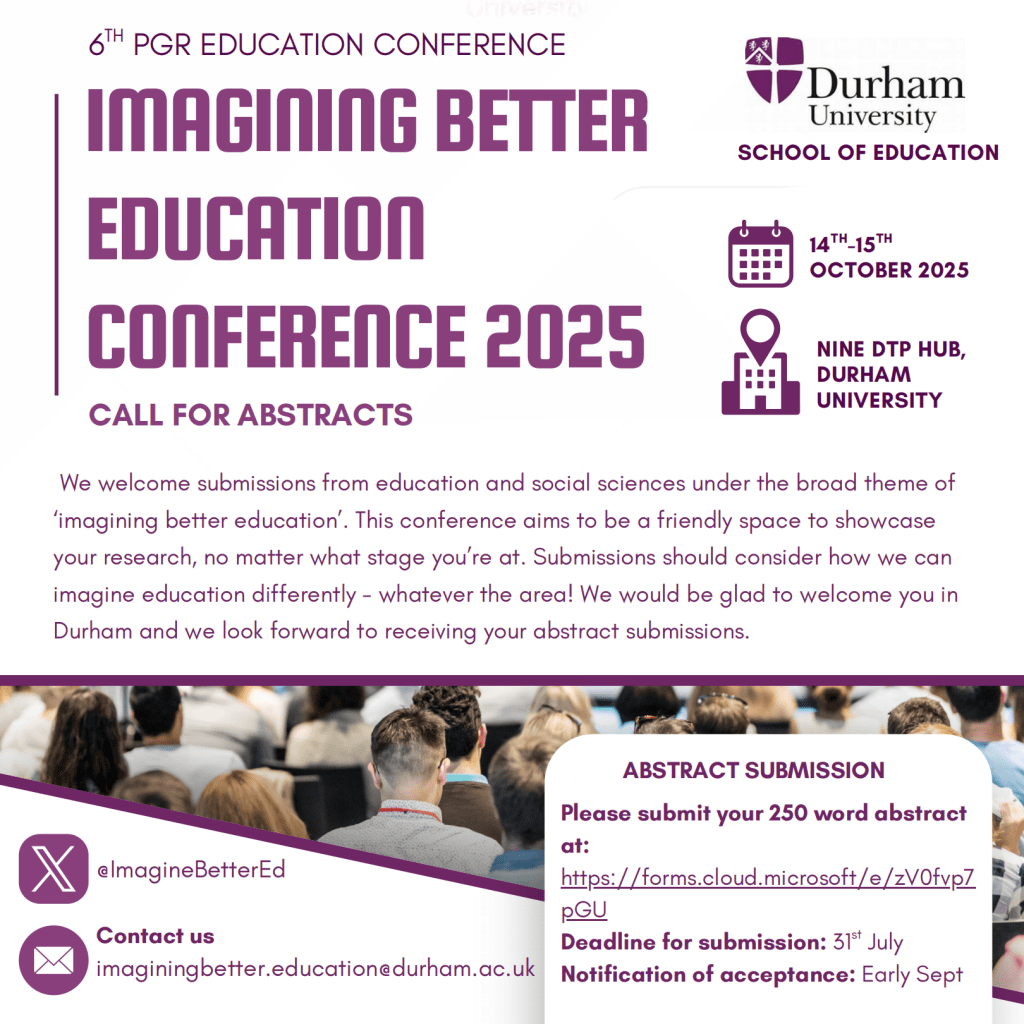
We are thrilled to announce the Imagining Better Education Conference 2025, taking place on 14–15 October 2025 at Durham University.

This conference is a welcoming space for researchers in education and the social sciences to share their work and explore the theme:

👉 Imagining Better Education

Whether you’re just starting out or finishing your PhD, we’d love to hear from you!

🔹 Deadline for abstract submissions (250 words): 31 July

🔹 Notification of acceptance: Early September

🔹 Location: School of Education, Durham University, NINE DTP Hub

🔹 Organisers: A team of PGRs from Durham’s School of Education

📲 Use the QR code in the poster to register and submit

📧 Contact us: imaginingbetter.education@durham.ac.uk

🐦 Twitter: @ImagineBetterEd

We can’t wait to read your ideas for reimagining education!

Call for Papers: 14th CESA Biennial Conference (Islamabad, Nov 23–25, 2025)

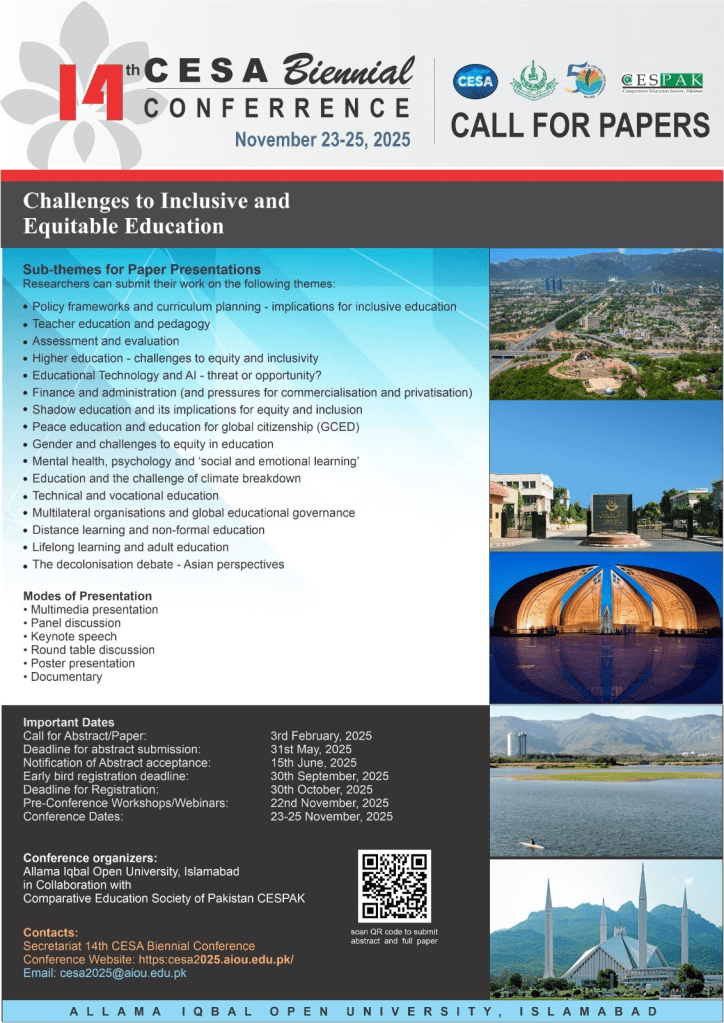
The Comparative Education Society of Asia (CESA), in collaboration with Allama Iqbal Open University and CESPAK, invites paper submissions for the 14th CESA Biennial Conference, to be held in Islamabad, Pakistan, from November 23–25, 2025.

 ThemeChallenges to Inclusive and Equitable Education

 Deadline for Abstract SubmissionMay 31, 2025

Please submit via QR code in the poster attached below.

Full call: https://cesa2025.aiou.edu.pk

If you face difficulties registering, please contact Professor Edward Vickers (Kyushu University) directly at edvickers08@gmail.com.

Call For Paper | Children and Youth in Asian Migration: Temporalities, Transitions, and Turbulence

CALL FOR PAPERS DEADLINE: 16 MAY 2025

Date : 11 Aug 2025 – 12 Aug 2025
Venue : Hybrid (Online via Zoom & AS8 04-04)
10 Kent Ridge Crescent, Singapore 119260
National University of Singapore @ KRC

Contact Person : TAY, Minghua

This workshop is organized by the Asia Research Institute, National University of Singapore, and partially supported by the Asian Metacentre Endowment which is funded through the Wellcome Trust.

While the terms “children” and “youth” are often associated with age-specific stages in the life course, scholars have shown that they are socially constructed categories whose meanings are deeply shaped by historical, cultural, and political contexts. In the context of increasing mobility and diversifying migration pathways in the Asian region, these constructs take on added complexity, particularly as young people face shifting expectations, heightened vulnerabilities and uncertain futures amidst increasing rapid and often turbulent change.

In recent decades, the intensification of mobility and migration has become a defining feature of life across many parts of Asia. These movements impact not just the lives of individuals who cross borders, but also those who remain, with effects that ripple across time and generations. For many children and youth, migration may be directly experienced or indirectly felt, and in either instance, it becomes a significant force influencing their identities, relationships and imagined futures. Childhood and youth thus emerge not as a stable early life stage, but a terrain marked by transition, uncertainty, opportunity and constraint.

Despite the increasing recognition of children and youth in migration studies, much research continues to frame them as temporally ‘bounded’—captured in static moments rather than examined as dynamic subjects simultaneously navigating life course transitions and migration trajectories across space and time. Thus, this workshop invites contributions that attend to the temporal dimensions of children and youth in migration, examining how young people’s lives unfold over time and space, and how their agency, aspirations, relationships and roles may shift across different life stages and migratory contexts. While considering children and youth as part of families and nation-states, the workshop also foregrounds their capacity as situated and relational, presenting them as future-oriented actors who actively contest, negotiate, and potentially reshape the terms of migration. Whether as left-behind children, independent migrants, accompanied “minors”, international students, or as returnees, their lives reflect both the consequences and opportunities of migration.

This workshop aims to deepen theoretical and empirical understandings of young people’s experiences within migratory contexts in Asia. We welcome papers that draws on a temporal lens in exploring how migration shapes children’s and youths’ life trajectories, identities, and aspirations—and in turn, how they may influence intergenerational migration pathways of their families and communities. Conceptually informed empirical contributions along the following themes are particularly welcomed:

  • Temporalities of migration and changing aspirations of migrant and “left-behind” children and youth
  • Young people as emerging agents in shaping, navigating, or resisting migration over the life course
  • The role of migrant networks and migration infrastructures in shaping children and youth’s mobility and aspirations in turbulent times
  • Intergenerational influences on migration and aspirations of children and youth

This workshop aims to present a more nuanced, temporal, and future-orientated understanding of children and youth in migration—one that recognises how the ability to migrate, or the pressure to be mobile, can itself be part of the crisis shaping their lived realities and imagined futures.


SUBMISSION OF PROPOSALS

Paper proposals should include a title, an abstract (300 words maximum), and a brief personal biography (about 150 words) for submission by 16 May 2025. The abstract should include as appropriate a discussion of the paper’s main aim(s), conceptual framework/theoretical contribution, research methods and data, and key findings. Please also include a statement confirming that your paper has not been published or committed elsewhere, and that you are willing to revise your paper for potential inclusion in a special issue of a journal. Please submit your proposal using the provided form below.

Authors of selected proposals will be notified in early June 2025. Presenters will have to submit a draft of their papers (about 4,000-6,000 words) by 11 July 2025. These drafts will be circulated to fellow presenters and discussants in advance.

The workshop will be available for both in-person and online participation. Depending on the availability of funding, the organizers may offer overseas participants financial assistance, which could include full or partial airfare and up to three nights of accommodation. If you require funding support, please indicate this on the proposal form.


WORKSHOP CONVENORS

Dr Theodora LAM
Asia Research Institute, National University of Singapore

Dr Bernice LOH
Asia Research Institute, National University of Singapore

Prof Brenda S.A. YEOH
Asia Research Institute & Department of Geography, National University of Singapore

Dr Kris Hyesoo LEE
Asia Research Institute, National University of Singapore

CFP Proposal Form Link

Managing editor: Tong Meng

Call for Abstract: 1st Annual CHELPS Conference

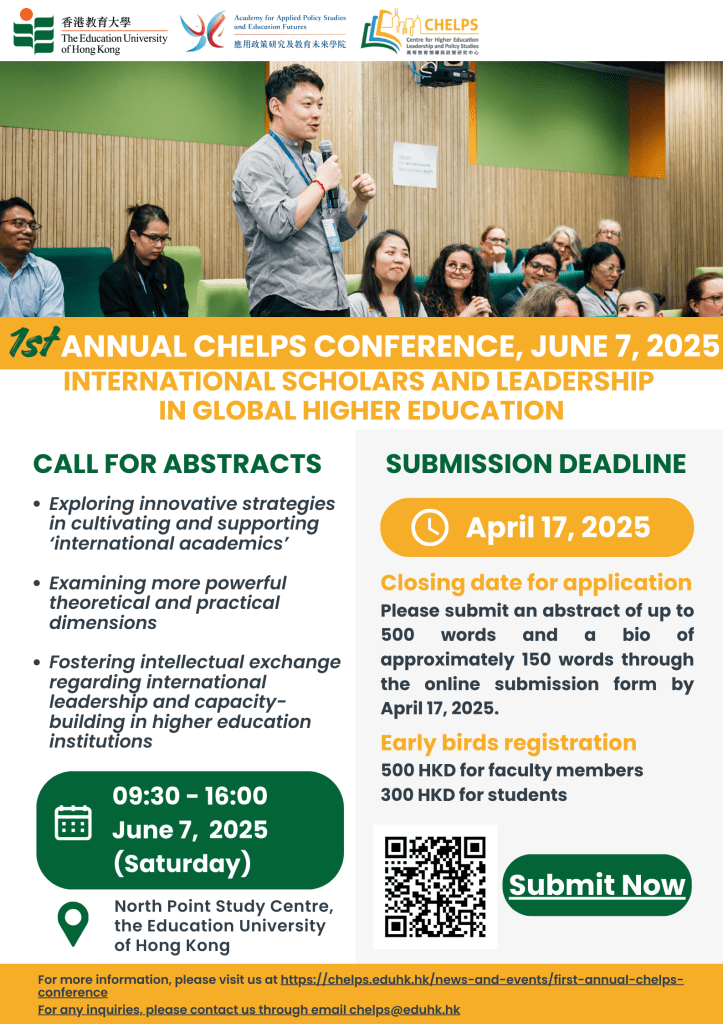
Centre for Higher Education Leadership and Policy Studies (CHELPS) are pleased to invite you to submit an abstract for the upcoming 1st Annual CHELPS Conference at North Point Study Centre of the Education University of Hong Kong on 7 June, 2025. This year, our theme is “International Scholars and Leadership in Global Higher Education”, and we welcome submissions from students, researchers, practitioners, and professionals at different stages of their career who are interested in international mobility, collaborations, and intellectual leadership within a globalised context. 

We welcome abstracts addressing issues of internationalisation, international leadership, international collaboration, and global higher education. Submissions should not exceed 500 words for an abstract and 150 words for a brief bio, and must be submitted by 17 April 2025. For more information, please refer to our website: https://chelps.eduhk.hk/news-and-events/first-annual-chelps-conference

To submit your abstract, please visit: https://eduhk.au1.qualtrics.com/jfe/form/SV_1SyOkxKQ9io69sW 

Managing Editor: Tong Meng

Participant Information Sheet/Information about the research

Title of Study: 

Understanding the challenges and opportunities for internationally mobile academic staff seeking recognition of their teaching experience in UK higher education. 

We are inviting you to take part in a research study. Before you decide, it is important that you know why we are doing the study and what is involved. Please read the following information carefully. 

What is the purpose of the study? 

The purpose of this study is to find out about the experiences of international academic staff who are teaching in UK higher education. Specifically, the study seeks to understand the challenges and opportunities for international staff who are seeking recognition of their teaching practice, for example, through Advance HE Fellowship schemes. 

The outputs of the research will contribute to improving how universities recognise and develop the pedagogic practice of internationally mobile staff. 

The study is being conducted at the University of Lincoln. It is open to academic staff at any other UK HE institution. 

Am I eligible to take part? 

You are eligible to take part in the study if you: 

  • Consider yourself to be international staff or an academic of migrant background 
  • Currently work in UK HE in a teaching or learning support role 
  • Have tried to gain recognition of your teaching practice via the Advance HE Fellowship scheme in the past five years (D1, D2, D3 or D4, successfully or unsuccessfully, whether through an internal institutional scheme or direct to Advance HE) or via another route (e.g. Teaching Excellence Award, National Teaching Fellow, Collaborative Award for Teaching Excellence). 

You will not be able to take part in the study if you: 

  • Are employed by the University of Lincoln 

Do I have to take part? 

Participation is completely voluntary. You should only take part if you want to and choosing not to take part will not disadvantage you in anyway. 

What will I be asked to do? 

You will be asked to participate in a single interview of between 30 minutes to 1 hour in length. The interviewer will ask about your experiences of teaching/learning support in UK HE, and specifically your experience of gaining formal recognition of your teaching/learning support practice. As part of the interview, you will also be asked to share personal data, including your contact details, gender, age, nationality, job title and employer. Before taking part, you will be asked to complete a consent form. 

Will I be paid expenses for taking part? 

You will not be paid to participate in the study. 

What are the possible benefits / risks of taking part?  

It is hoped that this project will draw attention to the needs and priorities of international staff who teach in UK universities, to inform practice and policy in this area. All participants will be offered a written summary of the research at the end of the project. It is not anticipated that participating in the study will cause any harm or discomfort. 

Will anyone know I have taken part? 

The University of Lincoln (UoL) is the sponsor for this study based in the United Kingdom. We will be using information from you in order to undertake this study and will act as the data controller for this study. This means that we are responsible for looking after your information and using it properly. 

The research team will keep your name and contact details confidential and secure. The research team will use this information as needed, to contact you about the research study, and make sure that relevant information about the study is recorded for your care, and to oversee the quality of the study.  

Certain individuals from UoL may look at your research records to check the accuracy of the research study. The people who analyse the information will not be able to identify you and will not be able to find out your name or contact details. 

The interview will be confidential unless you reveal that you or someone you know is at serious risk of harm. We will talk about it with you so that we can work out together how best to handle this. 

You will not be identified in any report or publication arising from this research. 

Where will my data be stored? 

The data obtained from the study will be stored securely on the university OneDrive in password protected files. Only the researcher will have access to it. The data from this study may be put in an Open Access repository for other researchers to use in future research. If so, responses will be anonymised and any personal data (e.g. contact details) will be removed.  

What will happen if I don’t want to carry on with the study?  

You are free to withdraw at any point from this study, without having to give a reason, by contacting Dr Nicola Chanamuto: nchanamuto@lincoln.ac.uk.  

If you choose to withdraw from this study, we will not retain the information you have given thus far, except when such data has already been included in aggregated analyses at the time of your withdrawal. 

What will happen to the results of the research study? 

The results of the research may be published, shared at external conferences and presented at internal meetings. If you wish, you will be sent a copy of any research outputs produced. You can confirm this at the time of your interview. 

Who is organising and funding the research? 

This research is being organised by Dr Nicola Chanamuto at the University of Lincoln. 

Who has reviewed the study? 

All research conducted by the University of Lincoln is looked at by an independent group of people, called a Research Ethics Committee, to protect your rights, dignity and wellbeing. This study has been reviewed and given favourable opinion by a University of Lincoln Research Ethics Committee [UoL2024_20252]. 

What if there is a problem? 

It is very unlikely that this study would cause you any harm. If you have a concern or a complaint about any aspect of this study, you should ask to speak to the researcher who will do their best to answer your questions. Contact details are given at the end of this information sheet.  

If you remain unhappy and wish to complain formally, you can make a formal complaint through the University complaints procedure or by contacting ethics@lincoln.ac.uk.  

Further information and contact details 

Contact details 

Dr Nicola Chanamuto 

Lincoln Academy of Learning and Teaching (LALT) 

University of Lincoln 

nchanamuto@lincoln.ac.uk  

Information compliance 

The University of Lincoln is the lead organisation for this study and will be the data controller for this study. This means that we are responsible for looking after your information and using it properly.  

The university’s Research Participant Privacy Notice (https://ethics.lincoln.ac.uk/research-privacy-notice/) explains how we will be using information from you in order to undertake this study.  

If you feel that we have let you down in relation to your information rights then please contact the Information Compliance Team by email on compliance@lincoln.ac.uk or by post at Information Compliance, Secretariat, University of Lincoln, Brayford Pool, Lincoln, LN6 7TS. 

You can also make complaints directly to the Information Commissioner’s Office (ICO). The ICO is the independent authority upholding information rights for the UK. Their website is ico.org.uk and their telephone helpline number is 0303 123 1113.