The COVID pandemic has exacerbated global geopolitical tensions and exposed Sinophobia and anti-Asian racism. Meanwhile, a nascent Asian diasporic consciousness has been emerging worldwide, celebrating Asian identity and cultural heritage. In the space between anti-Asian racism and Asian Pride, queer people’s voices have been largely missing.
This book draws on a range of contemporary case studies including art, fashion, performance, film, and political activism. It articulates an intersectional cultural politics that is anti-nationalist, anti-racist, decolonial, feminist and queer.
It is part of the Social Science for Social Justice series: where academics, journalists, and activists of colour respond to pressing social issues.
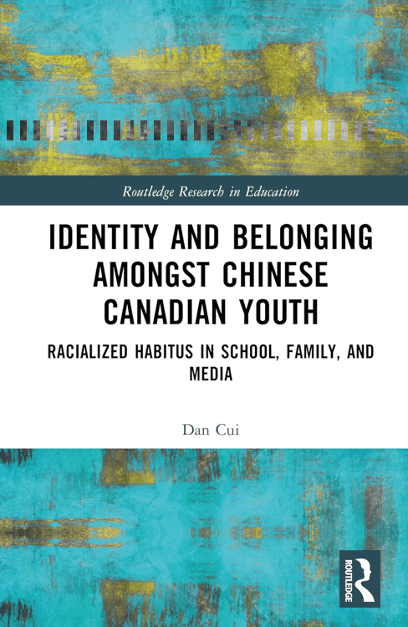
Cui, D. (2024) Identity and belonging among Chinese Canadian youth: Racialized habitus in school, family and media. Routledge. DOI: 10.4324/9781003054023
Introduction:
This book examines how Chinese immigrant youth navigates their identities as racialized minorities within school, family, and through their interactions with Canadian mainstream media. Drawing on rich interview data, the author unveils how contemporary forms of racism, multiculturalism, immigration, and transnationalism shape the identity construction and sense of belonging among second-generation Chinese immigrant youth in Canada. This book offers a systematic analysis of how these youth and young adults negotiate their lived experiences and perceptions of race, ethnicity and class.
By uniquely extending Bourdieu’s concept of habitus to race and ethnicity, the author traces the impact of racism and “model minority” discourses not only to their systemic and institutional roots but also to their internalization in individual thoughts, behaviors, and identities.
This book will appeal to academics and researchers examining racial inequality and Asian diasporas in Western societies, as well as those seeking new insights into contemporary schooling, media studies, and immigrant family dynamics, with a focus on multicultural education, the sociology of education, and critical theories of race and ethnicity.
Dan Cui is an Associate Professor in the Department of Child and Youth Studies at Brock University, Canada. Her research interests include sociology of education, immigration, integration and transnationalism, international and comparative education, social justice and equity studies, Chinese/Asian diasporas, and qualitative research methods. She previously held a SSHRC Postdoctoral Fellowship at the University of California Berkeley. Her work has been widely published across disciplines, appearing in the British Journal of Sociology of Education, Journal of International Migration and Integration, Journal of Youth Studies, and etc.
Edited by Rachel Brooks (University of Oxford) and Johanna Waters (University College London)
We welcome abstracts for an edited collection on national and regional schemes intended to foster short-term international mobility for higher education students. There are now many schemes that enable students to move abroad for part of their (higher) degree programme – to study, work and/or volunteer. Examples include Mobility+ (Taiwan); KMove (Korea); Mevlana (Turkey); New Colombo Plan (Australia); Erasmus+ (Europe); Turing Scheme (UK); Taith (Wales); Global Undergraduate Study Abroad Programme (US); Semester Abroad Programme (India); and NordPlus (Nordic countries). Nevertheless, to date, the literature in this area has tended to focus on single schemes only, and those that are run from countries in the Global North. In our edited collection, we hope to bring studies from a wide variety of national and regional contexts into dialogue, highlighting points of connection and divergence, and showing how they relate to broader debates within the fields of education, sociology, geography, social policy and youth studies (for example, about class (re)production, youth mobilities, education systems and social change, knowledge economies, cosmopolitanism, transnational networks and different aspects of globalisation).
Abstracts are welcome on any theme including, but not confined to, the following:
The aims and objectives of the scheme(s), and how these are situated within wider national/regional contexts
Responses to the scheme(s) from higher education institutions and other relevant social actors
The characteristics of participating students (and particularly social identity markers) and the implications of these
The experiences of participating students
The impact of the scheme(s) on, e.g., students’ identity formation, academic performance, employment outcomes
Contributions can be theoretical or empirical, and we have no preference for any particular methodology. However, all abstracts should make clear the evidence base and theoretical framework(s) upon which the proposed chapter will draw, and the main arguments that will be advanced. We do not necessarily expect contributions to focus on more than one scheme (although they could); we anticipate using the book’s introduction and conclusion to make the comparisons and connections. Please submit your abstract of around 500 words to Rachel Brooks by 30 November 2024 (rachel.brooks@education.ox.ac.uk). We will confirm by early January 2025 whether we will be including your abstract in our proposal. Our intention is then to submit the proposal to an appropriate publisher (e.g. Routledge or Policy Press) by early February. If we secure a contract, we are likely to need full chapter drafts (of around 8000 words) by October 2025.
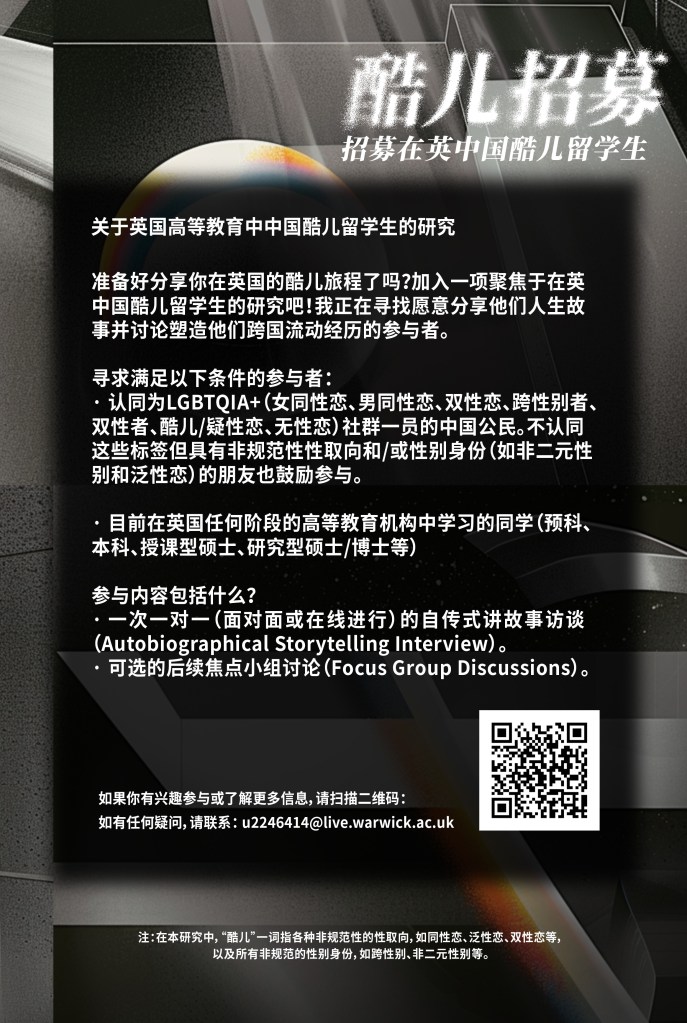
Haoxi Ou at the University of Warwick is seeking LGBTQIA+ Chinese international students in the UK to participate in a research project exploring their experiences and the kinds of desires that animate international mobility.
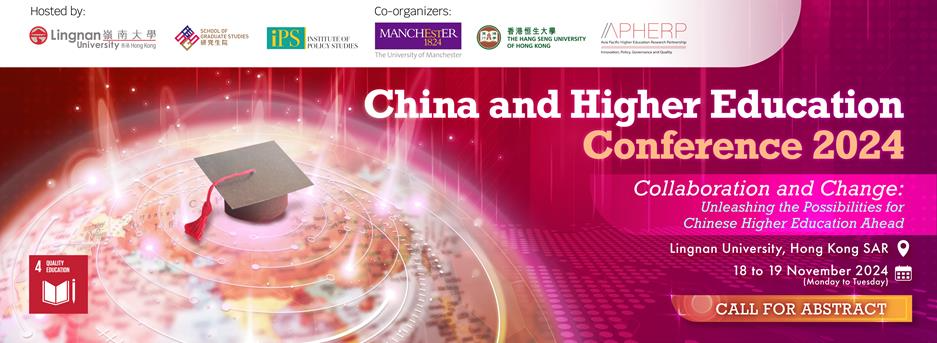
Greetings from Lingnan University! We are honored to extend this invitation to your faculty and postgraduate students to contribute and attend the China and Higher Education Conference 2024 (ChinaHE)from 18 to 19 November 2024 (Monday to Tuesday). The conference theme is Collaboration and Change: Unleashing the Possibilities for Chinese Higher Education Ahead.
With the above theme, the following key questions will be discussed at the conference include, but are not limited to:
1. How are collaborations between Chinese and international HEIs reshaping academic research, pedagogy, and students’ learning experiences?
2. How are emerging technologies and digital platforms facilitating collaboration and knowledge sharing among HEIs, and what are the implications for academic research, teaching, and learning?
3. What strategies are effective in promoting interdisciplinary collaboration within Chinese HEIs, and how can interdisciplinary approaches address complex societal challenges?
4. How are collaborations between Chinese HEIs and government agencies driving policy reform, regulatory changes, and institutional autonomy within the higher education sector?
5. What roles does industry-academia collaboration play in fostering innovation, entrepreneurship, and workforce development within Chinese higher education?
6. How can collaborative partnerships between Chinese HEIs and non-profit organizations or civil society groups contribute to social equity, community engagement, and sustainable development goals?
7. What opportunities and challenges arise from international collaboration initiatives, such as the Belt and Road Initiative, in shaping the globalization of Chinese HEIs?
8. As under-studied stakeholders, what are the roles of international students and professional staff in Chinese HEIs in building national and inter-national collaborations?
9. What are the roles of educational leaders in promoting collaboration among Chinese and international HEIs to thrive on the changes while addressing the deep-seated educational issues?
Call for Abstract We invite you to submit your scholarly abstracts and present your latest research at Lingnan University to an international audience. Submit Now: Click Here [lingnan.asia.qualtrics.com] Due date: 15 September 2024 at 23:59 HKT (GMT+8)
We also encourage you to share this conference within your professional network to enhance our collective impact.
For further information, kindly visit the webpage provided here [ln.edu.hk]. If you have any inquiries, please feel free to contact the Conference Organizing Committee at ChinaHE@LN.edu.hk .



 Network for Research into Chinese Education Mobilities (NRCEM)