Navigating transnational mobility: A phenomenological cultural analysis of Chinese students’ journey from Sino-Australian international schooling to Australian higher education

Research highlight:
Cutri, J. (2025). Navigating transnational mobility: A phenomenological cultural analysis of Chinese students’ journey from Sino-Australian international schooling to Australian higher education. In X. Liu (Ed.), Mobility, study, and cultural conflicts of international students [Working title]. IntechOpen. https://doi.org/10.5772/intechopen.1011635

This chapter investigates the lived experiences of Chinese alumni from a Sino-Australian School (SAS) as they transition into Australian higher education (AHE). Framed by Aihwa Ong’s concept of cultural logic (1999) and grounded in a phenomenological cultural approach (van Manen, 1997; Smith & Fieldsend, 2021), the study explores how students educated within Chinese Internationalised Schools (CIS) navigate transnational educational spaces shaped by hybrid curricula and cross-cultural expectations.

The chapter draws on in-depth narratives from three alumni—Kobe, Iris, and Pierre—who reflect on how values such as xiào (孝, filial piety), pedagogical dissonance, and linguistic vulnerability intersect with aspirations for global success. Their stories challenge deficit framings of Chinese international students and instead foreground student agency, cultural negotiation, and identity transformation.

SAS, as a CIS institution delivering the Victorian Certificate of Education (VCE), represents a site of educational hybridity where Western curriculum is localised through Chinese political and cultural logics (Cutri et al., 2024). These institutions have proliferated in China as part of a broader movement by the rising middle class to secure global educational capital (Ball & Nikita, 2014; Bunnell & Poole, 2024). However, the chapter moves beyond institutional analysis to centre student voice, revealing the emotional labour and relational dimensions underpinning international student mobility.

Students’ initial adjustment to AHE reveals tensions between imagined futures and lived realities—what Appadurai (1996) terms “travelling imaginations.” The pedagogical shift from didactic instruction to self-directed learning initially provokes confusion but eventually fosters the emergence of hybrid learning identities. Language is identified as a key site of identity negotiation and symbolic belonging, with students describing their evolving relationship to English as both empowering and exclusionary.

Importantly, the notion of xiào is not abandoned in this transnational context, but reworked. For these students, xiào evolves from passive obedience to an active ethic of responsibility, cultural pride, and self-determination. Their narratives demonstrate how well-being and educational identity are co-constructed through culturally proximate relationships, peer support, and everyday community engagement (Soong & Mu, 2025).

This study contributes to the decolonisation of international education by shifting the analytical gaze away from Eurocentric assumptions and toward culturally situated student perspectives. It shows how Chinese students from internationalised schooling backgrounds do not assimilate into Western academic cultures, but rather craft strategic and affectively rich identities that bridge Confucian values and cosmopolitan aspirations.

By centring phenomenological inquiry and cultural logic, the chapter offers a nuanced account of how international schooling prepares students not merely to succeed in global higher education but to reimagine what success, belonging, and identity mean on their own terms. It underscores the need for inclusive pedagogical practices that support students’ affective transitions and recognises international education as a space of cultural reweaving rather than cultural erasure.

References

Appadurai, A. (1996). Modernity at Large: Cultural Dimensions of Globalization. Minneapolis: University of Minnesota Press.

Ball, S. J., & Nikita, D. P. (2014). The global middle class and school choice: A cosmopolitan sociology. Zeitschrift für Erziehungswissenschaft, 17(S3), 81–93

Bunnell, T., & Poole, A. (2024). International Education and the Global Middle Class. London: Routledge

Cutri, J., Bunnell, T., & Poole, A. (2024). International education in transition: Perceptions of expatriate leadership at a Chinese school delivering an Australian curriculum. Compare, 1–18.

Ong, A. (1999). Flexible Citizenship: The Cultural Logics of Transnationality. Durham: Duke University Press.

Smith, J. A., & Fieldsend, M. (2021). Interpretative phenomenological analysis. In Camic, P. M. (Ed.), Qualitative Research in Psychology: Expanding Perspectives in Methodology and Design (2nd ed., pp. 147–166). Washington, DC: APA.

Soong, H., & Mu, G. M. (2025). International student wellbeing and everyday community engagement experiences: An Australian study. Studies in Higher Education.

van Manen, M. (1997). Researching Lived Experience: Human Science for an Action Sensitive Pedagogy (2nd ed.). London: Routledge.

Authors’ Bio 

Jennifer Cutri, Swinburne University of Technology, Australia

Jennifer Cutri is a lecturer and researcher at Swinburne University of Technology’s Department of Education. She is the course director for the Bachelor of Education (Early Childhood Teaching) and the Bachelor of Education Studies. Inspired by her international teaching experience in Hong Kong, her doctoral research focused on the Chinese educational context. Jennifer’s current research examines the impact of digital technology on early childhood education and international student mobility in the Asia-Pacific region.

Managing Editor: Tong Meng
Reshaping Agency and International Teacher Identity: Supporting EAL VCE Students via a Bilingual Immersion Model at a Sino-Australian Senior School in China


Research Highlighted:
 

Cutri, J. (2025). In Veliz, L., Nguyen, M.H., Slaughter, Y., & Bonar, G. (Eds.), Language Teacher Agency: Navigating Complex and Diverse Educational Contexts (pp. 129–146). Bloomsbury Academic.

This chapter explores the delivery of the Victorian Certificate of Education (VCE), an Australian senior secondary curriculum, within a Chinese Internationalised School (CIS) serving local students. Reflecting broader shifts in educational access and regulation, CIS institutions have proliferated in China, particularly among middle-class families seeking global credentials through bilingual education (Cutri, 2022). This study focuses on the agency of both local and foreign VCE teachers as they navigate identity, pedagogy, and institutional constraints in a transnational context. Framed by an ecological model of teacher agency (Biesta & Tedder, 2007; Priestley et al., 2015), the chapter examines how educators respond to the complex interplay of national policy, cultural expectations, and imported curricular demands within Chinese internationalised schooling.

This study examines the experiences of three VCE teachers: an expatriate and two local Chinese educators—as they support English as an Additional Language (EAL) learners in a bilingual Chinese Internationalised School (CIS). Their narratives reveal the complexities of cross-cultural adjustment, the development of culturally responsive pedagogy, and the emergence of a bilingual immersion model tailored to local needs.

CIS institutions differ from traditional international schools in that they serve Chinese nationals and blend local and international curricula under strict regulation (Poole, 2020; Wu & Koh, 2023). Within this context, the VCE program is delivered through partnerships between Chinese host schools and Australian accrediting bodies such as the VCAA. Rather than a straightforward export of Western curriculum, the VCE-in-China model represents a form of “educational import,” shaped by Chinese socio-political norms and regulatory frameworks. The experiences of VCE teachers thus offer a unique lens into how international education is localised through negotiation and adaptation.

The Director of the VCE in China reflects on recalibrating expectations around students’ English proficiency and socio-emotional readiness. His account necessitates a pedagogical shift from Western norms to approaches more attuned to local cultural realities. Narratives provided by local teachers, who are trained in both Chinese and Australian systems, exemplify pedagogical hybridity. Their ability to navigate between didactic and inquiry-based traditions is central to the program’s success. They report that students, particularly in Year 10, struggle to transition from exam-driven learning to the student-centred model characteristic of the VCE. In response, the teaching team developed a bilingual immersion model grounded in Vygotskian theory and scaffolded instruction, utilising strategies such as translanguaging, peer support, and the “I do, We do, You do” framework to build both language and content knowledge progressively.

English language proficiency remains a key challenge for students undertaking the VCE. In response, the teaching team developed a bilingual immersion model that incorporates translanguaging, peer scaffolding, and code-switching between pǔtōnghuà and English to support both content mastery and learner confidence. The chapter highlights how pedagogical adaptation is sustained through collaborative professional practices. Informal learning communities enable teachers to refine culturally responsive strategies and affirm their roles as transnational educators, defined not by nationality but by their capacity to navigate intercultural complexity.

The phased bilingual model developed within the Sino-Australian VCE program marks a significant pedagogical innovation in Chinese internationalised schooling. By allowing students to build foundational knowledge in pǔtōnghuà before transitioning to English, the model enhances academic confidence and engagement. It integrates explicit language support with culturally responsive teaching, demonstrating how bilingual instruction can effectively scaffold both linguistic and conceptual development.

This research also challenges deficit narratives surrounding Chinese students and educators. Rather than viewing local teachers as constrained by tradition, the study foregrounds their role as cultural brokers who mediate between national expectations and global aspirations. This co-construction of “cultural other-awareness” contributes to more nuanced and respectful educational practice, aligning with calls to decolonise international education (Wang & Chen, 2022).

These findings have broader implications for understanding Chinese education mobilities, highlighting the importance of localising international curricula to align with students’ linguistic and cultural contexts, rather than relying on wholesale curriculum export. The success of the bilingual model underscores the value of pedagogical hybridity—where global frameworks are adapted through culturally grounded practices.

This research contributes to the discourse on international education by offering an empirically grounded account of curriculum adaptation in a non-Western setting. It affirms that meaningful internationalisation requires not only the movement of educational programs across borders, but also the transformation of pedagogy through intercultural negotiation. As Chinese education mobilities continue to diversify, models like the VCE bilingual program offer valuable insights into how global and local educational logics can be reconciled to support equitable and effective learning.

References

Biesta, G., & M. Tedder. (2007). “Agency and Learning in the Life Course: Towards an Ecological Perspective.” Studies in the Education of Adults 39 (2): 132–149.

Cutri, J. (2022). The Localisation of Australian Elite Education Within China: A Case-Study of Various Social Actors’ Experiences at a Sino-Australian Senior School. Doctoral thesis, Monash University.

Poole, A. (2020). “Decoupling Chinese Internationalised Schools From Normative Constructions of the International School.” Compare: A Journal of Comparative and International Education 50 (3): 447–454.

Priestley, M., G. J. J. Biesta, & S. Robinson. (2015). “Teacher Agency: What It Is and Why It Matters.” In Flip the System: Changing Education From the Ground Up, edited by J. Evers and R. Kneyber, 134–148. London: Routledge.

Wang, L., & Y. Chen. (2022). “English Language Teacher Agency in Response to Curriculum Reform in China: An Ecological Approach.” Frontiers in Psychology 13: 935038.

Wu, X., & A. Koh. (2023). “Chinese Internationalised Schooling: Insights From Local Practices.” Comparative Education Review 67 (1): 1–26.

Author’s Bio 

Jennifer Cutri, Swinburne University of Technology, Australia

Jennifer Cutri is a lecturer and researcher at Swinburne University of Technology’s Department of Education. She is the course director for the Bachelor of Education (Early Childhood Teaching) and the Bachelor of Education Studies. Inspired by her international teaching experience in Hong Kong, her doctoral research focused on the Chinese educational context. Jennifer’s current research examines the impact of digital technology on early childhood education and international student mobility in the Asia-Pacific region.

Managing Editor: Tong Meng

Call For Paper | Children and Youth in Asian Migration: Temporalities, Transitions, and Turbulence

CALL FOR PAPERS DEADLINE: 16 MAY 2025

Date : 11 Aug 2025 – 12 Aug 2025
Venue : Hybrid (Online via Zoom & AS8 04-04)
10 Kent Ridge Crescent, Singapore 119260
National University of Singapore @ KRC

Contact Person : TAY, Minghua

This workshop is organized by the Asia Research Institute, National University of Singapore, and partially supported by the Asian Metacentre Endowment which is funded through the Wellcome Trust.

While the terms “children” and “youth” are often associated with age-specific stages in the life course, scholars have shown that they are socially constructed categories whose meanings are deeply shaped by historical, cultural, and political contexts. In the context of increasing mobility and diversifying migration pathways in the Asian region, these constructs take on added complexity, particularly as young people face shifting expectations, heightened vulnerabilities and uncertain futures amidst increasing rapid and often turbulent change.

In recent decades, the intensification of mobility and migration has become a defining feature of life across many parts of Asia. These movements impact not just the lives of individuals who cross borders, but also those who remain, with effects that ripple across time and generations. For many children and youth, migration may be directly experienced or indirectly felt, and in either instance, it becomes a significant force influencing their identities, relationships and imagined futures. Childhood and youth thus emerge not as a stable early life stage, but a terrain marked by transition, uncertainty, opportunity and constraint.

Despite the increasing recognition of children and youth in migration studies, much research continues to frame them as temporally ‘bounded’—captured in static moments rather than examined as dynamic subjects simultaneously navigating life course transitions and migration trajectories across space and time. Thus, this workshop invites contributions that attend to the temporal dimensions of children and youth in migration, examining how young people’s lives unfold over time and space, and how their agency, aspirations, relationships and roles may shift across different life stages and migratory contexts. While considering children and youth as part of families and nation-states, the workshop also foregrounds their capacity as situated and relational, presenting them as future-oriented actors who actively contest, negotiate, and potentially reshape the terms of migration. Whether as left-behind children, independent migrants, accompanied “minors”, international students, or as returnees, their lives reflect both the consequences and opportunities of migration.

This workshop aims to deepen theoretical and empirical understandings of young people’s experiences within migratory contexts in Asia. We welcome papers that draws on a temporal lens in exploring how migration shapes children’s and youths’ life trajectories, identities, and aspirations—and in turn, how they may influence intergenerational migration pathways of their families and communities. Conceptually informed empirical contributions along the following themes are particularly welcomed:

  • Temporalities of migration and changing aspirations of migrant and “left-behind” children and youth
  • Young people as emerging agents in shaping, navigating, or resisting migration over the life course
  • The role of migrant networks and migration infrastructures in shaping children and youth’s mobility and aspirations in turbulent times
  • Intergenerational influences on migration and aspirations of children and youth

This workshop aims to present a more nuanced, temporal, and future-orientated understanding of children and youth in migration—one that recognises how the ability to migrate, or the pressure to be mobile, can itself be part of the crisis shaping their lived realities and imagined futures.


SUBMISSION OF PROPOSALS

Paper proposals should include a title, an abstract (300 words maximum), and a brief personal biography (about 150 words) for submission by 16 May 2025. The abstract should include as appropriate a discussion of the paper’s main aim(s), conceptual framework/theoretical contribution, research methods and data, and key findings. Please also include a statement confirming that your paper has not been published or committed elsewhere, and that you are willing to revise your paper for potential inclusion in a special issue of a journal. Please submit your proposal using the provided form below.

Authors of selected proposals will be notified in early June 2025. Presenters will have to submit a draft of their papers (about 4,000-6,000 words) by 11 July 2025. These drafts will be circulated to fellow presenters and discussants in advance.

The workshop will be available for both in-person and online participation. Depending on the availability of funding, the organizers may offer overseas participants financial assistance, which could include full or partial airfare and up to three nights of accommodation. If you require funding support, please indicate this on the proposal form.


WORKSHOP CONVENORS

Dr Theodora LAM
Asia Research Institute, National University of Singapore

Dr Bernice LOH
Asia Research Institute, National University of Singapore

Prof Brenda S.A. YEOH
Asia Research Institute & Department of Geography, National University of Singapore

Dr Kris Hyesoo LEE
Asia Research Institute, National University of Singapore

CFP Proposal Form Link

Managing editor: Tong Meng

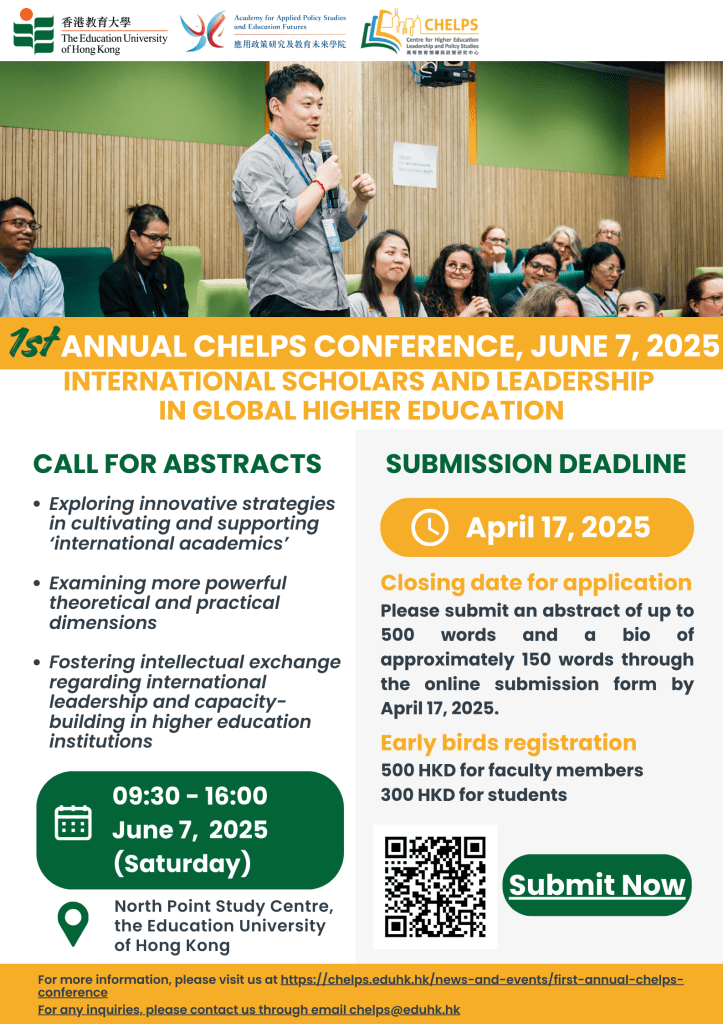
Call for Abstract: 1st Annual CHELPS Conference

Centre for Higher Education Leadership and Policy Studies (CHELPS) are pleased to invite you to submit an abstract for the upcoming 1st Annual CHELPS Conference at North Point Study Centre of the Education University of Hong Kong on 7 June, 2025. This year, our theme is “International Scholars and Leadership in Global Higher Education”, and we welcome submissions from students, researchers, practitioners, and professionals at different stages of their career who are interested in international mobility, collaborations, and intellectual leadership within a globalised context. 

We welcome abstracts addressing issues of internationalisation, international leadership, international collaboration, and global higher education. Submissions should not exceed 500 words for an abstract and 150 words for a brief bio, and must be submitted by 17 April 2025. For more information, please refer to our website: https://chelps.eduhk.hk/news-and-events/first-annual-chelps-conference

To submit your abstract, please visit: https://eduhk.au1.qualtrics.com/jfe/form/SV_1SyOkxKQ9io69sW 

Managing Editor: Tong Meng

Call for Papers-Special Issue/Section: Between Inclusion and Exclusion in Migrant Education

This special issue draws the attention to the realities of educating migrant children within different school systems around the world, focusing on the interplay of inclusionary and exclusionary practices, as well as the many in-between positions and the situational differences and processes that have emerged in education settings. Across diverse contexts, the positions and experiences of migrant students reveal a complex landscape shaped by national policies, local initiatives and practices, and institutional pressures. Schools often struggle to balance the value placed on multilingualism and cultural diversity up against the practical challenges of everyday life. In many cases, migrant children’s diverse cultural and linguistic assets are overshadowed by their perceived deficits, such as a lack of proficiency in the host country’s language. This disconnect highlights a broader issue where educational policies and practices may unintentionally further exclusion rather than inclusion.

Centralized educational frameworks and local adaptations and practices both play crucial roles in shaping migrant students’ experiences. While some systems and actors strive to tailor support to individual needs, others may default to standardized approaches that render irrelevant the diversity of student backgrounds. As a result, the extent of inclusionary practices can differ significantly based on local discretion and institutional priorities. Additionally, the readiness and competence of

educators to engage with migrant students, particularly those with refugee backgrounds, impact educational integration. Any gaps between formal training and real-world experiences of teachers underscore the need for better professional development and support structures.

The proposed special issue aims to shed light on these dynamics, offering insights into how actors in educational systems can better navigate the tension between inclusion and exclusion, and ultimately improve the educational experiences of migrant children.

We invite scholars from diverse disciplinary backgrounds to contribute papers that pertain to the scope described above. As we already have a core of articles from Europe, we are especially interested in attracting authors writing about settings in other parts of the world. We welcome empirical, policy and theoretical contributions. The final papers should not exceed 8000 words including abstract and references.

In spring/early summer 2025, we plan to hold a one or two day workshop with selected Authors to enable and benefit from collegial feedback on the proposed papers, which by the time of the workshop would be strong drafts, to be submitted as final versions around July/August 2025. The workshop will be held in-person in Poznań (Poland) and on-line, to allow wider participation. The workshop organizers will cover the cost of accommodation and meals, but we will ask participants to cover their travel costs. Please send us the working title of your paper along with an abstract of 250- 300 words by Friday, 28 of February 2025, to Katarzyna Byłów, PhD: katarzyna.bylow@amu.edu.pl.

Guest editors:

Katarzyna Byłów
Center for Migration Studies (CeBaM)
Adam Mickiewicz University in Poznań, Poland e-mail: katarzyna.bylow@amu.edu.pl

Marie Louise Seeberg
Department for Childhood, Family and Child Welfare research NOVA, Oslo Metropolitan University (OsloMet)

Managing Editor: Tong Meng