Transnational Habitus as a Configuration of Dispositions: Chinese International Students Navigating Online Information

Gao, H. (2023). Transnational Habitus as a Configuration of Dispositions: Chinese International Students Navigating Online Information. Literacy Research: Theory, Method, and Practice, 23813377231176259.

Introduction

This article is developed from a broader qualitative research project examining the online information-seeking experiences of Chinese international students in the United States. In today’s media-saturated society, the importance of online information literacy has increased exponentially. However, there is a dearth of research on the information literacy practices of international students. International students heavily rely on online information to navigate their studies and life as they adapt to new sociocultural, linguistic, and educational contexts in a foreign country (Click et al., 2017; Sin, 2015). Furthermore, they encounter a new information ecosystem that spans continents, cultures, and languages and must learn to navigate it (Chang et al., 2020). Therefore, it is crucial to explore the impact of the broad, bilateral, varied, and imbalanced social networks’ linkage with multiple nation-states and identities on how they navigate online information in the host country.

This study investigates the online information literacy practices of Chinese international students enrolled in higher education institutions in the United States. Currently, international students from China account for 35% of all international students in the United States (IIE, 2022). They are non-native English speakers and come from an online information environment that differs from the open internet in the United States (Freedom House, 2022). This research focuses on graduate-level students because Chinese graduate students generally possess more established Chinese worldviews, values, and habits of mind compared to their undergraduate counterparts (Wang & Freed, 2021). The study aims to understand the impact of transnationalism on these students’ information-seeking habits when searching for various online information.

Theoretical Framework

This study adopts a transnationalism framework, which refers to the complex process by which individuals maintain multiple social networks and connections to both their home and host communities (Levitt, 2009; Levitt & Schiller, 2004). Carlson and Schneickert (2021) theorized transnational habitus as a configuration of dispositions, suggesting that transnationalism may impact the habitual configuration of dispositions differently. This implies that there may be disparities between dispositions to believe and dispositions to act, creating a gap between beliefs and the actual possibilities of action. Furthermore, some dispositions may be more transnationalized than others. These ideas provide a valuable perspective for analyzing the information-seeking habits of international students, which can manifest in various forms, occur to different degrees, and are often subject to contestation, despite frequently being uniform and unidirectional in purpose.

Methods

This study employed purposeful sampling techniques (Merriam & Tisdell, 2016) to select six Chinese graduate students from a large public university in the Southeastern United States. Phenomenological interviewing (Seidman, 2006) was utilized, conducting a three-interview series with each participant. Each interview lasted approximately 90 minutes and employed an open-ended approach. Participants were also requested to maintain information-seeking diaries following their second interview. They recorded one online search incident per week for a consecutive four-week period. Additionally, a 90-minute focus group discussion was facilitated to further explore ideas and issues that may not have emerged in the individual interviews. Concurrent with data collection, an ongoing analysis of the participants’ online information seeking was conducted. Following the collection of all data, open and axial coding techniques (Merriam & Tisdell, 2016) were applied to the interviews to identify recurring patterns. These patterns were later corroborated, extended, or problematized with the data from the diaries and focus group.

Findings

The findings of the study shed light on the complex, dynamic, and adaptable online literacy practices of Chinese international students. It also demonstrates that the transnational habitus of students in information seeking is not a fixed construct, but rather emerges as a configuration of dispositions. Within this configuration, distinctions and gaps exist between dispositions to believe (beliefs or perceptions about information) and dispositions to act (actual actions in information seeking). Three forms of dualistic dispositions have been identified: Chinese international students’ transnational dispositions are strengthened in their academic information seeking, divided in their search for everyday life information, and activated in their consumption of news.

Strengthened Dispositions in Academic Information Seeking

During their studies in an English-dominated U.S. institution, participants embraced transnational information literacy practices by utilizing academic information from both U.S. and Chinese online environments. They demonstrated a flexible ability to navigate linguistic and digital information boundaries, leveraging the strengths of both information repositories to achieve their learning goals. Participants engaged in translanguaging (García & Li, 2014) by seamlessly alternating between named languages and even strategically creating bilingual keywords to optimize their search results. Furthermore, their transnational dispositions towards academic information seeking encompassed both dispositions to believe and dispositions to act. In reinforcing their existing dispositions to believe, they regarded academic information found on English language online platforms as more professional, authentic, credible, and rigorous. Moreover, their dispositions to act were strengthened as they readily accessed and more frequently utilized U.S.-based information for academic purposes.

Divided Dispositions in Everyday Information Seeking

While cultivating dispositions to believe in the authenticity of U.S. online information and a desire to assimilate into this dominant knowledge system, the participants’ dispositions to act did not always align with their belief in everyday information seeking. Instead, they frequently continued to rely on community-based information sources found on Chinese social media platforms. The Chinese international students demonstrated dispositions of belief, a cosmopolitan outlook, and transnational identifications, to use U.S. social media. Nonetheless, they exhibited limited dispositions to act, primarily relying on community-based platforms for obtaining identity-related information. These practices highlight the significance of authenticity characterized by relatability and similarity. Moreover, they suggest that students do not necessarily need to fully assimilate into another information culture in order to effectively navigate transnational contexts.

Activated Dispositions in Transnational News Consumption

Despite studying in the United States, all students in this study maintained their consumption of online news from Chinese media sources, considering them sufficient for staying informed about events in China and worldwide. However, their transnational dispositions to believe, which were nurtured both before and after studying abroad, allowed for the emergence of transnational dispositions to act in news consumption when desired. The students’ less transnationalized dispositions to act toward news consumption were influenced not only by their individual dispositions but also by external factors within the Western media environment. Some students expressed their reluctance to engage with Western news reports that portrayed China critically or had strong anti-China sentiments, especially when such portrayals contradicted their personal experiences or the information received from their families in China. Nevertheless, given suitable circumstances, students’ dispositions to act in transnational news consumption can be activated, as their belief in the importance of open-mindedness continues to shape their attitudes, values, and perspectives.

Discussion and conclusion

This study makes a significant contribution to the field of information literacy by adopting a transnational lens to investigate the online information literacy practices of Chinese international students in U.S. higher education institutions. By challenging assumptions that international students readily assimilate into the host country’s online resources or develop a singular transnational habitus, this study offers a more nuanced understanding of their diverse information needs and practices. The findings suggest that information literacy education that recognizes and utilizes students’ linguistic and transnational resources can be highly relevant to their experiences and beneficial to their academic success abroad. Additionally, by acknowledging and appreciating international students’ transnational mindsets and multilingual literacies as valuable assets, U.S. academic institutions can promote diversity, inclusion, and intercultural understanding, ultimately contributing to the development of globally minded individuals who are well-equipped to navigate today’s interconnected information landscape.

References

Carlson, S., & Schneickert, C. (2021). Habitus in the context of transnationalization: From ‘transnational habitus’ to a configuration of dispositions and fields. The Sociological Review, 00380261211021778. https://doi.org/https://doi.org/10.1177/00380261211021778

Chang, S., Gomes, C., & McKay, D. (2020). The digital information ecology of international students: Understanding the complexity of communication. In S. Chang & C. Gomes (Eds.), Digital Experiences of International Students: Challenging Assumptions and Rethinking Engagement (pp. 3-24). Routledge. https://doi.org/https://doi.org/10.4324/9780429276088

Click, A. B., Wiley, C. W., & Houlihan, M. (2017). The internationalization of the academic library: a systematic review of 25 years of literature on international students. College & Research Libraries, 78(3), 328. https://doi.org/https://doi.org/10.5860/crl.78.3.328

Freedom House. (2022). Freedom on the Net. https://freedomhouse.org/country/china/freedom-world/2022

García, O., & Li, W. (2014). Language, bilingualism and education. In Translanguaging: Language, bilingualism and education (pp. 46-62). Palgrave Macmillan.

IIE. (2022). International students. https://opendoorsdata.org/annual-release/international-students/

Levitt, P. (2009). Roots and Routes: Understanding the Lives of the Second Generation Transnationally. Journal of Ethnic and Migration Studies, 35(7), 1225-1242. https://doi.org/10.1080/13691830903006309

Levitt, P., & Schiller, N. G. (2004). Conceptualizing Simultaneity: A Transnational Social Field Perspective on Society. The international Migration Review, 38(3), 1002-1039. https://doi.org/10.1111/j.1747-7379.2004.tb00227.x

Merriam, S., & Tisdell, E. (2016). Qualitative research: A guide to design and implementation (Fourth). John Wiley & Sons.

Seidman, I. (2006). Interviewing as qualitative research: A guide for researchers in education and the social sciences. Teachers College Press.

Sin, S.-C. J. (2015). Demographic differences in international students’ information source uses and everyday information seeking challenges. The Journal of Academic Librarianship, 41(4), 466-474. https://doi.org/https://doi.org/10.1016/j.acalib.2015.04.003

Wang, X., & Freed, R. (2021). A Bourdieusian Analysis of the Sociocultural Capital of Chinese International Graduate Students in the United States. Journal of International Students, 11(1), 41-59. https://doi.org/10.32674/jis.v11i1.952

Author Bio 

Huan Gao, University of Memphis

Huan Gao is an Assistant Professor in Education at the University of Memphis, USA. Her research focuses on the intersection of digital and information literacies, transnational migration, and multilingual education. Currently, Huan’s work delves into the impact of transnationalism on Chinese international students’ online information-seeking practices. Her research has been recognized with the Student Outstanding Research Award at the Literacy Research Association and she has been honored with the National Council of Teachers of English Geneva Smitherman Cultural Diversity Grant. Huan holds a Ph.D. degree from the University of Florida and a master’s degree from the Hong Kong Polytechnic University.

Managing Editor: Tong Meng

Understanding Education Agent Engagement in China

Research highlighted

Dr Pii-Tuulia Nikula (Eastern Institute of Technology)

Education agents play a significant role in facilitating outbound student mobility from China. A new book Student Recruitment Agents in International Higher Education: A Multi-Stakeholder Perspective on Challenges and Best Practices explores the education agent phenomenon. It discusses the many complexities of agent engagement across the globe. The book features 19 chapters of which five are investigating the Chinese context. These contributions offer valuable insights into the views of students and parents as well as evidence of the impact of agents, evaluation of the Chinese regulative landscape and the role of agent key bodies that operate in China.

Two of the chapters in the Student Views section present primary data on Chinese students’ views and experiences. Ying Yang, Jenna Mittelmeier and Miguel Antonio Lim in their chapter “Giving Voices to Chinese International Students using Interpretative Phenomenological Analysis” explore the lived experiences of Chinese postgraduate students when applying to study in the UK, highlighting the value that agents can provide when students navigate the university selection and application processes. The chapter by Yi Leaf Zhang, Meng Xiao and Linda Serra Hagedorn, “Pursuing Higher Education Dreams in the US” presents data from Chinese undergraduate students and their parents when considering opportunities in the United States. They emphasise the critical role that parents play in the selection of an agent/agency. Both chapters discuss the benefits of agent engagement, but also identify various issues, such as student expectations not being met, limited transparency or agents trying to steer students to specific study opportunities. Hence, these chapters improve our understanding of students’ experiences and how agents can both provide and destruct value.

In the Agents’ Value Propositions and Impact section the chapter by Meng Xiao and Linda Serra Hagedorn “Agents and Test Preparation” sheds light into the inner workings of a large education agency offering English language tutoring services in China. A number of education agencies provide a wide array of service of which most focus is usually placed on the counselling and application processes. The chapter adds to this knowledge by offering insights into the organisation of language tutoring services by education agencies. It also presents data to demonstrate the impact of the language tutoring service offered by comparing participants’ English language test scores pre- and post-participation.

In the Government and Regulator Perspectives and Country Studies section two chapters explore the Chinese context. First, Siyan Feng in his chapter “Regulation, Deregulation, and Self-Regulation” evaluates the history and status quo of agent regulation in China. Feng’s chapter discusses the emergence of the special permit system regulating education agencies in 1998, and how it over time became dysfunctional and was discontinued. Feng discusses the new mechanisms of self-regulation and argues that to improve regulation in this area, key stakeholders, such as Chinese policymakers, should improve their knowledge of agents and how they operate. Second, Jon Santangelo in “Client-Agent Dispute Cases” discusses the role of Beijing Overseas Study Service Association (BOSSA) as a professional association of education agencies in China. This chapter provides case study various examples of complaints received from students who have been unsatisfied with their contracted agents’ services and BOSSA’s recommendations. The chapter prompts all students and their families to conduct their own due diligence. It is also recommended that both parties have a clear understanding of their responsibilities and accountabilities.

These chapters allow readers to improve their understanding of the work and impact of agents, how students and parents perceive the value provided by agents, and the past and current status quo of regulation in the Chinese context. Those interested in advancing their knowledge of agents will also benefit from reading chapters discussing other country contexts, including how higher education institutions (HEI) in various countries engage and work with agents. HEI perspectives and practices are critical to understand how HEI contracted agents operating in China are governed, incentivised and managed by their institutional partners. The views of HEI/agent management are equally valuable considering the ambitions of China to become a key destination for international students.

Student Recruitment Agents in International Higher Education: A Multi-Stakeholder Perspective on Challenges and Best Practices discusses a number of benefits and challenges associated with agent engagement. It provides theoretical perspectives and practical applications allowing readers to develop their understanding of the key conceptual issues and emerging trends, such as as the difficulties in defining ‘agents’ and the increasing reliance of mega-aggregators. Hence, the book contributes to a better understanding of wider agent related questions. It provides a good overview of the Chinese education agent context alongside a number of other recent publications (e.g., Yang et al., 2022;  Zhang, 2023). However, further research is needed to explore critical, but under-explored stakeholder views, such as those of policymakers, agent associations and universities/higher education institutions in China.

References

Nikula, P-T., Raimo, V. & West, E. (2023). Student Recruitment Agents in International Higher Education: A Multi-Stakeholder Perspective on Challenges and Best Practices. Routledge. https://www.routledge.com/Student-Recruitment-Agents-in-International-Higher-Education-A-Multi-Stakeholder/Nikula-Raimo-West/p/book/9781032136059#

Yang, Y., Lomer, S., Lim, M. A., & Mittelmeier, J. (2022). A study of Chinese students’ application to UK universities in uncertain times: from the perspective of education agents. Journal of International Students, 12(3), 565-586. https://doi.org/10.32674/jis.v12i3.3777

Zhang, C. (2023). The Legitimacy of Chinese Educational Recruitment Agencies (CERAs): Landscape evolution, policy environment, operating models, identities. Doctoral dissertation. UCL (University College London).

Author’s Bio

Dr Pii-Tuulia Nikula, Eastern Institute of Technology

Dr Pii-Tuulia Nikula is a Principal Academic at Eastern Institute of Technology/Te Pūkenga in New Zealand. Pii-Tuulia’s research covers international education, higher education and organisational sustainability. One of her areas of expertise is education agents. Pii-Tuulia’s articles on education agent management and governance have been published in leading international education and higher education journals. Pii-Tuulia holds editorial roles in Journal of International Students, Higher Education Research & Development, and Higher Education Quarterly. She holds a PhD in Politics and International Relations from the University of Auckland and Master in Social Sciences from the University of Helsinki.

https://www.researchgate.net/profile/Pii-Tuulia-Nikula

Managing Editor: Tong Meng

Call for Papers for Journal of Comparative and International Higher Education 

Call for Proposals for Winter 2024 Special Issue of Journal of Comparative and International Higher Education :  

Conceptualizing Micro-Level Narratives in  Thematic Constructs of Internationalization  

Send proposals to Guest Editors: Omolabake Fakunle, University of Edinburgh: omolabake.fakunle@ed.ac.uk and Fiona Hunter, Centre for Higher Education Internationalisation. Università Cattolica del Sacro Cuore, Milano 

Papers in this special issue will expound on the micro-level dimension in the internationalization of higher education. The aim is to critically examine internationalization at the individual level because internationalization is impossible without the participation and contribution of individuals who enable [and sustain] its functioning at the institutional, national, and international levels. A case in point is the paradoxical lack of integration of international students’ rationales for internationalization to underpin the development of strategies centered around student recruitment mainly from economic imperatives. This feeds into a persisting neglect of the humanising aspect of internationalization which remains drowned within dominant neoliberal marketized constructs. The relative lack of attention to the human aspect of internationalization implores the need to learn about the transformations that internationalization promises in advancing human development and flourishing, and how these may be actualized, and the challenges involved. The observation in the last three decades by scholars regarding the conceptual fuzziness around internationalization reflects the missing voices of individuals at the heart of internationalization.  

This special issue invites contributions to submit reflective accounts, theoretical papers, or findings from empirical research pointing to the importance of micro-level individual dimension in internationalization. Contributors can utilise different theoretical approaches that speak to the relational dimension of internationalization, such as a decolonial approach or capability approach to underpin articulations of agency amidst structural affordances and constraints. The papers will link to one or more thematic constructs of internationalization, such as:  

academic staff mobility, digitalisation of internationalization, international partnerships, international student mobility, internationalising the curriculum (pedagogical approaches and engagement in internationalised classrooms), internationalization at home, and transnational education.  

Proposals should be 500 words and submitted on or before October 1, 2023. Authors will be notified of their acceptance by November 15, 2023. Completed articles should be submitted by January 30, 2024. All articles will undergo a double-blind peer review process and must follow the JCIHE guidelines: https://www.ojed.org/index.php/jcihe/about/submissions. Proposals can be submitted directly to omolabake.fakunle@ed.ac.uk or can be submitted via the JCIHE website. 

Research with International Students Conference

December 11 – 12, 2023
Hybrid: at the University of Manchester (United Kingdom) and online

This conference is funded by The Spencer Foundation and builds on the upcoming publication of the Research with International Students book (to be published in late 2023). It further establishes a network of critical researchers and scholars who wish to develop more ethical approaches towards research that includes international students as participants and co-researchers. 

Conference focus

There is a growing recognition in research with international students that their experiences are intersectional (George Mwangi et al. 2019) and unequal (Mok and Zhang 2022). Although international students share a migrant identity, there is significant variation in how their experiences may be racialized, gendered, or seen through ableist or heteronormative lenses. For instance, different groups of international students are routinely ‘othered’ (Moosavi 2021) or stereotyped (Heng 2018) through assumptions they should ‘assimilate’ into the cultures and practices of their hosts. Scholars are also increasingly documenting the ways that becoming an international student may lead to renegotiating new minoritized identities in contexts where concepts such as race may be socially and culturally constructed in different ways (Madriaga and McCaig 2019). International students’ experiences with prejudices, xenophobia, and racism are also well documented (Jiang 2021; Harrison and Peacock 2009; Ladegaard 2017), where some research has started to unravel how this may unfold differently for students with different racial (Ramia 2021), religious (Arafeh 2020), gender (Brooks 2015), or dis/abled (Olave-Encina 2022) identities (among others).

However, research focusing on intersectional inequalities is the exception rather than the rule, as international students are routinely collectivised in research as a homogenised group (Jones 2017). Research has also historically operated from positions of deficit (Lomer and Mittelmeier 2021), as international students are often assumed to ‘lack’ experiences or skills necessary for success, particularly compared to home students. Similarly, international students are frequently portrayed as only experiencing challenges or difficulties (Deuchar 2023), which fails to see the complexity of their multidimensional and intersectional experiences. For example, the subfield is rife with research that seeks to ‘fix’ perceived problems with international students’ believed lack of critical thinking, language proficiency, classroom participation, or referencing knowledge, without reflecting that their educational experiences and knowledges may be different, but not deficient (Heng 2018). 

Many current research approaches fail to view international students as ‘epistemic equals’ (Hayes 2019) whose knowledges and experiences are equally worthy of inclusion rather than erasure. Further, the failure to recognise, document, and address intersectional facets of international students’ identities (of race, religion, gender, sexuality, disability, class, and more) through research means there are limited evidence-based measures for countering inequalities in practice. 

Given these issues, this conference focuses specifically on research designs and approaches within the subfield of research with international students. We aim to develop more methodological guidance to steer the subfield away from problematic discourses and assumptions. Therefore, we invite presentations which consider issues around the following questions:

  • What critical conceptual and methodological issues currently face research with international students as a subfield?
  • What are practical (macro or micro) considerations for research designs in this subfield?
  • How can researchers consider issues of power, inequality, intersectionality, and ethics in research with international students?
  • How might research with international students be imagined differently?
  • What should the future of research with international students look like?

Conference format

This is a two-day hybrid conference with a face-to-face component at the University of Manchester (UK) that will be streamed online. All presentation sessions will be recorded and shared online afterwards for those not able to attend live, but informal discussion sessions will not be recorded. We encourage as many speakers as possible to attend in person, but contributions will be considered at a distance if required. Prior to the conference, we will hold a pre-conference networking workshop online. We also aim to co-create a set of methodological guides for our website, which participants will be invited to collaborate on online after the conference. We ask all accepted speakers to participate in the full conference. 

Confirmed keynotes

We are pleased to confirm the following keynote speakers will join us at the conference in Manchester:

  • Kalyani Unkule (O.P. Jindal Global University)
  • Chrystal A. George Mwangi (George Mason University)
  • Hanne Kirstine Adriansen (Aarhus University) 

Submission guidance

You are invited to contribute as a presenter. We welcome contributions from around the world and support the inclusion of early career researchers and international student scholars. Authors may submit an abstract for an empirical or theoretical presentation related to the conference theme. Please note that the purpose of this conference is to focus on methodological and conceptual considerations for research with international students on a broader scale, considering the process of how we undertake research in the subfield. While authors are welcome to include examples of their research findings in their presentations, abstracts which fully intend to share research findings only will not be accepted.

You can submit a title and abstract of up to 300 words for consideration here: https://www.qualtrics.manchester.ac.uk/jfe/form/SV_5sYVTQcR4Cyuwo6
All (co-)authors will also be asked to include a short 100-word bio for inclusion in the conference programme.

If the Qualtrics survey is inaccessible for any reason, please contact the organisers. 

Deadline: 12:00 noon UK time on 17 July 2023
Time zone converter: https://www.timeanddate.com/worldclock/converter.html?iso=20230717T110000&p1=302 

Funding

This conference is free to attend, in person or online. 

The conference is funded by The Spencer Foundation’s Conference Grants Program. Limited funding is available to support scholars with attending the conference in Manchester (UK). This funding will be competitive and is reserved for those with the highest quality abstracts. Funding will be prioritised for the following categories:

  • Scholars with no institutional funding available for conference travel
  • Scholars based in ‘Global Majority’ or ‘Global South’ contexts
  • Scholars who identify as ethnic, religious, or cultural minorities in their contexts 
  • Disabled scholars
  • Scholars with caring responsibilities 
  • International student scholars
  • Early career researchers 
  • Scholars with any other marginalised or minoritised background or identity in their context 

We are unable to offer funding to scholars who already have institutional funding available for conference attendance. 

The abstract submission form will allow you to indicate whether you would like to be considered for funding to attend. A full application for funding should be submitted by August 31st at: https://www.qualtrics.manchester.ac.uk/jfe/form/SV_6lpysfOxC7NUF94

In the application, you should include a rough budget for the funding you would like to request. If successful, travel and hotels will be booked on your behalf by the conference team (no need to fund up front) and reimbursement is available for visa costs, caring costs, or supporter’s costs. Due to limited available funding, we will likely not be able to fund all requests and ask attendees to keep costs to a minimum to help us stretch the budget as far as we can. We are only able to fund a hotel around the conference days (up to 3 days maximum) and any extended stays will be at the attendee’s own expense. Lunches will be available at no cost on conference days, but other subsistence is at the attendee’s own expense (information about local grocery stores and budget restaurants will be provided). All travel must be in ‘economy’ class. Separate applications must be made for each individual author who wishes to attend.

Maximising your time in the UK: 

Other conferences

We have purposefully scheduled this conference to coincide with two other higher education conferences in the UK, should participants wish to maximise their travel. If you are in receipt of funding to attend our conference, we can pay for travel to/from your choice of an airport or train station in the UK, but not travel between conferences or hotel stays beyond the Research with International Students conference. 

Please note that abstracts to the Research with International Students conference should be significantly different from presentations made at SRHE or ChinaHE.

Collaboration and co-working

If you would like to extend your stay in Manchester for the purposes of collaboration and/or co-working with other conference attendees, we can book university rooms for your use on request. We are also happy to facilitate building connections with other researchers based in the Manchester Institute of Education.

Any questions about the conference can be directed to Jenna Mittelmeier.

Managing Editor: Tong Meng

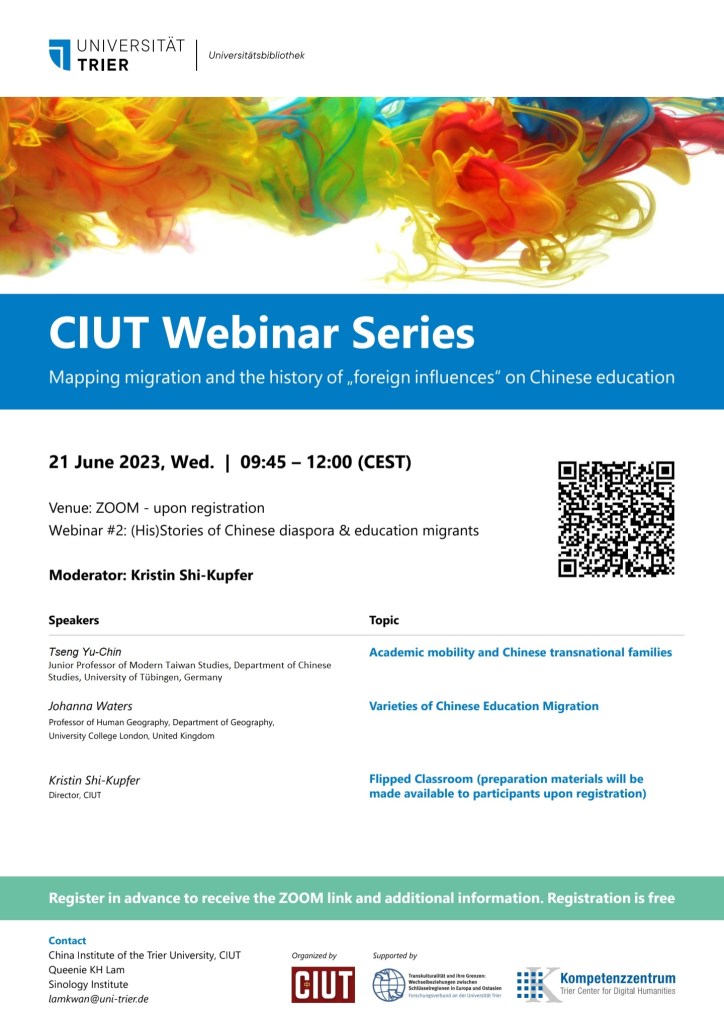
China Institute of Trier University Webinar “Mapping migration and the history of “foreign influences” on Chinese education, 21.06. 2023, 9:45-12:00 (CEST) via Zoom


21.06.2023 09:45–12:00 OnlineWorkshop | Seminar

China Institute of Trier University (CIUT) Webinar Series: Mapping migration of people and the impact on Chinese education

The mobility of people and goods between China, their neighbours and countries in the West has had a tremendous impact on individual as well as national and global education. Periods of openness and free flow of ideas were followed by seasons of self-imposed closing up isolation – as becoming much more evident again in our increasingly bipolar, challenging world. 

• How can we document and map individual histories of migration and its impact on education?

• Which analytical frameworks, methods and tools do different disciplines offer and what patterns of influence can be observed when looking at different historical contexts?

• How can international and interdisciplinary collaborative work on common topics about “China” be developed and conducted by researchers across temporal, geographical, cultural, and ethno-lingual boundaries? 

The series of three webinars focusing on “Linking data infrastructures for Chinese biographical research”, “(His)Stories of Chinese diaspora & education migrants” and “History of foreign influences on education & science in China” is part of the effort of the China Institute of the University Trier (CIUT) to strengthen research on the mobility of Chinese people, the Chinese diaspora communities, and the influence and impact of their interactions with the host societies on Chinese societies.

The finalized programme of the second webinar “(His)Stories of Chinese diaspora & education migrants” is as follows (time zone: Central Europe Summer Time):

Date/Time:21 June, 2023 (Wed), Time (CEST) (His)Stories of Chinese diaspora & education migrants 
9:45-9:55 Opening notes of the series: Kristin Shi-Kupfer, Director, CIUT 
9:55-10:00 Moderator: Kristin Shih-KupferHousekeeping
10:00-10:30Yu-Chin TsengJunior Professor of Modern Taiwan Studies, Department of Chinese Studies, University of Tübingen, GermanyAcademic mobility and Chinese transnational families
10:30-11:00Johanna WatersProfessor of Human Geography, Department of Geography, University College London, United KingdomVarieties of Chinese education migration
11:00-11:10 Fresh Air Break 
11:10-12:00Kristin Shi-KupferFlipped Classroom: linking the present with the past
Participants are invited two watch the following two selected videos BEFORE joining the webinar:

The first Chinese student in Europe, by Henrietta Harrison (https://www.youtube.com/watch?v=xxChaJq1d14)
The first Chinese student in the US: Yung Wing, by Frank Yung (https://www.youtube.com/watch?v=wDJXauQK_6Q)

To access the meeting room of the second webinar in the series, simply do a quick registration below to obtain the unique access link with your email account:

https://uni-trier.zoom.us/meeting/register/tZYofu-qrz8tHNAXKRAGIexr8piZYtg14Jxu

The confirmation will be automatically sent to that email address after your registration

The webinar series is kindly supported by the interdisciplinary research cluster “Cultures in Transition”,  Trier Center for Digital Humanities and the University Library @UniTrier.

Managing Editor: Tong Meng