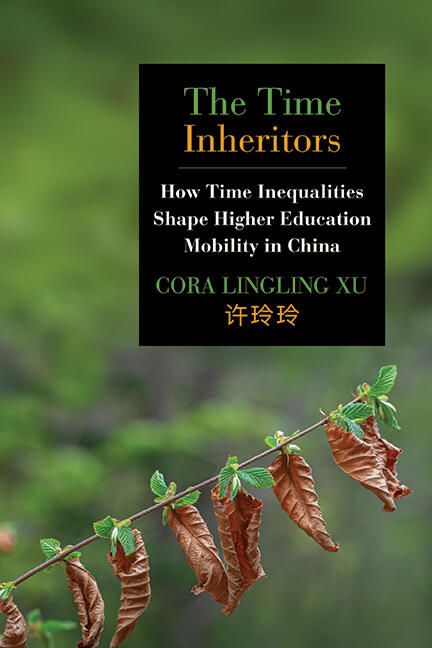
‘The Time Inheritors: How Time Inequalities Shape Higher Education Mobility in China’ by Cora Lingling Xu

We are delighted to share the publication of a new book by our director Dr Cora Lingling Xu. Read this profile (in Chinese) with People Magazine 《人物》杂志 and blog post to learn about the personal stories behind this book.

Please find an abstract of ‘The Time Inheritors‘ and critical reviews below.

If you wish to order this book, you can use SNWS25 to get 30% off when you order from the SUNY Press website.

To learn more about the book talks and interviews visit this page. Listen to the New Books Network’s interview with Cora. 听’时差In-Betweenness’与Cora的对话小宇宙链接). Check out this page for frequently asked questions (e.g. what you should do if you wish to write a book review) about this book. Share your stories of ‘time inheritance’. If you wish to contact Cora about arranging book talks and interviews, complete this contact form.

Abstract

Can a student inherit time? What difference does time make to their educational journeys and outcomes? The Time Inheritors draws on nearly a decade of field research with more than one hundred youth in China to argue that intergenerational transfers of privilege or deprivation are manifested in and through time. Comparing experiences of rural-to-urban, cross-border, and transnational education, Cora Lingling Xu shows how inequalities in time inheritance help drive deeply unequal mobility. With its unique focus on time, nuanced comparative analysis, and sensitive ethnographic engagement, The Time Inheritors opens new avenues for understanding the social mechanisms shaping the future of China and the world.

Critical reviews

“Xu’s conceptually sophisticated monograph reveals how intersectional inequalities are constructed, experienced, and transmitted temporally, with special reference to education. Through the vivid stories of students in mainland China and Hong Kong, and Chinese international students, Xu brings to life different individuals’ ‘time inheritances,’ demonstrating the exciting possibilities time offers as a lens for innovative thinking about inequality. A must-read for sociologists and anthropologists of education, China, and time.” — Rachel Murphy, author of The Children of China’s Great Migration

“Innovative and ambitious, The Time Inheritors proposes a time-centric framework that brings together analyses of social structure, history, individual behavior, and affect. We often feel we are fighting for time. But, as Cora Xu argues in this important study of Chinese students, the scarcity of time is not a given or universal. Different experiences of time result in part from the varying amounts of time we inherit from the previous generation. Time inheritance is therefore critical to the reproduction of social inequality.” — Biao Xiang, coauthor of Self as Method: Thinking through China and the World

“Cora Lingling Xu offers a groundbreaking analysis of educational inequality and social mobility in contemporary China. Xu centers the voices of marginalized students throughout, providing poignant insights into their lived experiences of rural poverty, urban precarity, and educational alienation. At the same time, Xu’s comparative scope reveals how even seemingly privileged groups can be constrained by the temporal logics of social reproduction. The Time Inheritors is a must-read for scholars, educators, and policymakers concerned with educational equity and social justice. Xu’s lucid prose and engaging case studies make the book accessible to a wide audience while her cutting-edge theoretical framework and methodological rigor set a new standard for research on education and inequality.” — Chris R. Glass, coeditor of Critical Perspectives on Equity and Social Mobility in Study Abroad: Interrogating Issues of Unequal Access and Outcomes

“By centering the temporal dimension of who is advantaged or disadvantaged, how, why, and with what consequences, The Time Inheritors takes a unique and powerful approach. Not only does the book contribute theoretically and empirically to our understanding of class inequalities but it also resonates deeply. The inclusion of Chinese translations and characters will give Chinese readers a rich, nuanced cultural appreciation of her findings.” — Dan Cui, author of Identity and Belonging among Chinese Canadian Youth: Racialized Habitus in School, Family, and Media

“An extremely well-written, theoretically informed, and compelling volume that represents a major contribution to the study of education, migration, and social inequality in China and beyond. The Time Inheritors proposes a bold and innovative framework—that of time inheritance—to open the black box of social inequality’s temporal dimension. Whereas the relatively privileged classes inherit temporal wealth and strategies that enable them to bank and save time, facilitating their mobility, the time poor lack this inheritance, forcing them into a vicious cycle of wasting time and paying back temporal debts. Drawing from a rich palette of vivid and intimate longitudinal case studies, The Time Inheritors unpacks the complex intersections between familial, national, and global time inequalities.” — Zachary M. Howlett, author of Meritocracy and Its Discontents: Anxiety and the National College Entrance Exam in China

Release Dates

Hardcover: 1st April 2025

Paperback: 1st October 2025
JRC: Recruitment of grantholder, trainees, graduate trainees & auxiliary contract staff

ESRA is the recruitment portal for the Joint Research Centre of the European Commission. Our mission is to provide independent, evidence-based science and knowledge, supporting EU policies to positively impact society.

As a multinational and multicultural research centre, we collaborate with partners worldwide and there are many opportunities to join our diverse workforce to work with some of the top scientists in the EU, no matter where you are in your career. More information on our research activities can be accessed here.

We have opportunities in both scientific and administrative domains and the recruitment process starts here with your application. Most of the vacancies published on this recruiter portal are for scientists/researchers of different domains who wish to join the JRC on a temporary contract (in Commission jargon: Auxiliary Contract Staff Function Group IV). In addition to the specific vacancies published here, the JRC also has an ongoing call for Research Fellows. We have also many vacancies in technical/administrative profiles.

Apart from temporary contract, the JRC also welcomes more researchers who are at other stages of their career. You may also join the JRC as Scientific TraineesBluebook Trainees (not in this portal), GrantholdersSeconded National Experts and under the Collaborative Doctoral Partnership programme.

Exploring the Geographies of Transnational Higher Education in China

Li, Y., Song, C., Zhang, X., & Li, Y. (2023). Exploring the geographies of transnational higher education in China. Geographical Research, online. https://doi.org/10.1111/1745-5871.12620

Background

The accelerated growth of transnational higher education (TNHE) has received extensive academic attention and become an important topic of public policy debate. In the field of geography, scholars also have an interest to unravel the complex geographical features and developmental consequences of TNHE. Focal points of research normally include transnational mobilities of students and academic staff, offshoring expansion of higher education institutions (HEIs), transference of (commercialised) academic knowledge with the marketisation of universities, and the nexus of transnational education and regional economic development. Theoretically, researchers often deploy the concepts of educational neoliberalism and academic hegemonies to explain higher education’s transnationalisation process. The former ascribes the rise of TNHE to a series of neoliberal transformations of the modern higher education system, which have pressured HEIs to expand their global reach to access external markets and resources. The latter focuses on the unequal geographical consequences of educational globalisation; that is, the power asymmetries between countries and regions in providing education services and exporting academic knowledge. Both perspectives tend to emphasise a shift in higher education competition from the national to the global scale and, in parallel, the worldwide dissemination of Western academic knowledge and educational standards.

In this study, we provide a pioneering geographical exploration of Chinese–foreign cooperation in running HEIs. After four decades of reform and opening-up, China has established the biggest higher education market and state-run education system in the world. While many national governments are reducing investment in their HEIs, Chinese authorities continue to intervene proactively in education in view of economic, cultural, and ideological considerations. As such, TNHE in China has always evolved against the backdrop of tensions between the incentives of marketisation and state-orchestrated developmental agendas. Therefore, in this study, we attempt to move beyond widespread neoliberal or postcolonial interpretations of educational globalization to examine how the Chinese state’s developmental targets, strategic policies, and political-ideological considerations have shaped the evolutionary trajectory, geographical distribution, and cross-border connections of China’s TNHE programs. Through this systematic geographical exploration, we wanted to highlight the significance of institutional and historical backgrounds in understanding the geoeconomics and geopolitics of TNHE in specific national and regional contexts.

Methodology

In this study, we mainly used the data collected from the Information Platform for Supervision of Chinese–Foreign Cooperation in Running Schools, promulgated by the Chinese Ministry of Education (https://www.crs.jsj.edu.cn/), to conduct a geographical analysis on Chinese–foreign TNHE institutions and programs. This platform lists all the officially approved, cooperatively run Chinese–foreign TNHE institutions and programs since 1991. Cooperative institutions and programs between China’s mainland and Hong Kong, Macao, and Taiwan were also included because they had to follow the same regulations as those between China and foreign countries. In total, 177 institutions (including 9 independent institutions and 168 institutions affiliated to Chinese universities) and 2,345 programs between 1991 and (June) 2022 were identified. Information about these institutions and programs’ names, disciplines, locations, initial years of enrolment, educational levels, and Chinese and foreign participants (including their host countries and cities) was collected from the Information Platform and the official websites of higher education institutions.

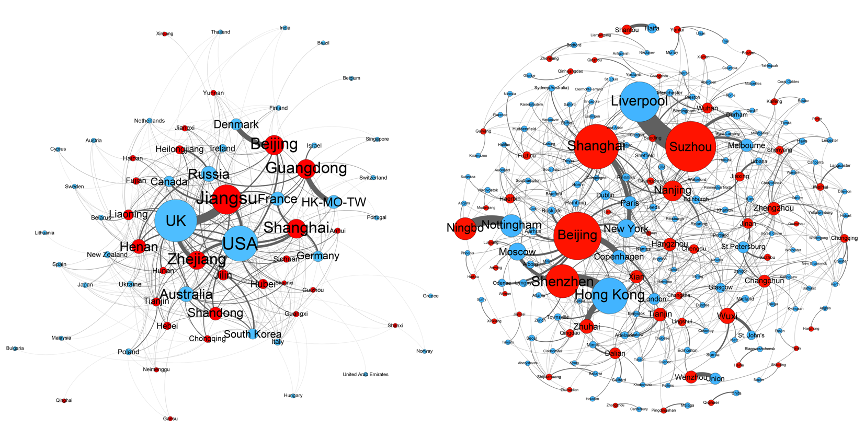
We employed a geographic information system and social network analysis to analyse the collected data. The former was used to map the geographic distribution of TNHE programs and participating institutions within and outside China’s mainland. These programs and participating institutions were aggregated and visualised according to their host countries and cities. The latter was used to reveal the patterns of transborder connections generated through TNHE programs. Each program represents a connection between two locations and a channel for disseminating academic knowledge. When several HEIs from one country, region, or city establish cooperative programs with HEIs from other countries, regions, or cities, a strong connection between them in the higher education domain is implied. Both intercity networks and province-country/region networks were created to reflect cooperative patterns at different spatial scales.

Findings and discussions

Reviewing the development of TNHE in China after its reforming and opening-up, we identify four major stages: exploration and experimentation (1979–1994), early expansion under state encouragement (1995–2002), institutionalisation and marketisation (2003–2015), and quality control and regulated development (2016 onwards). During these stages, the evolution of TNHE in China exhibits typical characteristics of the state developmentalism model. The growth of Chinese–foreign cooperative higher education programs has not only been motivated by the economic pursuit of HEIs on both sides, but also, to a great extent, has been driven by the revitalisation ambitions and modernisation strategies of the Chinese central state. As such, the target, status, scale, and discipline distribution (Table 1) of TNHE in China has frequently shifted with the reorientation of the state’s economic development agendas and political-ideological considerations, making it rather different from a purely market-centered, neoliberal-style TNHE regime.

Table 1. Discipline distribution of Chinese-foreign TNHE programs (%)

DisciplineBefore 20062006-2015After 2015All years
Engineering29.641.451.444.5
Management30.818.910.516.5
Art3.79.99.99.0
Science4.37.511.28.8
Economics13.78.04.37.0
Literature10.74.62.84.6
Medicine2.43.33.93.5
Education1.83.03.02.9
Law2.42.11.11.7
Agronomy0.61.11.71.3
History0.00.20.20.2
Total100.0100.0100.0100.0

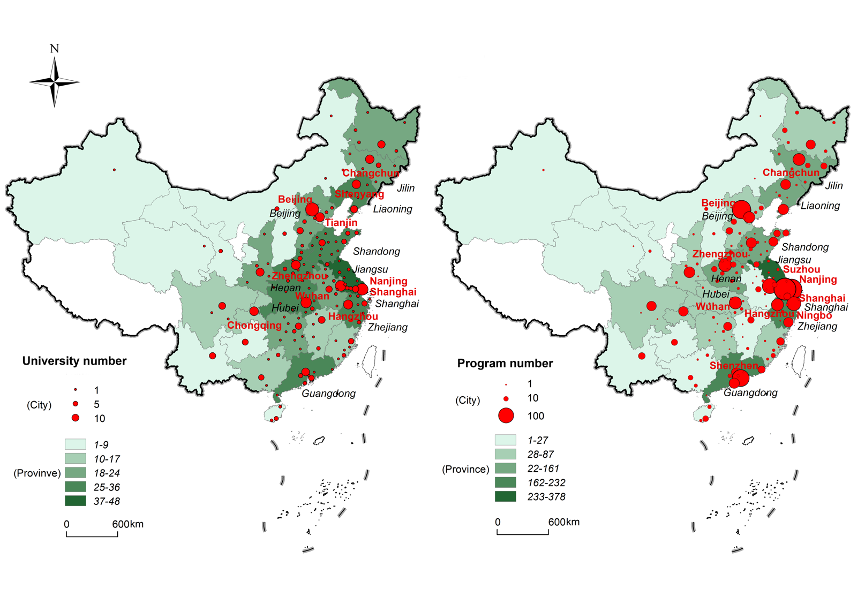
Geographically, the TNHE institutions and especially the programs identified in our database display a highly uneven spatial pattern within China’s mainland (Figure 1), reflecting both the imbalanced distribution of higher education resources and regional economic disparities. Meanwhile, state intervention, and especially support from local governments, also shapes the landscape of China’s TNHE development. For instance, the generous support from local governments has become the primary motivation for many global HEIs to cooperate with local Chinese universities in economically backward areas. Cities at higher administrative levels (e.g., provincial capitals) also have advantages in cooperating with TNHE institutions than purely economic centers. The landscape of TNHE within China highlights the government-driven approach to transnational education cooperation and the hierarchy in the country’s higher education governance system.

Figure 1. Distribution of TNHE participating universities and programs within mainland China

The overseas distribution of education institutions and programs demonstrates the extensive and pluralistic global connections of China’s TNHE. Major cooperators include not only the leading HEIs from the USA and the UK, but also those from non-English-speaking countries, such as Russia, France, Germany, Italy, and South Korea (Figure 2). The geographic features of China’s TNHE network are rather different from the global distribution of dominant education centers, which reflect the growing diversification of the sources of academic knowledge in the current global higher education and the deliberate educational cooperation strategy of the Chinese government. Overall, the geographies of China’s TNHE reveal complicated interactions between the state and the market, the global and the local, and economic and political/cultural forces.

Figure 2. Province-country/region (left) and inter-city (right) connections of China’s TNHE programs

Author’s Biography

Yajuan Li, Central China Normal University

Yajuan Li is an Associate Professor at Central China Normal University in the city of Wuhan. She earned her Ph.D. from the Institute of Geographic Sciences and Natural Resources Research at the Chinese Academy of Science, and is specifically interested in tourism and social cultural geography, transnational higher education. She can be contacted at yajuan.li@ccnu.edu.cn

Xu Zhang, Wuhan University of Technology

Xu Zhang is an associate professor in Human Geography and Planning at Wuhan University of Technology (China). He holds a PhD in Human Geography from the University of Amsterdam (2015). His research interests lie at the intersection of geography, planning and cultural studies, including but not limited to global cultural cities, urban networks, and creative economies. He can be contacted at x.zhang86@hotmail.com

Managing Editor: Tong Meng

Chinese international students’ wellbeing: Experiences of assessment in higher education

Research Highlighted:

Dai, Q. (2023). Chinese international students’ wellbeing: Experiences of assessment in higher education. Citizenship, Social and Economics Education, 22(2), 118–133. https://doi.org/10.1177/14788047231194173

About the study:

While there is growing research identifying the academic and non-academic challenges to the well-being of Chinese international students, there is little discussion about the differences in and challenges of the assessment they experience. This gap appears to come from a tacit assumption that assessment is universal worldwide, or that students will automatically learn strategies to deal with all the contrasts in assessment themselves. Although, as a Chinese student studying in a master’s programme in the UK in 2019, I experienced considerable differences in assessment between Chinese and British universities and my Chinese peers often expressed their unfamiliarity with various aspects of assessment and sometimes discontent with the ambiguity in assessment. Also, while outcomes of assessment in universities, such as marks, are closely related to resulting academic and career opportunities, according to Bourdieu and Passeron (1990), cultural capital or habitus is misrecognized as individual academic achievement through hegemonic assessment. So, this research aims to provide a close examination of the differences in and challenges of assessment facing Chinese internationals from an insider’s point of view. This research is a Chinese international master’s student’s effort to do research with, about and for international students.

Also, many existing studies and practice in internationalisation of UK Higher Education (HE) adopt a deficit approach that attributes international students’ experiences of challenges to their lack of capabilities, thus responsibilising international students only to adapt to the host environments (Andrade, 2017; Mittelmeier et al., 2022). This reductionist approach also (re)produces a dichotomous and static stereotype that Confucian Heritage Culture and Chinese education are contradictory to Western values and Western educational practice (Tu, 2018). So, as a counter-discourse, this research is developed on the concept of “academic hospitality” aiming to develop a reciprocal relationship between academic “hosts” and “guests” (Dorsett, 2017) and challenge the static dichotomous discourses. For instance, Heng (2017) proposed that fostering meaningful conversations between individuals of diverse backgrounds can challenge established parochialism and develop a recognition of, acceptance of, and respect for multiple identities and diverse cultures and ways of knowledge production. So, this research is an international master’s student’s act of epistemic disobedience to counter the deficit approach to the internationalisation of UK HE and contribute to the decolonisation of UK HE by challenging its neo-colonialist assumptions of universality in assessment.

This research explored Chinese international students’ experience of assessment in the UK, specifically their experienced differences in, and challenges of assessment, correspondingly, their adopted strategies and the institutional support they required. Answers are sought by examining relevant literature and by interviewing thirteen Chinese postgraduate-taught students majoring in different subjects at a Scottish University. 

Findings and implications:

Most Chinese students in this research were surprised and confused about the variety of assessment formats they experienced in the UK, especially the oral assessment and group work. Even when formats were familiar to them, the expected answers to the assessment were largely diverse from their previous experience. Specifically, all participants believed that expressing themselves in academic English under time pressure or word limit was the most challenging, such as the acceptable extent of inclusion of personal views, applications of concrete examples, and correct referencing to avoid plagiarism. None of them was confident enough to apply critical thinking, reading, and writing to various types of assessments in the UK. Also, most students felt unaccustomed to the autonomy of the exam preparation and coursework writing, so some of them failed the assessment and might suffer from depression. A deficit stereotype of Chinese students is refuted by the comprehensive understanding of Chinese transmissive education and empirical findings. This research, in line with Heng’s (2019) developmental perspective, showed that while they identified various challenges of assessment, there was a clear process of improvement among all participants, such as growing familiarity with and confidence in the different assessment formats, clarity of the expected answers, and more advanced linguistic capability.

Concerning assessment, most Chinese students used similar strategies when they first encountered assessment in British universities, and the influence on their performance varied among individuals. However, supported by Vygotsky’s sociocultural theory (Ploner, 2018) and Heng’s (2019) developmental perspective, participants developed new strategies when they realized the diverse expectations. Firstly, the significance of autonomous learning in British universities had a great impact on their preparation strategies and academic performance, such as significantly more use of the recommended reading and resources searched by themselves compared to their previous experience in China. Secondly, while most of them studied alone in Chinese universities, all of them considered social support as the main source and strategy to meet the challenging assessment in the UK, including their co-nationals, other internationals and tutors. Thirdly, apart from other positive strategies, such as time-management skills and making realistic plans, some students also adopted desperate methods in their assessments, such as the overuse of online translation tools. 

In terms of institutional support, participants suggested ongoing support for assessment from the whole university, ranging from lecturers, tutors, and academic services to international student services. Among the specific institutional support in the forms of special guidance, lectures, workshops and tutorials, most Chinese internationals highlighted the clarification of expected answers and assessment criteria, such as the extent of inclusion of personal views. Some students also suggested the provision of samples of and practical guidance on the unfamiliar format, and some thought mock exams or formative assessments with effective feedback from tutors and peers would benefit them considerably. Linguistic support in a combination of rich forms was mentioned by all and considered the most imperative support, including strategies and methods to find appropriate academic sources, practical guidance on critical thinking, reading and writing, correct referencing and effective paraphrasing. Also, students recommended training for the teaching staff and the provision of pressure-reducing activities throughout the academic year. Finally, almost all of them advised universities not only to focus on the establishment of campus resources but also to devote energy to the motivation of international students and help them to use resources effectively, such as the group revision and mentoring program provided by universities to ensure good practice shared among students.

International students’ experiences in assessment, including their challenges, growth, strategies and required institutional support, can be used as valuable resources for HE practitioners and researchers to develop culturally relevant pedagogy and for UK HE institutions to decolonise HE. This way, ‘institutions are involving international students in conversations with them, not about them’ (Heng, 2017, p. 847), otherwise ending up in commercialized education that (re)produces stereotypes about them (Dorsett, 2017).

References:

Andrade, M. (2017). Institutional policies and practices for admitting, assessing, and tracking international students. Journal of International Students, 7(1): I–VI.

Bourdieu, P., and Passeron, J.-C. (1990). Reproduction in education, society and culture (2nd ed.) (R. Nice, Trans.). Sage Publications, Inc.

Dorsett, J. (2017). High hopes: International student expectations for studying in the United States. New Directions for Student Services, 2017(158): 9–21.

Heng, T. (2017) Voices of Chinese international students in USA colleges: ‘I want to tell them that … ’. Studies in Higher Education, 42(5): 833–850.

Heng, T. (2019) Understanding the Heterogeneity of International Students’ Experiences: A Case Study of Chinese International Students in U.S. Universities. Journal of Studies in International Education, 23(5): 607–623.

Mittelmeier, J., Lomer, S., Al Furqani, S., and Huang, D. 2022. Internationalisation and students’ outcomes or experiences: A review of the literature 2011-2021. Advance HE.

Ploner, J. (2018). International students’ transitions to UK higher education – revisiting the concept and practice of academic hospitality. Journal of Research in International Education, 17(2): 164–178.

Tu, H. (2018). English Versus Native Language on Social Media: International Students’ Cultural Adaptation in the U. S. Journal of International Students, 8(4): 1709–1721.

Author Biography:

Qiao Dai, University of Glasgow

Qiao Dai is a PhD candidate in the School of Education at the University of Glasgow, where she also works as an Associate Tutor. Her PhD research looks at the role of UK International Higher Education in Chinese womanhood between China and the UK. Her research interests generally can be situated in three strands, namely feminisms, international HE, and postcolonial knowledge production and creative inquiry. She can be contacted via email: qiao.dai@glasgow.ac.uk.

Managing Editor: Tong Meng

Critical University Studies Conference 2024, Call for submissions

We welcome submissions on a wide variety of topics – or ways of apprehending/studying the university – and we are especially interested in those that ask critical questions of their material.

More traditional themes might include academic capitalism, academic work and practice, curriculum, doctoral education, internationalisation/globalisation, leadership and management, and performativity. Newer themes might include affect and bodies, ecologies of knowledges, neo-nationalism and the university, relationality and mattering, studying, teaching the university, temporality and spatiality.

We welcome submissions from researchers across the board (doctoral, early-career, established) in a range of different styles including:​

Papers (30 mins) – abstract of no more than 350 words

Single paper presentations explore one or more dimensions of the conference themes. The goal of these sessions is to share work-in-progress and engage in dialogue with conference participants, so timing should be balanced between presentation and discussion (20m+10m is optimal). You should also aim to demonstrate how your paper contributes (or is likely to contribute) to the existing body of scholarly research.

Symposia (90 mins) – abstract of no more than 1000 words

Where presenters have 3-4 thematically linked papers, you may propose a symposium with a maximum time of 90 mins. Provide an overarching abstract for the symposium as a whole as well as titles and reduced abstracts for each paper within the symposium. Please nominate a contact person for the symposium.

Roundtable (60 mins) – abstract of no more than 350 words

Roundtable discussions provide the opportunity for a lively discussion around a particular topic or area of research. They are an ideal opportunity for networking and for building collaborations. If you wish to propose a roundtable, the submission should include an overview of the topic, and pose some critical questions that the roundtable discussion will explore. These sessions will be chaired by the person who proposes the roundtable.

Performance and/or Creative Presentation (30 or 60 mins) – abstract of no more than 350 words

Performance-based presentations provide an opportunity for presenters to invent or draw on new forms and expressions as well as traditions of arts-based inquiry for exploring the conference themes. We welcome performance in all its variety. Some possibilities include: readers’ theatre, performance ethnography, and poetic representations of research. If you wish to propose a performance, your submission will need to be strong in both the idea (related to the conference themes), and in the description of the type of performance. If the performance involves audience participation, you need to indicate that in your submission.

Ensure your submission includes:

  • Submission type
  • Title of submission
  • Presenters and their institutional affiliations
  • Name and email address of the key contact person
  • Abstract (noting the maximum word count)
  • Up to 5 scholarly references.

Review Criteria

Every submission to the conference will be double-blind peer reviewed according to the following criteria:

  • It responds and contributes to the conference theme
  • It is connected to, and in conversation with, appropriate scholarly literature
  • It demonstrates how and why it is of interest to the intended audience
  • It is well written.

Note: This conference will be held in English and is an in-person event only.

Key Dates

Deadline for submission of abstracts: 30 October 2023

Notification of acceptance: 10 December 2023 

Conference dates: 19 – 21 June 2024

Abstract Submission

Send to: cusconf2024@gmail.com

More information: https://www.cusconf.com/submissions

Managing Editor: Tong Meng